Foucault News

News and resources on French thinker Michel Foucault (1926-1984)

Chang, H.-C.
The normalisation of body gifting in Taiwan
(2016) BioSocieties, 11 (2), pp. 135-151.

DOI: 10.1057/biosoc.2015.29

Abstract
The Tzu Chi Foundation has made body gifting, such as body donation, bone marrow donation and cord blood donation, successful in Taiwan. Using Foucault’s theoretical framework of governmentality and normalisation, this article discusses how a Buddhist charity, the Tzu Chi Foundation, normalises body gifting in Taiwan through their campaigns, system and philosophy. It argues that Buddhist discourses of karma create a ‘benefit-all altruism’ in body gifting. Furthermore, the emergence of the Tzu Chi Foundation in the last five decades has been a process of discipline and norm construction. The Tzu Chi Foundation, with its comprehensive missions, builds up an extensive network to spread their philosophy in different fields, from environmental protection and humanity education to medical care. The practice-oriented and community-based volunteer system helps the ‘giving’ ideology take root in the communities in Taiwan. Finally, through the media and the Internet, the effect goes beyond the institutional boundaries and reaches the public. © 2016 Macmillan Publishers Ltd.

Author Keywords
Body gifting; Foucault; Normalisation; Taiwan; Tzu Chi

Andrew Hope, Governmentality and the ‘selling’ of school surveillance devices, The Sociological Review. Volume 63, Issue 4, pages 840–857, November 2015

DOI: 10.1111/1467-954X.12279

Abstract
In late modernity there has been a massive growth in ‘new’ surveillance devices situated within schools. This paper explores the reasons behind this proliferation, considering the role of key protagonists and the promises made regarding these technologies. It is suggested that there is strong connection between notions of neoliberal governmentality (Foucault, 2008; Gane, 2012) and arguments relating to increased security, improved efficiency, the desirability of techno-surveillance devices and desensitization to pervasive monitoring. In particular, it is maintained that the devolution of state power, the marketization of education, increased responsibilization and the nature of observation in the viewer society all help to explain the emergence of ‘surveillance schools’. It is concluded that failure to recognize these new dynamics may result in schools quietly, subtly becoming experimental labs and then junkyards for our surveillance futures.

Keywords:
governmentality;surveillance;security;marketization;responsibilization;normalization

One of a series of posts on Barry Stocker’s blog on Foucault’s Theories et institutions pénale. Cours au Collège de France, 1971-1972. Paris: Seuil/Gallimard, 2015

Barry Stocker's avatarStockerblog

(Commentary on Theories et institutions pénale. Cours au Collège de France, 1971-1972. Paris: Seuil/Gallimard, 2015)

23rd February, 1972

Institutions of Peace

First function

Private wars are forbidden

They are forbidden by a collective or singular authority

This authority imposes what can be placed before a judicial body, that is private war or what provokes private war

Justice is now not what comes after injury, arbitration and peace. The court is under the control of an authority establishing peace.

Public authority has separated injury from justice (presumably Foucault means injury cannot be a reply to an injury, that the injury can only be punished in the public court).

Justice is confiscated by the judiciary (from the private agreements between aristocrats at war with each other)

Second Function

Establish region where taxation/state revenues are better organised, more stable, and generate more income.

The period of private wars within the aristocracy generated revenue for…

View original post 856 more words

María Alejandra Energici, Propuesta metodológica para un estudio de gubernamentalidad: Los procesos de subjetivación y los mecanismos de regulación poblacional como ejes de análisis para su abordaje empírico, Psicoperspectivas. Individuo y Sociedad, Vol. 15, No. 2 (2016)

Texto completo

Resumen

En 1982 Foucault definió una gubernamentalidad como el contacto entre las tecnologías de dominación de los demás y las referidas a uno mismo. Tomando dicha definición, el objetivo de este artículo es proponer una ruta metodológica para estudiar una gubernamentalidad específica atendiendo a las tecnologías propuestas por Foucault como ejes de análisis: las tecnologías de dominación de los demás son descritas como mecanismos de regulación poblacional y las referidas al sí mismo como procesos de subjetivación. En otras palabras, se propone dos grupos de prácticas sociales, o de mecanismos y procesos, para estudiar empíricamente una sociedad en términos de su razón gubernamental. A modo de ejemplo, se presenta la publicidad como un campo de estudio posible para dar cuenta de una gubernamentalidad dada. Trabajar desde los ejes de análisis propuestos, permite desarrollar investigaciones sobre la complejidad política actual, rescatando el método crítico y genealógico utilizado por Foucault.

asevillab's avatarmultipliciudades

My latest article, ‘Gramsci and Foucault in Central Park: Environmental hegemonies, pedagogical spaces and integral state formations’, is now available online on the early view webpage of Environment and Planning D: Society and Space (requires subscription).

The piece draws on the conceptualizations of power and the state by these authors to develop an explicitly political understanding of landscape struggles and the governmentalization of urban environments, using Manhattan’s Central Park as a historical  illustration of such processes. In fact the article is articulated not only through the dialogue between both thinkers, but as a more open conversation that also includes Frederick Law Olmsted, co-designer, architect-in-chief and superintendent of the park, as well as other figures and institutions related to its material and symbolic construction. The Greensward project and subsequent management of the park premises under Olmsted’s attention are depicted as a pioneering example of how design mediates new local state…

View original post 292 more words

Luque-Ayala, A., Marvin, S.
The maintenance of urban circulation: An operational logic of infrastructural control
(2016) Environment and Planning D: Society and Space, 34 (2), pp. 191-208.

DOI: 10.1177/0263775815611422

Abstract
This paper examines the increased visibility of urban infrastructures occurring through a close coupling of information technologies and the selective integration of urban services. It asks how circulatory flow is managed in the contemporary city, by focusing on the emergence of new forms of governmentality associated with “smart” technologies. Drawing on Foucault’s governmentality, and based on a case study of Rio de Janeiro’s Operations Centre (COR), the paper argues that new understandings of the city are being developed, representing a new mode of urban infrastructure based on the partial and selective rebundling of splintered networks and fragmented urban space. The COR operates through a “un-black boxing” of urban infrastructures, where the extension of control room logics to the totality of the city points to their fragility and the continuous effort involved in their operational accomplishment. It also functions through a collapse in relations of control—of the everyday and the emergency—, which, enabled by the incorporation of the public in operational control, further raise public awareness of urban infrastructures. These characteristics point to a specific form of urban governmentality based on the operationalisation of infrastructural flows and the development of novel ways of seeing and engaging with the city. © 2015, © The Author(s) 2015.

Author Keywords

black boxing; Control rooms; infrastructure; smart city; urban flows; urban governmentality

stuartelden's avatarProgressive Geographies

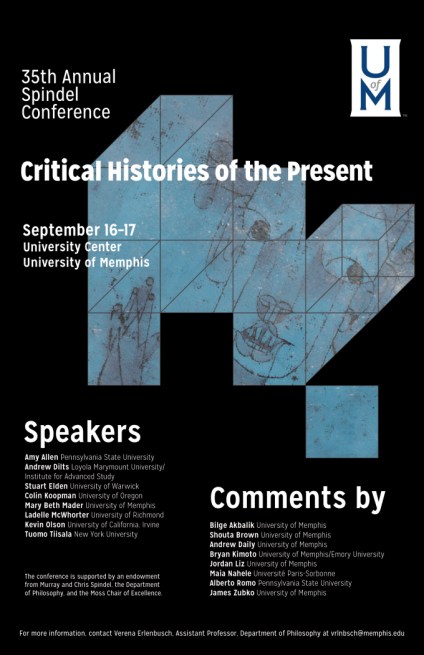
SpindelMy next visiting talk – and my first overseas talk in over a year – will be at ‘Critical Histories of the Present‘, the 35th Spindel conference, University of Memphis, 16-17 September 2016.

My talk is under the title of ‘Foucault and Shakespeare: Ceremony, Theatre, Politics’. A very early version was given in London last year. I’ll also be presenting this work to the Political Thought and Intellectual History seminar, University of Cambridge on 7 November 2016. Papers from Memphis will be published in the Southern Journal of Philosophy.

Most discussions of Foucault and Shakespeare are around the theme of madness, which appears in several plays and which Foucault discusses in a number of places. Late in his life he also reads King Lear on the theme of parrēsiaThese are all interesting discussions, and in the (current) written form I work through these references carefully. But my focus…

View original post 74 more words

The 2016 conference of the Australasian Society for Continental Philosophy (ASCP) will take place at Deakin University’s Burwood Campus, December 7-9 2016.

The ASCP aims to provide a broad intellectual forum for academics and postgraduates working in the European philosophical tradition. Its annual conference is the largest event devoted to European philosophy in Australasia.

The conference will feature a number of curated streams, including ‘Philosophies of Self-Formation’, ‘Continental Philosophy and Other Traditions’, ‘Phenomenologies of Oppression’, ‘Law and Continental Philosophy’, ‘Philosophy and Creative Practice’ and ‘Politics and Technology’.

Inquiries can be addressed to s.bowden@deakin.edu.au. Please use ‘ASCP2016’ in the subject line.

The keynote speakers are Penelope Deutscher (Northwestern), John Lippitt (Hertfordshire), Anne Sauvagnargues (Paris Ouest) and John Sellars (King’s College London).


Streams

1. Philosophies of Self-Formation – curated by Matthew Sharpe (matthew.sharpe@deakin.edu.au)

The later work of Michel Foucault announced a turn towards classical philosophical conceptions of self-formation. Alongside work by Dumanski, Sellars, Voelke and others influenced by Pierre and Ilsetraut Hadot, Foucault’s later works point to an alternative understanding of the history of philosophy, paying renewed attention to the Hellenistic, Roman and early modern periods downplayed or overlooked in many 19th and 20th century histories. This stream will involve papers examining the history of the metaphilosophical conceptions of philosophy as a way of life, or as therapeutic, or as interested in paideia or self-formation, which reached its peaks during these periods. Papers are invited on the Stoics, Epicureans, Cicero, the sceptics, Petrarch and the renaissance philosophers, Montaigne and the new Pyrrhonists, the founders of the modern scientific project(s), the philosophes, Spinoza, Schopenhauer, Nietzsche … or other figures speaking to this theme.

6. Law and Philosophy – curated by John Morss and Luca Siliquini-Cinelli (john.morss@deakin.edu.au, l.siliquinicinelli@deakin.edu.au)

What is sovereignty? What is a legal right or a legal obligation? What is a nation? What, if anything, is a human right, the Rule of Law, Global Justice? Can law recognise the plural: can a legal cosmopolitanism transcend identity politics? In addressing such questions contemporary legal philosophy and jurisprudence are dominated by English-speaking, Anglo-American traditions in philosophy. Analytic traditions of a conservative stripe, themselves a narrow representation of English-speaking philosophical discourse, exert near-exclusive control on jurisprudential debate. Cultural hegemony is one reason for this but the lack of engagement between legal theorists and Continental philosophies is another. This stream hopes to address this gap by foregrounding the contributions and challenges to legal theory that are presented by writers such as Agamben, Arendt, Deleuze, Derrida, Foucault, Ranciere, Zizek. In terms of non-Anglo jurisprudence, while already well mined, the writings of Schmitt and of Kelsen may yet have more to yield to these debates. Philosophy of law is too important to ignore the wide variety of perspectives offered by Continental thought.

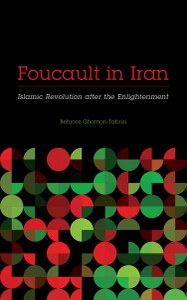
foucault-iranBehrooz Ghamari-Tabrizi, Foucault in Iran Islamic Revolution after the Enlightenment, University of Minnesota Press, 2016.

Were the thirteen essays Michel Foucault wrote in 1978–1979 endorsing the Iranian Revolution an aberration of his earlier work or an inevitable pitfall of his stance on Enlightenment rationality, as critics have long alleged? Behrooz Ghamari-Tabrizi argues that the critics are wrong. He declares that Foucault recognized that Iranians were at a threshold and were considering if it were possible to think of dignity, justice, and liberty outside the cognitive maps and principles of the European Enlightenment.

Foucault in Iran centers not only on the significance of the great thinker’s writings on the revolution but also on the profound mark the event left on his later lectures on ethics, spirituality, and fearless speech. Contemporary events since 9/11, the War on Terror, and the Arab Uprisings have made Foucault’s essays on the Iranian Revolution more relevant than ever. Ghamari-Tabrizi illustrates how Foucault saw in the revolution an instance of his antiteleological philosophy: here was an event that did not fit into the normative progressive discourses of history. What attracted him to the Iranian Revolution was precisely its ambiguity.

Theoretically sophisticated and empirically rich, this interdisciplinary work will spark a lively debate in its insistence that what informed Foucault’s writing was not an effort to understand Islamism but, rather, his conviction that Enlightenment rationality has not closed the gate of unknown possibilities for human societies.

A groundbreaking reassessment of Foucault’s writings on one of the greatest political upheavals of our time.

Foucault in Iran centers on the significance of Foucault’s writings on the Iranian Revolution and the profound mark it left on his lectures on ethics, spirituality, and fearless speech. This interdisciplinary work will spark a lively debate in its insistence that what informed Foucault’s writing was his conviction that Enlightenment rationality has not closed the gate of unknown possibilities for human societies.

Foucault in Iran is a courageous and thought-provoking invitation to understand the Iranian revolution, and Foucault’s reaction to it, in an original way. A splendid work that goes beyond simple binaries, it has no sympathy for the clichéd vocabulary used by Progressivists to describe these events—or to criticize Foucault for his alleged romanticisation of the Iranian revolution.

Talal Asad, City University of New York

ABOUT THE AUTHOR:
Behrooz Ghamari-Tabrizi is associate professor of history, and sociology and Director of the Center for South Asian and Middle Eastern Studies at the University of Illinois, Urbana–Champaign. He is the author of Islam and Dissent in Postrevolutionary Iran, Remembering Akbar: Inside the Iranian Revolution, and co-editor of The Iranian Revolution Turns 30.

Colin Gordon, “Brexit Means Brexit Means Nothing”
14/07/2016 on academia.edu

This note is a postscript to my earlier piece “The Will of the people in post – truth times”,

Apart from its oversexed headline and the now outdated speculations about the future of a certain individual, this piece by Sean O’Grady in The Independent seemed to me yesterday the shrewdest analysis so far of where we stand (that is to say, the one which agrees most with what I was thinking myself). Today or tomorrow, who knows..

Read more