Foucault News

News and resources on French thinker Michel Foucault (1926-1984)

Zerva, K., Nijkamp, P.
Tour guides as information filters in urban heterotopias: Evidence from the Amsterdam Red Light District
(2016) Tourism Management Perspectives, 18, pp. 42-50.

DOI: 10.1016/j.tmp.2015.12.020

Abstract
An unconventional urban environment often acts as an attraction for tourists. This is exemplified by the old city centre of Amsterdam, through its urban gentrification which offers a unique tourist experience through an interplay of contradicting concepts: legal and illegal, or moral and immoral. Based on Foucault’s heterotopias of informational deviance and the informational role of tour guides, the aim of this paper is to show the critical influence of the tour guide’s contribution to the tourist experience of visiting these often morally contradicting concepts. Tour guides operate in this context as ‘information filters’, based on the tourist guides’ personalities and background. To analyse this information sensitivity, five tours were examined in the Red Light District, three related to prostitution and two to Coffee Shops. Through systematic participant observation, descriptive results were obtained, which highlight the importance of the guides’ personal profile in interpreting this experience to tourists. © 2016 Elsevier Ltd.

Author Keywords
Coffee shops; Heterotopia; Interpretational skills; Prostitution; Tour guides

Done, E.J., Murphy, M., Knowler, H.
University-based professional learning for women teachers and the ‘to care’ or ‘to lead’ dilemma
(2016) Professional Development in Education, 42 (4), pp. 610-627.

DOI: 10.1080/19415257.2014.948690

Abstract
The authors consider the recasting of teaching as leadership with reference to school principals or heads and claim that many women teachers decline such senior roles and instead prioritize an ethics of care in resistance to neoliberal performative educational cultures. A future-orientated poststructuralist version of authenticity or authentic practice derived from Deleuze and Guattari, Foucault and Grosz is introduced that does not risk reinforcing gender stereotypes and a consequent political marginalization of women teachers. Grosz mobilizes the concept of authentic futurity in relation to feminism, but the authors contend that this concept might usefully provide women teachers with a less potentially marginalizing lexicon of resistance, and facilitate localized initiatives informed by an affirmative poststructuralist ethics embracing contingency and relationality. Care is interpreted as supporting virtual potentialities and their actualization. The Deleuzo-Guattarian concepts of ‘becoming-woman’ and ‘becoming-imperceptible’ are explained in relation to ‘active listening’ as a leadership ‘skill’. The importance of university-based professional learning in addressing variations in professional capital and problematizing tired neoliberal discourses concerning leadership, teacher quality and ethics is emphasized throughout the paper. © 2014 International Professional Development Association (IPDA).

Author Keywords

feminist-poststructuralist ethics; leadership; professional learning

Welsh, J.
Governing Academics: The Historical Transformation from Discipline to Control
(2016) International Journal of Politics, Culture and Society, pp. 1-24. Article in Press.

DOI: 10.1007/s10767-016-9228-4

Abstract
Given the transformation in the government of academic life over recent decades, the article attempts to derive a political critique of the changing psychosocial conditions of academic life via a historical juxtaposition with the nomos of the labour camp in Solzhenitsyn’s Gulag Archipelago. The aim is to address the need to think beyond normative disciplinary power, to explore a distinctly capitalist governmentality in relation to Foucault’s genealogy of power and to elaborate the techniques and practices of an emergent ‘meta-disciplinary’ technology of labour control in academia. Therefore, a broadly Foucauldian analysis on these questions will be undertaken, and augmented with Marxian and post-Freudian insights into the role of capital accumulation dynamics, in order to texture the conventional presentation of governmental rationality. The result is a metonymic presentation of the ‘camp’ as a physiological structure of capitalist Modernity, whose imprint can be discerned in numerous social and institutional settings, in this case Academia and the Gulag. From this outcome, insights into the transformation of living and labouring in academia, and the effects on psychological and intellectual well-being stemming from the new complex of control can be derived. The piece concludes with some thoughts on strategies of intellectual survival in academia, on counter-conducted techniques of subjectification and on possible means of resistance in the meta-disciplinary idiom. © 2016 Springer Science+Business Media New York

Author Keywords
Camp; Governmentality; Gulag; Labour; Meta-disciplinary; Society of control; University

Gillies, D. and Mifsud, D. (2016) Policy in transition: The emergence of tackling early school leaving (ESL) as EU policy priority, Journal of Education Policy, 31:4, 443-465,
DOI: 10.1080/02680939.2016.1196393.

Abstract
This paper explores, from a Foucauldian perspective, the emergence and nature of the current EU education policy priority issue of ‘early school leaving’. The paper suggests that a number of problematisations developing from the failure to secure Lisbon Strategy objectives have served to create a much stronger focus on the issue of young people deemed to be leaving education and training early in EU states. In examining how EU policy discourse positions such young people (subjectivation), the paper highlights how this has narrowed to a concern with young people as economic problems and principally positioned as economic units which are required to be more productive. Education and training are understood as investments in human capital and as the principal means to secure the dominant global economic position desired by the EU. The paper suggests, however, that human capital theory has been modified within this approach so that merely being retained in an educational setting is seen as proxy for the investment which education and training represent. This is a weaker policy position than previously espoused but, born of economic crisis, one which addresses related EU political aims of softening youth unemployment figures, dampening associated unrest and reducing risks to social cohesion.

Mifsud, D.
‘Decentralised’ neoliberalism and/or ‘masked’ re-centralisation? The policy to practice trajectory of Maltese school reform through the lens of neoliberalism and Foucault
(2016) Journal of Education Policy, 31 (4), pp. 443-465.

DOI: 10.1080/02680939.2015.1121409

Abstract
The politics of the later part of the twentieth century have been marked by the emergence of neoliberalism, which has consequently impregnated the global policy climate with neoliberal technologies of government. It is within this political scenario of hegemonic neoliberal discourse that I explore one aspect of school reform in Malta – contrived school networking as mandated by the policy document ‘For All Children to Succeed’ (FACT), issued in 2005, by which Maltese primary and secondary state schools were geographically clustered into 10 colleges. I explore the influence of neoliberalism and the presence/absence of its characteristics, namely, State central control, the ‘empowerment’ agenda and the tension between autonomy and accountability. This is done both through policy analysis and policy reception – I carry out a documentary analysis of FACT and present this together with the leaders’ views, collated from interviews and observation, after being subjected to narrative analysis and interpreted through Foucault’s concepts of discourse and governmentality. Despite the gradual unfolding of the decentralization process, there is a very strong presence of State central control. Besides methodological significance for policy scholarship, this article has particular philosophical implications for educational policy, practice and theory within the infrastructure of globalized neoliberal governmentality. © 2015 Informa UK Limited, trading as Taylor & Francis Group.

Author Keywords
Accountability; discourse; Foucault; governmentality; neoliberalism; policy analysis; school reform

Corinne Weisgerber, Shannan H. Butler,
Curating the Soul: Foucault’s concept of hupomnemata and the digital technology of self-care
(2016) Information Communication and Society, 19 (10), pp. 1340-1355.

https://doi.org/10.1080/1369118X.2015.1088882

Abstract
This paper explores how online actions such as the practice of digital self-writing shape our offline identity. We start with an examination of the concept of hupomnemata – a practice of self-writing in which notes are kept as a ‘material record of things read, heard, or thought’ in the intent of shaping the self [Foucault (1997). Self writing. In P. Rabinow (Ed.), Ethics, subjectivity and truth. The essential works of Foucault, 1954–1984. Volume 1 (pp. 207–222). New York, NY: The New Press p. 209] – before arguing that the practice of digital content curation can be understood as a modern-day variant of the Greco-Roman hupomnemata. Although the work of the digital curator is conducted online, this paper positions contemporary curatorial practices as acts of self-exploration, self-cultivation, and self-care, which nourish offline identity and which ultimately work to shape the offline, corporeal self. © 2015 Taylor & Francis.

Author Keywords
digital curation; Hupomnemata; identity

stuartelden's avatarProgressive Geographies

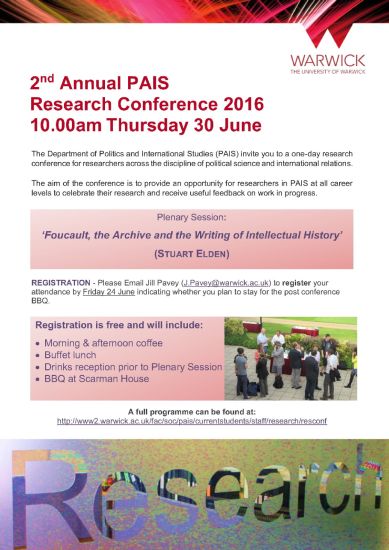
2nd_annual_pais_research_conference_2016_poster.jpgAt the end of June I gave the plenary lecture to my Warwick department’s annual conference. It was entitled ‘Foucault, the Archive and the Writing of Intellectual History’, and discussed the writing of the two books Foucault’s Last Decadeand Foucault: The Birth of Power.

The audio recording is available here.

Links to my series of updates on the books’ progress can be found here and other audio and video recordings are  here.

Some translations, scans and links are available at Foucault Resources – I mention some of these in the talk.

View original post

Mark Murphy, Foucault, hybridization and social research: reflections on the Foucault @90 Conference, Social Theory Applied Blog, 29 June 2016

I was fortunate enough to attend the recent Foucault @90 conference, held at the University of West of Scotland on the 22-23 June. It was well attended with a strong selection of papers and excellent keynotes from Prof. Mark Olssen, Dr. Clare O’Farrell and Prof. Stephen Ball. A conference wholly devoted to Foucault – what’s not to like?

[…]

What I particularly enjoyed about the conference was its lack of deference and willingness to think with Foucault and beyond his work. Evident among the presenters was a desire to match his ideas up with practical research agendas in specific cultural and national contexts. This desire was reflected in the ways in which presenters made connections between Foucault and other thinkers.

read more

Thörn, H.
Politics of responsibility: governing distant populations through civil society in Mozambique, Rwanda and South Africa
(2016) Third World Quarterly, 37 (8), pp. 1505-1523.

DOI: 10.1080/01436597.2015.1136207

Abstract
This article presents and analyses the findings of a research project on power relations in the context of development partnerships with civil society on HIV/AIDS in Mozambique, Rwanda and South Africa, and engages in a critical dialogue with governmentality analysis. It argues that contemporary neoliberal government needs to be understood as context-specific articulations of three forms of power discussed by Foucault – sovereignty, discipline and biopower – and, in the global domain, a fourth form of power – (new) imperialism. Further, the analysis demonstrates how the introduction of a ‘package of (de-)responsibilisation’ shapes CSOs’ activities so that they become competitive service providers, use evidence-based methods and produce measurable results. Addressing the issue of resistance, it shows how the transfer of responsibilities may involve tension and struggle – a politics of responsibility. © 2016 Southseries Inc., http://www.thirdworldquarterly.com.

Author Keywords
civil society; development partnerships; global governance; Global governmentality; international aid; sub-Saharan Africa

Fathallah, J.
‘Except that Joss Whedon is god’: fannish attitudes to statements of author/ity
(2016) International Journal of Cultural Studies, 19 (4), pp. 459-476.

DOI: 10.1177/1367877914537589

Abstract
Early internet and fan studies theorists believed the New Media context and work of the active fan would bring theories like the Death of the Author to fruition. Contemporary fan studies scholars are more reserved, acknowledging diversity in fan attitudes. Through analysis of a LiveJournal article with comments on authors’ views concerning fanfiction, this article demonstrates the paradoxical investment in various forms of authorial authority espoused across fan communities, as well as defiance and repudiation of them. I argue that while the authors quoted are denied legitimate authority through various tactics, the concept of an originating, proprietary authorship, with attendant capitalist powers and rights, retains much influence. The concept of the author holds more power than the individual figures attempting to wield it, and fans attribute or deny the power of authorship to particular figures according to their public personas and cultural politics. In this sense, fans may withhold or bestow legitimation through the operation of Foucault’s author-function, interpreting text and statements of authority through the public persona of the author. © 2014, © The Author(s) 2014.

Author Keywords
audience; author; authority; Barthes; fan studies; fanfiction; Foucault