
Foucault News

News and resources on French thinker Michel Foucault (1926-1984)

Uggla, Y., Lidskog, R.
Climate risks and forest practices: forest owners’ acceptance of advice concerning climate change
(2016) Scandinavian Journal of Forest Research, 31 (6), pp. 618-625.

DOI: 10.1080/02827581.2015.1134648

Abstract
Based on qualitative interviews with Swedish forest owners this study focuses on climate change, risk management and forest governance from the perspective of the forest owners. The Swedish forest governance system has undergone extensive deregulation, with the result that social norms and knowledge dissemination are seen by the state as important means of influencing forest owners’ understandings and practices. Drawing on Foucault’s concept of governmentality this study contributes knowledge on how forest owners understand and manage climate-related risk and their acceptance of advice. From the interview study, three main conclusions can be drawn: (1) forest owners’ considerations largely concern ordinary forestry activities; (2) knowledge about forest management and climate adaptation combines experiences and ideas from various sources; and (3) risk awareness and knowledge of “best practices” are not enough to ensure change in forestry practices. The results of this study show that the forest owners have to be selective and negotiate about what knowledge to consider relevant and meaningful for their own forest practice. Accordingly, local forest management can be understood as situated in a web of multifarious interests, claims, concerns and knowledges, where climate change adaptation is but one of several aspects that forest owners have to consider. © 2016 Informa UK Limited, trading as Taylor & Francis Group.

Author Keywords
adaptation; advisory practices; climate change; Forestry; governmentality; risk

Index Keywords
Forestry, Risk management, Risk perception, Risks, Timber; adaptation, advisory practices, Climate change adaptation, Climate related risks, Forestry practices, Governmentality, Knowledge dissemination, Qualitative interviews; Climate change

Environmentality

By Shaunna Barnhart
This post is part of the Discard Studies Compendium, a keyword text.

Environmentality is a term used to describe an approach to understanding complex interplays of power in environmental governance of human-environment interactions. It builds on philosopher Michel Foucault’s concept of governmentality developed in the late 1970s and early 1980s. Governmentality argues that a governing body manages a complex web of people and objects with the purported intent to improve the welfare and condition of the population through changing the relationship between the governing body and those it governs, mediated through objects of concern such as waste. This is achieved through scaled relationships of power, technologies of government, knowledge production, and discourse which results in individuals changing their thoughts and actions such that they then self-regulate and further the goals of the governing body (Foucault 1991).

read more

David Newheiser, Foucault, Gary Becker and the Critique of Neoliberalism, 13, 2016,
Theory, Culture & Society September 2016 vol. 33 no. 5 3-21

doi: 10.1177/0263276415619997

Abstract
Although Foucault’s 1979 lectures on The Birth of Biopolitics promised to treat the theme of biopolitics, the course deals at length with neoliberalism while mentioning biopolitics hardly at all. Some scholars account for this elision by claiming that Foucault sympathized with neoliberalism; I argue on the contrary that Foucault develops a penetrating critique of the neoliberal claim to preserve individual liberty. I show that the Chicago economist Gary Becker exemplifies what Foucault describes elsewhere as biopolitics: a form of power applied to the behaviour of a population through the normalizing use of statistics. Although Becker’s preference for indirect intervention might seem to preserve the independence of individuals, under biopolitics individual liberty is itself the means by which populations are governed indirectly. In my view, by describing the history and ambivalence of neoliberal biopolitics, Foucault fosters a critical vigilance that is the precondition for creative political resistance.

Keywords
biopolitics critique economics Foucault neoliberalism normalization power

See also video of author presenting paper

Josh Jones, Chez Foucault, the 1978 Fanzine That Introduced Students to the Radical French Philosopher, Open Culture Blog, 5 March 2015

chez-foucault1

Extract

Into this fomenting intellectual culture stepped French theorist Michel Foucault, who first lectured in the U.S. in 1975 after the publication of his History of Sexuality. Foucault was a true product of the French university system and an academic superstar of sorts, as well as a gadfly of revolutionary movements from Paris in ’68, to Iran in ’79, to Berkeley in the 80s. His work as a philosopher and political dissident prompted one biographer to refer to him as a “militant intellectual,” though his politics could sometimes be as obscure as his prose. By 1981, he had risen to such cultural prominence in the States that Time magazine published a profile of him and his “growing cult.” One of Foucault’s American acolytes, Simeon Wade, befriended the philosopher in the mid-seventies and wrote an unpublished, 121-page account of Foucault’s alleged 1975 LSD trip in Death Valley (referred to in James Miller’s The Passion of Michel Foucault). Wade, along with a number of other University of California students, also interviewed Foucault the following year.

[…]

Panopticon Pandemonium: New videogame brings to life Jeremy Bentham’s unrealised prison, UCL Bentham Project

You can download the Panopticon Pandemonium for PC from this site.

For around a decade of his life until 1803, the renowned English philosopher and reformer, Jeremy Bentham (1748–1832) lobbied the British government to build a ‘panopticon’ prison of his design. Bentham had envisaged an ‘Inspection House’—a circular building with the prisoners’ cells arranged around the outer wall and an inspection tower at the centre, from which the prison inspector could look into the cells at any time, though the inmates would be unable to see the inspector. The prisoners would have to assume that they were being watched, and Bentham expected that they would thus modify their behaviour in a positive manner in order to avoid the additional punishment which would inevitably follow for breaching the prison’s discipline.

The failure of the panopticon scheme was a crushing blow and the greatest disappointment of Bentham’s life. No prison which adhered to Bentham’s design has ever been built, and Panopticon Pandemonium sees the construction—virtually—of a working panopticon for the first time. The player, assisted by Bentham himself, acts as governor of the prison and has to balance economies of the social benefits of Bentham’s vision—happiness, rehabilitation, work—against the functions of discipline, punishment, and surveillance, while also ensuring that their panopticon is orderly and profitable. These conflicting functions, rooted in Bentham’s writings, are realised as game mechanics with the player managing economies of work and nutrition, the recruitment and deployment of staff, and reforming prisoners. Panopticon Pandemonium brings to life the complexities and ambiguities of Bentham’s prison scheme.

Based in large part on Bentham’s published works, and unpublished manuscripts being explored by volunteers for UCL’s award-winning Transcribe Bentham initiative, Panopticon Pandemonium will provide players with fresh insights into one of the most controversial aspects of Bentham’s thought.

This news sourced from Watching Jeremy, Watching Me, Watching Jeremy and dmf

Editor: Although Rodrigo Firmino’s long running Panopticam project has stopped working, this is worth knowing about.

Watching Jeremy, Watching Me, Watching Jeremy

About this Project
The idea of this project came from the irony of having the skeleton of the British philosopher Jeremy Bentham (with a wax head and real clothes) – known, among other things, for designing and proposing the panopticon, later explored by the French philosopher Michel Foucault – recording images of passers-by and visitors in one of the rooms in the main building of the University College London (UCL).

In his will, Bentham requested that after his death, his body be displayed in public, in what he called the “Auto-Icon”. At the UCL now, it is possible to see what is left from his body in a glass case. As part of a research project called PanoptiCam, from UCL Centre for Advanced Spatial AnalysisUCL Centre for Digital HumanitiesUCL Public and Cultural Engagement, and UCL’s Bentham Project, a webcam was installed on the top of the Auto-Icon watching the reaction of passers-by looking at Jeremy’s remains, and broadcasts the images live online via twitter and youtube.

read more

Karen Winter and Viviene E. Cree, Social Work Home Visits to Children and Families in the UK: A Foucauldian Perspective, British Journal of Social Work (2016) 46, 1175–1190.
doi: 10.1093/bjsw/bcv069

Abstract
The home visit is at the heart of social work practice with children and families; it is what children and families’ social workers do more than any other single activity (except for recording), and it is through the home visit that assessments are made on a daily basis about risk, protection and welfare of children. And yet it is, more than any other activity, an example of what Pithouse has called an ‘invisible trade’: it happens behind closed doors, in the most secret and intimate spaces of family life. Drawing on conceptual tools associated with the work of Foucault, this article sets out to provide a critical, chronological review of research, policy and practice on home visiting. We aim to explain how and in what ways changing discourses have shaped the emergence, legitimacy, research and practice of the social work home visit to children and families at significant time periods and in a UK context. We end by highlighting the importance for the social work profession of engagement and critical reflection on the identified themes as part of their daily practice.

Key words
Social work theory social work and sociology children and families child protection

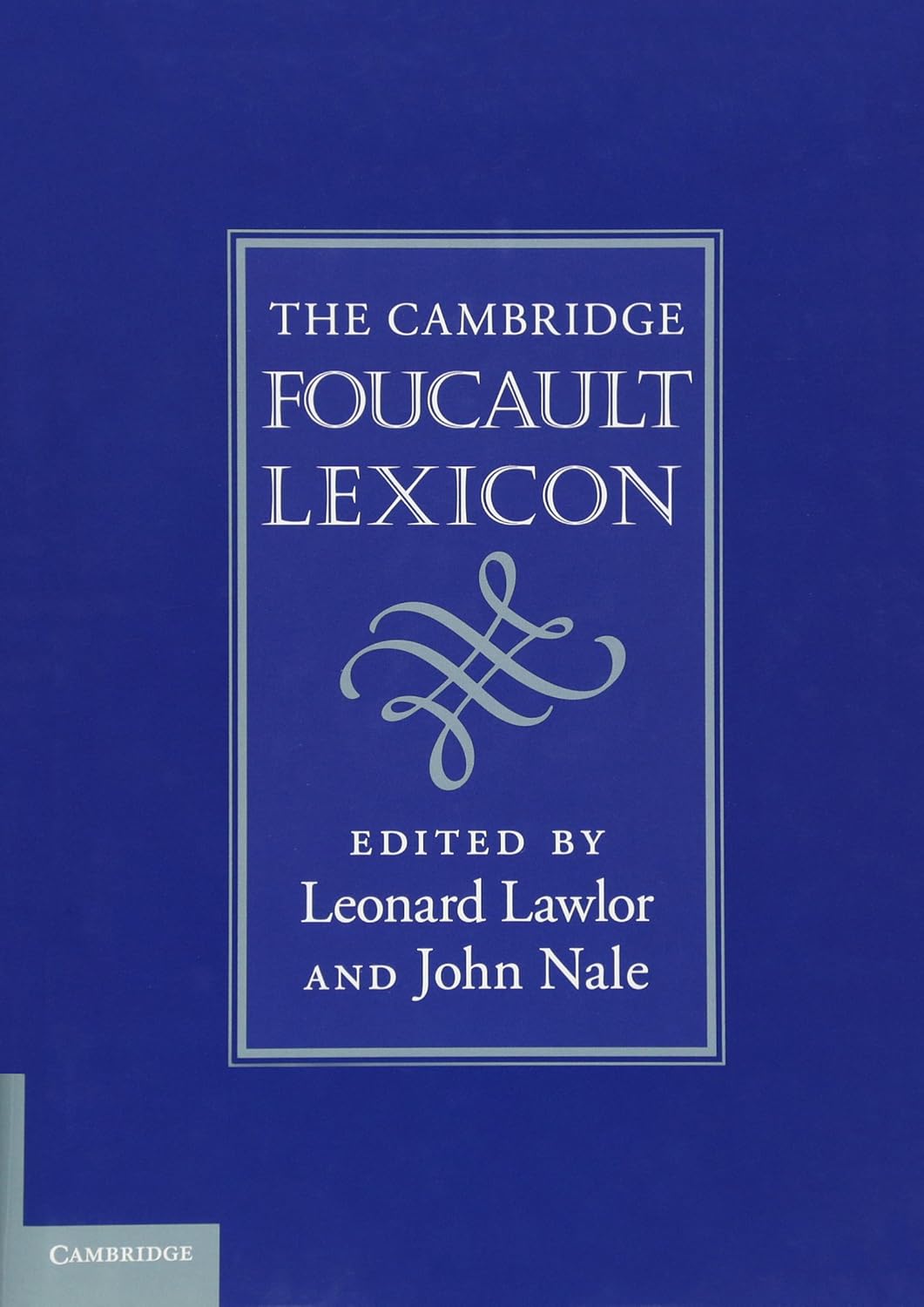
Colin Gordon, Review Article: The Cambridge Foucault Lexicon, History of the Human Sciences 2016, Vol. 29(3) 91–110
https://doi.org/10.1177/0952695116653948

Also on academia.edu

Leonard Lawlor and John Nale (eds) The Cambridge Foucault Lexicon. New York:Cambridge University Press, 2014. 741 pp. £99.99. ISBN: 9780521119214 (hbk)

Extract
This big and potentially influential volume is one sign among others of Michel Foucault’s ongoing elevation to classic status within the history of recent thought. The publishers say that the 117 entries in this volume are written by ‘the world’s leading scholars in Foucault’s thought’. Some of the 72 contributors certainly fit that billing. Alongside many established experts, there are also younger scholars whose renown lies, hopefully, in the near future; this mix gives a range of generational perspectives which is to be welcomed.The contributors are comprised overwhelmingly of philosophers working in the USA and Canada, plus a handful from western Europe, and two Australians. Foucault’s creative impact has long extended across a far wider global and intellectual community than is adequately represented here. The mass presence of philosophers doubtless reflects the commercial fact that academic reference works targeted at the university library market generally need a definite primary departmental focus. Nevertheless, it is a pity that a few more contributions have not been provided to this lexicon by some of those academics based in geography, history, politics, criminology, sociology, anthropology or classics who have engaged with, used or tested Foucault in their fields.This might have also diminished a tendency, perhaps compounded by the legacy of a past generation of commentaries focused on Foucault’s earlier books, to produce an overall emphasis which underplays Foucault’s public and political engagements.

Davies, W. (2012), The Emerging Neocommunitarianism. The Political Quarterly, 83: 767–776.
doi:10.1111/j.1467-923X.2012.02354.x
Full text on academia.edu

Abstract
The financial crisis which began in 2007 has been widely interpreted as a crisis of neoliberalism, akin to the crisis of Keynesianism of the 1970s. But there is little sign of a major paradigmatic alternative, either in theory or in practice. This article looks at how the crises and failures of neoliberalism are occurring at a micro-policy level, where they are interpreted in terms of the fallibility of individual rational choice. Policy responses to this crisis, drawing on more psychologically nuanced accounts of economic behaviour, can be described as ‘neocommunitarian’, inasmuch as they echo the communitarian critique of the liberal self. Where neoliberalism rests on a vision of the individual as atomised and rational, neocommunitarianism treats individuals as governed by social norms and incentives simultaneously. And where neoliberalism subjects individuals to periodic audit organised around targets and outputs, neocommunitarianism conducts a constant audit of behavioural fluctuations in real time.

Laurence McFalls & Mariella Pandolfi, Post-Liberalism, Academic Foresights, No. 5: July-September 2012

Update October 2025: There is something wrong with the formatting of this page but you can read the article if you highlight the page

How do you analyze the present status of post-liberalism?

Post-liberalism is the currently emergent historical formation that has both grown out of and broken with liberalism and neo-liberalism. Like its antecedents, post-liberalism entails its own forms of truth, of subjectivity, and of power. In the terminology of Michel Foucault, it is a governmentality, that is, a mode of government drawing on its own typical (post-) political rationality, practices, techniques and agents.

We can initially define post-liberalism by distinguishing it from liberalism and neo-liberalism. From liberal governmentality post-liberalism retains the “conduct of conduct” through the manipulation of interests, and from neo-liberal economic theory it adopts the idea that the market as a locus of veridiction, that is, as a mechanism that empirically produces truth through prices, is not natural but rather a fragile social construct. Well beyond neo-liberalism’s reinforcement and redeployment of market mechanisms and privatization of social services, post-liberalism through its multiplication and radicalization of mechanisms for controlling human life more fundamentally, even ontologically, redefines the human experience, replacing the self-interested liberal subject and the neo-liberal entrepreneur of the self with what Michael Dillon and Julian Reid call the “biohuman.” Unlike both classic and neo-liberalism, post-liberalism collapses the distinction between the individual and the collectivity through what we call the therapeutic government of individual bodies understood and understandable as particularly configured and manipulable exemplars of the human species in its diversity, with each susceptible to its particular vulnerabilities. The post-liberal subject is a composite subject, contingently pieced together genetically and socially. Humans, of course, have always been such constructs, but today they are subjected to social scientific discourses and biomedical technologies ranging from “intersectionality” to genetic engineering that empty them of the transcendent qualities of the autonomous, rational (neo-)liberal subject. (Indeed, post-liberalism’s simultaneous government of individuals and populations can most easily be understood through one of the biomedical practices that inspire it, namely “personalized medicine,” or the use of genetic, molecular, and environmental profiling for the optimization of individual patients’ preventive or therapeutic care.)

read more