
Foucault News

News and resources on French thinker Michel Foucault (1926-1984)

Mifsud, D.
‘Decentralised’ neoliberalism and/or ‘masked’ re-centralisation? The policy to practice trajectory of Maltese school reform through the lens of neoliberalism and Foucault
(2016) Journal of Education Policy, 31 (4), pp. 443-465.

DOI: 10.1080/02680939.2015.1121409

Abstract
The politics of the later part of the twentieth century have been marked by the emergence of neoliberalism, which has consequently impregnated the global policy climate with neoliberal technologies of government. It is within this political scenario of hegemonic neoliberal discourse that I explore one aspect of school reform in Malta – contrived school networking as mandated by the policy document ‘For All Children to Succeed’ (FACT), issued in 2005, by which Maltese primary and secondary state schools were geographically clustered into 10 colleges. I explore the influence of neoliberalism and the presence/absence of its characteristics, namely, State central control, the ‘empowerment’ agenda and the tension between autonomy and accountability. This is done both through policy analysis and policy reception – I carry out a documentary analysis of FACT and present this together with the leaders’ views, collated from interviews and observation, after being subjected to narrative analysis and interpreted through Foucault’s concepts of discourse and governmentality. Despite the gradual unfolding of the decentralization process, there is a very strong presence of State central control. Besides methodological significance for policy scholarship, this article has particular philosophical implications for educational policy, practice and theory within the infrastructure of globalized neoliberal governmentality. © 2015 Informa UK Limited, trading as Taylor & Francis Group.

Author Keywords
Accountability; discourse; Foucault; governmentality; neoliberalism; policy analysis; school reform

Corinne Weisgerber, Shannan H. Butler,
Curating the Soul: Foucault’s concept of hupomnemata and the digital technology of self-care
(2016) Information Communication and Society, 19 (10), pp. 1340-1355.

https://doi.org/10.1080/1369118X.2015.1088882

Abstract
This paper explores how online actions such as the practice of digital self-writing shape our offline identity. We start with an examination of the concept of hupomnemata – a practice of self-writing in which notes are kept as a ‘material record of things read, heard, or thought’ in the intent of shaping the self [Foucault (1997). Self writing. In P. Rabinow (Ed.), Ethics, subjectivity and truth. The essential works of Foucault, 1954–1984. Volume 1 (pp. 207–222). New York, NY: The New Press p. 209] – before arguing that the practice of digital content curation can be understood as a modern-day variant of the Greco-Roman hupomnemata. Although the work of the digital curator is conducted online, this paper positions contemporary curatorial practices as acts of self-exploration, self-cultivation, and self-care, which nourish offline identity and which ultimately work to shape the offline, corporeal self. © 2015 Taylor & Francis.

Author Keywords
digital curation; Hupomnemata; identity

stuartelden's avatarProgressive Geographies

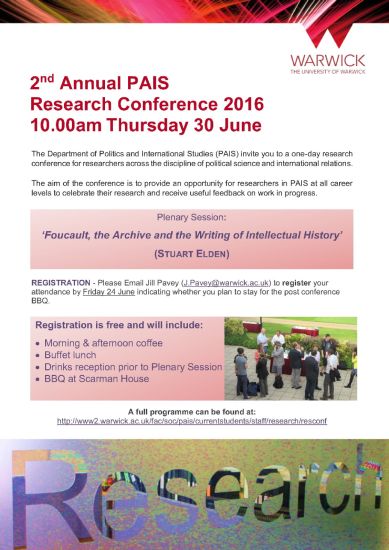
2nd_annual_pais_research_conference_2016_poster.jpgAt the end of June I gave the plenary lecture to my Warwick department’s annual conference. It was entitled ‘Foucault, the Archive and the Writing of Intellectual History’, and discussed the writing of the two books Foucault’s Last Decadeand Foucault: The Birth of Power.

The audio recording is available here.

Links to my series of updates on the books’ progress can be found here and other audio and video recordings are  here.

Some translations, scans and links are available at Foucault Resources – I mention some of these in the talk.

View original post

Mark Murphy, Foucault, hybridization and social research: reflections on the Foucault @90 Conference, Social Theory Applied Blog, 29 June 2016

I was fortunate enough to attend the recent Foucault @90 conference, held at the University of West of Scotland on the 22-23 June. It was well attended with a strong selection of papers and excellent keynotes from Prof. Mark Olssen, Dr. Clare O’Farrell and Prof. Stephen Ball. A conference wholly devoted to Foucault – what’s not to like?

[…]

What I particularly enjoyed about the conference was its lack of deference and willingness to think with Foucault and beyond his work. Evident among the presenters was a desire to match his ideas up with practical research agendas in specific cultural and national contexts. This desire was reflected in the ways in which presenters made connections between Foucault and other thinkers.

read more

Thörn, H.
Politics of responsibility: governing distant populations through civil society in Mozambique, Rwanda and South Africa
(2016) Third World Quarterly, 37 (8), pp. 1505-1523.

DOI: 10.1080/01436597.2015.1136207

Abstract
This article presents and analyses the findings of a research project on power relations in the context of development partnerships with civil society on HIV/AIDS in Mozambique, Rwanda and South Africa, and engages in a critical dialogue with governmentality analysis. It argues that contemporary neoliberal government needs to be understood as context-specific articulations of three forms of power discussed by Foucault – sovereignty, discipline and biopower – and, in the global domain, a fourth form of power – (new) imperialism. Further, the analysis demonstrates how the introduction of a ‘package of (de-)responsibilisation’ shapes CSOs’ activities so that they become competitive service providers, use evidence-based methods and produce measurable results. Addressing the issue of resistance, it shows how the transfer of responsibilities may involve tension and struggle – a politics of responsibility. © 2016 Southseries Inc., http://www.thirdworldquarterly.com.

Author Keywords
civil society; development partnerships; global governance; Global governmentality; international aid; sub-Saharan Africa

Fathallah, J.
‘Except that Joss Whedon is god’: fannish attitudes to statements of author/ity
(2016) International Journal of Cultural Studies, 19 (4), pp. 459-476.

DOI: 10.1177/1367877914537589

Abstract
Early internet and fan studies theorists believed the New Media context and work of the active fan would bring theories like the Death of the Author to fruition. Contemporary fan studies scholars are more reserved, acknowledging diversity in fan attitudes. Through analysis of a LiveJournal article with comments on authors’ views concerning fanfiction, this article demonstrates the paradoxical investment in various forms of authorial authority espoused across fan communities, as well as defiance and repudiation of them. I argue that while the authors quoted are denied legitimate authority through various tactics, the concept of an originating, proprietary authorship, with attendant capitalist powers and rights, retains much influence. The concept of the author holds more power than the individual figures attempting to wield it, and fans attribute or deny the power of authorship to particular figures according to their public personas and cultural politics. In this sense, fans may withhold or bestow legitimation through the operation of Foucault’s author-function, interpreting text and statements of authority through the public persona of the author. © 2014, © The Author(s) 2014.

Author Keywords
audience; author; authority; Barthes; fan studies; fanfiction; Foucault

Chang, H.-C.
The normalisation of body gifting in Taiwan
(2016) BioSocieties, 11 (2), pp. 135-151.

DOI: 10.1057/biosoc.2015.29

Abstract
The Tzu Chi Foundation has made body gifting, such as body donation, bone marrow donation and cord blood donation, successful in Taiwan. Using Foucault’s theoretical framework of governmentality and normalisation, this article discusses how a Buddhist charity, the Tzu Chi Foundation, normalises body gifting in Taiwan through their campaigns, system and philosophy. It argues that Buddhist discourses of karma create a ‘benefit-all altruism’ in body gifting. Furthermore, the emergence of the Tzu Chi Foundation in the last five decades has been a process of discipline and norm construction. The Tzu Chi Foundation, with its comprehensive missions, builds up an extensive network to spread their philosophy in different fields, from environmental protection and humanity education to medical care. The practice-oriented and community-based volunteer system helps the ‘giving’ ideology take root in the communities in Taiwan. Finally, through the media and the Internet, the effect goes beyond the institutional boundaries and reaches the public. © 2016 Macmillan Publishers Ltd.

Author Keywords
Body gifting; Foucault; Normalisation; Taiwan; Tzu Chi

Andrew Hope, Governmentality and the ‘selling’ of school surveillance devices, The Sociological Review. Volume 63, Issue 4, pages 840–857, November 2015

DOI: 10.1111/1467-954X.12279

Abstract
In late modernity there has been a massive growth in ‘new’ surveillance devices situated within schools. This paper explores the reasons behind this proliferation, considering the role of key protagonists and the promises made regarding these technologies. It is suggested that there is strong connection between notions of neoliberal governmentality (Foucault, 2008; Gane, 2012) and arguments relating to increased security, improved efficiency, the desirability of techno-surveillance devices and desensitization to pervasive monitoring. In particular, it is maintained that the devolution of state power, the marketization of education, increased responsibilization and the nature of observation in the viewer society all help to explain the emergence of ‘surveillance schools’. It is concluded that failure to recognize these new dynamics may result in schools quietly, subtly becoming experimental labs and then junkyards for our surveillance futures.

Keywords:
governmentality;surveillance;security;marketization;responsibilization;normalization

One of a series of posts on Barry Stocker’s blog on Foucault’s Theories et institutions pénale. Cours au Collège de France, 1971-1972. Paris: Seuil/Gallimard, 2015

Barry Stocker's avatarStockerblog

(Commentary on Theories et institutions pénale. Cours au Collège de France, 1971-1972. Paris: Seuil/Gallimard, 2015)

23rd February, 1972

Institutions of Peace

First function

Private wars are forbidden

They are forbidden by a collective or singular authority

This authority imposes what can be placed before a judicial body, that is private war or what provokes private war

Justice is now not what comes after injury, arbitration and peace. The court is under the control of an authority establishing peace.

Public authority has separated injury from justice (presumably Foucault means injury cannot be a reply to an injury, that the injury can only be punished in the public court).

Justice is confiscated by the judiciary (from the private agreements between aristocrats at war with each other)

Second Function

Establish region where taxation/state revenues are better organised, more stable, and generate more income.

The period of private wars within the aristocracy generated revenue for…

View original post 856 more words

María Alejandra Energici, Propuesta metodológica para un estudio de gubernamentalidad: Los procesos de subjetivación y los mecanismos de regulación poblacional como ejes de análisis para su abordaje empírico, Psicoperspectivas. Individuo y Sociedad, Vol. 15, No. 2 (2016)

Texto completo

Resumen

En 1982 Foucault definió una gubernamentalidad como el contacto entre las tecnologías de dominación de los demás y las referidas a uno mismo. Tomando dicha definición, el objetivo de este artículo es proponer una ruta metodológica para estudiar una gubernamentalidad específica atendiendo a las tecnologías propuestas por Foucault como ejes de análisis: las tecnologías de dominación de los demás son descritas como mecanismos de regulación poblacional y las referidas al sí mismo como procesos de subjetivación. En otras palabras, se propone dos grupos de prácticas sociales, o de mecanismos y procesos, para estudiar empíricamente una sociedad en términos de su razón gubernamental. A modo de ejemplo, se presenta la publicidad como un campo de estudio posible para dar cuenta de una gubernamentalidad dada. Trabajar desde los ejes de análisis propuestos, permite desarrollar investigaciones sobre la complejidad política actual, rescatando el método crítico y genealógico utilizado por Foucault.