Foucault News

News and resources on French thinker Michel Foucault (1926-1984)

asevillab's avatarmultipliciudades

My latest article, ‘Gramsci and Foucault in Central Park: Environmental hegemonies, pedagogical spaces and integral state formations’, is now available online on the early view webpage of Environment and Planning D: Society and Space (requires subscription).

The piece draws on the conceptualizations of power and the state by these authors to develop an explicitly political understanding of landscape struggles and the governmentalization of urban environments, using Manhattan’s Central Park as a historical  illustration of such processes. In fact the article is articulated not only through the dialogue between both thinkers, but as a more open conversation that also includes Frederick Law Olmsted, co-designer, architect-in-chief and superintendent of the park, as well as other figures and institutions related to its material and symbolic construction. The Greensward project and subsequent management of the park premises under Olmsted’s attention are depicted as a pioneering example of how design mediates new local state…

View original post 292 more words

Luque-Ayala, A., Marvin, S.
The maintenance of urban circulation: An operational logic of infrastructural control
(2016) Environment and Planning D: Society and Space, 34 (2), pp. 191-208.

DOI: 10.1177/0263775815611422

Abstract
This paper examines the increased visibility of urban infrastructures occurring through a close coupling of information technologies and the selective integration of urban services. It asks how circulatory flow is managed in the contemporary city, by focusing on the emergence of new forms of governmentality associated with “smart” technologies. Drawing on Foucault’s governmentality, and based on a case study of Rio de Janeiro’s Operations Centre (COR), the paper argues that new understandings of the city are being developed, representing a new mode of urban infrastructure based on the partial and selective rebundling of splintered networks and fragmented urban space. The COR operates through a “un-black boxing” of urban infrastructures, where the extension of control room logics to the totality of the city points to their fragility and the continuous effort involved in their operational accomplishment. It also functions through a collapse in relations of control—of the everyday and the emergency—, which, enabled by the incorporation of the public in operational control, further raise public awareness of urban infrastructures. These characteristics point to a specific form of urban governmentality based on the operationalisation of infrastructural flows and the development of novel ways of seeing and engaging with the city. © 2015, © The Author(s) 2015.

Author Keywords

black boxing; Control rooms; infrastructure; smart city; urban flows; urban governmentality

stuartelden's avatarProgressive Geographies

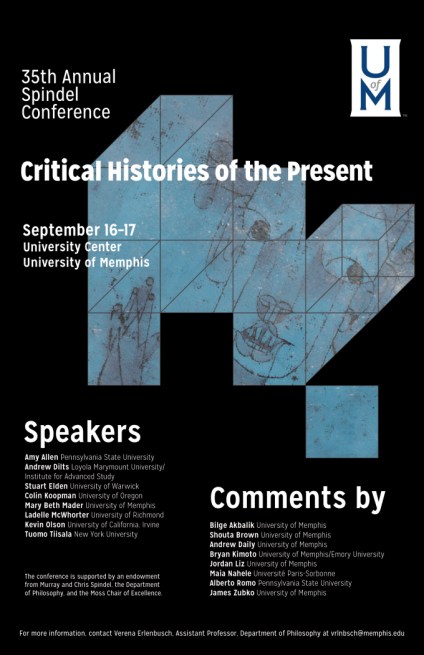
SpindelMy next visiting talk – and my first overseas talk in over a year – will be at ‘Critical Histories of the Present‘, the 35th Spindel conference, University of Memphis, 16-17 September 2016.

My talk is under the title of ‘Foucault and Shakespeare: Ceremony, Theatre, Politics’. A very early version was given in London last year. I’ll also be presenting this work to the Political Thought and Intellectual History seminar, University of Cambridge on 7 November 2016. Papers from Memphis will be published in the Southern Journal of Philosophy.

Most discussions of Foucault and Shakespeare are around the theme of madness, which appears in several plays and which Foucault discusses in a number of places. Late in his life he also reads King Lear on the theme of parrēsiaThese are all interesting discussions, and in the (current) written form I work through these references carefully. But my focus…

View original post 74 more words

The 2016 conference of the Australasian Society for Continental Philosophy (ASCP) will take place at Deakin University’s Burwood Campus, December 7-9 2016.

The ASCP aims to provide a broad intellectual forum for academics and postgraduates working in the European philosophical tradition. Its annual conference is the largest event devoted to European philosophy in Australasia.

The conference will feature a number of curated streams, including ‘Philosophies of Self-Formation’, ‘Continental Philosophy and Other Traditions’, ‘Phenomenologies of Oppression’, ‘Law and Continental Philosophy’, ‘Philosophy and Creative Practice’ and ‘Politics and Technology’.

Inquiries can be addressed to s.bowden@deakin.edu.au. Please use ‘ASCP2016’ in the subject line.

The keynote speakers are Penelope Deutscher (Northwestern), John Lippitt (Hertfordshire), Anne Sauvagnargues (Paris Ouest) and John Sellars (King’s College London).


Streams

1. Philosophies of Self-Formation – curated by Matthew Sharpe (matthew.sharpe@deakin.edu.au)

The later work of Michel Foucault announced a turn towards classical philosophical conceptions of self-formation. Alongside work by Dumanski, Sellars, Voelke and others influenced by Pierre and Ilsetraut Hadot, Foucault’s later works point to an alternative understanding of the history of philosophy, paying renewed attention to the Hellenistic, Roman and early modern periods downplayed or overlooked in many 19th and 20th century histories. This stream will involve papers examining the history of the metaphilosophical conceptions of philosophy as a way of life, or as therapeutic, or as interested in paideia or self-formation, which reached its peaks during these periods. Papers are invited on the Stoics, Epicureans, Cicero, the sceptics, Petrarch and the renaissance philosophers, Montaigne and the new Pyrrhonists, the founders of the modern scientific project(s), the philosophes, Spinoza, Schopenhauer, Nietzsche … or other figures speaking to this theme.

6. Law and Philosophy – curated by John Morss and Luca Siliquini-Cinelli (john.morss@deakin.edu.au, l.siliquinicinelli@deakin.edu.au)

What is sovereignty? What is a legal right or a legal obligation? What is a nation? What, if anything, is a human right, the Rule of Law, Global Justice? Can law recognise the plural: can a legal cosmopolitanism transcend identity politics? In addressing such questions contemporary legal philosophy and jurisprudence are dominated by English-speaking, Anglo-American traditions in philosophy. Analytic traditions of a conservative stripe, themselves a narrow representation of English-speaking philosophical discourse, exert near-exclusive control on jurisprudential debate. Cultural hegemony is one reason for this but the lack of engagement between legal theorists and Continental philosophies is another. This stream hopes to address this gap by foregrounding the contributions and challenges to legal theory that are presented by writers such as Agamben, Arendt, Deleuze, Derrida, Foucault, Ranciere, Zizek. In terms of non-Anglo jurisprudence, while already well mined, the writings of Schmitt and of Kelsen may yet have more to yield to these debates. Philosophy of law is too important to ignore the wide variety of perspectives offered by Continental thought.

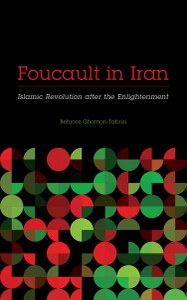
foucault-iranBehrooz Ghamari-Tabrizi, Foucault in Iran Islamic Revolution after the Enlightenment, University of Minnesota Press, 2016.

Were the thirteen essays Michel Foucault wrote in 1978–1979 endorsing the Iranian Revolution an aberration of his earlier work or an inevitable pitfall of his stance on Enlightenment rationality, as critics have long alleged? Behrooz Ghamari-Tabrizi argues that the critics are wrong. He declares that Foucault recognized that Iranians were at a threshold and were considering if it were possible to think of dignity, justice, and liberty outside the cognitive maps and principles of the European Enlightenment.

Foucault in Iran centers not only on the significance of the great thinker’s writings on the revolution but also on the profound mark the event left on his later lectures on ethics, spirituality, and fearless speech. Contemporary events since 9/11, the War on Terror, and the Arab Uprisings have made Foucault’s essays on the Iranian Revolution more relevant than ever. Ghamari-Tabrizi illustrates how Foucault saw in the revolution an instance of his antiteleological philosophy: here was an event that did not fit into the normative progressive discourses of history. What attracted him to the Iranian Revolution was precisely its ambiguity.

Theoretically sophisticated and empirically rich, this interdisciplinary work will spark a lively debate in its insistence that what informed Foucault’s writing was not an effort to understand Islamism but, rather, his conviction that Enlightenment rationality has not closed the gate of unknown possibilities for human societies.

A groundbreaking reassessment of Foucault’s writings on one of the greatest political upheavals of our time.

Foucault in Iran centers on the significance of Foucault’s writings on the Iranian Revolution and the profound mark it left on his lectures on ethics, spirituality, and fearless speech. This interdisciplinary work will spark a lively debate in its insistence that what informed Foucault’s writing was his conviction that Enlightenment rationality has not closed the gate of unknown possibilities for human societies.

Foucault in Iran is a courageous and thought-provoking invitation to understand the Iranian revolution, and Foucault’s reaction to it, in an original way. A splendid work that goes beyond simple binaries, it has no sympathy for the clichéd vocabulary used by Progressivists to describe these events—or to criticize Foucault for his alleged romanticisation of the Iranian revolution.

Talal Asad, City University of New York

ABOUT THE AUTHOR:
Behrooz Ghamari-Tabrizi is associate professor of history, and sociology and Director of the Center for South Asian and Middle Eastern Studies at the University of Illinois, Urbana–Champaign. He is the author of Islam and Dissent in Postrevolutionary Iran, Remembering Akbar: Inside the Iranian Revolution, and co-editor of The Iranian Revolution Turns 30.

Colin Gordon, “Brexit Means Brexit Means Nothing”
14/07/2016 on academia.edu

This note is a postscript to my earlier piece “The Will of the people in post – truth times”,

Apart from its oversexed headline and the now outdated speculations about the future of a certain individual, this piece by Sean O’Grady in The Independent seemed to me yesterday the shrewdest analysis so far of where we stand (that is to say, the one which agrees most with what I was thinking myself). Today or tomorrow, who knows..

Read more

Editor: For those of you who, like myself, are involved in teaching Foucault: I find this analysis by Slavoj Žižek of John Carpenter’s 1988 film They Live, from Sophie Fiennes’ 2012 film The Pervert’s Guide to Ideology to be particularly apt.

Maurice Stierl, A Foucauldian Take on Border Violence and Mediterranean Acts of Escape , 04/25/16

Podcast on soundcloud

The unauthorized mass-movements of 2015, when more than a million people crossed maritime borders into European space, demonstrated more clearly than ever before that Europe’s deterrence politics had failed. The necropolitical obstacle course created by its border regime proved unable to prevent these disobedient mobilities. What we witness today, while often termed a “migrant or refugee crisis,” is in fact a crisis of the European project. Current processes of internal re-bordering along sovereign nation-state lines and logics significantly undermine Europe’s supposed post-national ethos and trans-border imaginary. In this talk Stierl explores “Europe in crisis” and relates to some of the experiences he made through his own activist involvement in “border struggles,” as part of the activist collective ‘WatchTheMed Alarm Phone’ that has created a “hotline” for people in distress at sea. Advocating the freedom of movement and seeking to democratize maritime borderzones, the collective has created a presence in spaces seemingly reserved for sovereign state actors and has facilitated the safe arrival of thousands of travelers. In this talk he also draws from three “moments” in Michel Foucault’s writing and thought that help us think conceptually through the relationship between (migrations’) excess and (borders’) control and prompt us to reflect on the ways in which “Mediterranean acts of escape” transform the European socio-political landscape and community.

Co-sponsored by the Center for the Study of Law and Society, Townsend Center for the Humanities: Course Thread on Law and the Humanities, and the Institute of European Studies.

Stuart Elden on Brexit and the border implications.

stuartelden's avatarProgressive Geographies

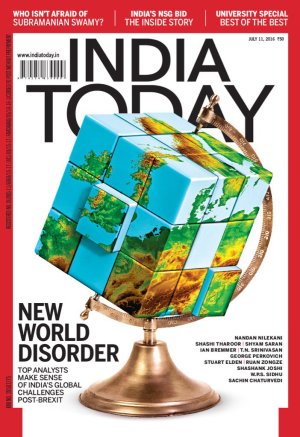
CmQVhMUVYAAnCAf.jpgI have a short piece in the new issue of India Today on ‘The legacies of the Leave EU vote’. The piece is available open access.

I was asked to write about this for an international audience, so for UK or other European readers some of the discussion is likely to be quite familiar. Given the fast-moving nature of events, it is hard not to be overtaken by the news – notably it was written before Boris Johnson said he would not run.

Perhaps the distinctive contribution is that I begin thinking about the territorial and boundary implications of this vote. That is a topic which I may explore in future academic work.

View original post

Colin Gordon, The will of the people in post-truth times. Notes on the current situation (2016)

Full text on academia.edu

10th July 2016

Daniel Cohn-Bendit gave an interview this week on French TV, discussing Brexit, referendums and democracy, in which he said that “we should stop saying that the people is always right”.1 Should we always, unconditionally, irrevocably defer to the expressed will of the people, right or wrong, as a definitive sovereign decision? If not, when, and on what legitimate grounds?

We are seeing the beginnings of a critique of the conception and conduct of the UK Brexit referendum, a critique which, if it is properly carried through, could influence the further course of public action. This critique relates primarily to (a) the manner in which the result was procured, through what has been justly described as an industrial-scale exercise in political lying, and (b) the fact that the best received formulation of the practical proposition which the UK people is deemed to have accepted is a de facto impossibility, namely the combination of full, unimpeded UK access to the EU single market with UK exemption from EU single market rules of free movement (except perhaps where such movement might benefit the UK and its citizens) – together with an assurance that immigration levels will be cut, and a promise that funds falsely described as being currently transferred from the UK to the EU would in future be used to supplement the funding of the National Health Service. The British public has voted, by a small majority, to award itself a round square and a free lunch. Or in the letter-day Marie Antoinette formula of the lead demagogue and charlatan of the Leave campaign, the nation has now adopted his policy on cake – let them have it and let them eat it. Professors of democracy are now offering to certify the binding legitimacy of such irrational sovereign volitions. A Leave majority composed of the poor, the uneducated and the post-industrial regions is hailed by commentators as having defied – at the instigation of the demagogues of Leave – the advice of “toffs and boffins, the chief executives, tycoons and clever-clogs”.

Read more