Foucault News

News and resources on French thinker Michel Foucault (1926-1984)

Carl Death, Counter-conducts: A Foucauldian Analytics of Protest, Social Movement Studies Vol. 9 , Iss. 3, 2010
https://doi.org/10.1080/14742837.2010.493655

Abstract
The influence of Foucault on studies of social movements, dissent and protest is not as direct as might be imagined. He is generally regarded as focusing more on the analysis of power and government than forms of resistance. This is reflected in the governmentality literature, which tends to treat dissent and protest as an afterthought, or failure of government. However, Foucault’s notion of ‘counter-conducts’ has much to offer the study of dispersed, heterogeneous and variegated forms of resistance in contemporary global politics. Using the protests that have accompanied summits including Seattle, Johannesburg, Prague, London and Copenhagen to illustrate an analytics of protest in operation, this article shows how a Foucauldian perspective can map the close interrelationship between regimes of government and practices of resistance. By adopting a practices and mentalities focus, rather than an actor-centric approach, and by seeking to destabilize the binaries of power and resistance, and government and freedom, that have structured much of political thought, an analytics of protest approach illuminates the mutually constitutive relationship between dominant power relationships and counter-conducts, and shows how protests both disrupt and reinforce the status quo, at the same time.

Keywords:
Foucault, counter-conducts, protest, summits, resistance, governmentality

De Schauwer, E., Van de Putte, I., Blockmans, I.G.E., Davies, B.
The intra-active production of normativity and difference
(2016) Gender and Education, pp. 1-16. Article in Press.

DOI: 10.1080/09540253.2016.1259463

Abstract
Drawing on memory stories told in a collective biography workshop about children’s encounters with schooling, this paper experiments with re-imagining the child-student-subject as an ‘emergent intracorporeal multiplicity’ [Fritsch, K. 2015. “Desiring Disability Differently: Neoliberalism, Heterotopic Imagination and Intra-Corporeal Configurations.” Foucault Studies 19: 43–66, 51]. From the feminist new materialist perspective that the authors work with, the child is configured not as an entity prior to, or separate from, encounters with education systems, but emergent with-in them. This paper focuses on difference in human relations, and in particular on the intersections of disability and gender. It does so not in terms of essential characteristics of individuals, but as emergent, in-the-moment, with others. In focussing on the detail of lives-in-their-making, the authors ask, with Barad [2007. Meeting the Universe Halfway: Quantum Physics and the Entanglement of Matter and Meaning. Durham: Duke University Press], if we are interested in justice, how we are to ‘understand our role in helping constitute who and what come to matter?’ © 2016 Informa UK Limited, trading as Taylor & Francis Group

Author Keywords
difference; Disability; gender; justice; normativity; responsibility

Raaper, R.
Tracing assessment policy discourses in neoliberalised higher education settings
(2016) Journal of Education Policy, pp. 1-18. Article in Press.

DOI: 10.1080/02680939.2016.1257160

Abstract
This article explores assessment policy in two European universities with different political, historical and social backgrounds: the University of Glasgow and Tallinn University. The University of Glasgow is a well-established Russell Group university in the UK; Tallinn University is a relatively new university in post-Soviet Estonia, shaped by very recent neoliberalisation processes. By applying a Foucauldian theorisation and Faircloughian methodology, this article approaches assessment policy as not only relating to institutional contexts but also national and global policy environments. The article argues that the assessment policy in Glasgow relates to globally dominant neoliberal discourses of accountability and excellence. These discourses have turned assessment into a complex technology of government that manages educational processes as well as academic and student subjectivities. While Tallinn University is shaped by neoliberalism at strategic levels, the policy documents in Tallinn still indicate a strong sense of local tradition where regulations have a modest impact on academic freedom and assessors’ disciplinary power over students. © 2016 Informa UK Limited, trading as Taylor & Francis Group

Author Keywords
assessment policy; discourse; Foucault; higher education; Neoliberalism

lorey_state_of_insecurity Eric Wilson, Precarious Politics, The Blackstone Review, December 2016

Review of State of Insecurity: Government of the Precarious. by Isabell Lorey, Verso, 2015

[…]
Using Foucault’s notion of self-governance, Lorey helps to demonstrate how the hustler internalizes the imperative to hustle. Self-governance implies the ways in which a population is made, through a variety of state- and work-disciplinary mechanisms, and comes to make, through self-discipline, itself into a subject. Neoliberal self-governance takes place under conditions where the burden of life has been shifted from the state to individuals who are made to appear solely responsible for their lives, their successes or failures, their employment or imprisonment. This transition produces precarious subjects who are increasingly called upon to live lives of constant precarious labor, to manage their precarity at all times, to constantly hustle, at work and at home. In this way, precarity becomes a way of life, a condition that not only structures employment, but also structures the governing of the self. The uncertainty produced by neoliberalism looms within the texture of daily life, informing not only conscious decisions about how to allocate resources for an uncertain future but also unconscious thoughts and behaviors. It is the production of radically isolated individuals who are driven by one imperative: to pursue security in a world of financial, political, environmental, and humanitarian crises.

The individual hustler, hustling, working multiple jobs, learning to love and identify with exploitative conditions, all appear variously in this moment of neoliberalism.

Saari, A.
Knowledge Without Contexts? A Foucauldian Analysis of E.L. Thorndike’s Positivist Educational Research
(2016) Studies in Philosophy and Education, 35 (6), pp. 589-603.

DOI: 10.1007/s11217-016-9527-2

Abstract
The article discusses the allegedly decontextualized and ahistorical traits in positivist educational research and curriculum by examining its emergence in early twentieth-century empirical education. Edward Lee Thorndike’s educational psychology is analyzed as a case in point. It will be shown that Thorndike’s positivist educational psychology stressed the need to account for the reality of schooling and to produce knowledge of the actual contexts of education. Furthermore, a historical analysis informed by Michel Foucault’s history of the human sciences reveals that there are multiple historical temporalities involved in Thorndike’s educational psychology. This allows a new critical angle to be taken on positivist educational research. The question concerning the contexts of empirical education turns to examining the way the conditions of possibility for scientific knowledge in education involve practices of contextualization as well as paradoxical and self-defeating elements. © 2016, Springer Science+Business Media Dordrecht.

Author Keywords
Foucault; History of education; Philosophy of education; Philosophy of science; Post-structuralism

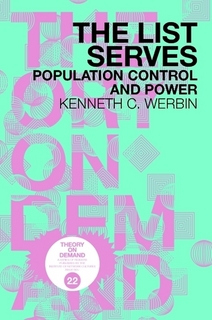
werbinKenneth C. Werbin, The List Serves: Population Control and Power, Institute of Network Cultures, Amsterdam, 2017

See also this link

Preface by: Geert Lovink. Edited By: Miriam Rasch. Cover design: Katja van Stiphout. DTP: Leonieke van Dipten. EPUB development: Leonieke van Dipten. Printer: Print on Demand. Publisher: Institute of Network Cultures, Amsterdam, 2017. ISBN: 978-94-92302-15-1, paperback, 182 pages.

About the book:
Inspired by taxonomist Jack Goody’s theorizing of ‘ancient lists’ as ‘intellectual technologies’, this book analyzes listing practices in modern and contemporary formations of power, and how they operate in the installation and securing of the milieus of circulation that characterize Michel Foucault’s conception of governmentality. Propelling the list’s role in the delimitation and policing of risky and threatening elements from out of history and into a contemporary analysis of power, this work demonstrates how assemblages of computer, statistical, and list technologies first deployed by the Nazi regime continue to resonate significantly in the segmenting and constitution of a critical classification of contemporary homo sapiens: the terrorist class, or homo sacer.

Author: Kenneth C. Werbin is an Associate Professor of Digital Media and Journalism at Wilfrid Laurier University’s Brantford Campus. His research focuses broadly on questions surrounding digital and social media, commodification and surveillance. His work has been published in notable journals including Media Culture and Society, The Canadian Journal of Communication, The International Review of Information Ethics, Fibreculture and The Journal of Canadian Studies. His current Social Sciences and Humanities Research Council of Canada funded research engages digital storytelling methods to raise awareness amongst young adults about digital privacy through the co-creation of a series of 21st-century digital learning materials.

Jennifer Charteris, Marguerite Jones, Adele Nye, Vicente Reyes,
A heterotopology of the academy: mapping assemblages as possibilised heterotopias (2017), International Journal of Qualitative Studies in Education, 30 (4): 340–53. Published online: 31 Oct 2016.

https://doi.org/10.1080/09518398.2016.1250178

Abstract
Heterotopias are counter-sites of enacted utopias through which reality is simultaneously represented, contested and inverted. They are physical or mental spaces where, although norms of behaviours are suspended, there are connections with a plethora of other spaces. This article constructs a collective biography as a heterotopology of the academy. Academic subjectivities are produced and often constrained within powerful Higher Education discourses. Constructing an affective assemblage of becomings as a heterotopology, the authors deploy poststructural philosophy to re-story academic life experiences and conceptualise agency in the academy. Taking licence with the notion of academicity and heterotopia, the article describes how spaces in the measured university can be deterritorialised through generative lines of flight. An affective assemblage is presented that ruptures the discursive orientation of category boundary work where academics are constituted as ‘productive metric-minded knowledge workers’. The collective biography research approach facilitates a mapping of affective cartographies as a heterotopology and a critique of the discursive production of selves. The subjectivations of identity politics in matricised assemblages may be, even if momentarily, evaded, refused and agentically resisted. © 2016 Informa UK Limited, trading as Taylor & Francis Group

Author Keywords
Affect; agency; collective biography; foucault; heterotopia

Wieser, C.
Teaching and personal educational knowledge–conceptual considerations for research on knowledge transformation
(2016) European Journal of Teacher Education, 39 (5), pp. 588-601.

DOI: 10.1080/02619768.2016.1253673

Abstract
Teacher knowledge is currently explored in three major research paradigms. This paper reviews how teaching and personal educational knowledge are related in these three paradigms, namely: the evidence paradigm, the life history paradigm and the practice theory paradigm. The paradigms can be linked through their demand to elaborate knowledge transformation conceptually. This paper introduces some perspectives for conceptual elaboration of knowledge transformation: a post-critical epistemology is used to distinguish two modes of knowledge: practical educational knowledge which provides orientations for teaching, and personal educational knowledge which provides orientations for reflection on teaching. These two modes of knowledge are consequently linked through the concept of technologies of the self as introduced in the epistemology of Foucault, which provides perspectives to relate practical with personal educational knowledge and comprehend how teachers transform their knowledge to adapt and develop their teaching with respect to specific teaching contexts. © 2016 Association for Teacher Education in Europe.

Author Keywords
knowledge transformation; personal knowledge; practical knowledge; Teacher knowledge; technologies of the self

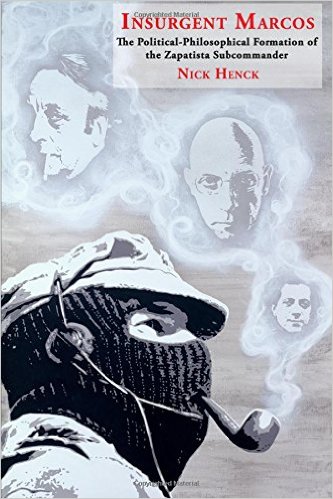
henckNicholas Henck, Insurgent Marcos: The Political-Philosophical Formation of the Zapatista Subcommander, Editorial A Contracorriente (January 9, 2017)

Publisher’s page
Amazon page

For over two decades now Subcommander Marcos has acted as military leader and spokesperson of Mexico’s Zapatista movement. In the process of doing so he has also become a key figure in the anti-capitalist and anti-globalization movements. There has been little attempt however to examine in significant detail the political-philosophical influences at work upon this important contemporary thinker. This book aims to rectify this by establishing which political-philosophical currents Marcos was exposed to during his formative years as a student at the National Autonomous University of Mexico, and then examining the Subcommander’s discourse in order to ascertain the extent to which these persisted in his thinking years later. Concretely, what we discover is that in his youth Marcos was especially influenced by his reading of Louis Althusser, Michel Foucault, and Nicos Poulantzas, and that certain core components of their thinking helped to form, and indeed continued to inform, the Subcommander’s political philosophy.

Reviews
“This book is an outstanding success in weaving together strands of literary theory, political practice, and political theory in delivering a window on the political-philosophical formation of Subcomandante Insurgente Marcos. In its detailed scope and depth of coverage it is an essential read on the making of Marcos and the politics of Zapatismo”
Adam David Morton (University of Sydney), author of Revolution and State in Modern Mexico

Farrell, F., Duckworth, V., Reece, M., Rigby, P.
The moral frontiers of English education policy: governmentality and ethics within an alternative provision free school
(2016) Educational Review, pp. 1-17. Article in Press.

DOI: 10.1080/00131911.2016.1223018

Abstract
This article is a critical poststructuralist analysis of Conservative led free school policy in England focussing on claims made by the New Schools Network and in the 2010 White Paper that free school provision promotes social justice. The article presents an empirical study of an alternative provision free school as a lens through which these claims can be interrogated. Drawing from Foucault’s concept of governmentality the article analyses the narratives of teachers working in the school in order to gain insights into the microphysics of the policy rationalities mobilised within the discursive site of the free school and claims that such provision promotes social justice. The teachers interviewed demonstrate a strong alignment to free school policy discourse, but also a blurring of pastoral and disciplinary rationalities expressed in terms of the rehabilitation of students on the educational boundaries of the “normal”. The article concludes that the school is a tactical move within neoliberal education policy in which the state responsibilises a new polity of actors, including teachers, sponsors and communities contracting out its interventions in order to govern the ungovernable. The article calls for further empirical research of free school provision in order to contest neoliberal discourses which obfuscate complex systemic failure and the social reality of intergenerational unemployment and disadvantage. © 2016 Educational Review