Foucault News

News and resources on French thinker Michel Foucault (1926-1984)

Colin Koopman, The power thinker, Aeon, 15 March 2017

Imagine you are asked to compose an ultra-short history of philosophy. Perhaps you’ve been challenged to squeeze the impossibly sprawling diversity of philosophy itself into just a few tweets. You could do worse than to search for the single word that best captures the ideas of every important philosopher. Plato had his ‘forms’. René Descartes had his ‘mind’ and John Locke his ‘ideas’. John Stuart Mill later had his ‘liberty’. In more recent philosophy, Jacques Derrida’s word was ‘text’, John Rawls’s was ‘justice’, and Judith Butler’s remains ‘gender’. Michel Foucault’s word, according to this innocent little parlour game, would certainly be ‘power’.

read more

Colin Koopman is the author of a book on Foucault and numerous essays in The New York Times, Critical Inquiry, and elsewhere. He is currently writing a genealogy of the politics of data. He teaches philosophy at the University of Oregon.

Tea Torbenfeldt Bengtsson, & Lars Fynbo (2017). Analysing the significance of silence in qualitative interviewing: questioning and shifting power relations. Qualitative Research, February
https://doi.org/10.1177/1468794117694220

Abstract
In this article we analyse the significance of silence in qualitative interviews with 36 individuals interviewed about high-risk, illegal activities. We describe how silence expresses a dynamic power relationship between interviewer and interviewee. In the analysis, we focus on two different types of silence: ‘silence of the interviewee’ and ‘silence of the interviewer’. We analyse how silence functions as an interviewee’s resistance against being categorized as ‘social deviant’, how an interviewer may use silence strategically, and how silence stemming from an interviewer’s perplexity constructs significant data. We conclude that silence constitutes possibilities for interviewees and interviewers to handle the complex power at play in qualitative interviewing either by maintaining or by losing control of the situation.

Dušan Marinković and Dušan Ristić, (2016) Foucault’s ‘Hall of Mirrors’: an Investigation into Geo‐Epistemology, Geografiska Annaler: Series B, Human Geography 98 (2): 83–96.
https://doi.org/10.1111/geob.12092

Abstract
In this article we aim to single out a part of Foucault’s trihedrals of spatialization – discourses and practices, that is, technologies of power that have their spatialized frames. In order to analyse them we use the concept of a trihedral, not a triangle, because we noticed that several lines can be drawn from any angle and can form new spaces. In such a manner we are able to see their multiplication, separation and parallelisms. Using the trihedrals of spatialization we detect in Foucault’s work, besides the demands for a certain (spatialized) ontology, the existence of no less significant geo‐epistemology as knowledge and discourses that are formed in spaces and as the space formed through knowledge/power/discourses. We face a polyvalent character of the angles of the trihedrals and try to avoid the labyrinth into which their multiplication pulls us. The article pays special attention to Foucault’s elementary trihedral, life–work–language, in which man came to life as a being who works, speaks and reproduces in a new shape – as population. In this trihedral the angles/concepts are only seemingly separated: they overlap, mix, collide and intertwine in a game that cannot end. That is why this is only a snapshot of the many trihedrals; a possible aggregate of combinations, yet in no case coherent and homogenous. In that sense this article is not an attempt to systematize Foucault’s thought but to identify one of the many possible models/matrices for understanding the meaning of his spatial turn and his analysis of power.

Keywords: Foucault, geo‐epistemology, spaces, spatialization, trihedrals

Valeria Varea, Bonnie Pang, 2018. Using visual methodologies to understand pre-service Health and Physical Education teachers’ subjectivities of bodies, Sport, Education and Society, 23 (5): 394–406. Published online: 07 Sep 2016
https://doi.org/10.1080/13573322.2016.1228625

Abstract
Socio-cultural theorists have argued that having a diverse understanding of subjectivities of normal/ideal bodies is important for Health and Physical Education (HPE) teachers. When teachers hold a single understanding and perception of normal/ideal bodies, such as a thin body as normal or ideal body, which are usually informed by dominant discourses, they may (re)produce narrow understandings of bodies among their students. This paper focuses on how a group of pre-service HPE specialist teachers (11 females and 3 males, aged between 18 and 26 at the time of the first interview) from an Australian university, discuss issues related to subjectivities of bodies. It draws on visual methodologies and semi-structured interviews to understand how these pre-service HPE specialist teachers construct discourses of bodies. Foucault’s concepts of normalisation, surveillance and biopedagogies are used to explore discursive constructions of bodies, with a particular focus on how some discourses are normalised via surveillance techniques. The results of the study invite us to reflect on how images may promote certain ways of thinking about and considering the body among pre-service HPE specialist teachers. In light of contradictions which were found across the comments of two participants who constructed different discourses during the interviews, we posit that making sense of subjectivities of bodies is complex and often contradictory. Furthermore, the results suggest that photo elicitation is a useful visual method for theorising issues related to bodies. Results can inform teacher education and policy in how to better prepare pre-service HPE teachers to teach about bodies. © 2016 Informa UK Limited, trading as Taylor & Francis Group

Author Keywords
biopedagogies; bodies; normalisation; photo elicitation; Pre-service Health and Physical Education teachers; surveillance

Index Keywords
adult, clinical article, female, human, male, physical education, semi structured interview, teacher, thinking, university
Edwards, R.
Competence-based education and the limitations of critique
(2016) International Journal of Training Research, 14 (3), pp. 244-255.

DOI: 10.1080/14480220.2016.1254366

Abstract
Drawing upon the work of Foucault and Latour, this article reflects on 25 years of critique of competence-based education and its continuing strength as a way of framing education and training. Using an example from England, it rehearses the argument from Foucault that, despite its student-centred discourse, competence-based education can be positioned as one of the disciplining techniques in modern societies. However, beyond the research community, such critiques have had little impact. The article seeks to explore this by drawing upon Latour’s argument that conventional forms of critique have run out of steam. This indicates the need for new forms of educational critique as a means of having impact on policy and practice. The article is theoretically driven and exploratory. © 2016 Informa UK Limited, trading as Taylor & Francis Group.

Author Keywords
competence-based education; critique; Foucault; Latour; vocational education

Ja’afar, Z., Md. Yusof, N., Ibrahim, N.
Revisioning history: A deconstructionist reading of a learner’s multimodal text, ‘Revenge’
(2016) Asian Social Science, 12 (8), pp. 64-73.

DOI: 10.5539/ass.v12n8p64

Abstract
Recent interest in multimodality recognizes the integration of text and image in meaning-making as representing reality. It has also been argued that with the use of digital communication, the meanings of visual and verbal data can be easily manipulated rendering them unreliable. As such, a close and critical reading of the text is required to discover what is hidden, absent, or inconsistent with it. In a deconstruction of a multimodal digital composition of a poem that involves revisioning of history, this paper privileges the absences of cultural and historical texts to signify socio-political issues. An eclectic use of theoretical concepts on meaning-making, especially those proposed by Kress and van Leeuwen, Foucault and Baudrillard, constructs the discussion of the analysis. The digital poem entitled ‘Revenge’ is deconstructed to further discover such absence in the text. The findings reveal that language and images are used by the learner as a source of power to negotiate the boundaries of identity. It has also been discovered that the message in rhetoric and visuals complement each other to support the process of meaning-making. © 2016, Canadian Center of Science and Education. All rights reserved.

Author Keywords
Absence; Deconstruction; Multimodal digital poem; Reality; Revisioning history; Socio-political

De Vries, L.A.
Politics of (in)visibility: Governance-resistance and the constitution of refugee subjectivities in Malaysia
(2016) Review of International Studies, 42 (5), pp. 876-894.

DOI: 10.1017/S0260210516000103

Abstract
This article explores the relationality of governance and resistance in the context of the constitution of refugee subjectivities in Malaysia. Whilst recognising their precarity, the article moves away from conceiving of refugees merely as victims subjected to violence and control, and to contribute to an emerging body of literature on migrant resistance. Its contribution lies in examining practices of resistance, and the specific context in which they emerge, without conceptualising power-resistance as a binary, and without conceiving of refugees as preconstituted subjects. Rather, drawing on the thought of Michel Foucault, the article examines how refugee subjectivities come into being through a play of governance-resistance, of practices and strategies that may be simultaneously affirmative, subversive, exclusionary, and oppressive. The relationality and mobility of this play is illustrated through an examination of practices surrounding UNHCR identity cards, community organisations, and education. Secondly, governance-resistance is conceptualised as a play of visibility and invisibility, understood both visually and in terms of knowledge production. What I refer to as the politics of (in)visibility indicates that refugee subjectivities are both constituted and become other than ‘the refugee’ through a continuous play of coming into being, becoming governable, claiming a presence, blending in and remaining invisible. © British International Studies Association 2016.

Author Keywords
(In)visibility; Governance; Politics; Refugees; Resistance; Subjectivity

Heffernan, A.
The Emperor’s perfect map: leadership by numbers
(2016) Australian Educational Researcher, 43 (3), pp. 377-391.

DOI: 10.1007/s13384-016-0206-7

Abstract
This paper establishes that system-generated data profiles are influencing the work of principals in three Queensland state schools. Drawing upon Foucault’s notions of governance, as well as research emphasising performative cultures and the importance placed upon numbers and data in education, this paper uses the tale of the Emperor’s map as a metaphor to explore the way principals’ work is being influenced by specific sets of data compiled by the department. These data profiles are representative of external accountabilities and high stakes testing regimes, as seen in systems that have adopted neoliberal policies which attempt to quantify the work being undertaken in schools. The paper demonstrates that principals are being constructed in part by discourses from a system that emphasises these system-generated performance data as a driver for school improvement. © 2016, The Australian Association for Research in Education, Inc.

Author Keywords
Data; Performativity; School improvement; School principals

Powell, D.
Governing the (un)healthy child-consumer in the age of the childhood obesity crisis
(2016) Sport, Education and Society, pp. 1-14. Article in Press.

DOI: 10.1080/13573322.2016.1192530

Abstract
In recent years, multinational food and drink corporations and their marketing practices have been blamed for the global childhood obesity ‘crisis’. Unsurprisingly, these corporations have been quick to refute these claims and now position themselves as ‘part of the solution’ to childhood obesity. In this paper, I examine how and why corporations fund, devise and/or implement ‘healthy lifestyles education’ programmes in schools. By using a critical ethnographic research approach alongside Foucault’s notion of governmentality, I interrogate what those with the ‘will to govern’ (such as corporations) wanted to happen (e.g. fight obesity, change marketing practices and increase consumption), but also what actually happened when these corporatised education programmes met their intended targets in three New Zealand primary schools. I critically examine these programmes by focusing on the ways in which three technologies of consumption – product placement, transforming children into marketers and sponsorship – attempt to govern children to be lifelong consumers of the corporate brand image and their allegedly ‘healthy’ corporate products. Although students were not necessarily naïve and easily coerced into becoming mindless consumers of corporate products, students and their teachers readily accepted that sponsorship, product placement and marketing in schools were normal, natural, necessary and mostly harmless. Healthy lifestyles education programmes represent a new ‘brand’ of health, health education and corporation. The child-citizen is governed to become the child-consumer. Corporations’ anxieties about being blamed for childhood obesity are fused with technologies of ‘healthy consumption’: the consumption of corporate products, corporate philanthropy, the corporate brand and corporate ‘education’. © 2016 Informa UK Limited, trading as Taylor & Francis Group

Author Keywords
childhood obesity; consumers; critical ethnography; food and drink industry; Foucault; governmentality; Health and physical education; marketing; sponsorship; technologies of consumption

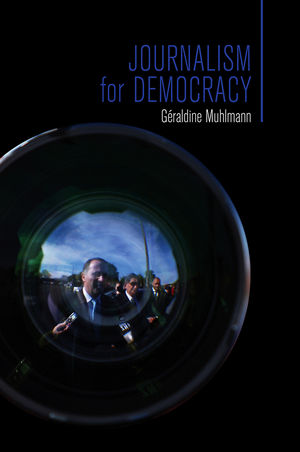
Géraldine Muhlmann, Journalism for Democracy, trans. Jean Birrell, Polity, 2010

Editor: There are some very interesting remarks on Foucault, Bourdieu and journalism in the first chapter

Description
Journalists are commonly denounced from all sides – a shameful, deceitful trade, a profession sold out to the powerful which gives a biased and misleading picture of the world. Behind the condemnation one can often detect a desire for reform, a feeling that good journalism is too important for the health of democracy to be left to languish among the tabloids. Yet the discussion rarely gets beyond the well-worn formulas of free speech and the Fourth Estate. The question of the political significance of journalism is never seriously addressed, and the question of what journalism should be is rarely posed.

This important new book by Géraldine Muhlmann addresses these gaps in our understanding and goes a long way to filling them. Putting aside the hasty diatribes against journalism, Muhlmann asks the fundamental questions: what should journalism be? What ideals should it serve? What do seeing and showing the world mean today? What direction should journalism take in order to emerge from its current crisis?

Drawing on a rich tradition of philosophical thought, Muhlmann breathes new life into the old debate about journalism and its role today. Avoiding the twin pitfalls of destructive criticism and naive celebration, she sees a double task for a reinvigorated journalism: to allow space for conflict but also to foster unity within the political community. In the practice of journalism we see the enigma of democracy itself: the coexistence of two stages, one of action and one of representations, the latter offering a symbolic resolution to the conflicts that animate the former.