Foucault News

News and resources on French thinker Michel Foucault (1926-1984)

Journée d’étude
Penser la digitalisation
Le pouvoir à l’âge digital : lire Exposed

14 décembre 2016
Columbia Global Centers–Paris

PDF Programme
Part of the Digital Initiative Program of the Columbia Law School

9h – Accueil
9h15 – Bernard E. Harcourt (Columbia University) : Introduction
9h45 – Morning Panel
Chair : François Ewald

Thomas Berns (Université Libre de Bruxelles) : Pourquoi parler de gouvernementalité
algorithmique ?
Toni Negri : Looking for New Weapons
Isabelle Falque-Pierrotin (CNIL) : TBC

Répondants : Jesús R. Velasco (Columbia University), Daniele Lorenzini (Columbia
University/Université Paris 1), Jean-Gabriel Ganascia (Université Pierre et Marie Curie)

13h Déjeuner

14h30 – Afternoon Panel
Chair : Daniele Lorenzini (Columbia University/Université Paris 1)

Gaspard Koenig (Génération Libre) : Pour une propriété privée des données personnelles
Yann Moulier-Boutang (Université de Technologie de Compiègne) : TBC
Antoinette Rouvroy (FNRS/CRIDS, Université de Namur) : Défaire la gouvernementalité
algorithmique : plaidoyer pour un droit des espaces-temps potentiels

Répondants : Simon Head (Rothermere American Institute, Oxford University), Dominique Deprins
(Université Saint-Louis Bruxelles), Dominique Cardon (Sciences Po/Médialab)

17h30 – François Ewald : Conclusions

Ravinder Sidhu, Navigating unfreedoms & re-imagining ethical counter-conducts: Caring about refugees & asylum seekers, Educational Philosophy and Theory,
Pages 1-12 | Published online: 05 Oct 2016

10.1080/00131857.2016.1225558

Abstract
This article uses Foucault’s concept of the care of the self to interrogate the accounts of ethical agency provided by professionals involved in the settlement of refugees, in a global and national context marked by fear of the stranger and the embrace of neoliberal political rationalities. An argument is made to ‘free the professional self’ by refusing an individualised, psychologised and dehistoricised approach in working with refugees and asylum seekers. In its place, a threefold ‘ethics of engagement’ for ‘international citizenship’ is proposed as a way forward to further professionalism and civic action. By understanding the refugee problem as an ‘integral part of North-South relations’ rather than as a ‘Third World’ problem, new possibilities are opened for an ethics of civility and an ethics of care.

Keywords: Social justice, care of the self, refugees, settlement, asylum seekers

Silcock, M., Payne, D., Hocking, C.
Governmentality within Children’s Technological Play: Findings from a Critical Discourse Analysis
(2016) Children and Society, 30 (2), pp. 85-95.

DOI: 10.1111/chso.12123

Abstract
In many countries today, digital technology and instant communication are embedded in children’s everyday lives to the extent that their play frequently incorporates smartphones, the Internet and other technologies. In this paper, we explore the recent historical conditions within the New Zealand context that have increased the accessibility of these technologies and imbued them with particular meanings. We suggest that from a Foucauldian perspective, these technologies can be seen as a form of subtle disciplinary power using techniques of governmentality through which children’s ways of thinking are shaped to benefit societal requirements of the current historical era. © 2016 National Children’s Bureau.

Author Keywords
Children; Foucault; Governmentality; Play; Technology

Foster, R.
The therapeutic spirit of neoliberalism
(2016) Political Theory, 44 (1), pp. 82-105.

DOI: 10.1177/0090591715594660

Abstract
My essay argues that neoliberal forms of government emerged through the shifting political trajectory of the therapeutic ethos in the postwar period in Anglo-American societies. In the postwar era, the therapeutic ethos attracted the attention of conservative cultural critics who described it as a destructive force on communal obligation. Initially, the therapeutic ethos appeared to align naturally with New Left ideas of democratization in the workplace and private sphere. However, I argue that the New Right was subsequently able to sever the therapeutic ethos from its alignment with social democratization by imbuing it with an alternative set of meanings centered on the ideas of market freedom and the entrepreneur. The result was the construction of the new, neoliberal forms of power, which, I argue, take the form of the management of subjectivity. Finally, I outline the two major social pathologies of the neoliberal era, namely, the consequences of its contractualized notion of citizenship and the explosion of social inequality, both of which are traceable to the influence of therapeutic notions of the self. © 2015 SAGE Publications.

Author Keywords
Citizenship; Democracy; Foucault; Neoliberalism; New left; Therapeutic ethos

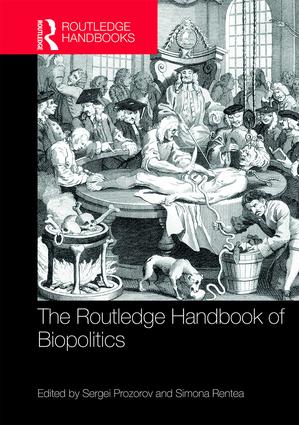
biopoliticsThe Routledge Handbook of Biopolitics
Edited by Sergei Prozorov, Simona Rentea, Forthcoming 2017 – Routledge

About the Book

The problematic of biopolitics has become increasingly important in the social sciences. Inaugurated by Michel Foucault’s genealogical research on the governance of sexuality, crime and mental illness in modern Europe, the research on biopolitics has developed into a broader interdisciplinary orientation, addressing the rationalities of power over living beings in diverse spatial and temporal contexts.

The development of the research on biopolitics in recent years has been characterized by two tendencies: the increasingly sophisticated theoretical engagement with the idea of power over and the government of life that both elaborated and challenged the Foucauldian canon (e.g. the work of Giorgio Agamben, Antonio Negri, Roberto Esposito and Paolo Virno) and the detailed and empirically rich investigation of the concrete aspects of the government of life in contemporary societies. Unfortunately, the two tendencies have often developed in isolation from each other, resulting in the presence of at least two debates on biopolitics: the historico-philosophical and the empirical one. This Handbook brings these two debates together, combining theoretical sophistication and empirical rigour.

The volume is divided into five sections. While the first two deal with the history of the concept and contemporary theoretical debates on it, the remaining three comprise the prime sites of contemporary interdisciplinary research on biopolitics: economy, security and technology. Featuring previously unpublished articles by the leading scholars in the field, this wide-ranging and accessible companion will both serve as an introduction to the diverse research on biopolitics for undergraduate students and appeal to more advanced audiences interested in the current state of the art in biopolitics studies.

Christopher Worthman & Beverly Troiano (2016): A good student subject: a Foucauldian discourse analysis of an adolescent writer negotiating subject positions, Critical Studies in Education Published online: 24 Oct 2016

DOI: 10.1080/17508487.2016.1246372

ABSTRACT
In this article, we draw on the work of Michel Foucault to analyze one student’s subject development in an expository writing classroom. James, the participant, was embarking on the project of becoming a good student, as he understood it, after struggling and leaving school previously. Drawing on interviews, classroom observations and written artifacts, we use Foucauldian concepts and discourse analysis, along with one James Gee’s discourse analysis tools – the identities building tool – to conduct a microanalysis of James’s efforts to objectify himself as a good student subject. The data show how James acquiesced to the truths and practices of the regime of school, including how he mobilized truths of the regime through a process we call masked confession. That is, he negotiated his good student subject position by masking or silencing other subject positions. James’s masked confession was his way of negotiating the realm of ‘multiple truths,’ or multiple subject positions.

KEYWORDS
School-based research; discourse analysis semiotics; Foucault; writing; youth adolescence

Terri Bourke, Mary Ryan, Margaret Lloyd, The discursive positioning of graduating teachers in accreditation of teacher education programs, Teaching and Teacher Education, Volume 53, January 2016, pp. 1–9

Abstract
This paper uses discourse analysis techniques associated with Foucauldian archaeology to examine a teacher education accreditation document from Australia to reveal how graduating teachers are constructed through the discourses presented. The findings reveal a discursive site of contestation within the document itself and a mismatch between the identified policy discourses and those from the academic archive. The authors suggest that rather than contradictory representations of what constitutes graduating teacher quality and professionalism, what is needed is an accreditation process that agrees on constructions of graduate identity and professional practice that enact an intellectual and reflexive form of professionalism.

Keywords
Accreditation; Foucault; Program standards; Professionalism; Teacher standards

seymourChildren’s Spatialities: Embodiment, Emotion and Agency
Editors: Seymour, Julie, Hackett, Abigail, Procter, Lisa (Eds.)
Palgrave Macmillan, 2015

This book as the foreword states ‘takes up Foucault’s challenge to “examine the critical power of space and place in being and becoming of children’s lives’.

Drawing from a wide range of disciplines, including anthropology, sociology, architecture and geography, and international contributors, this volume offers both students and scholars with an interest in the interdisciplinary study of childhood a range of ways of thinking spatially about children’s lives.

Table of contents (11 chapters)
Introduction: Spatial Perspectives and Childhood Studies
Hackett, Abigail (et al.)
Pages 1-17

Knowing the World Through Your Body: Children’s Sensory Experiences and Making of Place
Mackley, Kerstin Leder (et al.)
Pages 21-38

The Place of Time in Children’s Being
Curtis, Elizabeth
Pages 39-53

Making the ‘Here’ and ‘Now’: Rethinking Children’s Digital Photography with Deleuzian Concepts
Sakr, Mona (et al.)
Pages 54-74

Children’s Embodied Entanglement and Production of Space in a Museum
Hackett, Abigail
Pages 75-92

Children’s Emotional Geographies: Politics of Difference and Practices of Engagement
Blazek, Matej
Pages 95-111

Reconceptualising Children’s Play: Exploring the Connections Between Spaces, Practices and Emotional Moods
Karoff, Helle Skovbjerg
Pages 112-127

‘No, You’ve Done It Once!’: Children’s Expression of Emotion and Their School-Based Place-Making Practices
Procter, Lisa
Pages 128-143

Approaches to Children’s Spatial Agency: Reviewing Actors, Agents and Families
Seymour, Julie
Pages 147-162

Children and Young People’s Spatial Agency
Woolley, Helen
Pages 163-177

A Proper Place for a Proper Childhood? Children’s Spatiality in a Play Centre
Satta, Caterina
Pages 178-197

obstinacy History and Obstinacy
By Alexander Kluge and Oskar Negt
Edited by Devin Fore

With Cyrus Shahan, Martin Brady, Helen Hughes and Joel Golb
Translated by Richard Langston
The MIT Press, 2016

Devin Fore’s introduction which refers to Foucault can be found on his university website

Overview
If Marx’s opus Capital provided the foundational account of the forces of production in all of their objective, machine formats, what happens when the concepts of political economy are applied not to dead labor, but to its living counterpart, the human subject? The result is Alexander Kluge and Oskar Negt’s History and Obstinacy, a groundbreaking archaeology of the labor power that has been cultivated in the human body over the last two thousand years.

Supplementing classical political economy with the insights of fields ranging from psychoanalysis and phenomenology to evolutionary anthropology and systems theory, History and Obstinacy reaches down into the deepest strata of unconscious thought, genetic memory, and cellular life to examine the complex ecology of expropriation and resistance.

First published in German 1981, and never before translated into English, this epochal collaboration between Kluge and Negt has now been edited, expanded, and updated by the authors in response to global developments of the last decade to create an entirely new analysis of “the capitalism within us.”

About the Authors

Alexander Kluge is an author and filmmaker, known for launching the New German Cinema in the early 1960s.

Oskar Negt is Professor of Sociology at the Universität Hannover. Early in his career, he was a student of Theodor Adorno and assistant to Jürgen Habermas.

About the Editor

Devin Fore is Associate Professor in the Department of German at Princeton University.

Endorsements
“This book is an astounding manifestation of an improbable constellation of a great writer and filmmaker and an important social philosopher. They combine the production forces of two rare minds who mutually complement each another. Readers will enjoy the illuminating insights and surprising discoveries from the revealing assemblages of ideas, arguments, and imaginations.”
Jürgen Habermas

“By presenting theory as montage with photos, highlighted text, excursuses, diagrams, and box quotes, History and Obstinacy takes up the legacies of the historical avant-garde, but it does so in an anti-vanguardist mode. As it explores materialist anthropology, the archeology of labor power, histories and stories of defiance and tenacious resistance, it turns its political attention toward the extended past that grounds our evolving present. In its search for answers about the neglected organic and subjective dimension of capital’s logic, this book speaks more directly to our current condition than its historical origin in a period of post-1960s disorientation might suggest. An indispensable message in a bottle from another time and a pleasure to read.”
Andreas, Huyssen

de-valkMark de Valk (Ed.) Screening the Tortured Body. The Cinema as Scaffold, Palgrave Macmillan, 2016

Inspired by Michel Foucault’s examination of state subjugation and control, this book considers post-structuralist notions of the ‘political technology of the body’ and ‘the spectacle of the scaffold’ as a means to analyse cinematic representations of politically-motivated persecution and bodily repression. Through a critique of sovereign power and its application of punishment ‘for transgressions against the state’, the collected works, herein, assess the polticised-body via a range of cinematic perspectives. Imagery, character construction and narrative devices are examined in their account of hegemonic-sanctioned torture and suppression as a means to a political outcome. Screening The Tortured Body: The Cinema as Scaffold elicits philosophical and cultural accounts of the ‘retrained’ body to deliberate on a range of politicised films and filmmakers whose narratives and mise-en-scène techniques critique corporeal subjugation by authoritarian factions.

Table of contents – ebook links

Tortured Spectators: Massacred and Mucosal
MacCormack, Patricia
Pages 9-24

Torture Porn: The American Sadistic Disposition in the Post-9/11 Horror Genre
Kerner, Aaron
Pages 25-49

Discipline… But Punish!: Foucault, Agamben and Torture Porn’s Thanotopolitical Scaffold
Aldana-Reyes, Xavier
Pages 51-69

The Expectational Body: The Becoming of the Tortured Vampire Horde in Daybreakers
Bacon, Simon
Pages 71-88

An Apology for French Torturers: L’Ennemi intime (2007)
Wallenbrock, Nicole Beth
Pages 89-108

The Ideological Purpose of Torture: Artur London’s Nightmare of Reality in L’Aveu/The Confession (Costa-Gavras, 1970)
Hayward, Susan
Pages 111-132

Mr. Stone Goes to Washington: JFK 2.4
Valk, Mark
Pages 133-157

There’s No Geneva Convention Here: Torture in Three Films Set in World War II
Turim, Maureen
Pages 159-174

Modes of Silence and Resistance: Chilean Documentary and Gendered Torture
DiGiovanni, Lisa
Pages 177-206

Torture Documentaries and Taxi to the Dark Side (Alex Gibney, 2007)
Lesage, Julia
Pages 207-237

Zero Dark Thirty: A Filmmaker’s Notion
Anderson, Larra
Pages 239-263

Hypermediacy, Embodiment and Spectatorship in Brian de Palma’s
Fagan, Calvin
Pages 265-279

Enemy of the State: Framing the Political Assassin
O’Sullivan, Shane
Pages 281-317

‘She’s a Killer,’ ‘The Image of the Women of Zero Dark Thirty’
Olkowski, Dorothea
Pages 319-336