Foucault News

News and resources on French thinker Michel Foucault (1926-1984)

Sverre Raffnsøe, Peter Miller, Andrea Mennicken: “The Foucault Effect in Organization Studies”, Organization Studies, vol 40, Issue 2, 2017.
https://doi.org/10.1177/0170840617745110

Abstract
Since the establishment of Organization Studies in 1980, Michel Foucault’s oeuvre has had a remarkable and continuing influence on its field. This article traces the different ways in which organizational scholars have engaged with Foucault’s writings over the past thirty years or so. We identify four overlapping waves of influence. Drawing on Foucault’s Discipline and Punish, the first wave focused on the impact of discipline, and techniques of surveillance and subjugation, on organizational practices and power relations. Part of a much wider ‘linguistic’ turn in the second half of the twentieth century, the second wave led to a focus on discourses as intermediaries that condition ways of viewing and acting. This wave drew mainly on Foucault’s early writings on language and discourse. The third wave was inspired by Foucault’s seminal lectures on governmentality towards the end of the 1970s. Here, an important body of international research investigating governmental technologies operating on subjects as free persons in sites such as education, accounting, medicine and psychiatry emerged. The fourth and last wave arose out of a critical engagement with earlier Foucauldian organizational scholarship and sought to develop a more positive conception of subjectivity. This wave draws in particular on Foucault’s work on asceticism and techniques of the self towards the end of his life. Drawing on Deleuze and Butler, the article conceives the Foucault effect in organization studies as an immanent cause and a performative effect. We argue for the need to move beyond the tired dichotomies between discipline and autonomy, compliance and resistance, power and freedom that, at least to some extent, still hamper organization studies. We seek to overcome such dichotomies by further pursuing newly emerging lines of Foucauldian research that investigate processes of organizing, calculating and economizing characterized by a differential structuring of freedom, performative and indirect agency.

Keywords critique, discipline, discourse, ethics, Foucault, governmentality, performativity, power, subjectivity
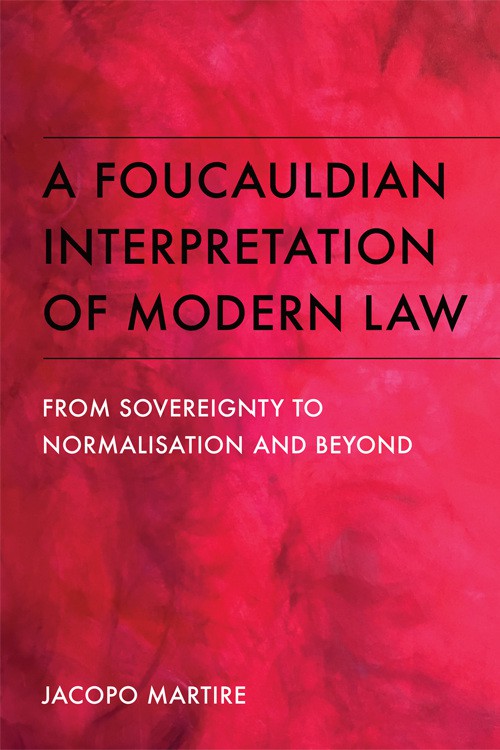
Jacopo Martire, A Foucauldian Interpretation of Modern Law. From Sovereignty to Normalisation and Beyond, Edinburgh University Press, 2017.

Addresses a surprisingly overlooked Foucauldian conundrum: what is the logical relationship between modern law and power?

Jacopo Martire investigates the development of modern law in conjunction with what Foucault termed biopolitical forms of power. He gives you a much-needed genealogical analysis of the modern legal phenomenon opening new avenues for Foucauldian approaches to law.

Key Features

  • Critically engages with current Foucauldian literature in the fields of law, philosophy and politics to give you an engaging and comprehensive overview of the field
  • Surveys the development of the modern legal phenomenon in an innovative and original way
  • Demonstrates the critical limits of both liberal and radical approaches to law
  • Develops the potential of Foucault’s theory in analysing the modern legal phenomenon, opening up new avenues for research

Jacopo Martire is Lecturer in Law at the University of Stirling. His main research interests are in legal and political philosophy, jurisprudence, constitutional theory and European Law.

The Birth of Austerity. German Ordoliberalism and Contemporary Neoliberalism
Edited by Thomas Biebricher and Frieder Vogelmann, Imprint: Rowman & Littlefield, Bloomsbury Publishing, 2017

Description
Ordoliberalism and the ‘Freiburg School’ have gained traction in contemporary political economy in response to two factors: a rising interest in governmentality studies and the banking, financial and sovereign debt crisis in Europe. In the face of these crises, Germany has assumed a position of quasi-hegemony in the European Union, making decisions about bailouts, the politics of crisis management and the rise of austerity.

This volume gathers together English translations of seminal ordoliberal texts by thinkers ranging from Walter Eucken and Wilhelm Röpke to Franz Böhm, Alexander Rüstow and Hans Grossmann-Doerth. Offering some foundational insights into ordoliberalism, these essays give insight into a field that is much misunderstood outside Germany. The second half of the book comprises of analyses of contemporary issues in light of ordoliberal thought, showing how its ideas endure and relate directly to austerity policy across Europe.

– – – Praise for The Birth of Austerity: German Ordoliberalism and Contemporary Neoliberalism – – –

“This book is indispensable reading for everyone interested in current debates on institutional economics, economic policy, the crisis of the Euro, and the role of Germany in it. It assembles several master texts from the Ordoliberal School, most of which were never published in English, and provides a lucid introduction into a widely unknown “Third Way” tradition in economic theory and policy.”
Wolfgang Streeck, Max Planck Institute for the Study of Societies, Cologne

“An excellent handbook on the influential and peculiar German version of neoliberalism. It contains classical texts as well as contemporary analyses of the content and impact of ordoliberalism by leading scholars. No one can understand European politics today without knowledge about ordoliberalism. This book is a good starting point.”
Professor Peter Nedergaard, Ph.D., Department of Political Science, University of Copenhagen

“Understanding the tenets and implications of Ordoliberalism is essential for grasping what is happening in European political economy and governance today. The Birth of Austerity provides this understanding through its carefully selected and translated works by the Ordoliberals themselves and its fine ensemble of analyses by contemporary critical thinkers. The introduction by Biebricher and Vogelmann is a model of clarity and insight. This is an important and immensely useful volume.”
Wendy Brown, University of California, Berkeley

FOUCAULT ON PAINTING
By Catherine M. Soussloff
University of Minnesota Press | 176 pages | November 2017

ISBN 978-1-5179-0242-1| paper | $25.00
ISBN 978-1-5179-0241-4 | cloth | $100.00

Catherine M. Soussloff argues that Michel Foucault’s sustained engagement with European art history critically addresses present concerns about the mediated nature of the image in the digital age. She explores the meaning of painting for Foucault’s philosophy, and for contemporary art theory, proposing a new relevance for a Foucauldian view of ethics and the pleasures and predicaments of contemporary existence.

PRAISE FOR FOUCAULT ON PAINTING:
“Catherine Soussloff is certainly one of the most intellectually intelligent and reflective art historians I can think of. Foucault on Painting is a clear, deeply thoughtful, and perfectly written contribution to the important field of intersect between art and philosophy.” —James Rubin, Stony Brook University

ABOUT THE EDITORS:
Catherine M. Soussloff is professor of art history, visual art, and theory at the University of British Columbia. She is editor of Foucault on the Arts and Letters and author of The Subject in Art (Minnesota, 1997).

For more information, including the table of contents, visit the book’s webpage:

https://www.upress.umn.edu/book-division/books/foucault-on-painting

6/13 | REVOLT: FOUCAULT IN IRAN

Daniel Defert (éditeur de Michel Foucault)
Behrooz Ghamari-Tabrizi (University of Illinois at Urbana)
Judith Revel (Université Paris Nanterre)
Moderated by John Rajchman, Daniele Lorenzini, and Bernard E. Harcourt

December 14, 2017 from 6:15 p.m. to 8:45 p.m.
Jerome Greene Annex, Columbia University
(410 West 117th Street, New York)

See also these links
BERNARD E. HARCOURT | INTRODUCTION TO FOUCAULT ON IRAN: REVOLT AS POLITICAL SPIRITUALITY

DANIELE LORENZINI | PERMANENT VIRTUALITIES

Michel Foucault identified in the Iranian uprising of 1978 a modality of religious political revolt and a form of political spirituality that privileged, in the secular realm, expressly religious aspirations. What Foucault discovered in Iran was, in his words, a political spirituality: a mass mobilization on this earth modeled on the coming of a new Islamic vision of social forms of coexistence and equality.

Foucault described the mass mobilization in Iran as an Islamic uprising. He did not minimize in any way its Islamic religious foundations or modes of expression. On the contrary, Foucault framed the uprising through the lens of Ernst Bloch’s thesis, in The Principle of Hope (3 vols., 1954-1959), on the rise, in Europe, from the twelve to the sixteenth century, of the religious idea that there could come about on this earth a form of religious revolution. Foucault related the events in Iran to this religious model, originally formulated by dissident religious groups in the West at the end of the Middle Ages—and which Foucault referred to as “the point of departure of the very idea of Revolution.”

Foucault explicitly characterized the will of those Iranians in revolt with whom he had contact as taking the form of a “religious eschatology”—not the form of a quest for another political regime, nor in his words for “a regime of clerics,” but instead for a new Islamic horizon. When those in revolt spoke of an Islamic government, Foucault maintained, what they had in mind were new social forms based on a religious spirituality, sharply different than Western models. Foucault pointed to Ali Shariati as the thinker who had most clearly posed the problematic and formulated this vision.

It is to this model of uprising as political spirituality, this modality of religious political revolt that we turn to in Uprising 6/13. By contrast to the modality of revolt that we discussed during our seminar Uprising 3/13 on the Arab Spring, the modality of revolt that Foucault identified in Iran in 1978-79 was expressly and primarily religious. Much (but of course not all, as evidenced once again by subsequent events) of the ideological wellspring in Tahrir Square was more secular, leaderless, and occupational: a form of disobedience against a secular authoritarian regime—at least as portrayed in much of the reportage and documentaries like Tahrir: Liberation Square, directed by Stefano Savona (2012). The situation was very different in 1978 Iran, at least on Foucault’s assessment. And it gives rise to a different modality of revolt: a religious eschatological modality of uprising.

Foucault did not condemn this mode of political spirituality—to the contrary, he wrote about it with respect and admiration for those who rose up and risked their lives against their oppressors. Foucault did warn that “Islam—which is not simply a religion, but a mode of life, a belonging to a history and to a civilization—risks constituting a gigantic powder keg, at the scale of hundreds of millions of people. Since yesterday, any Muslim state can be revolutionized from within, from the basis of its secular traditions.” But he traveled to Iran without hostility, rather with sympathy for the uprising.

And it is here, in his writings on Iran, that Foucault most clearly articulated what he called his own “theoretical ethic”: “It is ‘antistrategic’: to be respectful when a singularity revolts, intransigent as soon as power violates the universal.” (Useless to Revolt?)

Respectful of the individual who rises up, in order to keep one’s indignation and intransigence for the power that represses. What a remarkable statement—and an excellent place to start our seminar on Foucault on Iran: Revolt as Political Spirituality.

stuartelden's avatarProgressive Geographies

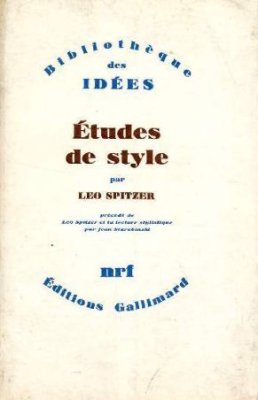
Spitzer.jpgOne of the few translations made by Michel Foucault, and perhaps the most unusual, was an essay by literary theorist Leo Spitzer.

It was published as “Arts du langage et linguistique”, in Leo Spitzer,Etudes de style, Paris: Gallimard, 1970, pp. 45-78. (There are several other pieces in there, translated by others. The text has since been reissued in the Tel series.) Daniel Defert’s ‘Chronology’ dates the publication to 21 January 1970.

The original text was “Linguistics and Literary History”, in Leo Spitzer, Linguistics and Literary History: Essays in Stylistics, Princeton: Princeton University Press, 1948, pp. 1-39.

The original was written in English, even though Spitzer had written most of his earlier work in German. All of the other translations by Foucault were from German to French, so this is unusual in being from English to French.

The other issue which I think is interesting is the date of the translation. The 1970…

View original post 567 more words

Crítica da representação e crise da ontologia: Foucault e Magritte – Philippe Sabot
Facebook page

No final de novembro de 2016, os Programas de Pós-Graduação em História e Filosofia da UFG organizaram uma jornada dedicada aos 50 anos de “As Palavras e as Coisas”.
“Crítica da representação e crise da ontologia: Foucault e Magritte” foi o título da conferência apresentada Philippe Sabot. O professor da Universidade de Lille, além de renomado estudioso da obra do filósofo francês, foi o responsável pela edição crítica de “Les mots et les choses” nas obras completas de Michel Foucault, publicadas recentemente na prestigiosa coleção Bibliothèque de la Pléiade.

Philippe Sabot permaneceu uma semana na UFG, onde ministrou mais duas conferências sobre os manuscritos de Michel Foucault e participou de uma série de atividades acadêmicas.

Editor: An unfortunate flip remark from former Australian Labor Prime Minister.

Kevin Rudd: Foucault’s more painful than the knife in my back
The Sunday Times, November 19 2017.

PDF of article

Kevin Rudd, the Australian prime minister ousted by his deputy, tells Leaf Arbuthnot his Oxford PhD course can be brutal too,

Kevin Rudd, the apple-cheeked former prime minister of Australia, is not going gently into that good night. Aged 60 and four years out of office, he has just embarked on a PhD at Oxford and seems exhilarated to be learning again.

[…]

Rudd was prime minister not once but twice. His first stint, as leader of the Labor Party, was in 2007-10; his second was in 2013.

Although we talk under the silent stare of one of his minders, Rudd is evidently throwing himself into student life. He enthuses about the “great minds” he is encountering and taking part in Oxford’s “weird” rituals — including the matriculation ceremony at the start of the academic year, where new university members parade through town in gowns.

[…]

Yet he is clearly still adjusting to the demands of academic work. “The other day I endured my first lecture on Derrida and Foucault,” he recalls with a laugh. “I’m still in the recovery ward.”

Olga Campbell-Thomson, 2017, The Soviet Reception of Selma Lagerlöf, NORA – Nordic Journal of Feminist and Gender Research 25(4), 296–316.
https://doi.org/10.1080/08038740.2017.1362590

Abstract
The focus of this paper is Selma Lagerlöf’s literary presence in Soviet Russia. Despite being one of the most translated and published foreign authors in pre-revolutionary times, Lagerlöf made very infrequent appearances on the Soviet literary scene for 40-odd years between 1917 and the end of the 1950s. The process of literary production is examined in this paper in search of an explanation for the changing pattern in the publication of Lagerlöf’s texts. To problematize the process of literary production in the newly established Soviet state, Foucault’s conceptualization of the process of knowledge construction is utilized to describe, understand, and explain the interplay between critical resources, such as linguistic and literary expertise, individual initiative, and the government-controlled publishing enterprise in the Soviet state. I argue that the agency of literary workers remained relevant to the literary process, despite increasing ideological pressure on literary production, and that they paved the way towards the official reintroduction of Lagerlöf to the Russian Soviet readership during the 1950s.

Keywords: Selma Lagerlöf, women writers, literary production, travelling texts, Soviet publishing

Craig Owen, Nicola De Martini Ugolotti, (2017), ‘Pra homem, menino e mulher’? Problematizing the gender inclusivity discourse in capoeira, International Review for the Sociology of Sport , 54(6), 691-710.
https://doi.org/10.1177/1012690217737044

Blog post on article by Craig Owen This paper uses Foucault’s understanding of power and discourse as the main theoretical focus.

Abstract
Capoeira is an Afro-Brazilian bodily discipline that has now become a global phenomenon. In 2014 the cultural significance of capoeira was recognized on the world stage when it was awarded the special protected status of an ‘Intangible Cultural Heritage of Humanity’ by the United Nations Educational, Scientific and Cultural Organisation. In the application to this organisation, and in wider advertising material and practitioner literature, capoeira is celebrated as a practice that promotes social cohesion, inclusivity, integration, racial equality and resistance to all forms of oppression. This paper seeks to problematize this inclusive discourse, exploring the extent to which it is both supported and contradicted in the gendered discourses and practices of specific capoeira groups in Europe. Drawing upon ethnographic data, produced through two sets of ethnographic research and the researchers’ 24 years of combined experience as capoeira players, this paper documents the complex and contradictory contexts in which discourses and practices of gender inclusivity are at once promoted and undermined.

Keywords
capoeira, ethnography, gender, inclusivity, masculinity