Foucault News

News and resources on French thinker Michel Foucault (1926-1984)

La pensée politique de Foucault
sous la direction d’Orazio IRRERA et Salvo VACCARO, Paris, Editions Kimé (coll. “Philosophie en cours”), 2017, p. 248.

Loin d’être considérée comme une simple notion appartenant au vocabulaire de la théorie politique, l’idée foucaldienne de la politique renvoie plutôt à une attitude généalogique fournissant un diagnostic du présent et restituant des relations complexes et contingentes qui nouent des domaines de savoir, des types de normativité et des formes de subjectivité. Par ce biais cette idée touche tout un ensemble de questions qui ont été cruciales pour l’itinéraire intellectuel de Foucault. En premier lieu celles de la gouvernementalité et de la biopolitique, des savoirs et des pouvoirs qui les constituent, des pressions normalisantes avec leurs effets spécifiques d’assujettissement, mais aussi des résistances et des contre-conduites que la gouvernementalité et la biopolitique rencontrent et produisent dans leur exercice. Au cœur de l’idée foucaldienne de la politique on retrouve même la notion de conduite considérée dans sa duplicité constitutive : à la fois manière de conduire les hommes en structurant leur champ d’action éventuel, mais aussi manière de se conduire de la part des hommes conçus comme des sujets libres. Ce qui par ailleurs ne peut pas être disjoint de la question d’une histoire politique de la vérité, ce qui vise à problématiser les manières dont, de l’Antiquité gréco-romaine jusqu’au néolibéralisme de nos jours, les rapports de forces qui traversent les sociétés occidentales se sont historiquement imbriqués avec des régimes de vérité afin de gouverner la vie et l’existence des hommes. Ainsi le domaine de la politique croise également le projet d’une généalogie de l’obligation de dire-vrai sur soi-même, un foyer de réflexion où, dans les années 1980, Foucault a tenté de recadrer nombre de ses analyses, des expertises médico-légales à l’aveu, du souci de soi à la parrêsia. Quoi qu’il en soit, d’après Foucault la politique reste toujours marquée par une conflictualité qui donne lieu à des champs d’agonismes incessants, dans l’immanence desquels cette série souvent dispersée des points de non-acceptation du pouvoir peut aussi se composer politiquement par le biais de formes inédites d’existence qui excédent tout ordre discursif ou normatif et sont en mesure de remettre en question l’évidence et la nécessité du tout pouvoir.

Table des matières

Introduction

Orazio IRRERA et Salvo VACCARO – La pensée politique de Foucault

Partie I
Du gouvernement à l’éthique

Frédéric RAMBEAU – La grève de la politique. Foucault et la révolution subjective

Judith REVEL – Résistance et subjectivation: du « je » au « nous »

Daniele LORENZINI – La contre-conduite et l’attitude critique

Salvo VACCARO – De l’éthopoiesis à l’éthopolitique

Partie II
l’historie politique de la vérité

Sandro LUCE – La doublure di Foucault: la pensée du « dehors » et les pratiques du vrai

Laura CREMONESI – Spectator novus: transfiguration et « estrangement » chez Foucault, Hadot et Ginzburg

Arianna SFORZINI – « Dramatiser » l’écriture. Theatrum politicum

Gianvito BRINDISI – L’Œdipe roi entre gouvernement, juridiction et véridiction

Partie III
La société des normes et l’ordre néolibérale

Orazio IRRERA – L’idéologie et la préhistoire du dispositif

Philippe SABOT – Discipliner et guérir. La « réalité » comme enjeu du pouvoir psychiatrique selon Foucault

Guillaume LE BLANC – Le dire vrai comme élément du « bien mourir » ? À propos de la création d’Aides en France »

Marco ASSENNATO – Ambiguïté de Foucault

Ottavio MARZOCCA – Foucault et la post-démocratie néolibérale. Au-delà de la « critique inflationniste » de l’État

Annexe

Foucault : Matérialité d’un travail. Entretien avec Daniel DEFERT par Alain BROSSAT, avec le concours de Philippe CHEVALLIER
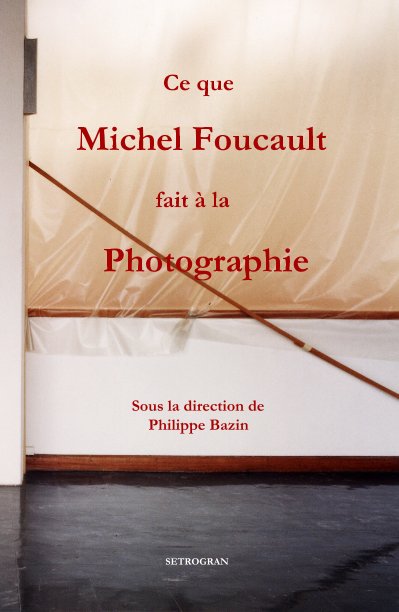
Ce que Michel Foucault fait à la Photographie
Sous la direction de Philippe Bazin, Setrogran

ebook

À propos du livre
Table des matières
La photographie et l’attitude critique du regard, Orazio IRRERA.
La photographie comme expérience politique du paysage. À propos de Lewis Baltz et de Michel Foucault, Arianna LODESERTO.
Figures de la folie – Dialogues, Philippe BAZIN.
La Visibilité, pivot de la pensée foucaldienne, Christiane VOLLAIRE.
L’écho de la photographie et la figure du militant, Bruno SERRALONGUE.
Lumières de Michel Foucault sur le photoconceptualisme, Morad MONTAZAMI.

Pezdek, K., Rasiński, L.
Between exclusion and emancipation: Foucault’s ethics and disability
(2017) Nursing Philosophy, 18 (2), art. no. e12131, .

DOI: 10.1111/nup.12131

Abstract
The aim of the study was to demonstrate how Foucault’s ethics, which we understand as a tension between exclusion and emancipation, helps both critically reassess two disability models that prevail in the contemporary literature concerning disability, that is the medical model and the social one, and support and inspire an ethical project of including people with disabilities in spheres of life from which they have been excluded by various power/knowledge regimes. We claim, following Foucault, that such a project should be informed by critical reflection on exclusion-generating forms of knowledge about people with disabilities and focused on individual ethical actions fostering self-realization and emancipation of people with disability. © 2016 John Wiley & Sons Ltd

Author Keywords
emancipation; ethics; exclusion; Foucault; people with disability; power

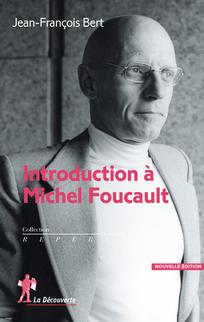
Bert, J. (2016). Introduction à Michel Foucault. Paris: La Découverte. (Original edition 2011)

Présentation

Michel Foucault (1926-1984) aura été en France le plus novateur des maîtres à penser – maître sans programme qui a su offrir à ses lecteurs une « boîte à outils » qu’il expose par fragments dans ses entretiens, cours, articles et livres…
Philosophe « par défaut », Foucault était loin d’ignorer les méthodes, les auteurs et surtout les controverses qui agitaient les sciences humaines, qu’il ne se priva d’ailleurs pas de critiquer ouvertement. En retour, plusieurs notions qu’il élabora tout au long de son parcours (« savoirs », « gouvernementalité », « subjectivation ») continuent de faire débat autant chez les historiens, les sociologues ou les anthropologues, que chez certains praticiens comme les criminologues, les psychanalystes ou les spécialistes du droit, sans oublier le vaste domaine des cultural studies.
Foucault n’est pas de ceux qui se laissent facilement saisir et l’objectif de cet ouvrage est d’éclairer les enjeux de sa pensée pour en faire ressortir l’intérêt actuel et, pourquoi pas, montrer comment penser différemment l’enfermement, les institutions, le rapport à soi ou à la vérité.

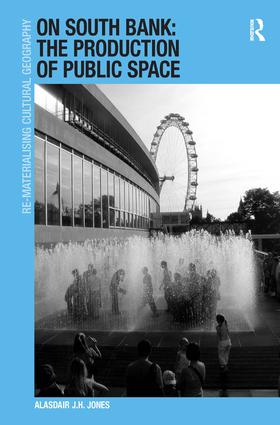
Alasdair J.H. Jones, On South Bank: The Production of Public Space, Routledge, 2014

Description

Tensions over the production of urban public space came to the fore in summer 2013 with mass protests in Turkey sparked by a plan to redevelop Taksim Gezi Park, Istanbul. In London, concomitant proposals to refurbish an area of the ’South Bank’ historically used by skateboarders were similarly met by staunch opposition. Through an in-depth ethnographic examination of London’s South Bank, this book explores multiple dimensions of the production of urban public space. Drawing on user accounts of the significance of public space, as well as observations of how the South Bank is ’practised’ on a daily basis, it argues that public space is valued not only for its essential material characteristics but also for the productive potential that these characteristics, if properly managed, afford on a daily basis. At a time when policy-makers, urban planners and law enforcement authorities simultaneously grapple with pressures to deal with social ‘problems’ (such as street drinking, vandalism, and skateboarding) and accusations that new modes of urban planning and civic management infringe upon civil liberties and dilute the publicity of ’public’ space, this book offers an insightful account of the daily exigencies of public spaces. In so doing, it questions the utility of the public/private binary for our understanding both of common urban space and of different sets of social practices, and points towards the need to be attentive to productive processes in how we understand and experience urban open space as public.

“What Do You Want Me to Regret?”: An Interview with François Ewald
Johannes Boehme interviews François Ewald, Los Angeles Review of Books, 3 November 2017

NOBODY COULD HAVE PREDICTED, in 1968, that François Ewald would one day receive the French state’s highest order for civil merit. At the time he was a young, ambitious, and radical philosophy student. He became a Maoist, demonstrated in the streets of Paris, and witnessed the violence that followed. In the early 1970s he went to the countryside. There he found himself swept up in one of France’s most notorious criminal scandals, the “Affaire Bruay-en-Artois.” A young miners’ daughter was killed, a lawyer was arrested (and later released), and the radical left staged mass demonstrations against “class violence.” It was then, in the small town of Bruay-en-Artois, that he first met Michel Foucault. Soon Ewald would become Foucault’s assistant at the Collège de France and one of his closest associates.

Ewald wrote a masterful 600-page dissertation, supervised by Foucault, on the history of the French welfare state. Foucault, who died in June 1984, never got to read the final version. After Foucault’s death, Ewald became the de facto executor of his estate. He edited most of his unfinished manuscripts and lectures. He also took a job in an unlikely field for a Foucauldian: the insurance industry. He struck up relationships with captains of industry like Claude Bébéar, the founder of AXA, and Denis Kessler, the CEO of SCOR, a French financial services company. In 2006 he received the Légion d’honneur.

And during the early 2000s his views seemed to change as well. He became a vocal advocate for liberal reforms of the French welfare state. He opposed the introduction of the 35-hour workweek and argued for the privatization of the pension-system.

[…]

Where did [Foucault’s] interest in liberalism come from?

His interest wasn’t ideological. It was a way to criticize traditional political philosophy. He didn’t study liberalism out of personal conviction, but as a way of passage — to get a clearer sense of what government actually meant. He was drawn to it, because it was so relevant to understand the contemporary situation. But he was much more interested in its epistemology than its politics. To read his lectures on liberalism as a statement of approval makes absolutely no sense. But on the other hand, there is a complication. Foucault didn’t believe in socialism. He wanted to criticize government practices. And liberalism at the time was one avenue of government-critique in France. But only one among many.

Recently there has been a heated debate about Michel Foucault’s attitude toward neoliberalism. The sociologist Daniel Zamora accused Foucault of adhering to neoliberal ideas. Do you agree?

Let me tell you two things. First of all, I am completely fed up with this entire discussion. Secondly, in terms of actual evidence, the claim that Michel Foucault held neoliberal views is just so far-fetched. Look, during those weeks in which Foucault was lecturing about liberalism at the Collège de France, he also visited Ayatollah Khomeini at Neauphle-le-Château. The Iranian Revolution happened shortly afterward and Foucault was particularly interested in the events in Tehran. He was fascinated by the fact that people were willing to die for a religious idea in the streets of Tehran! But nobody would say that he became a militant supporter of the Iranian Revolution. Based on the evidence it doesn’t make more sense to say that Foucault was a closet neoliberal, either.

[…]

read more

Séminaire “Penser l’identité et le sujet avec Foucault” à Curitiba (UFPR et PUCPR)
22 et 23 novembre 2017

Ce séminaire constitue le premier volet du programme TaFac (Travailler avec Foucault: approches contemporaines). Ce séminaire sera suivi, les 19 et 20 mars 2018, d’un colloque à Lille sur le thème “Discours et politiques de l’identité – avec et à partir de Foucault”.

Edward Mendelson, Book reviews: In the depths of the digital age, Financial Review, Nov 17 2016

Extract
The most socially alarming effect of the digital revolution is the state of continuous surveillance endured, with varying levels of complaisance, by everyone who uses a smartphone. Bernard Harcourt’s intellectually energetic book Exposed surveys the damage inflicted on privacy by spy agencies and private corporations, encouraged by citizens who post constant online updates about themselves. “We are not being surveilled today,” he writes, “so much as we are exposing ourselves knowingly, for many of us with all our love, for others anxiously and hesitantly.” In place of the medieval idea of the king’s two bodies – the king’s royal powers derived from heaven and his natural self – Harcourt proposes the two bodies of “the liberal democratic citizen … the now permanent digital self, which we are etching into the virtual cloud with every click and tap, and our mortal analog selves, which seem by contrast to be fading like the colour on a Polaroid instant photo.” (This seems accurate about common feelings, but overestimates the likelihood of digital immortality; in fact vast web-based communities, with all their history, have been swept away with a click.)

Harcourt draws heavily on Michel Foucault’s Discipline and Punish (1975) in his account of today’s “expository society”. Unlike Jeremy Bentham’s never-built 19th-century panopticon analysed by Foucault, where all-knowing, all-powerful jailers observed unknowing, unwilling prisoners, everyone in Harcourt’s expository society of Twitter posts and Instagram feeds can spy on everyone else and with few exceptions everyone wants to be spied on. A new kind of celebrity, perceived both as enviable and appalling, comes to those whose only talent is for insistent self-exposure. Worst of all, for Harcourt, is the knowing compliance of today’s consumers with forms of censorship and control once in government hands but now, for better or worse, practised by corporations. The Apple Store, gateway for all software accessible to iPhone users, blocks apps designed specifically to display politically sensitive matter like pictures of drone strikes. “Apple, it seems, has taken on [the] state function of censorship, though its only motive seems to be profit.”

After Harcourt’s book appeared, Apple and the state came into conflict when the FBI tried to force Apple to make it possible to decrypt a terrorist’s iPhone. Apple holds to the largely admirable view that it should provide no means to invade anyone’s privacy, while its software is designed to intrude on everyone’s privacy with messages, ads, alerts, and notifications, and to record and sell everything spoken to the phone’s built-in “digital assistant,” all in the name of convenience and profit. The knowledgeable and elite can reduce these intrusions to the extent that Apple permits, and the strong-willed can turn off their phones, but Apple relies on everyone else’s passive acceptance of interruption and eavesdropping in order to keep its profitable data moving.

Harcourt describes a new kind of psyche that seeks, through its exposed virtual self, satisfactions of approval and notoriety that it can never truly find. It exists in order to be observed; it must continually create itself by updating its declared “status,” by revealing itself in Facebook narratives and Instagram images, while our “conscientious ethical selves” need to be reminded – by ourselves and others – to exist at all. Harcourt apparently does not expect such reminders to have much effect and concludes despairingly: “It is precisely our desires and passions that have enslaved us, exposed us, and ensnared us in this digital shell as hard as steel.”

Read more

Elaine Blair, Chris Kraus, Female Antihero, The New Yorker, November 21, 2016

She turned her failures as a filmmaker and in her romantic relationships into the boundary-breaking autobiographical novel “I Love Dick.”
[…]

“I Love Dick,” Kraus’s first book, was published in 1997 by the independent press Semiotext(e) and received little notice. Semiotext(e), founded in 1974 as a journal by Sylvère Lotringer, whom Kraus later married, was a shoestring operation that had a loyal following in the art world and some corners of academia for having introduced the French theorists Gilles Deleuze, Michel Foucault, and Paul Virilio to American readers. “I Love Dick” sold fewer than a hundred copies a year until it was reissued, in 2006. Through word of mouth and the endorsement of some influential writers and critics, a new generation of readers has discovered the novel. In 2013, Sheila Heti wrote, in The Believer, that “I Love Dick” belongs to the category of novels that “tear down so many assumptions about what the form can handle.” Last year, Lena Dunham gave a copy to the singer-songwriter Lorde, who Instagrammed its distinctive white cover. It has sold about fourteen thousand copies so far this year. In August, the director Jill Soloway released a pilot for a television show based on the novel.

read more

Birman, J. & Hoffmann, C. (2016). Lacan et Foucault, une nouvelle lecture. La clinique lacanienne, 28,(2), 155-166. doi:10.3917/cla.028.0155.

Premières lignes
Les rapports entre Jacques Lacan et Michel Foucault sont plus riches qu’on le pense habituellement en rencontres entre les deux hommes et leurs œuvres. Une grande partie des malentendus provient de la différence de conceptions épistémologiques de l’histoire, qui de la psychanalyse à la médecine et à la psychiatrie, constituent des ruptures ou une continuité. La réception française du mouvement psychanalytique…