Foucault News

News and resources on French thinker Michel Foucault (1926-1984)

Giampiero Assumma
THE LOWER WORLD

“The Lower World” is the title of Giampiero Assumma’s photographic long term project (2001-2014) on human alienation within the context of the last six criminal lunatic asylums in Italy, named ‘Ospedale Psichiatrico Giudiziario’ (O.P.G).

These facilities, with the exception of one pioneering institution that was purely a psychiatric hospital, showed the characteristics of penitentiary institutes. That situation represented the evidence of a long standing debate, about crimes when related to mental illness and sentences as a cure, to serve into an institution which combines both medical treatment and strict social control. In recent years a Governmental investigation, reported several cases of violation of human rights, and all the last Italian judiciary mental institutions began their final dismission from 2015 until now.

Beyond the inevitable political foreground, Giampiero Assumma’s approach is quite far from photojournalistic visuals. He offers his own constructive interpretation of mental illness, exposing the vulnerability inherent to the human condition.These images ultimately witness all those shared acts of resistance, that humans have always brought foreword to avoid being deleted from their personal history.

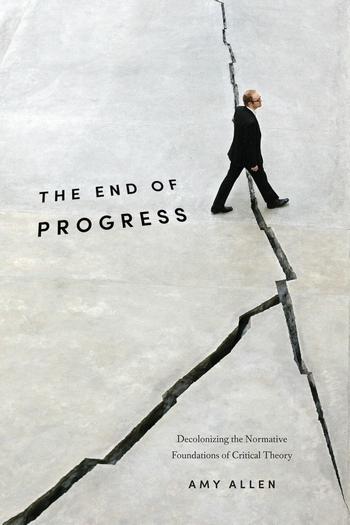
Amy Allen, The End of Progress. Decolonizing the Normative Foundations of Critical Theory, Columbia University Press, 2016 (2017 paperback)

While post- and decolonial theorists have thoroughly debunked the idea of historical progress as a Eurocentric, imperialist, and neocolonialist fallacy, many of the most prominent contemporary thinkers associated with the Frankfurt School—Jürgen Habermas, Axel Honneth, and Rainer Forst—have defended ideas of progress, development, and modernity and have even made such ideas central to their normative claims. Can the Frankfurt School’s goal of radical social change survive this critique? And what would a decolonized critical theory look like?

Amy Allen fractures critical theory from within by dispensing with its progressive reading of history while retaining its notion of progress as a political imperative, so eloquently defended by Adorno. Critical theory, according to Allen, is the best resource we have for achieving emancipatory social goals. In reimagining a decolonized critical theory after the end of progress, she rescues it from oblivion and gives it a future.

ABOUT THE AUTHOR

Amy Allen is Liberal Arts Research Professor of Philosophy and head of the Philosophy Department at Pennsylvania State University. She is the author of The Power of Feminist Theory: Domination, Resistance, Solidarity and The Politics of Our Selves: Power, Autonomy, and Gender in Contemporary Critical Theory, and she is the editor of the Columbia University Press series New Directions in Critical Theory.

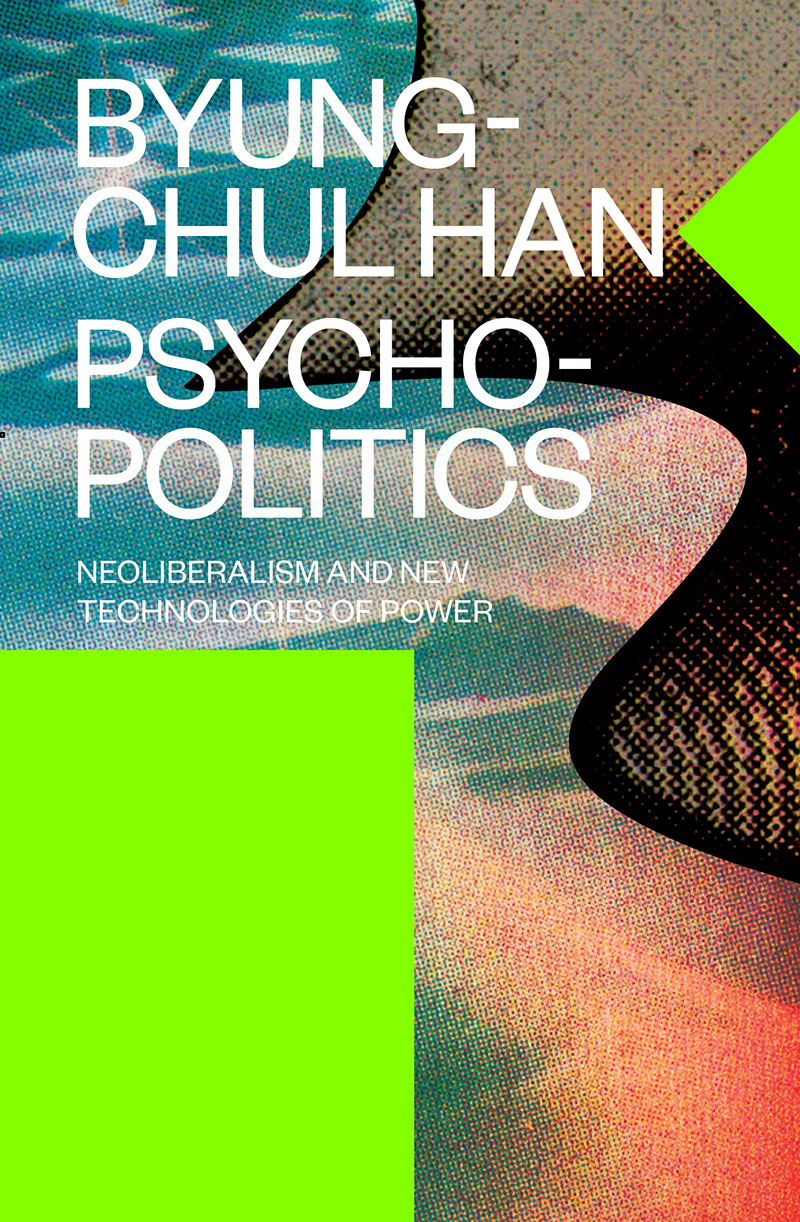
Byung-Chul Han, Psychopolitics. Neoliberalism and New Technologies of Power. Translated by Erik Butler, Verso 2017

See also Review in The Guardian

Exploring how neoliberalism has discovered the productive force of the psyche

Byung-Chul Han, a star of German philosophy, continues his passionate critique of neoliberalism, trenchantly describing a regime of technological domination that, in contrast to Foucault’s biopower, has discovered the productive force of the psyche. In the course of discussing all the facets of neoliberal psychopolitics fueling our contemporary crisis of freedom, Han elaborates an analytical framework that provides an original theory of Big Data and a lucid phenomenology of emotion. But this provocative essay proposes counter models too, presenting a wealth of ideas and surprising alternatives at every turn.

Reviews
“How do we say we? It seems important. How do we imagine collective action, in other words, how do we imagine acting on a scale sufficient to change the social order? How seriously can or should one take the idea of freedom in the era of Big Data? There seems to be something drastically wrong with common ideas about what the word act means. Psychopolitics is a beautifully sculpted attempt to figure out how to mean action differently, in an age where humans are encouraged to believe that it’s possible and necessary to see everything.”

– Timothy Morton

stuartelden's avatarProgressive Geographies

Earlier this month I finished working through Maladie mentale et personnalité, which I discussed beginning in the last update, and have drafted a substantial section analyzing the book. I imagine I can only use a fraction of the quotes I took down in my notes, as at the moment it’s a long section. Only then did I go to the valuable secondary literature on the book, including the work of Macherey, Dreyfus, Gutting, Bernauer, the biographies and so on. Initially I was trying to read it without those filters.

This book is often read either in relation to its 1962 version Maladie mentale et psychologie (the version we have in English), or as a summation of a positon Foucault moved beyond, in this chapter I’m trying to read it as a valuable book in its own right. (The other two aspects will be treated elsewhere in my study.)…

View original post 1,427 more words

Interview with Leonard Lawlor

Dr. Lawlor was interviewed by Laureano Ralón. Figure/Ground, December 11th, 2017

[Updated 28 July 2026. Link above is to the archived page on the Wayback Machine.]

Extract
[…]
I think there is something to be said – a clarification at least – with regards to that comment by Foucault, which says something along the lines that The Logic of Sense and Merleau-Ponty’s Phenomenology of Perception are as unlikely as they can be. I’m thinking it may be useful to address Foucault’s comment in the context of your attempt to build bridges between phenomenology and Deleuzian thinking…

This is an important point. Foucault’s comment, in “Theatrum Philosophicum,” supports the belief that Deleuze is not a phenomenologist. However, we should notice that Foucault compares Deleuze’s works to Merleau-Ponty’s Phenomenology of Perception. By the time he was writing The Visible and the Invisible in the late 1950s, Merleau-Ponty was already distancing himself from the Phenomenology of Perception. There several famous working notes to The Visible and the Invisible where Merleau-Ponty criticizes his earlier work. The criticisms basically amount to saying the Phenomenology of Perception is too subjectivist, especially when the book speaks of the tacit cogito. What distinguishes Deleuze’s Difference and Repetition and Logic of Sense from the Phenomenology of Perception is their anti-subjectivist positions. I’m relatively confident that it is this opposition between subjectivism and anti-subjectivism that Foucault has in mind when he makes his statement. More precisely, what we see in Deleuze’s important early works is, first, that the “I” (“the cogito,” whether tacit or not) is based on a more fundamental process of time, the three syntheses, the first two of which are unconscious (Chapter Two of Difference and Repetition contains a long discussion of Freud); and then, second, in Logic of Sense, that the agency of sense is based in a prior agency called non-sense. In his early works, Merleau-Ponty speaks a lot about non-sense, but he seems to mean something like the absurd (as in Camus). Non-sense in Deleuze is a structure that generates sense. The point I want to make, however, is that the later Merleau-Ponty – the one who works at the limits of phenomenology – is close to these Deleuzian positions. The final Merleau-Ponty is the thinker of silence, which resembles non-sense, and he is the thinker of institution, meaning a historical process or structure (Merleau-Ponty of course loves the cave paintings at Lascaux) that opens up a tradition, in other words, that opens up a sense or direction for thought. Therefore, I think Merleau-Ponty himself would agree with Foucault’s statement. But I think he would be more resistant to seeing a vast distance between the final form of his thought and Deleuze’s thought. There is no question in my mind that Merleau-Ponty’s “Eye and Mind” influences Deleuze in Difference and Repetition when Deleuze speaks of depth.
[…]

Mark G. E. Kelly, For Foucault. Against Normative Political Theory, SUNY series in Contemporary Continental Philosophy

Calls for a Foucauldian approach to political thought that is intrinsically resistant to power and subordination to public policy.

This book comprises a series of staged confrontations between the thought of Michel Foucault and a cast of other figures in European and Anglophone political philosophy, including Marx, Lenin, Althusser, Deleuze, Rorty, Honneth, and Geuss. Focusing on the status of normativity in their thought, Mark G. E. Kelly explains how Foucault’s position in relation to political theory is different, and, over the course of the book, describes a distinctive Foucauldian stance in political thought that is maximally anti-normative, anti-theoretical, and anti-political. For Foucault aims to undermine attempts to discern the appropriate form of political action, instead putting forward a rigorously critical program for a political theory that lacks any moralizing or totalizing dimension, and serves only to side with resistance against power, and never with power itself. Looking at attempts to think radically about politics from Marx to the present day, Kelly traces a novel history of political thought as a trend of attempts to overcome the constraints of normativity, theoreticism, and subordination to public policy. He concludes by assessing and rejecting recent attempts to reclaim Foucault for a form of normative politics by associating him with neoliberalism.

“This original and insightful book makes a significant contribution to political philosophy.” — Stuart Elden, author of Foucault: The Birth of Power

Mark G. E. Kelly is Associate Professor and ARC Future Fellow in the School of Humanities and Communication Arts at Western Sydney University in Australia. His books include Foucault and Politics: A Critical Introduction; Biopolitical Imperialism; and The Political Philosophy of Michel Foucault.

stuartelden's avatarProgressive Geographies

As the blog posts of the last couple of days indicate, I’m back at my desk working. The first writing submitted this year was a 2000 word piece entitled ‘Foucault, Biography, and Posthumous Publications’, destined for the American Book Review. Robert Tally is editing a collection of reviews and essays on ‘critical lives’, mainly relating to twentieth-century theory. I was asked to write a piece on Foucault, despite there not being a new biography to review. I used the absence of any biographies since 1993 (Macey and Miller) as the opening of the essay, mentioned the valuable-but-untranslated work Eribon has done since the first edition of his biography (1989, translated in 1991), and then moved to the main purpose. I discuss the material by Foucault that has appeared in the last twenty or so years, and some of what is in the archive, briefly outlining how this adds substantially to…

View original post 93 more words

stuartelden's avatarProgressive Geographies

In this short video, Marcelo Hoffman discusses his review essay of Heliana de Barros Conde Rodrigues’s book Ensaios sobre Michel Foucault no Brasil: Presença, efeitos, ressonâncias (Michel Foucault in Brazil: Presence, Effects, Resonances). His full review is available online and in the journal Theory, Culture & Society. The book sounds fascinating and is hopefully planned for translation.

View original post

Colloque International : « Michel Foucault, les Pères et le sexe »
1-2-3 février 2018
À l’Auditorium Colbert, 2 rue Vivienne, 75002, Paris, les 1er et 2 février 2018
Entrée libre
À l’Amphithéâtre Turgot, 17 rue de la Sorbonne, 75005 Paris, le 3 février 2018

Entrée sur inscription : Philo-Recherche@univ-paris1.fr

Comité d’organisation
Philippe Büttgen, Philippe Chevallier, Agustín Colombo, Laurence Le Bras, Bernard Meunier, François Nida, Arianna Sforzini

Comité scientifique
Philippe Büttgen, Philippe Chevallier, Agustín Colombo, Frédéric Gros, Bernard Meunier, Judith Revel, Philippe Sabot, Michel Senellart, Arianna Sforzini

Jeudi 1er février

18h00-18h30
Introduction, par Laurence Engel, BnF, Philippe Büttgen, Université Paris 1 Panthéon Sorbonne, Véronique Chankowski, Université Lumière Lyon 2
18h30-19h30
Conférence inaugurale, par Paul Veyne, Collège de France, et Frédéric Gros, Sciences Po

Vendredi 2 février
9h30-9h45
Laurence Le Bras, BnF, « Michel Foucault à la Bibliothèque nationale de France »

1. LE TOURNANT CHRÉTIEN
Modérateur : Michel Senellart, ENS de Lyon
9h45-10h30
Agustín Colombo, Boston College, Arianna Sforzini, BnF, « L’Antiquité chrétienne dans l’œuvre de Michel Foucault »

10h30-10h45 PAUSE

10h45-11h30
Johannes Zachhuber, Trinity College, Oxford, « L’intériorité de la conscience et l’extériorité des aveux : le sujet chrétien selon Michel Foucault »
11h30-12h15
Frédérique Ildefonse, CNRS, « Aucun de mes mouvements ne t’est caché. Modification de la sagesse antique dans le monachisme chrétien »

12h15-14h15 DÉJEUNER

2. UNE LECTURE SINGULIÈRE DES PÈRES
Modérateur : Philippe Büttgen, Université Paris 1 Panthéon Sorbonne
14h15-15h00
Paul Mattei, Université Lumière Lyon 2, Istituto Patristico « Augustinianum », Rome, « Le Tertullien de Foucault : quelle cohérence et quelle pertinence philologique et historique ? »
15h00-15h45
Michel Senellart, ENS de Lyon, « Pastorat, conversion, aveu : limites d’un paradigme »

15h45-16h00 PAUSE

16h00-16h45
Sébastien Morlet, Université Paris Sorbonne, « Les aveux du roi David : l’interprétation chrétienne ancienne, et son interprétation par Foucault »
16h45-17h30
Bernard Meunier, CNRS, « Foucault et les évolutions de la parrêsia chrétienne »

Samedi 3 février
3. AUGUSTIN, FINALEMENT

Modératrice : Arianna Sforzini, BnF
9h30-10h45
Elizabeth A. Clark, Duke University, Durham, « Contextualizing Foucault’s Augustine »
10h45-11h30
Michel-Yves Perrin, EPHE, « Lectures foucaldiennes de saint Augustin. Entre histoire et historiographie »
11h30-12h15
Laurent Lavaud, Université Paris 1 Panthéon Sorbonne, « L’insurrection du sexe. Foucault lecteur de saint Augustin »

12h15-14h15 DÉJEUNER

4. OUVERTURES
Modérateur : Daniele Lorenzini, Université Saint-Louis, Bruxelles
14h15-15h00
Jean Reynard, CNRS, « Réflexions sur la question de la folie dans le christianisme ancien à la lumière des travaux de Foucault »
15h00-15h45
Julie Mazaleigue-Labaste, CNRS, « Les pratiques de la chair. Théologie morale, relations maritales et subjectivité »

15h45-16h00 PAUSE

16h00-16h45
James Bernauer, Boston College, « Foucault and Theological Practices: A Personal Review »
16h45-17h15 Conclusions, par Philippe Büttgen, Université Paris 1 Panthéon Sorbonne

Présentation des intervenants
Laurence Engel, présidente de la Bibliothèque nationale de France

Philippe Büttgen, professeur de philosophie à l’Université Paris 1 Panthéon Sorbonne

Véronique Chankowski, professeure d’histoire égéenne et économie antique à l’Université Lumière Lyon 2, directrice du laboratoire HiSoMA (UMR 5189)

Paul Veyne, professeur honoraire au Collège de France

Frédéric Gros, professeur de pensée politique à Sciences Po

Laurence Le Bras, conservatrice, chargée de collections au département des Manuscrits de la Bibliothèque nationale de France

Agustín Colombo, lecturer au Romance Languages and Literatures Department du Boston College

Arianna Sforzini, chercheuse invitée au département des Manuscrits de la Bibliothèque nationale de France

Johannes Zachhuber, professeur de théologie historique et systématique à Trinity College, Université d’Oxford

Frédérique Ildefonse, directrice de recherche au CNRS, Centre Jean Pépin (UMR 8230)

Paul Mattei, professeur émérite de langue et littérature latines à l’Université Lumière Lyon 2 et professeur invité à l’Istituto Patristico « Augustinianum », Université du Latran, Rome

Sébastien Morlet, maître de conférences en langue et littérature grecque (HDR) à l’Université de Paris-Sorbonne

Bernard Meunier, chargé de recherche au CNRS, Institut des Sources Chrétiennes,
Laboratoire HiSoMA (UMR 5189)

Michel Senellart, professeur de philosophie à l’ENS de Lyon

Elizabeth A. Clark, professeure émérite de religion à la Duke University, Durham

Michel-Yves Perrin, directeur d’études, section des Sciences Religieuses, à l’École pratique des hautes études

Laurent Lavaud, maître de conférences en philosophie à l’Université Paris 1 Panthéon Sorbonne

Jean Reynard, ingénieur de recherche au CNRS, Institut des Sources Chrétiennes,
Laboratoire HiSoMA (UMR 5189)

Julie Mazaleigue-Labaste, chargée de recherche CNRS à l’Institut des sciences juridique et philosophique de la Sorbonne, Université Paris 1 Panthéon Sorbonne

James Bernauer, S.J., Kraft Family professeur de philosophie à Boston College

SUBJECTIVITÉ ET RÉVOLUTION
19 décembre 2017, de 10h à 13h30
Columbia Global Centers – Paris
4 rue de Chevreuse
75006 Paris

À quelles conditions les révolutions et les soulèvements peuvent-ils constituer des matrices de subjectivation ? Quelle place faut-il accorder, au sein de ces expériences visant la transformation du monde social et politique, à la subjectivité et à ses vertus « éthiques » (courage, intégrité, abnégation, etc.) ? Comment articuler la dimension individuelle de l’engagement en première personne à la dimension collective de la lutte, de l’occupation de places, de la grève générale, etc. ?

Rejoignez-nous à Reid Hall (Paris) le 19 décembre 2017 :

10h – Bernard E. Harcourt (Columbia University/EHESS) & Daniele Lorenzini (Université Saint-Louis – Bruxelles/CCCCT)
Introduction
10h20 – Sophie Wahnich (IIAC, CNRS)
Le courage individuel et collectif en mai-juin 1789 : interroger en historienne la lecture sartrienne de l’archive
10h50 – Frédéric Gros (Sciences Po Paris)
L’éthique du politique
11h20 – Discussion
11h50 – Pause
12h – Guilel Treiber (KU Leuven)
« Se convertir à la révolution »: la révolte comme miracle vécu
12h30 – Judith Revel (Université Paris Nanterre)
Critiques de l’Un : moments révolutionnaires et compositions subjectives
13h – Discussion