Foucault News

News and resources on French thinker Michel Foucault (1926-1984)

Interview with Leonard Lawlor

© Leonard Lawlor and Figure/Ground
Dr. Lawlor was interviewed by Laureano Ralón. Figure/Ground, December 11th, 2017

Extract

I think there is something to be said – a clarification at least – with regards to that comment by Foucault, which says something along the lines that The Logic of Sense and Merleau-Ponty’s Phenomenology of Perception are as unlikely as they can be. I’m thinking it may be useful to address Foucault’s comment in the context of your attempt to build bridges between phenomenology and Deleuzian thinking…

This is an important point. Foucault’s comment, in “Theatrum Philosophicum,” supports the belief that Deleuze is not a phenomenologist. However, we should notice that Foucault compares Deleuze’s works to Merleau-Ponty’s Phenomenology of Perception. By the time he was writing The Visible and the Invisible in the late 1950s, Merleau-Ponty was already distancing himself from the Phenomenology of Perception. There several famous working notes to The Visible and the Invisible where Merleau-Ponty criticizes his earlier work. The criticisms basically amount to saying the Phenomenology of Perception is too subjectivist, especially when the book speaks of the tacit cogito. What distinguishes Deleuze’s Difference and Repetition and Logic of Sense from the Phenomenology of Perception is their anti-subjectivist positions. I’m relatively confident that it is this opposition between subjectivism and anti-subjectivism that Foucault has in mind when he makes his statement. More precisely, what we see in Deleuze’s important early works is, first, that the “I” (“the cogito,” whether tacit or not) is based on a more fundamental process of time, the three syntheses, the first two of which are unconscious (Chapter Two of Difference and Repetition contains a long discussion of Freud); and then, second, in Logic of Sense, that the agency of sense is based in a prior agency called non-sense. In his early works, Merleau-Ponty speaks a lot about non-sense, but he seems to mean something like the absurd (as in Camus). Non-sense in Deleuze is a structure that generates sense. The point I want to make, however, is that the later Merleau-Ponty – the one who works at the limits of phenomenology – is close to these Deleuzian positions. The final Merleau-Ponty is the thinker of silence, which resembles non-sense, and he is the thinker of institution, meaning a historical process or structure (Merleau-Ponty of course loves the cave paintings at Lascaux) that opens up a tradition, in other words, that opens up a sense or direction for thought. Therefore, I think Merleau-Ponty himself would agree with Foucault’s statement. But I think he would be more resistant to seeing a vast distance between the final form of his thought and Deleuze’s thought. There is no question in my mind that Merleau-Ponty’s “Eye and Mind” influences Deleuze in Difference and Repetition when Deleuze speaks of depth.

Mark G. E. Kelly, For Foucault. Against Normative Political Theory, SUNY series in Contemporary Continental Philosophy

Calls for a Foucauldian approach to political thought that is intrinsically resistant to power and subordination to public policy.

This book comprises a series of staged confrontations between the thought of Michel Foucault and a cast of other figures in European and Anglophone political philosophy, including Marx, Lenin, Althusser, Deleuze, Rorty, Honneth, and Geuss. Focusing on the status of normativity in their thought, Mark G. E. Kelly explains how Foucault’s position in relation to political theory is different, and, over the course of the book, describes a distinctive Foucauldian stance in political thought that is maximally anti-normative, anti-theoretical, and anti-political. For Foucault aims to undermine attempts to discern the appropriate form of political action, instead putting forward a rigorously critical program for a political theory that lacks any moralizing or totalizing dimension, and serves only to side with resistance against power, and never with power itself. Looking at attempts to think radically about politics from Marx to the present day, Kelly traces a novel history of political thought as a trend of attempts to overcome the constraints of normativity, theoreticism, and subordination to public policy. He concludes by assessing and rejecting recent attempts to reclaim Foucault for a form of normative politics by associating him with neoliberalism.

“This original and insightful book makes a significant contribution to political philosophy.” — Stuart Elden, author of Foucault: The Birth of Power

Mark G. E. Kelly is Associate Professor and ARC Future Fellow in the School of Humanities and Communication Arts at Western Sydney University in Australia. His books include Foucault and Politics: A Critical Introduction; Biopolitical Imperialism; and The Political Philosophy of Michel Foucault.

stuartelden's avatarProgressive Geographies

As the blog posts of the last couple of days indicate, I’m back at my desk working. The first writing submitted this year was a 2000 word piece entitled ‘Foucault, Biography, and Posthumous Publications’, destined for the American Book Review. Robert Tally is editing a collection of reviews and essays on ‘critical lives’, mainly relating to twentieth-century theory. I was asked to write a piece on Foucault, despite there not being a new biography to review. I used the absence of any biographies since 1993 (Macey and Miller) as the opening of the essay, mentioned the valuable-but-untranslated work Eribon has done since the first edition of his biography (1989, translated in 1991), and then moved to the main purpose. I discuss the material by Foucault that has appeared in the last twenty or so years, and some of what is in the archive, briefly outlining how this adds substantially to…

View original post 93 more words

stuartelden's avatarProgressive Geographies

In this short video, Marcelo Hoffman discusses his review essay of Heliana de Barros Conde Rodrigues’s book Ensaios sobre Michel Foucault no Brasil: Presença, efeitos, ressonâncias (Michel Foucault in Brazil: Presence, Effects, Resonances). His full review is available online and in the journal Theory, Culture & Society. The book sounds fascinating and is hopefully planned for translation.

View original post

Colloque International : « Michel Foucault, les Pères et le sexe »
1-2-3 février 2018
À l’Auditorium Colbert, 2 rue Vivienne, 75002, Paris, les 1er et 2 février 2018
Entrée libre
À l’Amphithéâtre Turgot, 17 rue de la Sorbonne, 75005 Paris, le 3 février 2018

Entrée sur inscription : Philo-Recherche@univ-paris1.fr

Comité d’organisation
Philippe Büttgen, Philippe Chevallier, Agustín Colombo, Laurence Le Bras, Bernard Meunier, François Nida, Arianna Sforzini

Comité scientifique
Philippe Büttgen, Philippe Chevallier, Agustín Colombo, Frédéric Gros, Bernard Meunier, Judith Revel, Philippe Sabot, Michel Senellart, Arianna Sforzini

Jeudi 1er février

18h00-18h30
Introduction, par Laurence Engel, BnF, Philippe Büttgen, Université Paris 1 Panthéon Sorbonne, Véronique Chankowski, Université Lumière Lyon 2
18h30-19h30
Conférence inaugurale, par Paul Veyne, Collège de France, et Frédéric Gros, Sciences Po

Vendredi 2 février
9h30-9h45
Laurence Le Bras, BnF, « Michel Foucault à la Bibliothèque nationale de France »

1. LE TOURNANT CHRÉTIEN
Modérateur : Michel Senellart, ENS de Lyon
9h45-10h30
Agustín Colombo, Boston College, Arianna Sforzini, BnF, « L’Antiquité chrétienne dans l’œuvre de Michel Foucault »

10h30-10h45 PAUSE

10h45-11h30
Johannes Zachhuber, Trinity College, Oxford, « L’intériorité de la conscience et l’extériorité des aveux : le sujet chrétien selon Michel Foucault »
11h30-12h15
Frédérique Ildefonse, CNRS, « Aucun de mes mouvements ne t’est caché. Modification de la sagesse antique dans le monachisme chrétien »

12h15-14h15 DÉJEUNER

2. UNE LECTURE SINGULIÈRE DES PÈRES
Modérateur : Philippe Büttgen, Université Paris 1 Panthéon Sorbonne
14h15-15h00
Paul Mattei, Université Lumière Lyon 2, Istituto Patristico « Augustinianum », Rome, « Le Tertullien de Foucault : quelle cohérence et quelle pertinence philologique et historique ? »
15h00-15h45
Michel Senellart, ENS de Lyon, « Pastorat, conversion, aveu : limites d’un paradigme »

15h45-16h00 PAUSE

16h00-16h45
Sébastien Morlet, Université Paris Sorbonne, « Les aveux du roi David : l’interprétation chrétienne ancienne, et son interprétation par Foucault »
16h45-17h30
Bernard Meunier, CNRS, « Foucault et les évolutions de la parrêsia chrétienne »

Samedi 3 février
3. AUGUSTIN, FINALEMENT

Modératrice : Arianna Sforzini, BnF
9h30-10h45
Elizabeth A. Clark, Duke University, Durham, « Contextualizing Foucault’s Augustine »
10h45-11h30
Michel-Yves Perrin, EPHE, « Lectures foucaldiennes de saint Augustin. Entre histoire et historiographie »
11h30-12h15
Laurent Lavaud, Université Paris 1 Panthéon Sorbonne, « L’insurrection du sexe. Foucault lecteur de saint Augustin »

12h15-14h15 DÉJEUNER

4. OUVERTURES
Modérateur : Daniele Lorenzini, Université Saint-Louis, Bruxelles
14h15-15h00
Jean Reynard, CNRS, « Réflexions sur la question de la folie dans le christianisme ancien à la lumière des travaux de Foucault »
15h00-15h45
Julie Mazaleigue-Labaste, CNRS, « Les pratiques de la chair. Théologie morale, relations maritales et subjectivité »

15h45-16h00 PAUSE

16h00-16h45
James Bernauer, Boston College, « Foucault and Theological Practices: A Personal Review »
16h45-17h15 Conclusions, par Philippe Büttgen, Université Paris 1 Panthéon Sorbonne

Présentation des intervenants
Laurence Engel, présidente de la Bibliothèque nationale de France

Philippe Büttgen, professeur de philosophie à l’Université Paris 1 Panthéon Sorbonne

Véronique Chankowski, professeure d’histoire égéenne et économie antique à l’Université Lumière Lyon 2, directrice du laboratoire HiSoMA (UMR 5189)

Paul Veyne, professeur honoraire au Collège de France

Frédéric Gros, professeur de pensée politique à Sciences Po

Laurence Le Bras, conservatrice, chargée de collections au département des Manuscrits de la Bibliothèque nationale de France

Agustín Colombo, lecturer au Romance Languages and Literatures Department du Boston College

Arianna Sforzini, chercheuse invitée au département des Manuscrits de la Bibliothèque nationale de France

Johannes Zachhuber, professeur de théologie historique et systématique à Trinity College, Université d’Oxford

Frédérique Ildefonse, directrice de recherche au CNRS, Centre Jean Pépin (UMR 8230)

Paul Mattei, professeur émérite de langue et littérature latines à l’Université Lumière Lyon 2 et professeur invité à l’Istituto Patristico « Augustinianum », Université du Latran, Rome

Sébastien Morlet, maître de conférences en langue et littérature grecque (HDR) à l’Université de Paris-Sorbonne

Bernard Meunier, chargé de recherche au CNRS, Institut des Sources Chrétiennes,
Laboratoire HiSoMA (UMR 5189)

Michel Senellart, professeur de philosophie à l’ENS de Lyon

Elizabeth A. Clark, professeure émérite de religion à la Duke University, Durham

Michel-Yves Perrin, directeur d’études, section des Sciences Religieuses, à l’École pratique des hautes études

Laurent Lavaud, maître de conférences en philosophie à l’Université Paris 1 Panthéon Sorbonne

Jean Reynard, ingénieur de recherche au CNRS, Institut des Sources Chrétiennes,
Laboratoire HiSoMA (UMR 5189)

Julie Mazaleigue-Labaste, chargée de recherche CNRS à l’Institut des sciences juridique et philosophique de la Sorbonne, Université Paris 1 Panthéon Sorbonne

James Bernauer, S.J., Kraft Family professeur de philosophie à Boston College

SUBJECTIVITÉ ET RÉVOLUTION
19 décembre 2017, de 10h à 13h30
Columbia Global Centers – Paris
4 rue de Chevreuse
75006 Paris

À quelles conditions les révolutions et les soulèvements peuvent-ils constituer des matrices de subjectivation ? Quelle place faut-il accorder, au sein de ces expériences visant la transformation du monde social et politique, à la subjectivité et à ses vertus « éthiques » (courage, intégrité, abnégation, etc.) ? Comment articuler la dimension individuelle de l’engagement en première personne à la dimension collective de la lutte, de l’occupation de places, de la grève générale, etc. ?

Rejoignez-nous à Reid Hall (Paris) le 19 décembre 2017 :

10h – Bernard E. Harcourt (Columbia University/EHESS) & Daniele Lorenzini (Université Saint-Louis – Bruxelles/CCCCT)
Introduction
10h20 – Sophie Wahnich (IIAC, CNRS)
Le courage individuel et collectif en mai-juin 1789 : interroger en historienne la lecture sartrienne de l’archive
10h50 – Frédéric Gros (Sciences Po Paris)
L’éthique du politique
11h20 – Discussion
11h50 – Pause
12h – Guilel Treiber (KU Leuven)
« Se convertir à la révolution »: la révolte comme miracle vécu
12h30 – Judith Revel (Université Paris Nanterre)
Critiques de l’Un : moments révolutionnaires et compositions subjectives
13h – Discussion

Sverre Raffnsøe, Peter Miller, Andrea Mennicken: “The Foucault Effect in Organization Studies”, Organization Studies, First Published December 14, 2017

DOI: 10.1177/0170840617745110

Abstract
Since the establishment of Organization Studies in 1980, Michel Foucault’s oeuvre has had a remarkable and continuing influence on its field. This article traces the different ways in which organizational scholars have engaged with Foucault’s writings over the past thirty years or so. We identify four overlapping waves of influence. Drawing on Foucault’s Discipline and Punish, the first wave focused on the impact of discipline, and techniques of surveillance and subjugation, on organizational practices and power relations. Part of a much wider ‘linguistic’ turn in the second half of the twentieth century, the second wave led to a focus on discourses as intermediaries that condition ways of viewing and acting. This wave drew mainly on Foucault’s early writings on language and discourse. The third wave was inspired by Foucault’s seminal lectures on governmentality towards the end of the 1970s. Here, an important body of international research investigating governmental technologies operating on subjects as free persons in sites such as education, accounting, medicine and psychiatry emerged. The fourth and last wave arose out of a critical engagement with earlier Foucauldian organizational scholarship and sought to develop a more positive conception of subjectivity. This wave draws in particular on Foucault’s work on asceticism and techniques of the self towards the end of his life. Drawing on Deleuze and Butler, the article conceives the Foucault effect in organization studies as an immanent cause and a performative effect. We argue for the need to move beyond the tired dichotomies between discipline and autonomy, compliance and resistance, power and freedom that, at least to some extent, still hamper organization studies. We seek to overcome such dichotomies by further pursuing newly emerging lines of Foucauldian research that investigate processes of organizing, calculating and economizing characterized by a differential structuring of freedom, performative and indirect agency.

Keywords critique, discipline, discourse, ethics, Foucault, governmentality, performativity, power, subjectivity

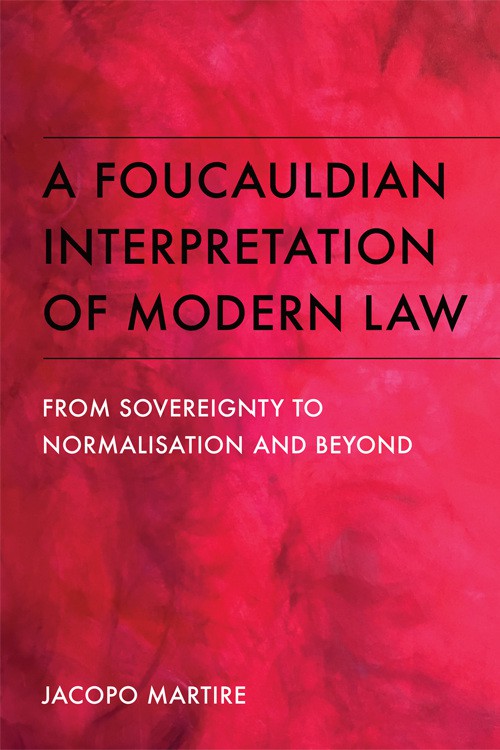
Jacopo Martire, A Foucauldian Interpretation of Modern Law. From Sovereignty to Normalisation and Beyond, Edinburgh University Press, 2017.

Addresses a surprisingly overlooked Foucauldian conundrum: what is the logical relationship between modern law and power?

Jacopo Martire investigates the development of modern law in conjunction with what Foucault termed biopolitical forms of power. He gives you a much-needed genealogical analysis of the modern legal phenomenon opening new avenues for Foucauldian approaches to law.

Key Features

  • Critically engages with current Foucauldian literature in the fields of law, philosophy and politics to give you an engaging and comprehensive overview of the field
  • Surveys the development of the modern legal phenomenon in an innovative and original way
  • Demonstrates the critical limits of both liberal and radical approaches to law
  • Develops the potential of Foucault’s theory in analysing the modern legal phenomenon, opening up new avenues for research

Jacopo Martire is Lecturer in Law at the University of Stirling. His main research interests are in legal and political philosophy, jurisprudence, constitutional theory and European Law.

The Birth of Austerity. German Ordoliberalism and Contemporary Neoliberalism
Edited by Thomas Biebricher and Frieder Vogelmann, Imprint: Rowman & Littlefield, Bloomsbury Publishing, 2017

Description
Ordoliberalism and the ‘Freiburg School’ have gained traction in contemporary political economy in response to two factors: a rising interest in governmentality studies and the banking, financial and sovereign debt crisis in Europe. In the face of these crises, Germany has assumed a position of quasi-hegemony in the European Union, making decisions about bailouts, the politics of crisis management and the rise of austerity.

This volume gathers together English translations of seminal ordoliberal texts by thinkers ranging from Walter Eucken and Wilhelm Röpke to Franz Böhm, Alexander Rüstow and Hans Grossmann-Doerth. Offering some foundational insights into ordoliberalism, these essays give insight into a field that is much misunderstood outside Germany. The second half of the book comprises of analyses of contemporary issues in light of ordoliberal thought, showing how its ideas endure and relate directly to austerity policy across Europe.

– – – Praise for The Birth of Austerity: German Ordoliberalism and Contemporary Neoliberalism – – –

“This book is indispensable reading for everyone interested in current debates on institutional economics, economic policy, the crisis of the Euro, and the role of Germany in it. It assembles several master texts from the Ordoliberal School, most of which were never published in English, and provides a lucid introduction into a widely unknown “Third Way” tradition in economic theory and policy.”
Wolfgang Streeck, Max Planck Institute for the Study of Societies, Cologne

“An excellent handbook on the influential and peculiar German version of neoliberalism. It contains classical texts as well as contemporary analyses of the content and impact of ordoliberalism by leading scholars. No one can understand European politics today without knowledge about ordoliberalism. This book is a good starting point.”
Professor Peter Nedergaard, Ph.D., Department of Political Science, University of Copenhagen

“Understanding the tenets and implications of Ordoliberalism is essential for grasping what is happening in European political economy and governance today. The Birth of Austerity provides this understanding through its carefully selected and translated works by the Ordoliberals themselves and its fine ensemble of analyses by contemporary critical thinkers. The introduction by Biebricher and Vogelmann is a model of clarity and insight. This is an important and immensely useful volume.”
Wendy Brown, University of California, Berkeley

FOUCAULT ON PAINTING
By Catherine M. Soussloff
University of Minnesota Press | 176 pages | November 2017

ISBN 978-1-5179-0242-1| paper | $25.00
ISBN 978-1-5179-0241-4 | cloth | $100.00

Catherine M. Soussloff argues that Michel Foucault’s sustained engagement with European art history critically addresses present concerns about the mediated nature of the image in the digital age. She explores the meaning of painting for Foucault’s philosophy, and for contemporary art theory, proposing a new relevance for a Foucauldian view of ethics and the pleasures and predicaments of contemporary existence.

PRAISE FOR FOUCAULT ON PAINTING:
“Catherine Soussloff is certainly one of the most intellectually intelligent and reflective art historians I can think of. Foucault on Painting is a clear, deeply thoughtful, and perfectly written contribution to the important field of intersect between art and philosophy.” —James Rubin, Stony Brook University

ABOUT THE EDITORS:
Catherine M. Soussloff is professor of art history, visual art, and theory at the University of British Columbia. She is editor of Foucault on the Arts and Letters and author of The Subject in Art (Minnesota, 1997).

For more information, including the table of contents, visit the book’s webpage:

https://www.upress.umn.edu/book-division/books/foucault-on-painting