Foucault News

News and resources on French thinker Michel Foucault (1926-1984)

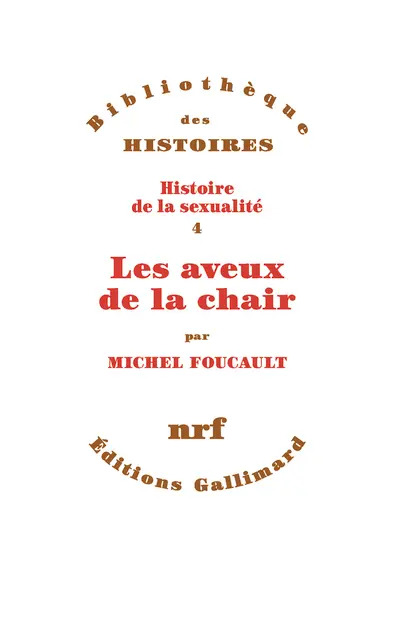
Michel Foucault, Les aveux de la chair, Histoire de la sexualité IV,
Édition de Frédéric Gros, Collection Bibliothèque des Histoires. Gallimard
Parution 08-02-2018

Détails
Les aveux de la chair, qui paraît aujourd’hui comme le quatrième et dernier volume de L’histoire de la sexualité, est en réalité le premier auquel Michel Foucault s’était consacré après La volonté de savoir (1976) qui constituait l’introduction générale de l’entreprise. Il s’attachait aux règles et doctrines du christianisme élaborées du Ilᵉ au IVᵉ siècles par les Pères de l’Église.

Au cours de son travail, Michel Foucault s’était persuadé que l’essentiel de ces règles et doctrines était un héritage remanié des disciplines de soi élaborées par les philosophes grecs et latins de l’Antiquité classique et tardive. Cest à leur analyse qu’il s’est courageusement appliqué, pour aboutir en 1984 à la publication simultanée de L’usage des plaisirs et du Souci de soi.

Louvrage est donc un premier jet auquel Foucault comptait se remettre au moment de sa mort. La réunion des quatre volumes de Dits et Écrits (1954-1988) publiés en 1994, puis celle des treize volumes des Cours au Collège de France en ont retardé l’édition et la mise au point dont s’est chargé Frédéric Gros, l’éditeur des œuvres de Michel Foucault dans la Bibliothèque de la Pléiade.

Tel quel, cet ouvrage constitue un état très élaboré de la pensée de l’auteur et peut-être le cœur même de l’entreprise, la partie à laquelle il attachait assez d’importance pour se lancer dans l’aventure.

Appel à Communications
Call for Papers

4èmes Journées d’études sur l’Épistémologie Historique
4th International Workshop on Historical Epistemology

L’épistémologie historique et les désunités des sciences

Historical epistemology and the disunities  of the sciences

Paris, 24-26 mai 2018

École doctorale de Philosophie ED 280
Université Paris 1 Panthéon-Sorbonne

Confirmed Keynotes :

Andrew Arana (Paris 1, Fr)
Hasok Chang (Cambridge, Uk)
Stéphanie Ruphy (Lyon 3, Fr)
Léna Soler (Lorraine, Fr)
[ENGLISH BELOW]
A l’échelle internationale, la seconde moitié du XXe siècle a vu émerger différentes tentatives pour penser la « désunité » des sciences. Celles-ci se sont constituées en réponse au monisme méthodologique issu du Cercle de Vienne, stipulant l’unité de la science et donc la validité du projet d’une philosophie de « la » science. Ainsi, dès la fin des années 1960, la philosophie de la biologie a voulu affirmer la spécificité des sciences du vivant et donc l’obligation de se départir des canons de la philosophie de la physique. Au cours de la décennie suivante, on constate l’institutionnalisation de plusieurs philosophies « des sciences spéciales » : de la biologie, de la géographie, de la médecine, etc. Bien que ces différentes philosophies soient aussi pensées comme des sous-disciplines d’une philosophie générale de la science ou des sciences, cette spécialisation vient mettre à mal la longue tradition d’affirmation de l’unité de la science fondée sur un réductionnisme physico-chimique.

Pour autant, l’idéal positiviste de clarification conceptuelle et de purification du langage demeure souvent central pour ces nouvelles philosophies. Ce qu’elles contestent au premier chef est donc le « dogme » de l’unité de la science, et non nécessairement la méthodologie positiviste. Parmi ces critiques, on peut rappeler, entre autres, Paul Feyerabend, Jerry Fodor et le groupe de la « Stanford School » (Nancy Cartwright, John Dupré, Peter Galison, Patrick Suppes et Ian Hacking). Tous soulignent le caractère social et culturel des sciences ainsi que l’importance de l’histoire des sciences pour l’élaboration d’une image moins abstraite et idéalisée de la pratique scientifique. La critique de l’unité de la science a conduit à la révision de certains concepts fondamentaux et traditionnels de l’épistémologie, au premier rang desquels celui de « méthode » (Feyerabend 1975) auquel ces auteurs préfèrent des concepts soulignant le pluralisme des sciences comme celui de « style de raisonnement scientifique » (Crombie 1994 ; Hacking 1982, 1992).

La question des modalités philosophiques de la « désunité » de la science se pose ainsi au cœur de la réflexion épistémologique la plus actuelle. Elle s’est accompagnée de l’essor de nouvelles catégories, comme celle de pluralisme, qui visent le même rejet du monisme méthodologique. Le pluralisme – c’est-à-dire l’affirmation de la coexistence de plusieurs systèmes de connaissance à l’intérieur d’un même domaine de recherche – est un concept qui occupe aujourd’hui une place centrale dans les discussions philosophiques anglophones (voir le volume collectif édité par P. Galison et D. J. Stump, The Disunity of Science, 1995, et les travaux plus récents de A. Arana, « Purity of Methods », 2011 ; H. Chang, Is Water H20. Evidence, Realism and Pluralism, 2012 ; S. Ruphy, Scientific pluralism reconsidered. A New Approach to the (Dis)Unity of Science, 2016; L. Soler, E. Trizio & A. Pickering (eds.), Science as it Could Have Been. Discussing the Contingency / Inevitability Problem, 2015).

Le retour sur le devant de la scène de la désunité de la science ne doit cependant pas masquer le fait que la tradition plus typiquement française de l’épistémologie historique s’était elle-même déjà emparée de cette question, et avait, de longue date, produit un certain nombre d’arguments soutenant une telle désunité. Déjà Auguste Comte, qui est aux origines de la tradition de l’épistémologie historique française, proposait dans son Cours de philosophie positive une subdivision des sciences fondée sur leurs objets et leurs méthodes, conçus comme irréductibles d’une science à l’autre. La pluralité des sources de la connaissance scientifique est donc un des traits caractéristiques du système de Comte (R. Scharff 1995 ; J.-F. Braunstein 2009), solidaire de sa volonté d’asseoir l’étude philosophique des sciences sur leur histoire.

Plus près de nous, le concept de pluralisme fait écho, dans des proportions qu’il s’agira de discuter, au régionalisme revendiqué dès l’entre-deux-guerres par des philosophes comme Gaston Bachelard. Pour Bachelard il ne s’agit pas seulement d’affirmer une pluralité de méthodes, mais plus fondamentalement encore de reconnaître la spécificité des valeurs rationnelles propres à chaque domaine ou région scientifique. En ce sens, la raison s’organise et s’applique différemment selon le domaine matériel où elle s’exerce, sans quoi un progrès rationnel serait inconcevable.

Ce concept de régionalisme est demeuré pleinement opératoire au sein de l’épistémologie de Canguilhem, celui-ci affirmant qu’on ne peut « parler de science au singulier [que] comme phénomène de culture » (Canguilhem 1965). Dans un entretien avec Alain Badiou, Canguilhem a aussi indiqué une différence entre l’épistémologie (au sens « français ») et la philosophie des sciences : la philosophie des sciences est l’équivalent de la Wissenschaftslehre et son objectif est « l’unification du savoir, au moins par sa méthode », alors que l’épistémologie est une « étude spéciale ou régionale ».

Ainsi, la désunité des sciences a donc été pensée, semble-t-il indépendamment, dans au moins deux contextes philosophiques sensiblement différents : celui de la critique du positivisme dans le monde anglo-saxon et celui de l’épistémologie historique en France. Le projet de ces journées est avant tout de confronter ces désunités afin de saisir si leur rapprochement ou leur mise en correspondance pourrait aider d’une part à mieux les caractériser et d’autre part à faire émerger des voies de recherche inédites.

La thématique de la désunité est une thématique transversale, qui doit permettre le dialogue entre chercheurs aux options méthodologiques variées et travaillant sur des domaines scientifiques les plus divers (physique, chimie, biologie, psychologie, mathématiques, etc.). Nous attendons donc d’abord des communications travaillant la question de la désunité sur la base d’exemples précis et de cas concrets mobilisant le spectre le plus large possible des régions du savoir. Nous souhaitons également recevoir des propositions portant sur l’histoire des conceptions du pluralisme et du régionalisme. Enfin, une attention particulière sera donnée aux interventions qui proposent de discuter l’originalité de l’épistémologie historique vis-à-vis d’autres approches méthodologiques d’étude des sciences qui mettent au premier plan leur désunité.

Les propositions d’interventions (max 500 mots, plus une courte présentation du candidat) sont à nous faire parvenir, avant le 12 février 2018 (date de réponse le 1 mars), en format word ou pdf à epistemologiehistorique@gmail.com. Les deux langues des Journées seront le français et l’anglais.

[ENGLISH VERSION]

The second-half of the twentieth century saw the emergence of various attempts at thinking the “disunity” of the sciences. They appeared as a reaction against the methodological monism fostered by the Vienna Circle that promoted the unity of science and therefore the validity of the project of a singular philosophy of science. Hence, from the end of the 1960s, the philosophy of biology affirmed the specificity of the living and, as a consequence, the obligation to move away from the standards of the philosophy of physics. In the following decade, there was an institutionalization of various philosophies of « the special sciences»: of biology, of geography, of medicine etc. Although these different philosophies are often seen as sub-disciplines of a general philosophy of science, this specialization also presented a challenge to the long tradition of affirming the unity of science based on physical-chemical reductionism.

Nevertheless, the positivist ideals of conceptual clarification and the purification of language are still central for these new philosophies. What is being criticized is therefore the “dogma” of the unity of science, not necessarily the positivist methodology. Among these criticisms, one can think of Paul Feyerabend, Jerry Fodor and the group of the so called “Stanford School” in philosophy of science (Nancy Cartwright, John Dupré, Peter Galison, Patrick Suppes and Ian Hacking), just to name a few. These critics emphasized the cultural and social aspects of the sciences and the importance of the history of science for the construction of a more elaborated and less abstract image of scientific practice. By criticizing the project of the unity of science, these authors have reworked some of the most central and traditional concepts of epistemology, such as that of “method” (Feyerabend 1975), thus coming to elaborate other concepts, such as that of “styles of scientific reasoning” (Crombie 1994; Hacking 1982, 1992), ultimately highlighting the pluralism of the sciences.

The question of the philosophical modalities of the disunity of science stands nowadays at the heart of the most recent epistemological reflections. This leads to the mobilizing of other categories, such as that of pluralism and regionalism, aiming at the same refusal of methodological monism. Pluralism, or the coexistence of various systems of knowledge within a given research domain, is a concept which currently holds a central place in Anglophone philosophical discussions (see the volume edited by P. Galison – D. J. Stump The Disunity of Science, 1995 and the most recent works of A. Arana, « Purity of Methods », 2011; H. Chang, Is Water H20. Evidence, Realism and Pluralism, 2012; S. Ruphy, Scientific pluralism reconsidered. A New Approach to the (Dis)Unity of Science, 2016; L. Soler, E. Trizio & A. Pickering (eds.), Science as it Could Have Been. Discussing the Contingency / Inevitability Problem, 2015).

This renewed centrality of the disunity of science should nevertheless not hide the fact that the “French” tradition of historical epistemology had already addressed this question and has produced various arguments, some of which are rather old, to support the disunity of science. Already Auguste Comte, who is at the origin of the French “tradition” of historical epistemology, proposed in his Cours de philosophie positive a subdivision of the sciences on the basis of their objects and their methods, fundamentally differing from one science to the other. According to Comte, a sharp dividing line runs between the sciences of brute facts and the sciences of organized facts. Similarly, each science has its own particular object of study that is approached with a method fitting that object. The plurality of the sources of scientific knowledge is therefore one of the defining traits of Comte’s post-positivism (R. Scharff 1995; Braunstein 2009), coupled with his attempt to base a philosophical study of the sciences upon their history.

The present workshop will discuss the extent to which, in more recent times, the concept of pluralism can be said to be echoed by the regionalism claimed in the interwar period by such philosophers as Gaston Bachelard. For Bachelard, it is not just a matter of affirming the plurality of the methods of inquiry, but also of acknowledging the specificity of the rational values characterizing each scientific domain. In this sense, reason organizes and applies itself differently according to the material domain where it is exerted; otherwise there would be no rational understanding of progress.
This concept of regionalism remained operative in the epistemology of Georges Canguilhem, according to whom “one can talk of science in the singular [only] as a cultural phenomenon” (Canguilhem 1965). In an interview with Alain Badiou, Canguilhem also underlined the difference between epistemology (in the French sense) and the philosophy of the sciences: whereas this latter is the equivalent of the Wissenschaftslehre and its aim is the “unification of knowledge, at least by its method”, epistemology is a “special or regional study”.

The problem of the disunity of the sciences has therefore been articulated in at least two sensibly different philosophical contexts: the anti-positivistic backlash started in the 1960s in the Anglo-Saxon world, and the tradition of historical epistemology which played a central role in France until the 1980s. The project of this workshop is in the first place that of comparing these two different ways of conceptualizing/coming to terms with the disunity thesis with the aim of assessing whether their proximity or their distance could help, on the one hand, to characterize them better and, on the other hand, to make novel research paths possible.

The theme of disunity is a transversal one that facilitates dialogue among researchers with different methodological backgrounds, working on very different scientific domains (physics, chemistry, biology, psychology, mathematics, etc.). We thus expect proposals rethinking the question of disunity on the basis of precise examples and of concrete case studies, mobilizing the largest possible spectrum of regions of knowledge. We also expect proposals on the history of the conceptions of pluralism and regionalism. Finally, particular attention will be given to those proposals investigating the originality of historical epistemology with respect to other methodological approaches also focusing on the disunity of the sciences.

Proposals (500 words plus a short presentation of the candidate) must be sent by 2018 February 12 (notification of acceptance or refusal by March 1st), in word or pdf formats, toepistemologiehistorique@gmail.com. Proposals by graduate students and early career researchers will be privileged. The languages of the workshop will be French and English.

Comité d’organisation

Matteo Vagelli, Ivan Moya Diez, Laurent Loison (coordinateurs) ;
Marcos Camolezi, Wenbo Liang, Gabriele Vissio.

Comité Scientifique

Christian Bonnet, Professeur, CHSPM Paris 1
Jean-François Braunstein, Professeur, PhiCo Paris 1
Cristina Chimisso, Professeur, Open University, UK
Arnold I. Davidson, Professeur, Université de Chicago
Moritz Epple, Professeur, Université de Francfort
Pierre Wagner, Professeur, IHPST Paris 1

Dates importantes

Limite de proposition d’interventions : 12 février 2018
Réponses : 1 mars 2018
Journées d’étude : 24-25-26 mai 2018

episthist.hypotheses.org

Monica Loyola Stival, Politique et morale chez Foucault. Entre la critique et le nominalisme, Paris: L’Harmattan
La philosophie en commun
PHILOSOPHIE

Dans la sphère anthropologique ou dans la sphère politique, la manière dont Foucault élabore sa critique reste attachée à la procédure critique qui l’empêche d’échapper à la dimension transcendantale de la synthèse. Cette exigence est contraire au « nominalisme en histoire » qu’il mettrait révolutionnairement en scène, selon Paul Veyne. Ce livre analyse, à partir de cet arrière-plan, la façon dont se définit, chez Foucault, le sujet du néolibéralisme, le sujet dans l’histoire et, finalement, le sujet moral.

Monica Loyola Stival est professeur au Département de Philosophie et Méthodologie des Sciences à l’Universidade Federal de Sao Paulo (UFScar), Brésil.

Broché – format : 15,5 x 24 cm
ISBN : 978-2-343-13017-0 • janvier 2018 • 298 pages
EAN13 : 9782343130170
EAN PDF : 9782140055096

Daniele Lorenzini, “Subjects of Desire: Foucault’s ‘Aveux de la chair’ and the Roots of Modern Governmentality”

Research Seminar in Post-Kantian European Philosophy
Tue, Feb 6, 2018 – 5:30pm – 7:30pm (S0.11)
University of Warwick, Department of Philosophy, Social Sciences

Nudges: Better choices?, The Tocqueville Review/La revue Tocqueville, Volume 37, Number 1, 2016. Special issue.

Nudges:Better choices? Introduction
Malik Bozzo-Rey, Anne Brunon-Ernst, and Arnaud Van Waeyenberge, (Membres du French Nudge Project)

Brief excerpt

Nudges en questions
L’ouvrage Nudge de Cass Sunstein et Richard Thaler1 est singulier à plusieurs titres : il est en effet rare qu’un livre écrit par des universitaires rencontre un succès public, engendre une littérature universitaire foisonnante et soit cité dans des rapports d’organisations publiques ; en d’autres termes, il est rare qu’un ouvrage suscite autant de débats. Car tel est bien la singularité de ce texte : il pense intrinsèquement le lien entre monde universitaire et monde public grâce à cette théorie des désormais fameux nudges (« coups de pouce »), ces arrangements des contextes dans lesquels sont prises les décisions afin de les influencer dans le but d’améliorer le bien-être des individus, voire de la société en général. Thaler raconte ainsi assez humblement : « Nous avions écrit Nudge dans l’espoir timide que quelques personnes avec un peu d’influence pourraient le lire et en concevoir certaines idées politiques utiles »2. Il a bel et bien réussi le tour de force de mobiliser à la fois les acteurs universitaires et les décideurs publics. La théorie des nudges est à l’origine d’un mouvement de redéfinition de la manière dont il convient d’élaborer les politiques publiques, tout d’abord limité aux pays anglophones lorsque Barack Obama nomme Sunstein à la tête de l’OIRA (Office of Information and Regulatory Affairs). David Cameron va un peu plus loin en créant, à la suite des discussions avec Thaler, la « Behavioural Insights Team », plus connue sous le nom de « Nudge [End Page 7] Unit » et dirigée par David Halpern3. D’autres pays suivront4 et la Commission européenne a créé récemment la « Foresight and Behavioural Insights Unit ». Cette succession de décisions politiques témoigne à la fois de l’engouement des décideurs publics qui voient dans les nudges « des approches simples, à bas coût, préservant la liberté de choix, fondées directement sur les enseignements de l’économie comportementale qui promet d’économiser de l’argent, d’améliorer la santé des gens et leur vie »5, mais aussi de l’émergence d’une application des sciences comportementales aux politiques publiques, les « behaviourally informed policies ».

Il nous semble en effet désormais peu contestable que les sciences comportementales proposent un cadre d’analyse intéressant quant à la compréhension des processus de décision et offrent de nombreuses potentialités afin d’améliorer la qualité et l’effectivité des décisions prises par les décideurs lorsqu’ils mettent en place une politique publique6. Toutefois ce recours au nudge n’est pas sans poser de nombreuses questions quant à la légitimité et l’utilisation de ces « sciences ». A cet égard, et bien que le nudge soit étudié et utilisé depuis plusieurs décennies par les décideurs politiques et les universitaires outre-Atlantique, il commence seulement à être abordé en Europe. Plus particulièrement en France, si ce n’est le French Nudge Project7 qui dirige ce numéro spécial, peu de groupes de recherche revendiquent explicitement leur intérêt pour les nudges. Il était donc temps d’apporter une réflexion sur les fondements philosophiques de la théorie du nudge mais également sur les enjeux éthiques qu’il crée et les conséquences politiques et juridiques que son utilisation implique.

Deux remarques liminaires permettent de bien contextualiser l’ambition de ce numéro.

Premièrement, le nudge, apparaît comme le nouvel avatar de l’ « envahissement du droit par les normes »8. En effet, parmi les transformations profondes qui affectent le droit contemporain et plus largement les modes de gouvernance, on observe aujourd’hui un essor inédit de la « norme »9. Ces dispositifs de normalisation tendent de plus en plus à concurrencer, compléter voire remplacer les dispositifs juridiques classiques fondés sur des règles et contribuent à installer un mode de régulation caractéristique des « sociétés de contrôle », qui prend progressivement le pas…

BRUNON-ERNST Anne, BOZZO-REY Malik (dir.), Nudges et normativités. Généalogies, concepts et applications, Hermann, 15 Janvier 2018.

Lorsqu’il est question d’influencer le comportement des individus à l’aide de politiques publiques ou d’interventions gouvernementales, certains préféreront parler de contrôle social. Nous pouvons remarquer que la première décennie du XXIe siècle est marquée par la volonté de développer et tester des politiques réglementaires envisagées et évaluées selon le critère de l’efficacité, sans que celui-ci ne soit nécessairement explicité. De telles politiques sont habituellement regroupées sous le concept général de nudge, inventé par Cass Sunstein et Richard Thaler. Ils expliquent qu’un nudge est une « initiative qui préserve la liberté de choix tout en orientant les décisions des gens dans la bonne direction ». Le dernier élément de cette définition peut sembler surprenant : pourquoi faudrait-il orienter les décisions des gens dans la « bonne » direction ? Ceux-ci ne sont-ils pas rationnels et autonomes ? Ne seraient-ils pas en mesure de prendre des décisions en accord avec leurs valeurs et leurs projets de vie ?

Directeurs de publication :

Malik Bozzo-Rey est maître de conférences en éthique économique et philosophie du management à l’université catholique de Lille et responsable du centre « Ethique, Economie, Entreprise » (C3E). Il est également chercheur titulaire auprès de l’école doctorale de droit de Sciences Po et Honorary Research Fellow au Bentham Project de University College London.

Anne Brunon-Ernst est professeur d’anglais juridique à l’université Panthéon-Assas, chercheur au Cersa (Panthéon-Assas) et au centre Bentham (Sciences Po, Paris).

CALL FOR PAPERS

materiali foucaultiani journal / Associazione italiana Walter Benjamin

Foucault and Benjamin

Materiali foucaultiani journal and the Italian Association “Walter Benjamin” launch a call for papers dedicated to a comparison between Walter Benjamin and Michel Foucault.

MF journal proposes to open up new research pathways that jointly crisscross the works of Benjamin and Foucault, beyond the philosophical differences between the two authors. Indeed, we contend that despite their different philosophical horizon and conceptual constellations, both Benjamin and Foucault equip us with powerful tools for undertaking a critical analysis of our present time. In both cases, such a critique is carried on through a refusal of the concept of “progress” and of an understanding of history conceived as a linear and incessant process, as an accumulation of events taking place in an empty and heterogeneous time. Although in different ways, Benjamin and Foucault situate their work within a triangulation between philosophical thought, historical past and present which escapes the modern understanding of contemporaneity, as an epoch unrelated to the others. In Foucault, “contemporary reality” is the term which conveys/refers to in the best way to such a triangulation, designating the way in which, through a series of genealogical analyses, it is possible to produce and boost critical movements that transform the present. For Benjamin as well, a history which does not account for those who write it, and which separates the past from the present moment, is unavoidably the triumphing history of the winners. Therefore, according to Benjamin, the task of the historian consists in reconnecting past and present, through an understanding of contemporaneity that has considerable convergences with Foucault.

We welcome articles that shed light on the possible convergences between Benjamin’s thought and Foucault’s one, essays that develop the relationship between past, present and philosophical thought, as well as contributions that retrace new and different contact points between the two authors with the purpose of bringing to the fore the present relevance of their philosophical work.

In particular, we welcome contributions that find thematic constellations which are common to Benjamin and Foucault, although tackled from different standpoints, as for instance the following ones:

  • The relationship between the history and the present
  • The history of the present
  • Political power, economic power and religion
  • Reading of the poetics of Charles Baudelaire
  • Elaboration of the concept of modernity
  • Space and metropolis
  • Critique of capitalism
  • Critical comparison with the Frankfurt School

Abstracts of about 1000 words (in English, Italian or French) should be sent by February 15, 2018 to: redazione@materialifoucaultiani.org

Editor: I am pleased to announce a new book which I translated which will be out in August.

Foucault at the Movies
Michel Foucault, Patrice Maniglier, Dork Zabunyan. Translated and Edited by Clare O’Farrell
Columbia University Press, forthcoming July 2018

Michel Foucault’s work on film, although not extensive, compellingly illustrates the power of bringing his unique vision to bear on the subject and offers valuable insights into other aspects of his thought. Foucault at the Movies brings together all of Foucault’s commentary on film, some of it available for the first time in English, along with important contemporary analysis and further extensions of this work.

Patrice Maniglier and Dork Zabunyan situate Foucault’s writings on film in the context of the rest of his work as well as within a broad historical and philosophical framework. They detail how Foucault’s work directly or indirectly inspired both film critics and directors in surprising ways and discuss his ideas in relation to significant movements within film theory and practice. The book includes film reviews and discussions by Foucault as well as his interviews with the prestigious film magazine Cahiers du cinéma and other journals. Also included are his dialogues with the noted French feminist writer Hélène Cixous and film directors Werner Schroeter and René Féret. Throughout, Foucault and those he is in conversation with reflect on the relationship of film to history, the body, power and politics, knowledge, sexuality, aesthetics, and institutions of internment. Foucault at the Movies makes all of Foucault’s writings on film available to an English-speaking audience in one volume and offers detailed, up-to-date commentary, inviting us to go to the movies with Foucault.

ABOUT THE AUTHORS
Patrice Maniglier is a senior lecturer in the department of philosophy at the University of Paris–Nanterre.

Dork Zabunyan is professor of film studies at the University of Paris–8.

Clare O’Farrell is a senior lecturer in the Faculty of Education at the Queensland University of Technology. Her books include Foucault: Historian or Philosopher? (1989) and Michel Foucault (2005).

Réal Fillion, Freedom, Responsibility, and the ‘American Foucault’, Philosophy and Social Criticism, Volume: 30 issue: 1, page(s): 115-126
January 1, 2004

https://doi.org/10.1177/0191453704039400

Abstract
Foucault’s work is rich enough to sustain multiple readings. I argue in this paper for the continued construction and maintenance of what I have called the ‘American Foucault’, whose principal preoccupation is with the question of how to be free within our contemporary political constraints and possibilities. (Such a Foucault can be found in the works of American writers such as W. E. Connolly, Todd May, and Thomas Dumm.) Appreciation of Foucault’s contribution to an understanding of freedom is too often hampered, however, by the insistence on the part of many of the most influential of Foucault’s critics (and some of his defenders) that his particular mode of thinking is ultimately too irresponsible. It is thought that Foucault’s refusal to account for the grounds of his work vitiates his overall project. I argue that, if we distinguish between the ‘account-ability’ demanded by his critics and the ‘response-ability’ that his work permits, we will be in a better position to appreciate the timeliness of his conception of freedom.

Keywords accountability, critique, Foucault, freedom, genealogy, responsibility, theory

Alexandre Lefebvre, The End of a Line: Care of the Self in Modern Political Thought
Genealogy 2017, 1(1), 2;

https://doi.org/10.3390/genealogy1010002

Open access

Abstract
This article examines the reasons why Foucault thought that morality based on the care of the self died out in the modern age. I pay special attention to his contention that modern political thought was a key player in bringing about this demise. The essay consists of two parts. In Part One, I overview Foucault’s conception of the care of the self and situate it within his later work on ancient philosophy and culture. In Part Two, I turn to his remarks on the incompatibility between the ancient tradition of the care of the self and an ascendant modern political philosophy based on the notions of rights and the juridical subject. To conclude, I suggest that while Foucault may have overstated this compatibility he opened the door to consider how the care of the self could be taken up in the context of modern and contemporary political theory.

Keywords: Foucault; care of the self; political theory; rights; human rights