Foucault News

News and resources on French thinker Michel Foucault (1926-1984)

Roundup of media discussion of Foucault’s Les Aveux de la chair (mostly French) | Progressive Geographies

Some of the media discussion of Foucault’s Les Aveux de la chair. Will add other pieces as I see them – do add comments if you know of more.

Michel Foucault, culture physique – FranceCulture podcast

Il est comment le dernier Michel Foucault? – FranceCulture podcast

Parts of these are transcribed on the webpages. The second has some clips of Foucault talking about the work.

read more

18th Annual Meeting of the Foucault Circle
John Carroll University
Cleveland, OH
April 6-8, 2018

Foucault Circle homepage:
For more information please contact Edward McGushin

Friday, April 6th

3:30-5pm: Visit to Cleveland Museum of Art (CMA): gallery tour
6pm: optional social event at CMA

Dinner on your own

Saturday, April 7th:

8:30am: Coffee and light breakfast

9-11am
Session #1: Speaking, writing, feeling

Michael Eng, John Carroll University
Foucault, Blanchot, and Deleuze: Writing the Outside in the University

Lauren Guilmette, Florida Atlantic University
We Tend to Feel: Foucault, Fictions, and the Present-Day Politics of Personal Feeling

Marcelo Hoffman
From Public Silence to Public Protest: Michel Foucault at the University of São Paulo in 1975

11-11:15am Break

11:15am-1:15pm
Session #2: (Managing) bodies

Juniper Alcorn
Is Pregnancy Biopolitical?

Devonya N. Havis, Canisius College and Melissa Mosko
Managing Individuals and Populations through Psychiatric Classification

Chloë Taylor, University of Alberta
Alimentary Monstrosity

1:15-2:15: lunch

2:30-3:45
Session #3: Manet and the Object of Painting

3:45-4 Break

4-5:20pm
Session #4: Foucault and Baldwin

Corey McCall, Elmira College
Prophets in Spite of Themselves: Michel Foucault, James Baldwin, and Intellectual Praxis

Erica Nelson, Florida Atlantic University
Coercive Coming Out

5:30-6:30pm Business meeting

7:00pm Dinner

Sunday, April 8th

8:30am: Coffee and light breakfast

9-11am
Session #5: Truth and post-truth

Lynne Huffer, Emory University
Post-Truth American Grotesque: Foucault, Ubu, Trump

Rylin Johnson, Emory University
Descartes and Cynical Embodiment: On Cartesianism in the Late Foucault

Amie Zimmer, University of Oregon
The Modern Cynic: Foucault’s Manet

11-11:15 Break

11:15am-1:15pm
Session #6: Violence, power, resistance

Erinn Gilson, University of North Florida
Practices of Self-Relation and Relations of Solidarity

Steven G Ogden, Charles Sturt University
Foucault’s Violence: Political Rationality and Embodied Subjectivity

Brad Elliott Stone, Loyola Marymount University
Blood On Our Minds, Blood On Our Hands

Optional lunch for people staying in town or with late flights

I’ve changed the look and theme of Foucault News. My last design was starting to show its age! The banner picture is of two chimera on the roof of Notre Dame – looking out pensively over Foucault’s city.

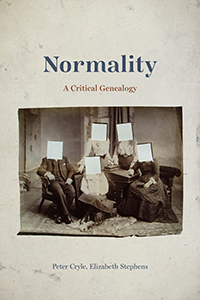
Peter Cryle and Elizabeth Stephens, Normality: A Critical Genealogy, University of Chicago Press, 2017

The concept of normal is so familiar that it can be hard to imagine contemporary life without it. Yet the term entered everyday speech only in the mid-twentieth century. Before that, it was solely a scientific term used primarily in medicine to refer to a general state of health and the orderly function of organs. But beginning in the middle of the twentieth century, normal broke out of scientific usage, becoming less precise and coming to mean a balanced condition to be maintained and an ideal to be achieved.

In Normality, Peter Cryle and Elizabeth Stephens offer an intellectual and cultural history of what it means to be normal. They explore the history of how communities settle on any one definition of the norm, along the way analyzing a fascinating series of case studies in fields as remote as anatomy, statistics, criminal anthropology, sociology, and eugenics. Cryle and Stephens argue that since the idea of normality is so central to contemporary disability, gender, race, and sexuality studies, scholars in these fields must first have a better understanding of the context for normality. This pioneering book moves beyond binaries to explore for the first time what it does—and doesn’t—mean to be normal.

Contents

Part One. The Normal in Nineteenth-Century Scientific Thought

Chapter One
The “Normal State” in French Anatomical and Physiological Discourse of the 1820s and 1830s

Chapter Two
“Counting” in the French Medical Academy during the 1830s

Chapter Three
Rethinking Medical Statistics: Distribution, Deviation, and Type, 1840–1880

Chapter Four
Measuring Bodies and Identifying Racial Types: Physical Anthropology, c. 1860–1880

Chapter Five
The Dangerous Person as a Type: Criminal Anthropology, c. 1880–1900

Chapter Six
Anthropometrics and the Normal in Francis Galton’s Anthropological, Statistical, and Eugenic Research, c. 1870–1910

Part Two. The Dissemination of the Normal in Twentieth-Century Culture

Chapter Seven
Sex and the Normal Person: Sexology, Psychoanalysis, and Sexual Hygiene Literature, 1870–1930

Chapter Eight
The Object of Normality: Composite Statues of the Statistically Average American Man and Woman, 1890–1945

Chapter Nine
Sex and Statistics: The End of Normality

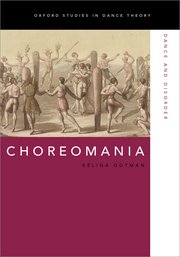
Kélina Gotman, Choreomania. Dance and Disorder, Oxford Studies in Dance Theory. Oxford University Press.

Description
When political protest is read as epidemic madness, religious ecstasy as nervous disease, and angular dance moves as dark and uncouth, the disorder being described is choreomania. At once a catchall term to denote spontaneous gestures and the unruly movements of crowds, choreomania emerged in the nineteenth century at a time of heightened class conflict, nationalist policy, and colonial rule. In this book, author Kélina Gotman examines these choreographies of unrest, rethinking the modern formation of the choreomania concept as it moved across scientific and social scientific disciplines. Reading archives describing dramatic misformations of bodies and body politics she shows how prejudices against expressivity unravel, in turn revealing widespread anxieties about demonstrative agitation. This history of the fitful body complements stories of nineteenth-century discipline and regimentation. As she notes, constraints on movement imply constraints on political power and agency. In each chapter, Gotman confronts the many ways choreomania works as an extension of discourses shaping colonialist orientalism, which alternately depict riotous bodies as dangerously infected others, and as curious bacchanalian remains. Through her research, Gotman also shows how beneath the radar of this colonial discourse, men and women gathered together to repossess on their terms the gestures of social revolt.

  • Positions dance studies in the realm of scientific modernity
  • Evolves definitions of dance to include dance-like gesture
  • Looks at movement and mania histories through a critical theoretical lens
  • Transforms language of movement disorders and disability studies

CONTENTS

Introduction: Choreomania, Another Orientalism
Part I: Excavating Dance in the Archives
1. Obscuritas Antiquitatis: Institutions, Affiliations, Marginalia
2. Madness after Foucault: Medieval Bacchanals
3. Translatio: St. Vitus’s Dance, Demonism and the Early Modern
4. The Convulsionaries: Antics on the French Revolutionary Stage
5. Mobiles, Mobs and Monads: Nineteenth-Century Crowd Forms
6. Médecine Rétrospective: Hysteria’s Archival Drag
Part II: Colonial and Postcolonial Stages: Scenes of Ferment in the Field
7. “Sicily Implies Asia and Africa”: Tarantellas and Comparative Method
8. Ecstasy-belonging in Madagascar and Brazil
9. Ghost Dancing: Excess, Waste and the American West
10. “The Gift of Seeing Resemblances”: Cargo Cults in the Antipodes
11. Monstrous Grace: Blackness and the New Dance “Crazes”
12. Coda: Moving Fields, Modernity and the Bacchic Chorus

Kélina Gotman is Lecturer in Theatre and Performance Studies at King’s College London. She is translator among others of Félix Guattari’s The Anti-Oedipus Papers (2006) and collaborates widely on dance and theatre productions in Europe and North America.

terenceblake's avatarAGENT SWARM

I will be summarising and commenting Les Aveux de la chair, Foucault’s fourth volume in the history of sexuality tetralogy philosophically. In this first substantial post I wish to show how the first few pages conform to the theses that can be extracted from the sketch for an introduction appended in Annex 1.

The book’s first, and longest, chapter has for title: “The formation of a new experience”, which situates it as a demonstration of the thesis of the mutability of experience.

This is at first sight an epistemological thesis (there is no “raw” experience), but we must not forget that it is also a political (prescriptions for conduct can be neither legitimated nor invalidated by an appeal to constituted experience) and an ontological one (Being scinds experience, rescinds its authority, and prescinds it from exteriority).

The title of the first part of the first chapter is “Creation…

View original post 597 more words

Damjanov, K. and Crouch, D. (2018) ‘Orbital Life on the International Space Station’ Space and Culture First Published January 9, 2018

DOI: 10.1177/1206331217752621

Abstract
The International Space Station (ISS) is the largest object in the earth’s orbit and currently the only environment that harbors human life outside the planet. This habitable satellite operates as a sophisticated scientific laboratory and is a complex and costly technological endeavor in expanding our extraplanetary presence. The ISS constitutes a unique living space—a sociotechnical arrangement that encloses humans and nonhumans in a highly regulated and experimental setting that anticipates the orbital order of terrestrial ways of life. This article draws upon Michel Foucault’s work on power and space to frame the ISS as a form of “heterotopia” and explore it as a site in which technologically inflected inscriptions of the human incubate distinct material and social relations. It suggests that these orbital effects configure the practices underpinning the strategic spatialization of life and its governance beyond the globe.

stuartelden's avatarProgressive Geographies

BHI_Foucault_Le_souci_Plat.inddThere is a Warwick news release of information about Foucault’s Les aveux de la chair, in which I briefly explain how the book fits within Foucault’s work and its importance.

I’ve already agreed to write a longer review of the book, and did a first interview on it yesterday evening.

View original post

stuartelden's avatarProgressive Geographies

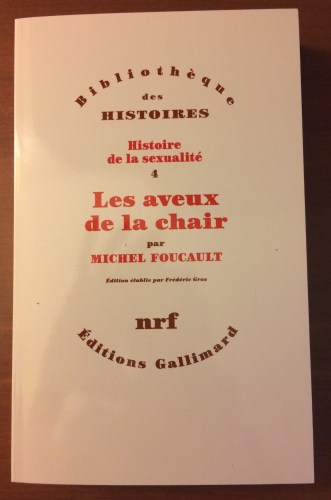
Les Aveux de la chairIt’s officially published tomorrow, but I’ve just picked up a copy of the fourth volume of Foucault’s History of Sexuality – Les Aveux de la chair [Confessions, or Avowals, of the Flesh]. Some of the book is available to view here (essentially just the editor Frédéric Gros’s foreword). The back cover simply has the line of René Char that appeared on volumes II and III. “The history of men is the long succession of synonyms of the same term [vocable]. To contradict them is a duty”.

The book is in three main parts – ‘The formation of a new experience’, ‘Being a virgin’ and ‘Being married’. It looks like the first and second titles are not Foucault’s own. There are some  ‘annexes’ of material appended to the main text – these are related texts found together with the main manuscript. Three are brief of 1, 3 or 7 pages, but…

View original post 42 more words

GÜRHAN ÖZPOLAT, “Between Foucault and Agamben: An Overview of the Problem of Euthanasia in the context of Biopolitics” (2017) 7(2) Beytulhikme International Journal of Philosophy 15

Abstract
In this paper, considering the fact that special forms of dying and killing are mostly seen in a shadowy zone or blurred boundary between life and death, I shall attempt to find a compromise between Michel Foucault (bio-politics) and Giorgio Agamben’s (thanatopolitics) considerations of biopolitics in the case of euthanasia. In this respect, believing that this article requires a historical backround, I shall start with a brief history of euthanasia and suicide in order to understand the present juridico-medico-political complex from which the sovereign power derives its philosophical underpinnings and theoretical justifications today; and show that the relationship power and death has always been very problematic. Secondly, I will focus on the meaning(s) of the disappearance of death in the context of Foucauldian biopolitics and conclude that, in contrast to Foucault’s consideration, something akin to re-discovery of death has taken place in the Western world since the mid-twentieth century. Finally, in the third and last part of the article, I will put forward that Agamben, by introducing the concept life unworthy of being lived, was successful in completing what is missing, that is the politics of death, in Foucault’s notion of biopolitics with reference to the problem of euthanasia.