Foucault News

News and resources on French thinker Michel Foucault (1926-1984)

Elmgreen & Dragset at Istanbul Biennial 2017, Bazaar, September 14, 2017

The Danish-Norwegian artist duo have been challenging notions of power through their multidisciplinary work since they first emerged in 1995. They’ve now taken on the curation of this year’s Istanbul Biennial. Maria Marques speaks to them in Istanbul.

In the winter of 2012, an unusual figure joined the austere statues in London’s Trafalgar Square. A bronze sculpture of a young boy riding his rocking horse with gusto, his right arm raised in the tradition of equestrian statuary, took its place atop of the square’s empty Fourth Plinth. The child’s insouciance made the staid kings and war heroes presiding over the square look somewhat uneasy. In the company of monuments commemorating the military victories of Britain’s imperial past, Powerless Structures, Fig. 101 appeared to invite spectators to celebrate the innocence of childhood instead.
[…]

As self-confessed outsiders to the art world, the pair could not help but wonder at the seemingly arbitrary conventions and limitations that governed it. This realisation led to the artists’ on-going series, Powerless Structures. Inspired by the French philosopher Michel Foucault’s writings on power, they began — quite literally — rocking the foundations on which the art institution stood. In Traces of a Never Existing History / Powerless Structures, Fig. 222, which was part of the 2001 Istanbul Biennial, the pair sunk a Kunsthalle replica into the earth. In Powerless Structures, Fig. 111 (2001), they elevated the floor of the Portikus, a contemporary art space in Frankfurt, creating an obstacle that forced hasty art consumers to slow down their pace.

read more

‘Together with war [the death penalty] was for a long time the other form of the right of the sword; it constituted the reply of the sovereign to those who attacked his will, his law, or his person… As soon as power gave itself the function of administering life, its reason for being and the logic of its exercise – and not the awakening of humanitarian feelings – made it more difficult to apply the death penalty. How could power exercise its highest prerogatives by putting people to death, when its main role was to ensure, sustain and multiply life, to put this life in order? For such a power, execution was at the same time a limit, a scandal, and a contradiction. Hence capital punishment could not be maintained except by invoking less the enormity of the crime itself than the monstrosity of the criminal, his incorrigibility, and the safeguard of society. One had the right to kill those who represented a kind of biological danger to others.’

Michel Foucault, The History of Sexuality, Volume 1: An Introduction, Harmondsworth: 1990, pp. 137-8.

Editor: Richard Lynch has updated his bibliography of Foucault’s shorter writings in English translation. You can find the bibliography on the resources pages of Foucault News.

You can also find other bibliographies on the resources pages:

If there is material missing please let me know, either via email or via the comments sections on the relevant pages.

The City and the Pen: An Excerpt from Shlomo Sand’s “The End of the French Intellectual” – Los Angeles Review of Books, April 17, 2018

The following is an excerpt from Shlomo Sand’s The End of the French Intellectual: From Zola to Houellebecq, translated by David Fernbach and out April 2018 with Verso.

See also this review

[…]
It is a constant surprise that such major French intellectuals as Jean-Paul Sartre, Simone de Beauvoir, Michel Foucault, or Jean-Luc Godard, who had supported the protests of the rebel generation of the late 1960s, were precisely able to fix their choice on the current with the most totalitarian tendency (Foucault was still able to rally to the final totalitarian squall of the century, the Islamic revolution in Iran). [17] Why did these thinkers, and others with them, not prefer the less authoritarian and more rational currents of political revolt? Why did they bring themselves to sympathize with movements that organized a cult, and whose affinities with a distant dictatorship and its oppressive practices were visible to the naked eye?

see more

ThinkOlio Foucault & Modern Prisons, External and Internal

Strand Bookstore
Published on Feb 14, 2018
Professor Jamie Warren devotes this Olio solely to unpacking and understanding one of Foucault’s most celebrated and provocative works, Discipline and Punish. With the help of Foucault, we will ask ourselves the painful but much needed questions: What role should the non-caged play during this era of mass incarceration? What is our duty in the face of such massive unfreedom?

Jamie says: As a historian of American slavery, I often find myself confronted by the same question from my students. Invariably, during our discussion of human bondage, someone will ask: “How could people do that? How could human beings justify enslaving other human beings?” Each time I encounter this inquiry, I begin by pointing not to the past, but to the present. At some point in the future, I suggest to my class, people will be asking a similar question about us—only they will be referring to mass incarceration.

How have we come to believe that the state is justified in its power to lock people in cages? How can we bear witness to the mass imprisonment of millions of human bodies, particularly brown and black bodies, without widespread revolt and outrage? And why do we now measure punishment, not through explicit bodily pain or monetary penalty, but by time? Months, years, decades. What, exactly, does the prison set out to punish? The criminal or the crime? The body or the soul? The public spectacle of the tortured body may have all but disappeared, but as philosopher and historian Michel Foucault reminds us in his masterful work, Discipline and Punish: The Birth of the Prison, we must not be so gullible as to believe that the disappearance of the whipping post signals a move toward a more humanitarian society. The torturer and the public executioner may have gone into hiding, but according to Foucault, their absence marks a shift not toward liberty, but toward one of the most policed and regulated societies the world has ever known. Even bodies that live outside the cage, he tells us, are systematically disciplined to obey and submit—even when we know the watchtower is empty. Thus, we have foolishly come to embrace our internalized personal prison as our most precious place of freedom. The soul, Foucault argues, has become “the prison of the body.”

Recorded February 9, 2018

stuartelden's avatarProgressive Geographies

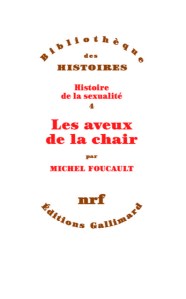
hs-iv.jpgI’ll be talking about Foucault’s Les aveux de la chair at Goldsmiths University on May 9th at 3pm at the Centre for Philosophy and Critical Thought. Full details here.

Richard Hoggart Building room 137, 3-5pm

Goldsmiths, University of London, New Cross, SE14 6NW

In February 2018 the fourth volume of Michel Foucault’s History of Sexuality was finally published. Les Aveux de la chair [Confessions of the Flesh] was edited by Frédéric Gros, and appeared in the same Gallimard series as volumes 1, 2 and 3. The book treats the early Christian Church Fathers of the 2nd-5th century. This talk will discuss the book in relation to Foucault’s other work, showing how it sits in sequence with volumes 2 and 3, but also partly bridges the chronological and conceptual gap to volume 1. It will discuss the state of the book and whether it should have been…

View original post 70 more words

Bilge Friedlander’s work at the installation.

Turkish, German museums present joint show – Daily Sabah, April 18 2018

The Arter Gallery in Istanbul and Neues Museum Nürnberg have collaborated for a joint exhibition featuring three artists’ work centering on the theme of silence

Arter Gallery Istanbul and Neues Museum Nürnberg have collaborated for the exhibition titled “Zamanın Kıyısında” (On the Edge of Time), which is organized with a selection from the Contemporary Art Collection of the Vehbi Koç Foundation. Curated by professor Thomas Heyden, the exhibition features the works of Bilge Friedlaender, Ahmet Doğu İpek and Füsun Onur. While Heyden prepares the exhibition in the theme of silence that he sees as the common point in the works of this trio, the exhibition is being presented with the concept of being on the edge of time, inspired from philosopher Michel Foucault and determines the exhibition’s poetic scope, separating the past and present. The exhibition, which was opened on March 2 at Neues Museum Nürnberg, will continue until June 10 2018

Gilles Deleuze, Michel Foucault: as formações históricas, Editora Politeia, 2018
tradução e notas: Cláudio V. F. Medeiros e Mario Antunes Marino
páginas: 304 (aprox.)
isbn: 978-85-94444-01-1

Open access

CURSO ONLINE
Em 1985 e 1986, Gilles Deleuze ministrou dois cursos dedicados ao pensamento de Michel Foucault na Universidade de Paris. Sua voz gravada e a transcrição das aulas estão disponíveis no portal da Universidade Paris 8. O primeiro curso chama-se Michel Foucault: as formações históricas. O segundo chama-se Michel Foucault: o poder. Juntos eles apresentam um formidável panorama do pensamento de Foucault, estruturado por Deleuze segundo três eixos: saber, poder e subjetivação.

A partir de março as editoras Politeia e N-1 iniciam a publicação online e gratuita da tradução do primeiro curso, composto por 8 aulas. Clique nos links abaixo para baixar as aulas.

Portuguese translation of: “Michel Foucault: the historical formations” by Gilles Deleuze

Shortly after Michel Foucault’s death in 1984, Gilles Deleuze devoted himself to teaching and writing about the thought of his friend. In 1986, he published Foucault, the first book about the prematurely disappeared philosopher.

In 1985 and 1986, Deleuze taught two courses dedicated to Michel Foucault’s thought at the University of Paris. His recorded voice and the transcript of classes are available on the Paris-8 University portal. The first course is called Michel Foucault: the historical formations. The second one is called Michel Foucault: the power. Together they present a formidable panorama of Foucault’s thought, structured by Deleuze according to then three well-knows axes: knowledge, power and subjectivation. The courses exceed the academic and academic scope, establishing with precision the fundamental elements of elucidation of the philosophy of Foucault.

The importance of this material is much more than it’s volume (900-over printed pages, compared to only 140 of the book Foucault). The classes functioned as a kind of laboratory in which Deleuze experimented with the ideas and concepts from which he traced the cartography foucauldian Some of these elements – for example, biopolitic – are not paralleled in the book. For this reason, the courses represent important research material on the thinking of the two philosophers.

The Brazilian translation and the online availability of the courses is been made by Editora Politeia and N-1 Edições. It keeps the testamentary dispositions of Deleuze, who did not want posthumous publications. It only brings to the Brazilian reader what is already on the Internet in French, democratizing access to this little treasure.

In March 2018, we began the online availability of the first course, consisting of 8 classes that will be released monthly.

Technical information:

translation and notes: Cláudio V. F. Medeiros and Mario Antunes Marino

Paolo Godani, La verità del desiderio La carne e l’amicizia (II)

Editor.January 2026. Link above archived on the Wayback Machine

Finalmente gli eredi del lascito di Michel Foucault hanno ritenuto fosse venuto il momento di pubblicare Les aveux de la chair. Un’opera attesa da decenni, su cui molto si è fantasticato, che ora le edizioni Gallimard, con la cura di Frédéric Gros, presentano come quarto e ultimo tomo di quella Histoire de la sexualité annunciata già nel 1976 con la pubblicazione del suo primo volume, La volonté de savoir.

[…]

Glen Fuller, Renee Barnes, A history of anticipating the future: an analysis of the AN Smith lectures, Andrew Olle Lectures and media commentary, Media International Australia
Article first published online: April 19, 2018

DOI: 10.1177/1329878X18768012

Abstract
There are multiple narratives of technological and organisational change for making sense of the news media industry since the turn of the century. In Australia, the Andrew Olle and AN Smith lectures have served as key sites whereby leading members of the journalistic field have articulated narratives of change. Drawing on Bourdieu’s concept of ‘field’ and using Foucault’s notion of ‘commentary’ as a method, we begin by analysing all Andrew Olle and AN Smith lectures from 1997 to 2015 and selected those that substantially discuss journalism and the media industry more broadly. Our analysis develops an account of the narratives of change to better understand the different negotiations and translations of the journalistic field. We found three key narratives: (1) commercial performance and concerns over the decline of ‘quality journalism’, (2) the role of technology in surviving industrial change and (3) fundamental change to journalistic practice.

Keywords Bourdieu, commentary, Foucault, journalistic field, media technology, news industry