Foucault News

News and resources on French thinker Michel Foucault (1926-1984)

A Photo Journey Through Italy’s Abandoned Nightclubs – Noisey By Laura Petillo, translated by Cristina Politano, May 14 2017

Discotex, a new documentary project, offers an audiovisual glimpse into the cathedrals from the glory days of Italian vinyl.
[…]
Melillo’s journey is probably best summarized as a study in understanding a location as an extension of a different space. She argues that these nightclubs are heterotopias, and paraphrases the philosopher Michel Foucault: “Different spaces are […] alternate locations, a type of challenge to the mythical and real simultaneity of the spaces in which we live.” You can still ignore reality at a discotheque, even if it’s abandoned. Discourse runs dry; only music resounds. That music is gone, but Discotex offers a chance to rediscover the sound of it, if only for a few seconds.

Source: A Photo Journey Through Italy’s Abandoned Nightclubs – Noisey

The Call for Panels and Roundtables of the 2018 Australian Anthropological Society conference, to be held 4-7 December at the Cairns campus of James Cook University,  has been extended till the 23rd of May.

We welcome proposals that engage directly or indirectly with the conference theme – Life in an Age of Death.

Conference website: https://www.aasconf.org/2018/

If you have any questions, please email admin@aasconf.org

Life in an age of death

During the first decades of the twenty-first century, the proliferation of life as a generative possibility has become marked by the spectre of death, closure, denial and ends. Ours is an era of precarity, extinction, militarised inequality, a seemingly boundless war on terror, the waning legitimacy of human rights, a rising consciousness of animal cruelty and consumer complicity in killing and suffering, and the global closure of decolonial and socialist windows of emancipation. Artificial intelligence and post-human technology-flesh interventions have become sources of existential threat to be secured against, rather than means of freeing, or otherwise expanding life. Mbembe (2003) first developed the notion of necropolitics in relation to ‘assemblages of death’, zones where technology, economy and social structures bind together to reproduce patterns of extreme violence. Following Foucault, he envisaged a distribution of the world into life zones and death zones. While we can readily identify zones of life and death on these terms, the imaginaries of death have increasingly colonised life zones.

This conference seeks to embrace this moment in history in all its roiling complexity, challenge, and specificity. It asks what accounts for this current interest in the spectre of Death in the anthropological imagination? What sorts of life—social, cultural, technological, creative—emerge in spaces pregnant with death and other life-ending spectres? What new horizons of fear, hope and possibility emerge? What kinds of new social formations, subjectivities and cultural imaginaries? What social and cultural forms might an affirmative biopolitics, where the power of life is regained from the spectre of death, take? What new strategies of engagement, activism and refusal?


Philippe-Joseph Salazar, The Alt-Right as a Community of Discourse (2018) Javnost – The Public, 25(1–2), 135–143.
https://doi.org/10.1080/13183222.2018.1423947

Abstract
This paper suggests ways to examine the American Alt-Right as a community of discourse. It relies on Michel Foucault’s notion that discourse is marked by external procedures of prohibition, division and will to truth, and it shows how the Alt-Right owes its powerful emergence in the public sphere to these procedures. It concludes with a brief recall that internal procedures also shape a community of discourse, by giving its actors access to commentary, providing the community with a sense of shared authorship and leading to a “fellowship” of discourse. This paper was researched and written before the Charlottesville fracas (12 August 2017) that propelled the Alt-Right into the limelight, and further obscured its discursive construction.

Author Keywords
Alt-Right; discursivity; fascism; Michel Foucault; racism; Richard Spencer; supremacism; United States


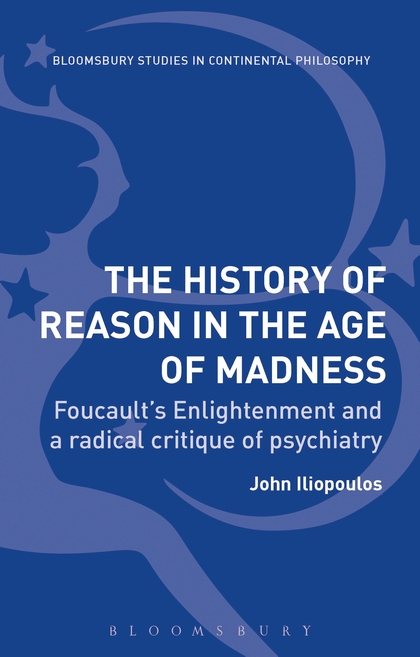
John Iliopoulos, The History of Reason in the Age of Madness: Foucault’s Enlightenment and a Radical Critique of Psychiatry Bloomsbury Academic, 2017

The History of Reason in the Age of Madness revolves around three axes: the Foucauldian critical-historical method, its relationship with enlightenment critique, and the way this critique is implemented in Foucault’s seminal work, History of Madness. Foucault’s exploration of the origins of psychiatry applies his own theories of power, truth and reason and draws on Kant’s philosophy, shedding new light on the way we perceive the birth and development of psychiatric practice. Following Foucault’s adoption of ‘limit attitude’, which investigates the limits of our thinking as points of disruption and renewal of established frames of reference, this book dispels the widely accepted belief that psychiatry represents the triumph of rationalism by somehow conquering madness and turning it into an object of neutral, scientific perception. It examines the birth of psychiatry in its full complexity: in the late eighteenth century, doctors were not simply rationalists but also alienists, philosophers of finitude who recognized madness as an experience at the limits of reason, introducing a discourse which conditioned the formation of psychiatry as a type of medical activity. Since that event, the same type of recognition, the same anthropological confrontation with madness has persisted beneath the calm development of psychiatric rationality, undermining the supposed linearity, absolute authority and steady progress of psychiatric positivism. Iliopoulos argues that Foucault’s critique foregrounds this anthropological problematic as indispensable for psychiatry, encouraging psychiatrists to become aware of the epistemological limitations of their practice, and also to review the ethical and political issues which madness introduces into the apparent neutrality of current psychiatric discourse.

Table of contents

Introduction

1. What is Enlightenment?

2. The Historical Critique of Phenomenology

3. Foucault’s Epistemology: Sujectivity, Truth, Reason, and the History of Madness

4. Is Foucault and Anti-Psychiatrist?

5. Hysteria at the Limits of Medical Rationality

6. Foucault and Psychoanalysis: Traversing the Enlightenment

Conclusion

Bibliography

Index

Reviews

“Grounded in a deep knowledge of Foucault’s oeuvre, The History of Reason in the Age of Madness establishes remarkable continuity from his early, under discussed, Introduction to Kant’s Anthropology to his final articles on the Enlightenment. In addition to seriously advancing our comprehension of major works such as the History of Madness John Iliopoulos’ clear and lucid prose sheds new light on reason, rationalism and madness as well as on anthropology and psychiatry. A highly valuable undertaking.” –  Sverre Raffnsøe, Editor-in-chief of Foucault Studies and Professor of Philosophy, Copenhagen Business School, Denmark,

“’The History of Reason in the Age of Madness offers a remarkably fresh and convincing interpretation of Foucault’s complex and often misunderstood relation with Enlightenment philosophy and psychiatry. It successfully challenges the still prevalent view that Foucault’s thinking resolutely opposes these movements, cogently arguing that such a reductive view would contradict one of the basic aims of Foucault’s writings which is to expose the ambiguity of all phenomena, their susceptibility to ongoing critique, modification and radical transformation. This important work is a must for scholars of Foucault, critical psychiatry and Enlightenment studies.’” –  Kevin Inston, Senior Lecturer, Centre for Multidisciplinary and Intercultural Inquiry, University College London, UK,

Connor Richards: Demonstrating Politics Through Music – Daily Utah Chronicle, November 17, 2017

Extract

The tradition of using music to make social commentary is being kept alive by American post-metal band ISIS. Post-metal, as a genre, is described by ISIS frontman and lyricist Aaron Turner as being a “thinking man’s metal.”

The 2004 album Panopticon draws heavily on the works of English philosopher Jeremy Bentham and French sociologist Michel Foucault to comment on the prevalence of surveillance in modern society.

Working off Foucault’s idea that surveillance turns humans into objects of observation rather than subjects of communication, Panopticon offers a gloomy take on “life reduced to ticks” through government surveillance and invasions of privacy. This is seen in the song “Backlit.” “Always object, never subject. Can you see us? Are we there? … Always upon you, light never ceases. … Thousands of eyes, gaze never ceases.”

read more


68, année philosophique ? (1/4) : Deleuze, Foucault, Derrida: les « nouveaux » philosophes
LES CHEMINS DE LA PHILOSOPHIE par Adèle Van Reeth, 23/04/2018
podcast

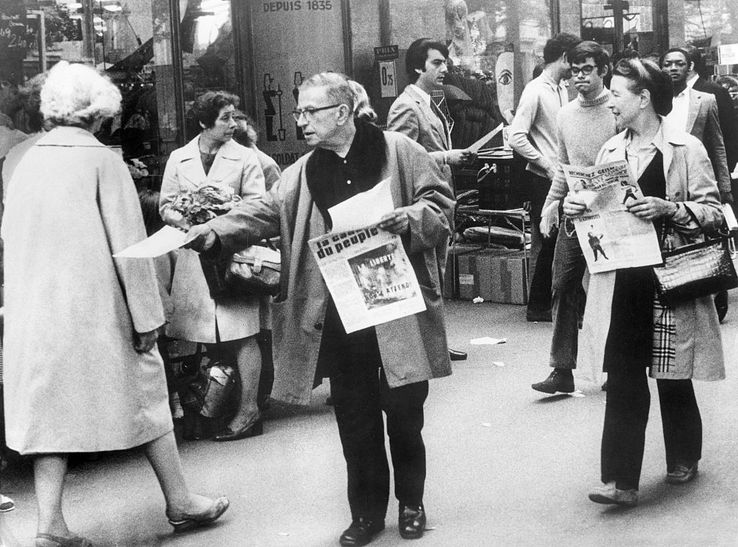
La philosophie française est étroitement associée à l’événement de MAI 68. Preuve en est : Les mots des philosophes descendent dans la rue et se retrouvent placardés aux murs! Frédéric Worms nous éclaire.

Lassen, I.
Resisting dehumanization: citizen voices and acts of solidarity
(2018) Critical Discourse Studies, pp. 1-17. Article in Press.

DOI: 10.1080/17405904.2018.1441038

Abstract
Recent years have seen an increase in the influx of asylum-seekers in Scandinavia, and in Denmark this has led to ever-tighter immigration control. This article discusses emerging practices of refugee solidarity and resistance to migration policy in Danish civil society in the wake of what has been referred to as the European refugee crisis. To accomplish this purpose, I analyse how participants in Facebook discussions construe topoi and attitudes when facing the ethical dilemma of respecting the law versus showing concern for humans in need, in line with what Foucault (1983. The subject and Power. In H. Dreyfus & P. Rabinow (Eds.), Michel Foucault: Beyond Structuralism and Hermeneutics (pp. 208–226). Chicago: The University of Chicago Press) has referred to as ‘ethical self-formation’. This is illustrated through a case study of an incident from September 2015, when a member of a Danish City Council offered private shelter to immigrants on their way to Norway. The incident led to legal proceedings in August 2016 for what the defendant referred to as ‘the offense of helping fellow human beings in need’. The study is informed by Critical Discourse Analysis (Fairclough, N. (2003). Analysing Discourse. Textual analysis for social research. London and New York: Routledge; Wodak, R. (2015). The politics of fear. London and New York: Sage) and governmentality theory (Foucault, M. (1983). The subject and Power. In H. Dreyfus & P. Rabinow (Eds.), Michel Foucault: Beyond Structuralism and Hermeneutics (pp. 208–226). Chicago: The University of Chicago Press; Foucault, M. (2007). Security, Territory, Population: Lectures at the Collège de France 1977–78. (G. Burchell, Trans.). New York: Palgrave Macmillan; McIlvenny, P., Klausen, J. Z., & Lindegaard, L. B. (2016). Studies of Discourse and Governmentality. Amsterdam and Philadelphia: Benjamins). Data include media representations and facebook comments published during 2016. The analytical approach combines topos analysis (Wodak, R., & Meyer, M. (Eds.). (2010). Methods of Critical Discourse Analysis. London: Sage; Wodak, R. (2015). The politics of fear. London and New York: Sage) and appraisal analysis to tease out evaluative meaning. © 2018 Informa UK Limited, trading as Taylor & Francis Group

Author Keywords
appraisal analysis; discursive discrimination; governmentality; immigration; populism; solidarity; topoi

“Voir sans être vu”, serait-ce le rêve du pouvoir ?

podcast

durée : 00:58:55 – Les chemins de la philosophie – par : Adèle Van Reeth – – réalisé par : Nicolas Berger. Les chemins de la philosophie, Radio France, 30 janvier, 2018

Starts with audio of Foucault speaking about the gaze and power. Interview with Guillaume Le Blanc.

La surveillance pourra-t-elle un jour se passer de surveillants ? C’était déjà la question que se posait Foucault à l’époque de Surveiller et Punir en 1975. La fin annoncée des institutions de surveillance par Foucault est-elle toujours d’actualité ? Du panoptique de Bentham à la série Black Mirror, où en est l’œil du pouvoir dans nos vies ?

Comment la libido a-t-elle été inventée ? Les aveux de la chair

podcast

Comment notre sexualité en est-elle venu à faire la vérité sur nous-mêmes ? Et comment est-elle devenue coupable à travers les aveux de la chair ? Foucault interroge « ce moment où, dans l’histoire de la subjectivité, on va dire : pour savoir qui tu es, interroge d’abord ta sexualité. ». Le dernier tome de l’Histoire de la Sexualité présenté par Frédéric Gros.

The Apartments Where They Lived

Edmund White, Writer

I lived in the Colonnades — they’re those 1830s buildings on Lafayette Street across the street from the Public Theater. I had a studio apartment with all the period details, like little wooden doors over the windows. There was also a white marble fireplace, where I kept a brazier. In those days I was an ambitious cook — I’d shop at Balducci’s on Sixth Avenue, where you could get exotic things like white eggplant and dazzle your guests. My most famous guest was Michel Foucault, who once told me he was going to come over with 10 boys he’d picked up, but who didn’t know each other. I was afraid they’d have nothing to say to each other and that it would be a disaster. I called my mother and said, “Eek, what do I do?” and she said, “Cook for three days and make 22 Indian dishes and then they’ll just talk about food all night.” So I did.