Foucault News

News and resources on French thinker Michel Foucault (1926-1984)

Paolo Vernaglione Berardi, Critica: La carne e l’amicizia Deleuze per Foucault, Laboratorio “archeologia filosofica”, 2018
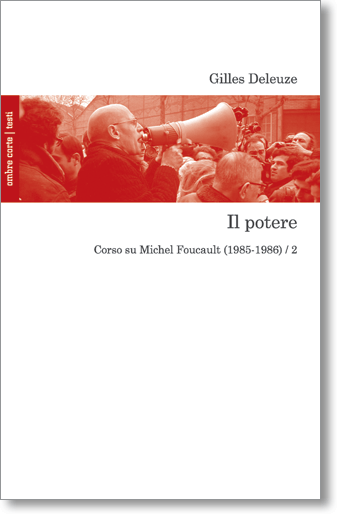
Gilles Deleuze, Il potere. Corso su Michel Foucault (1985-1986)/2, Ombre Corte, 2018

Editor. Update January 2026. Link above to the page archived on the Wayback Machine

On the occasion of the publication in France of  Les aveux de la chair, the “so called” fourth Foucault volume of the History of sexuality, and the contemporary publication in Italy of the second part of the Deleuze course dedicated to Foucault, Il potere (1985- ’86), we publish here  La carne e l’amicizia, first of three reflections about relationships and practices of subjectivation on both philosophers.

Non per semplice associazione diremo che il corso tenuto nel semestre 1985-’86 da Gilles Deleuze su Michel Foucault ha il suo luogo filosofico in Nietzsche. Il motivo è forse più profondo e meno colto, certo meno intuitivo di quanto il parlato trasposto in questo secondo testo dedicato all’amico possa farci ascoltare. A confronto con il precedente Il sapere, in cui sono trascritte le lezioni del primo trimestre, Il potere retrocede verso l’origine del discorso là ove Nietzsche è il vero nome di amicizia.

Gilles Deleuze, Il potere. Corso su Michel Foucault (1985-1986) / 2, Ombre Corte, 2018
Prefazione di Ubaldo Fadini

il libro
Le lezioni sul potere costituiscono la seconda parte del Corso che Gilles Deleuze dedicò all’opera dell’amico a poco più di un anno dalla scomparsa. Iniziato nell’ottobre 1985, le prime otto vennero dedicate al “sapere”, ovvero al primo dei tre grandi assi che Deleuze individua nel pensiero di Foucault. Nelle lezioni contenute in questo secondo volume viene messo a tema il secondo asse: quello appunto rappresentato dal “potere”.
Per Deleuze, il pensiero non è mai qualcosa di effettivamente sistematico, di ordinato una volta per tutte, ma piuttosto un percorso vitale e pratico, ricco di acquisizioni, shock, deviazioni, trappole, salti improvvisi e abbandoni, che non sono semplicemente oggetto di una ricostruzione ma richiedono, a loro volta, nuovo pensiero e differenti vie di ricerca, in una sorta di combinazione felice, virtuosa, di commento e capacità inventive, di ulteriore concettualizzazione. Le lezioni sul potere forniscono allora una periodizzazione dell’opera foucaultiana, dei suoi rapporti con il periodo post-68 in Europa, con il marxismo e l’esistenzialismo, con Nietzsche: commentano i postulati di un’analisi serrata e produttiva del potere e nozioni decisive quali microfisica, disciplina e biopolitica. Ma accanto all’impegno del commento, la lettura di Deleuze diventa capace di aperture fulminanti, di operazioni che consentono di analizzare, ad esempio, Le parole e cose, un lavoro di fatto anteriore, in relazione con le analisi del potere dei primi anni Settanta. Il fatto è che il concetto di potere richiede il dispiegamento di una vera e propria filosofia delle forze e l’invenzione della nozione di diagramma. Il problema della relazione con il sapere è affrontabile attraverso l’utilizzo di strumenti che rinviano anche alla matematica (gli integrali) e alla biologia (la differenziazione). Infine, l’enigma dei contropoteri e del cambiamento storico chiede di definire quella nozione del “fuori”, così rilevante, che annuncia il passaggio al terzo asse dell’opera di Foucault: quello della “soggettivazione”.

l’autore
Gilles Deleuze (1925-1995) è stato uno dei maggiori filosofi del Novecento. Tra i suoi numerosi lavori: Nietzsche e la filosofia (1962), Spinoza e il problema dell’espressione (1968), Differenza e ripetizione (1968), Logica del senso (1969), Francis Bacon. Logica della sensazione (1981), Spinoza. Filosofia pratica (1985); con Félix Guattari: L’anti-Edipo (1972), Mille piani (1980) e Che cos’e? la filosofia? (1991). E per i nostri tipi: Cosa può un corpo? Lezioni su Spinoza, Conversazioni (con Claire Parnet) e il primo volume del Corso su Foucault: Il sapere (2014).

Workshop: Foucault and the politics of resistance in Brazil

Associação Comercial do Rio de Janeiro (Rua Candelária, 9 – Auditório, 12 andar – Centro, Rio de Janeiro)
RSVP on this page

This workshop will bring together scholars throughout Brazil to discuss a little-known topic outside of Brazil: the intellectual and political import of Michel Foucault’s visits to Brazil in 1965, 1973, 1974, 1975, and 1976. During these visits, Foucault synthesized and advanced his research in lectures and talks on an astoundingly wide range of topics, from juridical practices, to social medicine, to sexuality. He sought to clarify his unconventional perspectives in interviews with the press. Faced with the growing repression of students, professors, and journalists, Foucault also engaged in open opposition to the military dictatorship.

In this workshop, scholars will situate Foucault’s enormous contributions in Brazil within a series of theoretical, historical, and political contexts. They will also reflect on these contributions to illuminate aspects of the politics of resistance in Brazil in the past and present. The contributions to the workshop will serve as the basis for articles in the forthcoming issue of the interdisciplinary journal Carceral Notebooks (http://www.thecarceral.org/journal-vol13.html).

WORKSHOP SCHEDULE:

9:00-11:15AM | Panel 1 (in English): Subjects of Resistance

Moderator: Shai Gortler

Marcelo Hoffman, “From Public Silence to Public Protest: Michel Foucault at the University of São Paulo in 1975”

Margareth Rago, “Foucault, Subjectivity, and Self-Writing in Brazilian Feminism”

Mauricio Pelegrini, “Foucault in Iran, Foucault in Brazil: Political Spirituality and Religious Counter-Conducts”

11:30AM-1:15PM | Panel 2 (in Portuguese): Resistances Today

Moderator: Alessandro de Lima Francisco

Edson Passetti, “Foucault and Resistances: Penal Abolitionism”

Priscila Piazentini Vieira, “Foucault and the Courage to Radically Transform Existence”

1:15PM-2:30PM | Lunch Break

2:30-5:00PM | Panel 3 (in Portuguese): Encounters and Theoretical Contexts

Moderator: Marcelo Hoffman

Heliana de Barros Conde Rodrigues and Rosimeri de Oliveira Dias, “The Tiny Brazilian Press as Resistance: Foucault, the Enemy of the King”

Ernani Chaves, “‘The SNI Was Asking for the Roster’: Michel Foucault in Belém in November 1976”

Márcio Alves da Fonseca, “Power and Resistance: Foucault’s Laboratory in Brazil”

Sponsors: Center for Contemporary Critical Thought (CCCCT) – Columbia Law School and Columbia Global Center | Rio de Janeiro

Epistémologie historique et les désunités des sciences
Historical Epistemology and the Disunities of the Sciences

Paris, 24-25-26 mai 2018

École Doctorale de Philosophie ED 280, Université Paris 1 Panthéon-Sorbonne
Institut des Sciences Juridique & Philosophique de la Sorbonne, UMR 8103 CNRS
Centre de Philosophie Contemporaine de la Sorbonne
https://episthist.hypotheses.org/

Link to event page on Facebook

[Formulaire d’inscription]
IMPORTANT: Pour des raisons de sécurité l’inscription est obligatoire pour avoir accès à la Sorbonne et au Centre Panthéon

Jeudi 24 mai 
Salle Lalande, Sorbonne, 17 rue de la sorbonne, 75005. Escalier C, 1er étage

09:00 Accueil
09:10 Présentation des journées

09:30-10:30 Are scientific results inevitable or contingent? The crucial role played by the monist regime of our science in the philosophical debateLéna SOLER, Université de Lorraine; répondant: Lorent LOISON

Pause café

10:50-11:30 Régionalisme épistémologique et constructivisme: Proximités et distances entre Bachelard, Canguilhem et FoucaultAndrea ANGELINI, Università degli Studi di Pisa / Firenze

11:30-12:10 Les styles de méthode. Le problème de la variation des canons et des critères dans les dynamiques de rechercheSylvain LAVELLE, ICAM Paris

Pause déjeuner

14:10-14:50 Reconfiguring underdetermination, and the benefits and risks of epistemic pluralism in historical sciencesThomas BONNIN, University of Exeter

14:50-15:30 Mapping the Disunity of Science. Scientometrics and Historical Epistemology in DialogueEugenio PETROVICH, Università degli Studi di Milano

15:30-16:10 Three Historical EpistemologiesDavid HYDER, Université d’Ottawa

Pause café

16:30-17:30  Pluralisme feuilleté : pour un pluralisme non régionaliste et constructivisteStéphanie RUPHY, Université Jean Moulin Lyon 3; répondant: à confirmer

Vendredi 25 mai 
Salle Lalande, Sorbonne

9:30-10:10  Comment, pourquoi reconstruire un concept de science ? L’épistémologie selon Desanti, Alain-Marc RIEU, Université Jean Moulin Lyon 3

10:10-10:50  Jean-Claude Passeron : Pluraliser l’épistémologieLucie FABRY, Ecole Normale Supérieure

Pause café

11:10-11:50 Comment peut-on être écologue des écosystèmes ? L’écologie des écosystèmes, une discipline en tension entre physique et biologieVictor LEFÈVRE, IHPST – Paris 1

11:50-12:30  The Disunity of Constructivism: From Synthetic Chemistry to Synthetic BiologyMassimiliano SIMONS, KULeuven

Pause déjeuner

14:30-15:10 Pluralisme épistémologique, stratification ontologique et histoire de la raison chez Castoriadis
Geneviève GENDREAU-BEAUCHAMP, Université d’Ottawa

15:10-15:50 Nazism and the Unity of Psychology. German Psychology in Nazi Period viewed from the Perspective of Franziska Baumgarten-Tramer and Maria ZilligLaurens SCHLICHT, Humboldt Universität

15:50-16:30 Ernst Cassirer’s Transcendental Account of Mathematical ReasoningFrancesca BIAGIOLI, University of Vienna

Pause café

16:50-17:50 The disunity of mathematics, Andrew ARANA, IHPST – Paris 1; répondant: Jean-Luis GASTALDI

Samedi 26 mai
Salle 06, Centre Panthéon, 12, place du Panthéon, 75005. Escalier M, 4e étage

9:30-10:10 Can Economics be Liberated From Physics? Rethinking the Demarcation Problem in the Light of Historical EpistemologySina BADIEI, Université Toulouse – Jean Jaurès

10:10-10:50 Does Philosophy of Science Meet History of Science? Epistemic ConstraintsLuca GUZZARDI, Università degli Studi di Milano

Pause café

11:10-12:40 Using History of Science for Pluralist Philosophy and ScienceHasok CHANG, Cambridge University

Pause déjeuner

14:40-15:20 Therapeutic Relationship and Scientific Experimentation: Technical Activity in SurgeryOlivier DEL FABBRO & Xavier MULLER, ETH Zurich / University Hospital Zurich

15:20-16:00 Georges Canguilhem : aux sources biologiques de l’unification de la science par voie techniqueUgo BALZARETTI, Université de Bâle

Pause café

16:20-17:00 Pratiquer l’inter-régionalité du savoir en éducation. Repères canguilhemiensXavier ROTH, Université Grenoble-Alpes

Clôture des journées

Comité scientifique
Christian BONNET, CHSPM, Université Paris 1 Panthéon-Sorbonne
Jean-François BRAUNSTEIN, PhiCO, ISJPS, Université Paris 1 Panthéon-Sorbonne
Cristina CHIMISSO, Open University (UK)
Arnold I. DAVIDSON, Université de Chicago
Moritz EPPLE, Goethe Universität Frankfurt am Main
Pierre WAGNER, IHPST, Université Paris 1 Panthéon-Sorbonne

Comité organisateur
Laurent LOISON, Ivan MOYA DIEZ, Matteo VAGELLI (coordinateurs)
Marcos CAMOLEZI,  Wenbo LIANG, Gabriele VISSIO

Editor: I have added a list of open access tools and repositories to the side bar of the Foucault News blog (see list below) to assist readers who don’t have institutional access to journals. If anything is missing please let me know

(See these cautions about the commercial aspirations of both academia.edu and Research Gate).


Update 5/5/18. I’ve added Scribd to the list. It operates on a similar model to the streaming music service Spotify, or Neflix in that for a reasonable monthly subscription fee you have online access to books, journal articles, audiobooks and other documents.

Patricio Lepe-Carrión, Educación, racismo cultural y seguridad nacional: la escuela intercultural en contextos de violencia, Educação e Pesquisa, vol.44 São Paulo 2018 Epub 16-Abr-2018
DOI:10.1590/s1678-4634201844174819
Open access

Education, cultural racism and national security: the intercultural school in contexts of violence

RESUMEN
El artículo recoge conclusiones parciales de un proyecto en curso, financiado por Fondecyt (nº11140804) y Becas-Chile, y patrocinado por la Universidad de Chile, Universidad de Sao Paulo, y Universidad de La Frontera. Tiene como objetivo analizar el discurso educativo intercultural en contextos de violencia, tomando como foco específico de estudio, la función que la escuela intercultural cumple al interior del conflicto armado que el Estado chileno mantiene con el pueblo mapuche en la región de la Araucanía. La perspectiva teóricometodológica utilizada es el Análisis del Discurso desde las contribuciones y posibilidades abiertas por el filósofo Michel Foucault, tomando como archivo de análisis dos tipos de muestras: documentales y etnográficas; las primeras, recopiladas desde los años 1990-2016; y las segundas, adquiridas en el transcurso de los último dos años (2015-2016). En la primera parte, intentaré visibilizar aquellas prácticas no-discursivas implicadas en la desestabilización del modelo extractivista y monoexportador en Chile, y de sus efectos en la militarización de la región de la Araucanía. Luego, describiré brevemente las características de la racionalidad etnogubernamental que opera en los discursos y prácticas multiculturales en post-dictadura, para después mostrar el modo en que funcionan los procesos de etnicidad en los programas educativos sobre interculturalidad. En la última parte, a modo de conclusión, formularé algunas reflexiones que pretenden establecer vínculos entre los programas de educación intercultural, culturalismo o racismo cultural, gubernamentalización del Estado, y estrategias securitarias de percepción y construcción del enemigo interno.

Palabras-clave: Educación; Interculturalidad; Racismo; Violencia; Pueblo Mapuche

ABSTRACT
The article collects partial conclusions of an ongoing project, financed by Fondecyt (nº11140804) and Becas-Chile, and sponsored by the University of Chile, University of Sao Paulo, and the University of La Frontera. Its objective is to analyze the intercultural educational discourse in contexts of violence, taking as a specific focus of study the function that the intercultural school fulfills within the armed conflict that the Chilean State maintains with the Mapuche people in the Araucanía region. The theoretical-methodological perspective used is the Discourse Analysis from the contributions and possibilities opened by philosopher Michel Foucault, taking as a file of analysis two types of samples: documentary and ethnographic; the first, collected from the years 1990-2016; and the second, acquired during the last two years (2015-2016). In the first part, I will try to make visible those non-discursive practices involved in the destabilization of the extractivist and mono-exporting model in Chile, and its effects on the militarization of the Araucanía region. Then, I will briefly describe the characteristics of ethno-governmental rationality that operates in multicultural discourses and practices in post-dictatorship period, and then show how ethnicity processes work in educational programs on interculturality. In the last part, as a conclusion, I will formulate some reflections that intend to establish links between intercultural education programs, culturalism or cultural racism, governmentalization of the State, and security strategies of perception and construction of the internal enemy.

Key words: Education; Interculturality; Racism; Violence; Mapuche People

Editor: I’ve made a few changes and additions to Foucault News. I have merged my old michel-foucault.com site with Foucault News and have also transferred the domain name. Henceforth, the url for the Foucault News site will be https://michel-foucault.com. The domain name of foucaultnews.com will continue to work however and links with that address will all redirect to this site.

I have brought a number of (updated) pages across from my old michel-foucault.com website. You can find a list of these pages below and also in the top and bottom menu bars under ‘Foucault Resources’. If there is information missing which you would like to see on the resource pages, please email me or leave a comment in the comments boxes on the relevant pages.

My original Foucault site went online on January 1997, and was initially used to advertise an edited volume of papers from a conference I ran in 1994 on the Gold Coast in Queensland, Foucault: The Legacy (Brisbane: QUT, 1997). See here, courtesy of the wayback machine what my website looked like in 1998, complete with dire amateur retro design. The site was initially coded by hand in html (a slow painstaking process!) before the advent of sophisticated web design software.

I subsequently expanded the site and here is a ‘redesigned’ version in 2000 and then its final form (done in 2007) as it appeared after its last update in July 2013.

New pages on Foucault News
Key concepts
Bibliographies (includes an updated bibliography by Richard Lynch of English translations of Foucault’s shorter works).
Gallery of images relating to Foucault
Notes on translations
Foucault related links

I will also be adding select quotations from Foucault’s work at regular intervals to the blog. I have commented on some of these quotations, as well as others, on my own personal blog.

Ian Leask, ‘”The Happy Limbo of a Non-Identity” (Or: Herculine Barbin’s Possibility)’, Yearbook of the Irish Philosophical Society 2014-15, pp.85-98. [published in 2018]

The treatment of the ‘hermaphrodite’ in Foucault’s work remains ripe for scholarly attention, especially given the insight it provides into the nature and development of his thinking about issues like the construction and policing of ‘normality’, the question of identity, and the role of agency. Accordingly, this paper gives close attention to the two occasions on which Foucault himself gives close attention to the inter-sexed condition: first, the introduction he publishes in 1980 to the story of Herculine Barbin,who,raised as a girl, was forced by authorities and ‘experts’ to live as a man,once she reached adulthood, and who, as a result, was driven to suicide and, secondly, a lecture Foucault gives in 1975, as part of his broader consideration of the genesis of the notion of ‘the Abnormal’,in which he provides fuller empirical details regarding changes in the institutional reception and treatment of inter-sexed people.

Colloque international

« Une généalogie littéraire de la pensée des pratiques de soi »

Date : 8, 9 novembre 2018
Lieu : Université Bordeaux-Montaigne

Laboratoire de recherche : TELEM
(Textes, Littératures : Écritures et Modèles)

URL DE RÉFÉRENCE
https://procesosdesubjetivacion.com/inicio/

Il s’agira dans le cadre de ce colloque de s’interroger, du point de vue de la littérature et de la philosophie, sur ce moment charnière de la fin des années 1970 qui voit infléchir la pensée de Michel Foucault vers une problématisation autre de son objet de recherche. Après avoir publié en 1976, le premier tome de l’Histoire de la sexualité, Foucault délaisse les ars eroticae pour recentrer son propos sur les pratiques du souci de soi antiques, l’Epimeleia heautou.

Ce moment coïncide avec un retour implicite, indirect et non-dit à la littérature. S’il évoque alors officiellement un intérêt pour la « non-littérature », dans « La vie des hommes infâmes » c’est bien une généalogie de la « littérature au sens moderne » qu’il tente d’échafauder. De même, s’il définit à partir de Kant et de l’article « Was ist Aüklarung ? », une « attitude de la modernité » répondant à une « critique ontologique de soi-même », c’est Baudelaire qui vient l’incarner.

Alors même que Michel Foucault avait souhaité rompre avec la littérature dans les années 1960, n’y voyant plus un extérieur du langage qui pourrait interrompre un ordre du discours, le tournant des années 1970-1980 s’ouvre sur une nouvelle approche du littéraire, de l’écriture littéraire, qui n’est plus un objet d’étude mais paraît revêtir un intérêt autre. Ce retour à la littérature semble nourrir sa réflexion sur les pratiques de soi alors même qu’il n’écrit qu’un seul article, en 1983, dans le numéro consacré à l’autoportrait de la revue Corps écrit, sur l’ « Écriture de soi ». Ce que Michel Foucault définissait sous l’expression de « trip gréco-latin » pourrait avoir été pensé non seulement à l’aune des textes de l’Antiquité, mais plus encore sous l’observation de pratiques littéraires contemporaines qui relevaient d’un modèle d’une « esthétique de l’existence ». La littérature aurait été en quelque sorte l’autre de la pensée foucaldienne des pratiques de soi, cette « belle étrangère ». Comme il l’a souvent affirmé, c’est à partir d’une époque contemporaine qu’il problématise son objet d’étude, dans un mouvement centré sur l’actualité, une actualité relevant alors de pratiques littéraires comme pratique de soi.

Quelles fonctions joue la littérature dans la pensée du dernier Foucault ? Les dernières influences ne sont-elles pas essentiellement littéraires ? Et l’on pense aux dernières amitiés du philosophe pour Jean Genet et Claude Mauriac dès 1971, Hervé Guibert dans les années 1980 et avec Roland Barthes dont il se rapproche à nouveau à partir de 1976.

On pourra donc s’intéresser, par exemple, aux cours du Collège de France de Roland Barthes,  Comment vivre ensemble, Le neutre et plus encore La préparation du roman afin de s’interroger sur un dialogue possible entre les deux œuvres sur la littérature comme moyen d’échapper au langage et à « l’ordre du discours », mais encore sur la question des pratiques de subjectivation.

De même, le cycle du Temps immobile de Claude Mauriac a pu constituer un exemple de mise en pratique du souci de soi par l’écriture littéraire.

D’autres affinités électives foucaldiennes pourront aussi nourrir notre réflexion comme l’amitié pour Lindon et Guibert, ce dernier affirmant, dans A l’ami qui ne m’a pas sauvé la vie, avoir pratiqué l’écriture de soi dans l’esprit des pratiques de soi selon Foucault.

Mais notre intérêt se portera avant tout, dans ce premier temps de notre recherche, sur un dialogue possible avec Barthes et Mauriac, concernant la théorie et la pratique littéraire dans la pensée foucaldienne.

Le colloque pourra s’organiser autour de quatre axes :

  • Processus de subjectivation et écritures politiques
  • Pratique de soi et formes d’existence
  • De la théorie littéraire comme processus de subjectivation
  • Poétiques de l’écriture de soi

Comité scientifique

Oscar Barroso (Université de Granada)
Philippe Baudorre (Université Bordeaux-Montaigne)
Arnold Davidson (Université de Chicago)
Valéry Laurand (Université Bordeaux-Montaigne)
Judith Revel (Université Paris-Nanterre)
Tiphaine Samoyault (Université Sorbonne Nouvelle – Paris 3)

Les propositions de communication (300 mots maximum), en français, espagnol ou anglais, accompagnées d’une courte notice bio-bibliographique devront être adressées à l’adresse suivante : isabelle.galichon@orange.fr

La durée des communications sera de 20 minutes

Date limite d’envoi des propositions : 31 mai 2018

Date limite de réponse : 30 juin 2018

À l’issue du colloque, le comité scientifique sélectionnera les communications qui feront l’objet d’une publication.

RESPONSABLE :
Isabelle Galichon

Mitchell Dean and Daniel Zamora, Did Foucault Reinvent His History of Sexuality Through the Prism of Neoliberalism? Los Angeles Review of Books

THE RECENT PUBLICATION of the long-awaited fourth volume of his History of Sexuality, Les Aveux de la chair, [1] raises questions as to why and how Foucault chose to reinvent his magnum opus as an investigation of ancient “techniques of the self” and their incorporation in early Christianity. In some ways, this shift parallels his reformulation of power relations in terms of governmentality, which was triggered by his encounter with neoliberalism during the same period.

read more