Foucault News

News and resources on French thinker Michel Foucault (1926-1984)

Erol, A.E.
Queer contestation of neoliberal and heteronormative moral geographies during #occupygezi
(2018) Sexualities, 21 (3), pp. 428-445.

DOI: 10.1177/1363460717699768

Abstract
During the summer of 2013, Turkey witnessed the largest protest movement in the history of the republic. The protests began with environmentalist concerns to save a public park in central Istanbul, Gezi Park, from becoming a shopping mall. However, in a matter of days, the protests turned into a reaction against what many protestors perceived to be the authoritarian rule of the prime minister at the time. While the mainstream protest discourses focused on reacting against such perceptions, which produced sexist and heterosexist discourses, queer discourses were centered on celebrating coexistence and diversity through resistance. Drawing on literatures of queer theory that focus on queer space and moral geography, this article builds on Foucault’s notion of heterotopic space. Using queer linguistics to investigate blog posts that were written at the time of the protest by queer individuals who were taking part in protest, this article investigates the ways in which queer discourses construct the moral geography of the Gezi Park and at the same time challenge neoliberal and heteronormative moral geographies.

Author Keywords
Gezi Park; heteronormative space; heterotopia; neoliberal space; queer space

Palacios, C.
Society, like the market, needs to be constructed: Foucault’s critical project at the dawn of neoliberalism (2018) History of the Human Sciences, 31(1), pp. 74-96.

DOI: 10.1177/0952695117746045

Abstract
It has been commonplace to equate Foucault’s 1979 series of lectures at the Collège de France with the claim that for neoliberalism, unlike for classical liberalism, the market needs to be artificially constructed. The article expands this claim to its full expression, taking it beyond what otherwise would be a simple divulgation of a basic neoliberal tenet. It zeroes in on Foucault’s own insight: that neoliberal constructivism is not directed at the market as such, but, in principle, at society, arguing that the value of this insight goes beyond the critique of a neoliberal present. The neoliberal rationale rather helps him to reveal a unique historical architecture, a latent approach to the social dissimilar to the one that has long predominated in the human sciences. The inversion of homo œconomicus in neoliberal theory amounted to the unearthing of a ‘social subject of interest’ within civil society. Such a subject, barely recognized by neoliberals who simply instrumentalize it for the sake of the market, demonstrates that the social is not necessarily the natural product of ethical subjects, that society may also need to be constructed.

Author Keywords
Civil society, constructivism, economization, Michel Foucault, neoliberalism

Palacios, C.
Freedom can also be productive: The historical inversions of “the conduct of conduct” (2018) Journal of Political Power, pp. 1-21. Article in Press.

DOI: 10.1080/2158379X.2018.1478641

Abstract
The Foucauldian conception of power as ‘productive’ has left us so far with a residual conception of freedom. The article examines a number of historical cases in which ‘relationships of freedom’ have potentially come into existence within Western culture, from ‘revolution’ and ‘political truth-telling’ to ‘cynicism’ and ‘civility’. But the argument is not just about demonstrating that there have in fact been many historical inversions of ‘the conduct of conduct’. It is about theorizing how freedom can be ‘productive’ or give rise to cultural norms if any such inversion can only come into being as an event in itself.

Author Keywords
Foucault; Judith Butler; Arendt; parrhesia; performativity

Masterclass with Thomas Lemke on biopolitics and materiality

Further details publicity flyer

When
10am-12pm,
5 September 2018

Where
CCANESA boardroom, Madsen Building, Eastern Avenue, University of Sydney, Sydney, Australia

ABSTRACT
The past two decades have seen a remarkable development in the social sciences and the humanities: the rise of “new materialisms”. Theoretical perspectives and empirical studies that focus on the diverse and plural forms of materiality are replacing or complementing research on social constructions, cultural practices and discursive processes. The “material turn” criticizes the idea of the natural world and technical artifacts as a mere resource or raw material for technological progress, economic production or social construction. It aims at a new understanding of ontology, epistemology, ethics and politics.

In this context, the master class will take up and discuss different understandings of biopolitics that no longer exclusively address human individuals and populations, but attend to the complex associations of humans and nonhumans. It invites to disentangle the notions of matter, ontology, nature and biology as necessarily associated with determinism, essentialism and reductionism, and it challenges political imaginations and critical vocabularies by questioning the idea of nature as solid, stable and static.

AUTHOR BIO
Thomas Lemke is Professor of Sociology with a focus on Biotechnologies, Nature and Society at the Faculty of Social Sciences of the Goethe- University Frankfurt/Main in Germany and Honorary Professor at the University of New South Wales, Sydney. His research interests include social and political theory, biopolitics, new materialisms, social studies of genetic and reproductive technologies. Lemke has published extensively on the social implications of the life sciences and contributed to the theoretical advancement of social theory and the social studies of biotechnology. He is especially recognized for his readings of Foucault and theoretical contributions to the debates on governmentality and biopolitics. In 2018 he was awarded an Advanced Grant of the European Research Council (ERC) for a research project on the social and cultural impacts of cryobiology.

How to apply
Open to all PhD students and early career researchers working in the humanities, social sciences, and law. To apply email Zsuzsanna Ihar at ziha2281@uni.sydney.edu.au and Sonja van Wichelen at sonja.vanwichelen@sydney.edu.au with your name, affiliation, discipline, research interests and a 200-word statement of interest before July 1, 2018.

stuartelden's avatarProgressive Geographies

Cook---Critical-Matrix-3461dfcb5160dd47c54bad815441e71c.jpgAdorno, Foucault and the Critique of the West by Deborah Cook, forthcoming with Verso, October 2018

Adorno, Foucault, and the Critique of the West argues that critical theory continues to offer valuable resources for critique and contestation during this turbulent period in our history. To assess these resources, it examines the work of two of the twentieth century’s more prominent social theorists: Theodor W. Adorno and Michel Foucault. Although Adorno was situated squarely in the Marxist tradition that Foucault would occasionally challenge, Cook demonstrates that their critiques of our current predicament are complementary in important respects. Among other things, they converge in their focus on the historical conditions—economic in Adorno and political in Foucault—that gave rise to the racist and authoritarian tendencies that continue to blight the West. But this book will also show that as Adorno and Foucault plumb the economic and political forces that have shaped our identities…

View original post 91 more words

stuartelden's avatarProgressive Geographies

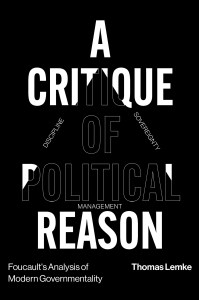
Lemke---Critique-of-Political-Reason-c0bda97e498ee06279c0258d0e2577ecAlso with Verso, the long overdue translation of Thomas Lemke, A Critique of Political Reason: Foucault’s Analysis of Modern Governmentality– forthcoming in January 2019.
Lemke offers the most comprehensive and systematic account of Michel Foucault’s work on power and government from 1970 until his death in 1984. He convincingly argues, using material that has only partly been translated into English, that Foucault’s concern with ethics and forms of subjectivation is always already integrated into his political concerns and his analytics of power. The book also shows how the concept of government was taken up in different lines of research in France before it gave rise to “governmentality studies” in the anglophone world. A Critique of Political Reason provides a clear and well-structured exposition that is theoretically challenging but also accessible for a wider audience. Thus, the book can be read both as an original examination of Foucault’s concept of…

View original post 11 more words

From Stockerblog
Philosophy, Politics, Culture from Barry Stocker, British philosopher based in Istanbul

Barry Stocker, ‘Foucault on Two Types of Neoliberalism: ORDO Liberalism and Anarcholiberalism, along with European Historical Roots’ (in English) in Dokuz Eylül Üniversitesi Edebiyat Fakültesi Dergisi, latest issue. See linked pdf, article starts page 187. It represents early work for a project on Foucault and liberty (also nodding towards work on philosophy of Europe).

Abstract

Michel Foucault is well known for writing on Neoliberalism, but the richness of his approach should be better understood, along with its place in his work as a whole. Foucault does not refer to Neoliberalism as one thing, but as divided into two types: Ordoliberalism and anarcholiberalism. That is between a more institutional version allowing for some state direction and a more anti-statist version. This overlaps with a distinction between Europe and the United States. It also connects with Foucault’s interests in the relation between the roles of Germany and France in European history with regard to state sovereignty and law. The interaction of France and Germany has produced various conflicting and coalescing ideas of liberty and the state up to the way Neoliberal ideas have circulated. In the context of Foucault’s own development, his investigations into Neoliberalism build on work on Enlightenment liberalism, bringing in Phenomenological anti-naturalism as a way of understanding the difference. It also builds on work on the development of political economy from its earliest texts to the work of Marx. The discussion of earlier political economy emphasises its place in a philosophy of history and humanism, which is recontextualised in Foucault’s work on Neoliberalism. Foucault’s work on the inevitability of blindness and subjectivity in epistemology, along with the role of subjectivity in ethics, also develops through the encounter with Neoliberalism.

stuartelden's avatarProgressive Geographies

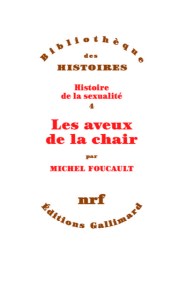
hs-iv.jpgI gave a talk about Foucault’s Les aveux de la chair on May 9th at the Centre for Philosophy and Critical Thought, Goldsmiths University. Full details here.

The talk was based on my review essay on the book, published on the Theory, Culture & Societywebsite. If you’ve read that review, then there is little in the talk beyond it, but since a couple of people asked, an audio recording of the talk is available here.

In February 2018 the fourth volume of Michel Foucault’s History of Sexuality was finally published. Les Aveux de la chair [Confessions of the Flesh] was edited by Frédéric Gros, and appeared in the same Gallimard series as volumes 1, 2 and 3. The book treats the early Christian Church Fathers of the 2nd-5th century. This talk will discuss the book in relation to Foucault’s other work, showing how it sits…

View original post 103 more words

Craig Owen's avatarDancing Gender

I’m a lecturer in Psychology and I’ve used Foucauldian discourse analysis (FDA) in my own research on masculinity and health. On 2nd May 2018 I led a FDA workshop for staff and PhD students at St.Mary’s University. A video of the workshop is below, and might be of use to qualitative researchers considering using or teaching discourseanalysis.

Building on Michel Foucault’s work on power, discourse, knowledge and language, FDA offers critical analyses of a range of multi-media texts, practices and social interactions.

In the workshop, participants explored the key principles of social constructionism and Foucault’s work which underpin this method. Workshop participants then worked in small groups to analyse a contemporary pop video by ‘Plan B’. The workshop concluded with a discussion of how the method could be integrated into the workshop participants’ ongoing research.

Workshop Resources:

A Theoretical and Hands-on Introduction to Foucauldian Discourse Analysis –…

View original post 41 more words

KINGSTON SHAKESPEARE SEMINAR AT GARRICK’S TEMPLE

SATURDAY JUNE 23 2018

FOUCAULT AND SHAKESPEARE

10.00: Chair: Richard Wilson (Kingston University)

Jonathan Dollimore
‘Foucault, Shakespeare and Cultural Materialism’

11.00: Coffee (Temple Pavilion)

11.30: Chair:

Kélina Gotman (King’s College University of London)
‘Foucault, Theatre, Critique’

Thomas Brockelman (Le Moyne College)
‘Foucault and Lacan Interpret Las Meninas: On the virtues and limitations of philosophical reading’

13.00: Lunch (Bell Inn, Hampton)

14.30: Chair:

Duncan Salkeld (University of Chichester)
King Lear and Foucault’s History of Madness

Jennifer Rust (Saint Louis University)
‘Of Government the Properties to Unfold:Foucault’s Genealogy of Governmentality and Measure for Measure

16.00: Tea (Temple Pavilion)

16.30: Chair:

Stuart Elden (University of Warwick)
‘Contagion in Troilus and Cressida

17.30: Round Table Discussion

To register for this event go to:
https://foucaultandshakespeare.eventbrite.co.uk