Journée d’étude internationale : Michel Foucault et la force des mots
Programme: Centre Prospero, Bruxelles


Journée d’étude internationale : Michel Foucault et la force des mots
Programme: Centre Prospero, Bruxelles
Extract
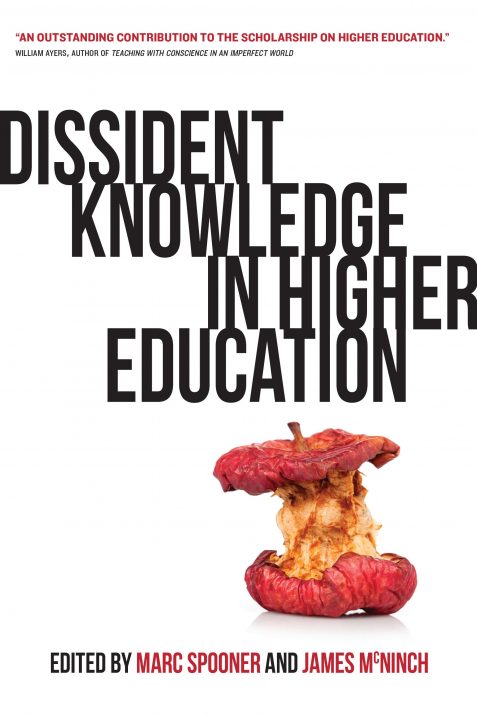
Marc Spooner and James McNinch write about their new edited book: Spooner & McNinch (2018) Dissident Knowledge in Higher Education(https://uofrpress.ca/Books/D/Dissident-Knowledge-in-Higher-Education)
It is an exciting time of possibility as research approaches continue to be contested, disrupted, and broadened to include a wide variety of promising departures from orthodoxy. What has been labelled, in various instances, posthumanism, new materialism, the ontological turn, the affective turn, and/or post-qualitative research join ongoing developments in community-engaged, participatory, decolonizing, place-based, and Indigenous research approaches.
Yet, just as these enticing possibilities invite us to expand our research in ways unimagined just a decade ago, a parallel counterbalancing shift towards a ubiquitous neoliberal and accountability-focused culture – both in the academy and in society – imperils these promising developments. As audit culture and governmentality spread, they give rise to a new managerialism set on measuring us against rigid conceptions of research and impact, regardless of how inappropriate, unethical, or deleterious such constricting measures may be to ourselves and our communities. Ultimately, at stake, is the very notion of what can be considered knowledge itself.
Foucault fiches de lecture
ANR project: Foucault’s Reading Notes
Transcrire les fiches de lecture de Michel Foucault avec le logiciel Transkribus : compte rendu des tests
Une collaboration internationale avec le projet européen READ/Transkribus a été mise en oeuvre pour la transcription automatique des manuscrits de fiches de lecture. Transkribus est un logiciel de reconnaissance automatique de l’écriture manuscrite, accompagné d’une plateforme de transcription d’images numérisées de manuscrits et d’un OCR classique.
À propos
Le projet Foucault Fiches de Lecture (FFL) a pour but d’explorer et de mettre à disposition en ligne un large ensemble de fiches de lecture de Michel Foucault (1926-1984) conservées à la BnF depuis 2013. Ce corpus de plusieurs milliers de feuillets contient une collection considérable de citations et de références, organisées et commentées par Foucault pour la préparation de ses livres et de ses cours. Il ne s’agira pas seulement de rendre accessibles les sources du philosophe, mais de contribuer à l’élaboration d’une herméneutique philosophique, reposant sur l’analyse des pratiques documentaires et des styles de travail de Foucault. Ce carnet de recherche, véritable carnet de route du projet, souhaiterait informer la communauté scientifique et plus largement le public de l’avancée des travaux (numérisation, transcription, prototype, etc.) et du développement d’une plateforme dédiée. Ce projet financé par l’ANR (2017-2020) et coordonné par Michel Senellart, professeur de philosophie à l’ENS Lyon, bénéficie des partenariats de l’ENS/PSL et de la BnF.
 Review by Nicholas Till, Times Higher Education.
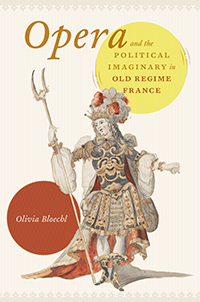
Olivia Bloechl, Opera and the Political Imaginary in Old Regime France
University of Chicago Press,
272pp, £41.50ISBN 9780226522753Published 10 April 2018
[,,,]
Bloechl turns to writers such as Michel Foucault, Judith Butler and Agamben, who have all theorised the ways in which power operates not only through the exercise of violence – actual or threatened – and reward, but also in the micro-regimes of a culture that becomes naturalised and internalised in the subject.
Obligatory displays of ritualised grief at the passing of public figures are re-enacted in the scenes of choral lament in tragédie lyrique. The passivity of the subject in the face of power is replicated in the lack of agency of the chorus.
Foucault’s self-disciplinary regime of the “confessing society” is conveyed through the ubiquity of self-punishing confessions in French opera, in which there is a transition from an externally imposed sense of moral obligation in the 17th century to an internalised mode that is represented by the advent of the “tormenting orchestra” in 18th-century operas. Bloechl also demonstrates that in the near century of tragédie lyrique’s ascendancy, power in the ancien régime shifted from the personal absolutism of Louis XIV to the more remote rulership of his great-grandson Louis XV. This is conveyed in dramatic narratives in which it is not the god or ruler who exercises authority or justice, but a mediating representative. And Pluto’s underworld? It resembles “nothing so much as an absolutist monarchical state”, founded on the principle of the precarity of the subject under the permanent threat of death.
Nedim Karakayali, Burc Kostem, and Idil Galip, Recommendation Systems as Technologies of the Self: Algorithmic Control and the Formation of Music Taste
(2018) Theory, Culture and Society, 35 (2), pp. 3-24.
https://doi.org/10.1177/0263276417722391
Abstract
The article brings to light the use of recommender systems as technologies of the self, complementing the observations in current literature regarding their employment as technologies of ‘soft’ power. User practices on the music recommendation website last.fm reveal that many users do not only utilize the website to receive guidance about music products but also to examine and transform an aspect of their self, i.e. their ‘music taste’. The capacity of assisting users in self-cultivation practices, however, is not unique to last.fm but stems from certain properties shared by all recommendation systems. Furthermore, unlike other oft-studied digital/web technologies of the self which facilitate ‘self-publishing’ vis-à-vis virtual companions in social media, recommender algorithms themselves can act as ‘intimate experts’, accompanying users in their self-care practices. Thus, recommendation systems can facilitate both algorithmic control and creative self-transformation, which calls for a theorization of this new cultural medium as a space of tension.
Author Keywords
algorithms; care of the self; Foucault; last.fm; online music recommendation; recommendation systems; technologies of the self

“This Tale Is About You!”: On Bini Adamczak’s “Communism for Kids” – Los Angeles Review of Books, By Ross Wolfe JUNE 27, 2017
BINI ADAMCZAK’S Communism for Kids isn’t just for kids. The book is meant for readers of all ages, but its style is deliberately naïve. Adamczak addresses everyone as children in order to awaken their childlike sense of imagination and ability to dream. She reminds them that the world has not always been this way, and need not stay as it is. Adopting the language of make-believe, Adamczak introduces the problem posed by capitalism so those still young at heart might arrive at a solution. “[G]enuine fairy tales,” the Marxist critic Siegfried Kracauer maintained during the Weimar years, “are not stories about miracles but rather announcements of the miraculous advent of justice.”
[…]
The crucial reference for Adamczak is Deleuze’s colleague, Michel Foucault. She quotes him as saying that “the role of intellectuals today must be to restore the same level of desirability for the image of revolution that existed in the 19th century.” Foucault wavered on this, though, unsure if revolution was really so desirable after all (citing Horkheimer’s doubts). He told Bernard-Henri Lévy that “something quite different is at stake in Stalinism [than the viability of revolution]. You know very well […] that the very desirability of the revolution is the problem today.” Asked whether revolution was something he desired, Foucault refused to commit himself.
The following is an interview with the famed Continental philosopher Giorgio Agamben conducted by journalist Antonio Gnolio. Originally published in La Repubblica on May 15, 2016. the interview is translated from the Italian by Ido Govrin, whose bio is given at the end. It is translated with permission of La Repubblica.
[…]
AG: In recent years you have intensified your call on “biopolitics.” Is this a concept we owe in large part to Michel Foucault?
GA: Certainly. But just as important to me was the problem of method in Foucault, namely the archeology. I’m convinced that these days the only way to access the present is through investigation of the past, the archeology. It should be made clear, as Foucault does, that archeological researches are not just the shadow that the interrogation of the present projects on the past. In my case, this shadow is often longer than that sought after by Foucault and probes fields such as theology and law, which Foucault hardly looked at. It certainly may turn out that the results of my research are disputed, but I hope at least that the purely archeological researches I developed in State of Exception,[6] The Kingdom and the Glory,[7] or in the book on oath,[8] help us understand the time in which we live.

Oleg Bernaz, Une archéologie de l’épistémè de l’union, in Oleg Bernaz et Marc Maesschalck (éds), Approches philosophiques du structuralisme linguistique russe, Peter Lang, Bruxelles, 2018.
Cette entreprise foucaldienne se déploie en trois étapes. Il s’agit premièrement d’analyser le statut du savoir de ce que Foucault appelle « l’épistémè moderne ». Nous montrons, à ce stade de notre enquête archéologique, que l’articulation des savoirs de l’économie, de la linguistique et de la biologie modernes se fait d’une manière singulière. Ce parcours nous permet de montrer deuxièmement en quoi consiste l’originalité de l’articulation que l’on peut établir entre l’économie, la biologie et la linguistique dans le cadre de ce que nous proposons de nommer « épistémè de l’union » dans le contexte de l’URSS des années 1920-1930. La troisième étape de notre analyse est consacrée à une réflexion sur le rapport non plus entre la biologie, l’économie et la linguistique, mais entre les deux épistémès identifiées précédemment. L’idée d’une histoire sérielle, centrale pour comprendre ce que Foucault entend par « savoir », nous sert de fil conducteur pour thématiser ce nouveau rapport entre les épistémès moderne et de l’union.
by Skye Sherwin, Sat 25 Nov 2017
Stephen Friedman Gallery, London
Editor’s note: old news
Kehinde Wiley: In Search of the Miraculous is at Stephen Friedman gallery, London, until 27 January.
The US artist picked as Obama’s official portraitist plots a romantic, maritime course for his show “In Search of the Miraculous”
Kehinde Wiley is the superstar American painter famed for placing anonymous, beautiful black men in kitsch pastiches of Old Master portraits of the ruling class. He is also that rare thing, an artist who has broken through to a mass audience. In addition to his street-cast “boys”, as he has called his models, he’s painted a black pantheon, from hip-hop stars to Michael Jackson. Fox’s most-watched soap, Empire, uses his paintings as a sure-fire sign of black empowerment. Topping it all, it was recently announced that he is to be the official portraitist of Barack Obama.
[..]

Ship of fools … the film installation Narrenschiff. Photograph: Mark Blower/courtesy Kehinde Wiley and Stephen Friedman Gallery, London
He’s also made his first film, which speaks, amid paradisal swimming scenes, of how the self (so central to the romantics) has been violently denied to black people. In voiceover, we get quotes from philosopher Michel Foucault’s Madness and Civilisation, and African-Caribbean philosopher, revolutionary and psychiatrist Frantz Fanon’s The Wretched of the Earth, about “otherness”, engendered by colonisation or imposed on the mad, as well as the medieval “ship of fools” and its pilgrimage for selfhood. While this brings an intellectual framework behind the seascapes somewhat neatly into focus, the thinkers’ weighty ideas about psychic violence and cultural trauma are never convincingly borne out in the works themselves.
Matthews, J.
Occupation as refrain: territory and beyond in Occupy London
(2018) Social Movement Studies, 17 (2), pp. 127-143.
DOI: 10.1080/14742837.2018.1427056
Abstract
Emerging with the wider ‘movements of the squares’ of 2011, Occupy London was defined by occupation, and by participants’ negotiation of what occupation meant. Its forms and meanings changed as London’s Occupiers moved between occupied sites, through uprootings by eviction, and into post-eviction attempts to extend Occupy’s territorial politics without the camps. This paper builds on three years of ethnography to consider occupation as an unfolding process, using Deleuze and Guattari’s concept of the ‘refrain’. This describes territory in three ‘moments’: the marking of a fragile centre; the stabilization of a bounded ‘home’; and the breaching of boundaries, extending in progressive directions. This rubric is used to analyze London’s occupations, and their defining tension, between an expansive desire to ‘Occupy Everywhere’–connecting to the wider ‘99 percent’–and the tendency to become embedded in the protest camp ‘home’. The features of ‘home’ are analyzed using Foucault’s concept of ‘heterotopia’, highlighting an alterity with ambivalent consequences for Occupy’s project. The paper argues that despite a desire to ‘deterritorialize’ occupation, Occupy London stalled in the moment of ‘home’, a consequence of the camp’s status as the ‘common ground’ of an often disparate movement, and the reduction of productive capacities characterizing Occupy’s terminal downswing. © 2018 Informa UK Limited, trading as Taylor & Francis Group.
Author Keywords
heterotopia; occupation; Occupy movement; protest camp; refrain; social movement territory

 Foucault News