Foucault News

News and resources on French thinker Michel Foucault (1926-1984)

Vicente L. Rafael (2019), The Sovereign Trickster, The Journal of Asian Studies Vol. 78, No. 1 (February) 2019: 141–166.
doi:10.1017/S0021911818002656

Abstract
In our current moment, authoritarian figures loom large. One of them is Philippine President Rodrigo Duterte. He seems to embody two notions of sovereignty. One is related to law, the other to norms: on the one hand, the power of taking exception to the former, deciding who will live and who will die; on the other hand, the freedom from the limits of the latter by way of dissipation, irresponsibility, and excess. This article explores the double sources of his power with reference to the works of Michel Foucault and Achille Mbembe. While most of Foucault’s work has focused on Europe, Mbembe has written about postcolonial conditions in ways that make critical use of Foucault. Drawing from their writings, this article situates Duterte as a “sovereign trickster” who seeks to dominate death while monopolizing laughter. Finally, this article speculates on the comparative usefulness of this figure of the sovereign trickster with regard to President Donald Trump, whose form of tricksterism derives, the author argues, from the tradition of blackface minstrelsy.

Keywords: death, drug war, Duterte, Foucault, Mbembe, Philippines, sovereignty, trickster, Trump

Susan L. Johnson, Workplace bullying, biased behaviours and performance review in the nursing profession: A qualitative study (2019) Journal of Clinical Nursing, 28 (9-10), pp. 1528-1537.
https://doi.org/10.1111/jocn.14758

Abstract
Aims and objectives: To explore staff nurses’ discourses of workplace bullying, to critically examine how these discourses affect their responses to bullying. Background: Workplace bullying has been identified as a pervasive problem within the nursing profession. Efforts to eradicate workplace bullying need to involve staff—targets as well as bystanders. By understanding how this population conceptualises workplace bullying, more effective and targeted solutions to the problem can be devised. Design: This qualitative study used a critical discourse analysis method which was based on the work of Foucault.

Methods: Thirteen staff nurses who worked in a variety of settings in the USA were interviewed. COREQ checklist was used for this article.

Results: Three interrelated discursive strands were identified: “biased behaviour manifested as workplace bullying, workplace bullying disguised as performance review and workplace bullying as entrenched behaviour in nursing”. Actions in response to bullying varied according to which discursive strand was invoked.

Conclusions: The central theme at the intersection of the discursive strands was that workplace bullying is a mechanism for driving out nurses who are different. Relevance to clinical practice: Efforts to address workplace bullying among nurses need to include training on legitimate methods of performance review, workshops on how to interact with diverse co-workers, and examination of how practices with nursing education contribute to the perpetuation of bullying in clinical settings. © 2018 John Wiley & Sons Ltd

Author Keywords
bias; critical discourse analysis; harassment; nursing education; performance review; staff nurses; workplace bullying

Index Keywords
article, bullying, checklist, clinical practice, coworker, discourse analysis, harassment, human, human experiment, nursing education, occupation, qualitative research, staff nurse, workplace

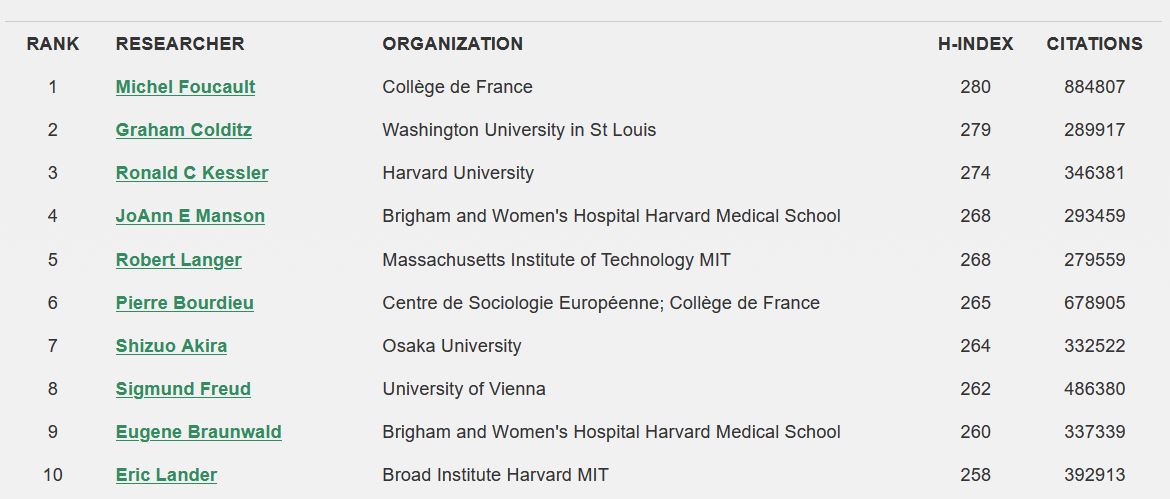
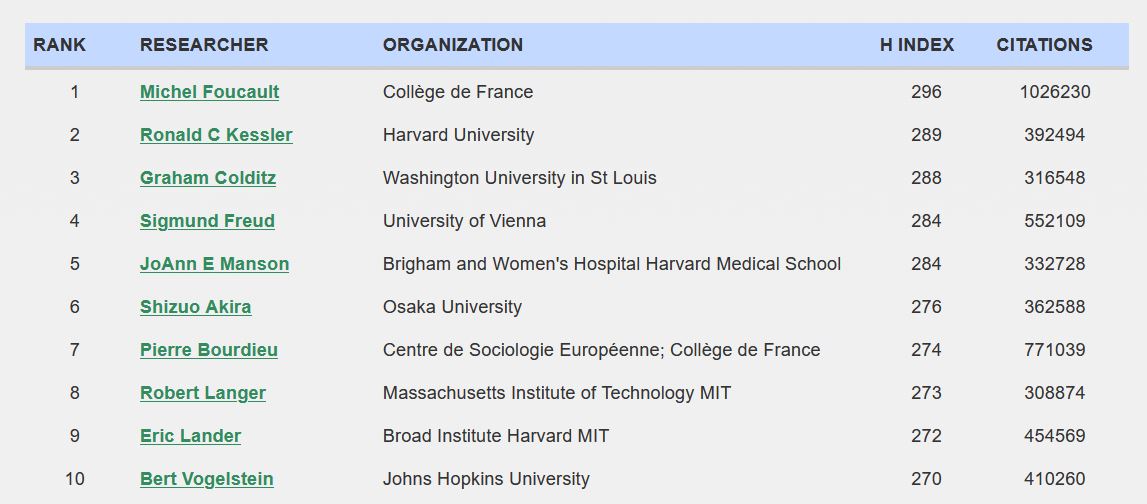
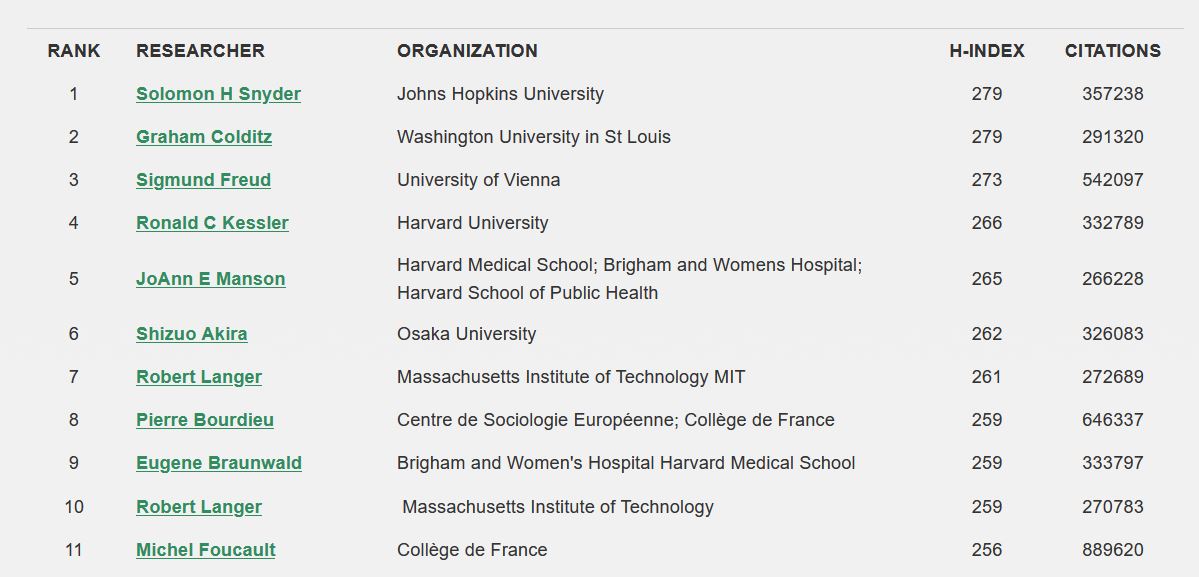
Highly Cited Researchers (h>100) according to their Google Scholar Citations public profiles, Ranking Web of Universities, Tenth Edition

[Editor: See also my January 2025 post on this topic.]

[Editor. Update 8 February 2026. The link above is to the archived page on the Wayback Machine. The Wayback Machine only started indexing the Ranking Web of Universities in 2018. In 2018, Foucault was ranked at number 11
In April 2020, he was ranked again at number 1. In 2021, the list excluded deceased authors and Foucault was no longer ranked as a result.
]

Highly Cited Researchers (h>100) according to their Google Scholar Citations public profiles. Tenth Edition

The data for this edition was collected during the first week of April 2019 of a BETA list of the public profiles of the most highly cited researchers (h-index larger than 100) according to their declared presence in the Google Scholar Citations database. There is a separate ranking for the high energy physicists with hyper-authored papers.

The list, that includes both living and deceased authors, is ranked first by h-index in decreasing order and when ties appear, then by the total number of citations as a secondary criteria.

This ranking is far of being complete, as many scientists have no developed a GSC public profile yet, that it is a very easy and free task and with a surprisingly large coverage of both contributions and citations. […]

Methodology

2019

2020

2018

Marlon Salomon, “Eso no es un libro de historia”: Michel Foucault y la publicación de documentos de archivos, Topoi (Rio de Janeiro). vol.20 no.40 Rio de Janeiro Jan./Apr. 2019
DOI: 10.1590/2237-101×020040011

Open access

RESUMO
Entre 1973 e 1982, Michel Foucault dedicou-se à publicação de documentos de arquivo. Em 1973, publicou o memorial de Rivière; em 1977, os extratos do livro de um libertino inglês; em 1978, as lembranças de uma jovem hermafrodita; e em 1982 uma seleta de documentos judiciários. Dividido em duas partes, este artigo busca compreender o que esteve em jogo nesse gesto arquivístico-editorial. Na primeira parte, analisarei as relações existentes entre os textos que compõem esse corpus e como se inserem no quadro, então, de suas pesquisas. Depois, estudarei os deslocamentos existentes entre o projeto de publicação de uma coletânea de arquivos da infâmia e a publicação do livro com documentos da Bastilha. Na segunda parte, apresentarei duas hipóteses sobre os problemas ligados a esse projeto editorial: 1) Mostrarei que se tratava de um estudo das condições extraliterárias da constituição da literatura como saber; 2) Mostrarei como seu empenho em publicar documentos não pretendia apenas dar a palavra aos sem-história, mas assinalar que havia um pensamento em suas falas. Esse empenho chocava-se com um dos principais dogmas historiográficos contemporâneos.

Palavras-chave: historiografia francesa; teoria da história; arquivologia; biblioteconomia; saberes literários

“It is not a history book”: Michel Foucault and the publication of archival documents

ABSTRACT
Between 1973 and 1982, M. Foucault dedicated himself to editing and publishing archival texts. He published Pierre Rivière’s memorial in 1972, extracts from an English libertine’s book in 1978, and the memoirs of a young hermaphrodite in 1979. In 1982, he published a selection of documents from court archives. This article, organized in two parts, aims to understand what was at play in that archivistic-editorial endeavor. In the first part, I analyze the relations among the texts that make up that corpus and their insertion in Foucault’s overall research work of that period. Then, I address the contrasts between the project to publish a collection of archives of infamy, as it was announced in 1977, and the book actually published in 1982 with documents of the Bastille. In the second part, I put forward two hypotheses I consider to be connected to that editorial project: 1) it was a study of extra-literary conditions of the constitution of literature as knowledge; and 2) his effort to publish archival documents sought not only to “give voice” to those with no history, but also to show that a thought was embedded in their pronouncements. Foucault’s performance swam against the main currents of historiographical dogmas at the time.

Keywords: French historiography; theory of history; archive science; library science; literary knowledge forms

Petri, O. Discipline and Discretionary Power in Policing Homosexuality in Late Imperial St. Petersburg (2019) Journal of Homosexuality, 66 (7), pp. 937-969.

DOI: 10.1080/00918369.2018.1485302

Abstract
This article explores queer sexual policing in late Imperial St. Petersburg (c.1900–1917). The focus is on the street-level constables who bore the principal responsibility for policing male homosexual offenses in the city’s public and semi-public spaces. This emphasis on the street-level policing of homosexuality contrasts with other discussions of gay urban history and the oppression of queer men by the authorities. The article draws on new evidence from precinct-level police archives to complement and challenge previous discussions of queer sexual policing in the Imperial capital. By taking the fate of queer men in an autocratic city, this article refines our understanding of the ways in which homosexual practices and identities emerged in modern times. Specifically, it builds on Michel Foucault’s descriptions of constables as “arbiters of illegalities,” where the term arbiter suggests rule-based and yet discretionary coercion. Here, the influential model of disciplinary policing of sexuality is complemented by an emphasis on the role of discretionary power in the history of homosexuality. © 2019, © 2019 Taylor & Francis Group, LLC.

Author Keywords
administrative history; disciplinary society; late imperial St. Petersburg; Queer sexual policing; queer urban history; selective control of urban space

Informations – link to further info

Special Issue: Biopolítica, segurización y gubernamentalidad, Revista Mexicana De Análisis Político Y Administración Pública, Vol. 7, núm. 2 (2018)

Open access

Tabla de contenidos

Índice

Índice PDF
1-2

Presentación

Presentación PDF
José de Jesús Ramírez Macias, Cuauhtémoc N. Hernández Martínez 3-10

Autor invitado

La frontera incorporada: espacio, cuerpo y seguridad PDF
Ignacio Mendiola Gonzalo 13-32

Dossier

Aproximaciones espaciales a la biopolítica y la gubernamentalidad en clave territorial PDF
José de Jesús Ramírez Macias, Cuauhtémoc N. Hernández Martínez 35-58
Estrategias de gobierno, espacios de desregulación y posiciones de conflicto. Urbanismo y enfoque gubernamental PDF
Adán Salinas Araya 59-70
La ciudad como diagrama de las artes liberales de gobierno en la lectura foucaulteana del nacimiento del gobierno económico de la población PDF
Guillermo Andrés Vega 71-88
Dispositivos discretos de cumplimiento de reglas legales PDF
Vicente Ugalde Saldaña 89-110
La magia de la gubernamentalidad: el caso de los Pueblos Mágicos en México PDF
Nubia Cortés Márquez, Jorge Vélez Vega 111-132
El dispositivo frontera PDF
Emmanuel Guerrero Trejo 133-150

Ensayos

Autonomía de gestión para la calidad y equidad educativa: una evaluación del Programa Escuelas de Calidad (PEC) PDF
Francisco J. Cabrera Hernández, María Elena Pérez Campuzano 153-174
El derecho humano de defensa técnica en el sistema de responsabilidades administrativas, como parte del Sistema Nacional Anticorrupción en México y Sistema Estatal Anticorrupción de Guanajuato PDF
Antonio Silverio Martínez Hernández 175-192

Reseñas

Mitología de la seguridad. La ciudad biopolítica, de Andrea Cavalletti PDF
Emmanuel Guerrero Trejo 194-196
La Profesionalización Legislativa en México. Evidencias en Congresos estatales y el Congreso federal, de Fernando Patrón Sánchez y Ma. Ofelia Camacho García PDF
Mara Gómez Ojeda 197-200
Mujeres en la política. Experiencias nacionales y subnacionales en América Latina, de Flavia Freidenberg, M. Caminotti, B. Muñoz Pogossian, y T. Došek (edits.) PDF
María Emilia Perri

5th International Workshop on Historical Epistemology
The Philosophy of the Life Sciences.Biology and Medicine Through the Prism of Historical Epistemology

Paris, 16-17-18 May 2019

École doctorale de Philosophie (ED 280 – Paris 1)
Centre de Philosophie Contemporaine de la Sorbonne,
Institut des sciences Juridique & Philosophique de la Sorbonne
(UMR 8103 CNRS – Paris 1)
Institut d’Histoire et de Philosophie des Sciences et des Techniques
(UMR 8590 CNRS – Paris 1)

Avec le soutien de la Maison d’Auguste Comte

Register here

IMPORTANT: All sessions will take place at Centre Panthéon, 12 Place de la Sorbonne, 75005, Paris (Room 6, Staircase M, 4th floor). For safety reasons registration is mandatory.

Thursday 16 May

9h Welcome & Opening

9h30 Accumulation and the Progress of Knowledge. Reflections on Natural History and Biology, Staffan Müller-Wille (Exeter)

10h30 Coffee break

10h50 Revisiting the history of biology with nutrition: vital mechanisms and the ontology of life, Cecilia Bognon (Labex Who am I/IHPST)

11h30 Le principe de la sélection naturelle : une loi « organique » pour les sciences de la vie ? , Nicola Bertoldi (IHPST)

12h10 Lunch

14h10 Dreaming of a universal biology, Massimiliano Simons (Leuven)

14h50 La biologie relationnelle : ni vitalisme, ni mécanisme, Modera Astrid (Namur)

15h30 Coffee break

15h50 The underestimated influence of Spinoza’s philosophy on Johannes Peter Müller’s sensory physiology, Buyse Filip (Leuven)

16h30 Biological and psychological development. On the translation of a concept in youth psychology (ca. 1920-1945), Carla Seeman & Laurens Schlicht (Humboldt)

17h10 Du mode d’existence des bio-objets : comment les bio-banques défient l’épistémologie, Emanuele Clarizio (ISJPS)

Friday 17 May

9h30 Formes et formations de la vie – Foucault et Canguilhem Maria Muhle (Münich)

10h30 Coffee break

10h50 A life among necrological folds: A vitapolitics for education, Pietra Mikulan & Taylor Webb (Vancouver)

11h30 Gouvernement du vivant et gouvernement des vivants. Une critique du concept cybernétique de régulation (sociale), Marco Ferrari (Padoue)

12h10 Lunch

14h10 L’axiologie dans les sciences de la vie : une confrontation entre la pensée de Canguilhem et le débat contemporain en philosophie de la biologie, Silvia De Cesare (Leipzig)

14h50 La philosophie biologique de Canguilhem en question : pour une nouvelle alliance entre la technique et la vie, Fiorenza Lupi (Sapienza)

15h30 Coffee break

15h50 Les commencements de la philosophie de la technique : vers une approche biologique de l’activité fabricatrice, Marcos Camolezi (Paris 1)

16h30 The normativity of life: Canguilhem and Hegel, Pierpaolo Cesaroni (Padoue) & Luca Corti (Porto)

17h10 Schelling et Canguilhem lecteurs de John Brown (1735-1788) – quelle analogie entre leurs vitalismes ? , Gregorio Demarchi (Zürich)

Saturday 18 May

9h30 L’équivocité du sexe à travers les regnes, Thierry Hoquet (Nanterre)

10h30 Coffee break

10h50 Quelle scientificité pour la santé comme normativité ?, Stéphane Zygart (Lille)

11h30 Faire de la santé un objet de science : les échecs répétés d’un projet médical à l’aune de la philosophie canguilhémienne, Delphine Olivier (Paris 1)

12h10 Closing remarks

Register here

IMPORTANT: All sessions will take place at Centre Panthéon, 12 Place de la Sorbonne, 75005, Paris (Room 6, Staircase M, 4th floor). For safety reasons registration is mandatory.

Scientific committee

Christian BONNET, CHSPM Paris 1
Jean-François BRAUNSTEIN, PhiCo Paris 1
Hasok CHANG, Cambridge University
Cristina CHIMISSO, Open University
Arnold I. DAVIDSON, University of Chicago
Moritz EPPLE, Goethe Universität Frankfurt Am Main
Pierre WAGNER, IHPST Paris 1

Organizing committee

Laurent LOISON, Ivan MOYA DIEZ, Matteo VAGELLI (coordinateurs)
Caroline ANGLERAUX, Marcos CAMOLEZI, Victor LEFEVRE, Gabriele VISSIO

Facebook page

epistemologiehistorique@gmail.com

M. Habib Qazi, Saeeda Shah, Discursive construction of Pakistan’s national identity through curriculum textbook discourses in a Pakistani school in Dubai, the United Arab Emirates (2019) British Educational Research Journal, 45 (2), pp. 275-297.
https://doi.org/10.1002/berj.3496

Abstract
This study investigates Pakistan’s secondary school children’s constructions of their national identity in a Pakistani school in Dubai by drawing on data collected from students and teachers from the case school and analysing national curriculum textbooks used in the school. Informed by Foucault’s concepts, the article problematises how the curriculum textbooks are employed as a technology of power for inculcating national consciousness in the students. The findings suggest that Pakistan’s national curriculum textbooks deploy a specific version of Islam as a major technology, which then influences other national identity signifiers in the textbooks for shaping students’ national identity. The school affords a crucial space for the complex interplay of these technologies, which construct students’ ethnocentric national identities, encouraging social polarisation. This has implications for Pakistan’s national social cohesion as well as the potential for subverting international peaceful coexistence and working relationships, particularly in the selected overseas study context. © 2018 British Educational Research Association

Author Keywords
curriculum and national identity construction; ethnocentric identities; Foucault’s technologies of power and self; Islam and gender

Behrendt, S. This Is Not an Improvisation: Letitia Landon and the Slipperiness of Taxonomy (2019) European Legacy, 24 (3-4), pp. 283-300.

DOI: 10.1080/10848770.2018.1562667

Abstract
Writing in 2007, in The Wordsworth Circle, Jeffrey Robinson remarked on the “ephemerality” of improvisational poetry, its fundamental resistance to being “preserved.” Printed poetry is typically regarded as “fixed” and static: what any poem represents as improvisation is, at best, only a record, executed in a fixed medium, of a performance whose infinite variability is inherent in the nature of improvisation itself. Partly an homage to Rene Magritte’s This is Not a Pipe (1928–29) and to Michel Foucault’s 1973 essay on that painting, and using as a test case The Improvisatrice (1825), the long poem by Letitia Elizabeth Landon, herself a devotee of interdisciplinary and multimedia performance, this essay considers the physical, structural, and methodological challenges and limitations posed to printed “word art” by works that purport to be, or aspire to the condition of, “improvisations.” The improvisatrice who is the poem’s narrator claims to be both a painter and a songstress, but her “speech,” captured and rendered in printed words by Landon (who ventriloquizes that speech), can neither “be” nor even “represent” a work produced (“performed”) in visual art or vocal song. In her long poem Landon effectively creates a literary trompe l’oeil, an illusion that depends for its “completion” upon the reader’s implied participation in that performative act of completion. In the process, Landon’s poem reveals the fundamental incompatibility of improvisational literary production with the performative nature of improvisation. © 2019, © 2019 International Society for the Study of European Ideas.

Author Keywords
British Romanticism; illusion; Improvisation; interdisciplinary; Letitia Elizabeth Landon; multistability; narrative/narrativity; performance/performativity; poetic voice; poetry; women writers