Foucault News

News and resources on French thinker Michel Foucault (1926-1984)

Emerson Maione, Thiago Rodrigues, Genealogia e Agonismo: uma analítica do poder na Justiça de Transição, Carta Internacional. Revista da Associação Brasileira de Relações Internacionaisv, 14 n. 1 (2019)
https://doi.org/10.21530/ci.v14n1.2019.821

Resumo
Este artigo baseia-se em sugestões teórico-metodológicas de Michel Foucault. Em especial,focaremos a analítica das relações de poder/saber, a genealogia, o agonismo, e as visõesdesse autor sobre justiça, veridicção e constituição dos sujeitos. Para sugerir como trabalha ametodologia genealógica, trazemos breves ilustrações sobre justiça de transição. Daí emergeuma sugestão de análise da justiça de transição que visa enxergá-la não como algo queapenas busque romanticamente a “verdade” e a “justiça”, mas também como uma verdadeirafrente de batalha cujo resultado dependerá das variações das relações de força em embateslocalizados. Sugere-se, portanto, que a genealogia é uma metodologia capaz de gerar análisesque fujam do maniqueísmo que estabelece, rigidamente, o “certo” e o “errado”, o “justo” eo “injusto”. E uma vez que a genealogia é, em si mesma, uma abordagem altamente política, parcial, ela busca questionar discursos que, ao contrário, se apresentam como neutros euniversais. Por isso ela se foca não em “objetos” rígidos e supostamente isoláveis do conjuntode acontecimentos sociais, mas interpela os acontecimentos, discursos e práticas de poder,interessada em identificar quais relações de poder e saber moldaram tal objeto.

Reflecting upon Genealogical and Agonistic Methodologies in International Relations: The case of Transitional Justice.

Abstract
This is article is based on theoretical-methodological suggestions by Michel Foucault. It focuses on the analytics of power/knowledges relations, on genealogy, on agonism and on his visions on justice, veridiction and the constitution of subjects. To suggest how the genealogic methodology works we bring brief illustrations form Transitional Justice. From this, it emerges an analysis of Transitional Justice that sees it not just as a romantic search for “truth” and “justice” but also as a battle front whose results will depend on the variations of force relations in localized struggles. Therefore, we suggest that genealogy is a methodology capable of produce analyses that skip rigid dichotomies such as “right” and “wrong”, “just” and “unjust”. And since genealogy is, in itself, a highly political and partial approach it seeks to question discourses that, on the other side, presents itself as neutral and universal. Hence it do not focus on rigid research “objects” that supposedly could be isolated from the set of social events but questions the events, discourses and practices of power with the aim of identify which relations of power and knowledge has shaped this object.

Keywords: Transitional Justice; Genealogy; Michel Foucault.
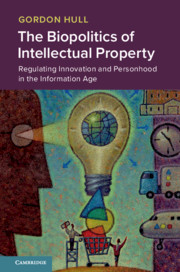
Gordon Hull, The Biopolitics of Intellectual Property: Regulating Innovation and Personhood in the Information Age, Cambridge University Press, 2018

As a central part of the regulation of contemporary economies, intellectual property (IP) is central to all aspects of our lives. It matters for the works we create, the brands we identify and the medicines we consume. But if IP is power, what kind of power is it, and what does it do? Building on the work of Michel Foucault, Gordon Hull examines different ways of understanding power in copyright, trademark and patent policy: as law, as promotion of public welfare, and as promotion of neoliberal privatization. He argues that intellectual property policy is moving toward neoliberalism, even as that move is broadly contested in everything from resistance movements to Supreme Court decisions. This work should be read by anyone interested in understanding why the struggle to conceptualize IP matters.

LaMothe, R.
Pebbles in the Shoe: Acts of Compassion as Subversion in a Market Society
(2019) Pastoral Psychology, 68 (3), pp. 285-301.

DOI: 10.1007/s11089-018-0833-1

Abstract
This article considers how compassion can be subversive to political-economic orders, whether these orders are found in church or society. Compassion is explained in terms of John Macmurray’s and Alex Honneth’s notion of recognition, the psychoanalytic concept of identification, and Michel Foucault’s views of knowledge and power. To illustrate how compassion can be subversive, the author turns to the realities of a market society—a society dominated by a culture of neoliberalism and neoliberal capitalism—and concludes with two case illustrations. © 2018, Springer Science+Business Media, LLC, part of Springer Nature.

Author Keywords
Capitalism; Compassion; Empathy; Identification; Neoliberalism; Power; Subversion

Index Keywords
article, capitalism, empathy, human, market, religion

Son, K.-M.
The making of the neoliberal subject: Response to Whyte
(2019) Political Theory, 47 (2), pp. 185-193.

DOI: 10.1177/0090591718774572

Abstract
In her recent essay, Jessica Whyte has challenged the tendency to repurpose Friedrich Hayek’s thought for a progressive and participatory politics. Objecting to such thinkers as Michel Foucault and William Connolly who find inspiration in Hayek’s critique of the monolithic political sovereign and his defense of spontaneous order, Whyte contends that his neoliberalism is actually predicated on the cultivation of politically submissive subjectivity and the curtailment of democratic politics. While agreeing with her substantive conclusions, I suggest that her conceptual frame centered on the themes of invisibility and providentialism is limited in explaining Hayek’s ideas and, more generally, the operation of neoliberalism. Pace Whyte, I argue that Hayek’s neoliberalism does not simply stave off political challenges by obfuscation, but wages an active and highly visible campaign to recruit and interpellate individuals as market subjects. © The Author(s) 2018.

Author Keywords
Friedrich Hayek; Neoliberalism; Political theory; Spontaneous order; Subjectivity

Theoretical Puppets
Published on May 19, 2019
Michel Foucault from A to Z. Foucault talks about Power and Freedom and the Liberty of Puppets…

Hildegunn Sundal, Karin Anna Petersen & Jeanne Boge, Exclusion and inclusion of parents of hospitalized children in Norway in the period 1877–2017 (2019) BMC Nursing, 18 (1), art. no. 6.
https://doi.org/10.1186/s12912-019-0330-6

Abstract
Background: Today, Norwegian parents have the right to stay with their children when they are in hospital. This right is relatively new. The purpose of this article is to examine the nursing profession’s ideas on how parents should be included/excluded when their children are in hospital, and to examine the social and ideological conditions that made the nursing profession’s ideas on inclusion/exclusion practices possible.

Methods: The analyses are done in the tradition of the French philosopher Michel Foucault’s writings on how different kinds of knowledge have been used to discipline citizens. Such studies include analyses of descriptive and normative material and analyses of the ideological and social conditions that made the practices possible. The analyses are based on Norwegian textbooks on nursing.

Results: Parents are rarely mentioned in Norwegian nursing textbooks from the period 1877-1940, and they are not present in photos from hospitals. The exclusion of parents may be due to the absence of welfare services and the fear of parents transmitting diseases from the hospitals to the general population. The first Norwegian nursing textbook that argued for the importance of letting parents visit their children in hospital was published in 1941. In 1968, nursing textbooks started to argue for parents’ participation in the care. Since 1987, nursing textbooks have advocated full parental participation. The inclusion of parents was in accordance with humanistic ideology. The inclusion of parents occurred in a period of great nursing shortage. In this situation, it would have been of interest to entrust as much as possible of the nurse’s work to the family.

Conclusions: Our conclusion is that ideas break through when they are in line with social conditions. From 1877 to 1940 social and economic conditions made it difficult for parents to be with their children in hospital, and hygiene ideology/theory contributed to legitimization of the exclusion of the parents in the care. During the period 1941-2017 it has been economically advantageous for the hospitals that parents care for their children. Ideas on the vulnerable child and self-help ideology have contributed to legitimization of the inclusion of the parents. © 2019 The Author(s).

Author Keywords
Children; Discipline; Exclusion; Hospital; Inclusion; Michel Foucault; Parents

Rowe, E., Lubienski, C., Skourdoumbis, A., Gerrard, J., Hursh, D.
Templates, typologies and typifications: neoliberalism as keyword
(2019) Discourse, 40 (2), pp. 150-161.

DOI: 10.1080/01596306.2019.1569875

Abstract
Neoliberalism as a concept, ideology, or theoretical lens has emerged in the last couple of decades as a monolithic presence in education research, and the social sciences more broadly. We bring two aims to this Special Issue: to critique the rigour of neoliberalism as a theoretical framework utilised within education research; and second, to explore and propose an alternative to neoliberalism as a critical frame of analysis. This paper will postulate three-waves of neoliberalism, specifically ordo-liberalism, radical liberalism, and post-neoliberalism. We challenge ‘big-N’ neoliberalism; conceptualisations of neoliberalism as homogenous and monolithic; and, demonstrate how neoliberalism interacts with particular milieus of time and space. In reflection of Williams but also Foucault’s tracing of ‘discursive formations’, neoliberalism as a keyword points to a genealogy of power which requires further excavation. The notion of an assemblage, enabling mutations and contra configurations, may offer a way forward. © 2019, © 2019 Informa UK Limited, trading as Taylor & Francis Group.

Author Keywords
Foucault; Fraser; keyword: assemblage; Neoliberalism; ordo-liberalism

Tara Brady, Paw Patrol: Mighty Pups: Cartoon canines in fascistic mission, The Irish Times, May 17, 2019

Review: An apawlling attempt to normalise state-sponsored thuggery

During the 1970s in a series of lectures at the Collège de France, Michel Foucault outlined a “secret history of the police”, characterising a force that paid greater attention to regulating the marketplace than investigating and arresting criminals.

The central task of the police, according to classical Foucauldian analysis, has also been to thwart and foil the possibility of revolution, the possibility of transgressing the order of capital: “For the bourgeoisie the main danger against which it had to be protected, that which had to be avoided at all costs, was armed uprising, was the armed people, was workers taking to the streets in assault against the government.”

Paw Patrol: Mighty Pups, the first theatrical reiteration from the popular animated franchise, is the latest shadowy attempt to normalise state-sponsored thuggery.

read more

Michel Foucault, left, and Michael Stoneman in a photo from the book “Foucault in California.” (David Wade)

SCOTT BRADFIELD, Death Valley acid trips and cocktails with Einstein — The SoCal lives of exiled minds, Los Angeles Times, MAY 17, 2019

“Foucault in California” by Simeon Wade, Heyday, 2019,

Over the decades, many intellectuals came to Southern California from somewhere else; and often they came to escape the systems of politics, logic and art they left behind. This seems especially true of French philosopher and social theorist Michel Foucault, the subject of this odd memoir.

Foucault was one of the most influential philosophers of the 20 century, producing numerous “disciplinary histories” documenting how systems of knowledge (sexual, linguistic, medical) were more effective at controlling populations than at disseminating knowledge. (He was also an early proponent of shaved heads and cool Kraftwerkian demeanor.)

[…]

Simeon Wade, Foucault in California [A True Story—Wherein the Great French Philosopher Drops Acid in the Valley of Death] Foreword by Heather Dundas, Heyday, 2018

In The Lives of Michel Foucault, David Macey quotes the iconic French philosopher as speaking “nostalgically…of ‘an unforgettable evening on LSD, in carefully prepared doses, in the desert night, with delicious music, [and] nice people.’” This came to pass in 1975, when Foucault spent Memorial Day weekend in Southern California at the invitation of Simeon Wade—ostensibly to guest-lecture at the Claremont Graduate School where Wade was an assistant professor, but in truth to explore what he called the Valley of Death. Led by Wade and Wade’s partner Michael Stoneman, Foucault experimented with psychedelic drugs for the first time; by morning he was crying and proclaiming that he knew Truth.

Foucault in California is Wade’s firsthand account of that long weekend. Felicitous and often humorous prose vaults readers headlong into the erudite and subversive circles of the Claremont intelligentsia: parties in Wade’s bungalow, intensive dialogues between Foucault and his disciples at a Taoist utopia in the Angeles Forest (whose denizens call Foucault “Country Joe”); and, of course, the fabled synesthetic acid trip in Death Valley, set to the strains of Bach and Stockhausen. Part search for higher consciousness, part bacchanal, this book chronicles a young man’s burgeoning friendship with one of the twentieth century’s greatest thinkers.

About the Author
Simeon Wade

Simeon Wade was born July 22, 1940, in Alabama. After earning his Ph.D. in the intellectual history of Western civilization from Harvard in 1969, Wade moved to California and became an assistant professor at Claremont Graduate School. His early teaching years culminated in his hosting a Death Valley trip for Michel Foucault in 1975, an experience Foucault described as “one of the most important in my life.” Wade later taught at several universities in Southern California and worked as a psychiatric nurse. He died in Oxnard, California, on October 3, 2017.