Foucault News

News and resources on French thinker Michel Foucault (1926-1984)

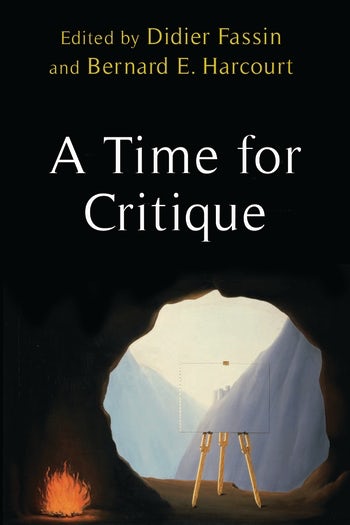
A Time for Critique, Edited by Didier Fassin and Bernard E. Harcourt
Columbia University Press, 2019

In a world of political upheaval, rising inequality, catastrophic climate change, and widespread doubt of even the most authoritative sources of information, is there a place for critique? This book calls for a systematic reappraisal of critical thinking—its assumptions, its practices, its genealogy, its predicament—following the principle that critique can only start with self-critique.

In A Time for Critique, Didier Fassin, Bernard E. Harcourt, and a group of eminent political theorists, anthropologists, sociologists, philosophers, and literary and legal scholars reflect on the multiplying contexts and forms of critical discourse and on the social actors and social movements engaged in them. How can one maintain sufficient distance from the eventful present without doing it an injustice? How can one address contemporary issues without repudiating the intellectual legacies of the past? How can one avoid the disconnection between theory and action? How can critique be both public and collective? These provocative questions are addressed by revisiting the works of Foucault and Arendt, Said and Césaire, Benjamin and Du Bois, but they are also given substance through on-the-ground case studies that treat subaltern criticism in Palestine, emancipatory mobilizations in Syria, the antitorture campaigns of Sri Lankan activists, and the abolitionism of the African American critical resistance and undercommons movements in the United States. Examining lucidly the present challenges of critique, A Time for Critique shows how its theoretical reassessment and its emerging forms can illuminate the imaginative modalities to rejuvenate critical praxis.

Contents
Introduction, by Didier Fassin and Bernard E. Harcourt

Part I: Critique as Practice
1. How Is Critique?, by Didier Fassin
2. Critique as a Political Practice of Freedom, by Linda M. G. Zerilli
3. Critique Without a Politics of Hope?, by Ayşe Parla
4. The Usefulness of Uncertain Critique, by Peter Redfield
5. Human Rights Consciousness and Critique, by Karen Engle
6. Critique as Subduction, by Massimiliano Tomba
7. What’s Left of the Real?, by Vanja Hamzić

Part II: Critique in Practice
8. Subaltern Critique and the History of Palestine, by Lori Allen
9. Critical Theory in a Minor Key to Take Stock of the Syrian Revolution, by Fadi A. Bardawil
10. Pragmatic Critique of Torture in Sri Lanka, by Nick Cheesman
11. Dispossession, Reimagined from the 1690s, by David Kazanjian
12. Crisis, Critique, and Abolition, by Andrew Dilts
13. Law, Critique, and the Undercommons, by Allegra M. McLeod
14. Critical Praxis for the Twenty- First Century, by Bernard E. Harcourt

Didier Fassin is the James Wolfensohn Professor at the Institute for Advanced Study and a director of studies at the École des Hautes Études en Sciences Sociales. The author of several books, including most recently Life: A Critical User’s Manual, he was the first social scientist to receive the Nomis Distinguished Scholar Award.

Bernard E. Harcourt is the Isidor and Seville Sulzbacher Professor of Law and professor of political science at Columbia University and a director of studies at the École des Hautes Études en Sciences Sociales. Founding director of the Columbia Center for Contemporary Critical Thought at Columbia University, he is the author of several books, including most recently The Counterrevolution: How Our Government Went to War Against Its Own Citizens.
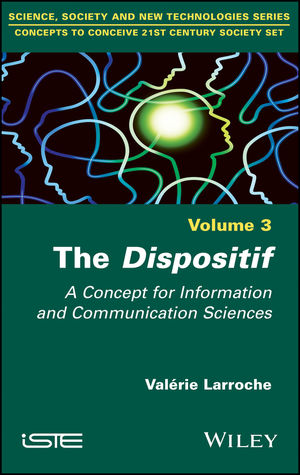
VValérie Larroche, The Dispositif: A Concept for Information and Communication Sciences, Wiley, 2019

DESCRIPTION
The notion of the dispositif (dispositive) is particularly relevant for understanding phenomena where one can observe the reproducibility of distributed technical activities, operational or discursive, between human and non-human actors.

This book reviews the concept of the dispositive through various disciplinary perspectives, analyzing in turn its technical, organizational and discursive dimensions. The relations of power and visibility enrich these discussions.

Regarding information and communication sciences, three main uses of this concept are presented, on the one hand to illustrate the heuristic scope of issues integrating the dispositive and, on the other hand, to demonstrate its unifying aspect in this disciplinary field. The first use concerns the complexity of media content production; the second relates to activity traces using the concept of the “secondary information dispositive”; finally, the third involves the use of the dispositive in contexts of digital participation.

ABOUT THE AUTHOR
Valérie Larroche is a senior lecturer at the École nationale supérieure des sciences de l’information et des bibliothèques (Enssib) in France. As a researcher at Elico she studies professional digital recognition technologies, innovation organization and open data.

TABLE OF CONTENTS
Part 1. Epistemological Foundations
1. Techne-Poiesis and the Dispositive.
2. The Dispositive, Organization and Collective Action.
3. Discursive Productions and the Dispositive.

Part 2. The Dispositive and ICS
4. Complexity of Media Productions.
5. Data, Activity Traces and the Dispositive.
6. Digital Participation and Work.

Barry, Laurence & Fisher, Eran. Digital audiences and the deconstruction of the collective, Subjectivity (2019) 12: 210.

DOI: 10.1057/s41286-019-00073-w

Abstract
This paper aims at characterizing the change that occurred in audience conception with the advent of big data technologies. We argue that a good place to analyze this change is in the marketing techniques geared to capturing the characteristics of consumers of contents and goods. Some of these techniques are existing statistical tools applied to new kinds of data, others, like predictive analytics, are radically new. Our contention is that online individual actions are now studied, predicted, and managed in the way macroeconomic parameters were analyzed in the past. By changing the perspective on the individual and the group, these new technologies further transform the manner in which an audience is imagined. The conceptions of modern collectives once defined by top-down, broadly defined demographic categories, are therefore transformed or, rather, deconstructed.

Keywords
Imagined audiences Digital audiences Big data Algorithms Predictive analytics

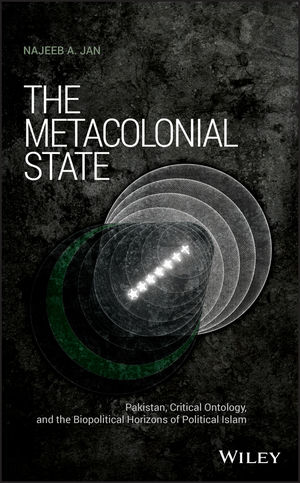
Najeeb A. Jan, The Metacolonial State: Pakistan, Critical Ontology, and the Biopolitical Horizons of Political Islam, Wiley 2019

The Metacolonial State presents a novel rethinking of the relationship between Islam and the Political. Key to the text is an original argument regarding the “biopoliticization of Islam” and the imperative need for understanding sovereign power and the state of exception in resolutely ontological terms. Through the formulation of a critical ontology of political violence, The Metacolonial State endeavors to shed new light on the signatures of power undergirding postcolonial life, while situating Pakistan as a paradigmatic site for reflection on the nature of modernity’s precarious present.

The cross-disciplinary approach of Dr. Jan’s work is certain to have broad appeal among geographers, historians, anthropologists, postcolonial theorists, and political scientists, among others. At the same time, his explication of critical ontology – with its radical reading of the interlacement of history, power and the event – promises to add a bold new dimension to social science research on Islamism and biopolitics.

ABOUT THE AUTHOR
NAJEEB A. JAN is Assistant Professor of Human Geography in the Department of Geography of the University of Colorado, Boulder, Colorado.

Geoffroy de Lagasnerie: Foucault et le Neoliberalisme – France Culture (2019)
Émission: La Suite dans les Idées du 01.12.2012

Critique 1/13: In Search of a Method

Center for Contemporary Critical Thought
Bernard Harcourt
Amy Allen (Penn State)
September 11, 2019

Gordon Hull, On the Authorship of Law: Copyright, Foucault, and Hobbes, New APPS: Art, Politics, Philosophy, Science, 12 Nivember 2019

There is an interesting copyright case before the Supreme Court this term, Georgia v. Public Resource.org. It is settled law that official edicts of the government – statutory texts, judicial opinions, agency rules – are not copyrightable. More about that in a moment. In this case, Georgia entered into a contract with Lexis to produce an annotated version of its code. The state gets editorial control, and Lexis gets exclusive publication rights. The product is the “Official Georgia Code Annotated” and is generally cited as the authoritative statement of Georgia law. Public Resource made copies of the OGCA publicly available for free, including the annotations. The state claims copyright over the annotations and sued to enjoin Public Resource.  The question before the court is thus whether the annotations to state law are copyrightable, even given that the statutory text is not.

[…]

I’ve been interested in Foucault’s remarks on authorship for a while, and this seems to me to be a perfect example of the juridical function of authorship as Foucault articulates it.  Recall that for Foucault, important to recognize that authorship does important political work, whatever one thinks of it as a way to approach textual interpretation.  In particular, we are prone to organize texts according to “authors” in part as a strategy for managing meanings and assigning them to creators.

[more]

Guillaume Le Blanc, Why read Foucault’s Confessions of the Flesh today? (french version), Critique 13/13, Seminars at Columbia, Nov 30 2019

Que pouvons-nous trouver dans un texte sur la sexualité chrétienne qui aurait dû paraître en 1982 voire en 1984 et qui finalement ne le sera qu’en 2018 ? Étrange situation puisque nous lisons ce livre aujourd’hui alors qu’il a été écrit il y a plus de 35 ans et qu’il a même été rédigé avant les tomes 2 et 3 de l’Histoire de la sexualité. Que signifie se rendre le contemporain de ce livre résolument décalé ? Décalé parce qu’il étudie un matériau historique enfoui, un ensemble de textes sur la chair chrétienne entre le 2ème et le 5ème siècle. Décalé également parce que les lecteurs que nous sommes n’y ont accès qu’en 2018 alors que le tapuscrit a été rendu chez Gallimard en 1982 et que Foucault corrigeait les épreuves au moment de sa mort en 1984. Tous ces éléments de contexte ont leur importance car la réception de ce livre aujourd’hui est indissociable de l’état de la question sexuelle auquel je ferai retour dans une deuxième grande partie de mon intervention.

[suite]

Foucault’s theatres
Edited by Tony Fisher and Kélina Gotman, Manchester University Press, 2020

DESCRIPTION
The volume contributes to a new articulation of theatre and performance studies via Foucault’s critical thought. With cutting edge studies by established and emerging writers in areas such as dramaturgy, film, music, cultural history and journalism, the volume aims to be accessible for both experienced researchers and advanced students encountering Foucault’s work for the first time. The introduction sets out a thorough and informative assessment of Foucault’s relevance to theatre and performance studies and to our present cultural moment – it rereads his profound engagement with questions of truth, power and politics, in light of previously unknown writings and lectures set in relation to current political and cultural concerns. Unique to this volume is the discovery of a ‘theatrical’ Foucault – the profound affinity of his thinking with questions of performativity. This discovery makes accessible the ‘performance turn’ to readers of Foucault, while opening up ways of reading Foucault’s oeuvre ‘theatrically’.

Contents
Introduction: theatre, performance, Foucault – Tony Fisher and Kélina Gotman
1 Foucault’s philosophical theatres – Mark D. Jordan
2 The dramas of knowledge: Foucault’s genealogical theatre of truth – Aline Wiame
3 Foucault live! ‘A Voice That Still Eludes the Tomb of the Text.’ – Magnolia Pauker
4 Foucault, Oedipus, Négritude – Kélina Gotman
5 Foucault’s critical dramaturgies – Mark Robson
6 Heterotopia and the mapping of unreal spaces on stage – Joanne Tompkins
7 Foucault and Shakespeare: the theatre of madness – Stuart Elden
8 Philosophical phantasms: ‘the Platonic differential’ and ‘Zarathustra’s laughter’ – Mischa Twitchin
9 Cage and Foucault: musical timekeeping and the security state – Steve Potter
10 Foucault and the Iranian Revolution: reassessed – Tracey Nicholls
11 Sightlines: Foucault and Naturalist theatre – Dan Rebellato
12 Theatre of poverty: popular illegalism on the nineteenth century stage – Tony Fisher
13 The philosophical scene: Foucault interviewed by Moriaki Watanabe – translated by Robert Bononno
14 After words, afterwards: teaching Foucault – Ann Pellegrini

Archeologia filosofica è il nome di questa nuova collana, diretta da Alessandro Baccarin e Paolo Vernaglione Berardi, [Laboratorio archeologia filosofica] e dedicata a temi, autori e problemi di solito relegati in una zona difficilmente accessibile del pensiero. Scopriamo invece che il “senso comune” dei discorsi e dei “valori” è intessuto di saperi esclusi dalla “cultura” occidentale. La prima scoperta di queste stratificazioni si deve a Michel Foucault che ha inaugurato un metodo basato sull’indagine delle “formazioni discorsive”.

Contemporaneamente il grande filosofo Enzo Melandri farà dell’archeologia del pensiero occidentale il campo di una storia dei problemi. Oggi Giorgio Agamben, che ha coniato l’archeologia filosofica”, riprende questo metodo in vista di una “scienza senza nome” che è ricerca genealogica dei dispositivi di sapere-potere e confronto tra storia e archivio. Si apre così una inattuale possibilità di ricerca e di sperimentazione che potrebbe indicare la via per destituire la “cattura” della vita.

Quaderni di archeologia filosofica
volume primo
Nietzsche e la modernità; Michel Foucault, gli antichi e la “cura di se”; l’arte della guerra; L’erotica antica; Michel De Certeau, la mistica e la storia; Giorgio Agamben e l’uso dei corpi; il dispositivo psichiatrico; il neoliberismo e i paradigmi del potere. Questo volume raccoglie la prima serie dei Quaderni realizzati dal Laboratorio di archeologia filosofica (www.archeologiafilosofica.it) in tre anni di ricerche e riapre il dibattito filosofico, costretto finora nello spazio angusto di una disciplina di cui da tempo si percepisce la “crisi”. Accessibile ad un vasto pubblico di lettori, il testo testimonia una delle realtà più vive nell’esercizio del pensiero.

“Se è vero che l’archeologia è la sola via di accesso al presente, il Laboratorio di archeologia filosofica è forse oggi in Italia per eccellenza il luogo in cui il pensiero si misura coi problemi più urgenti del nostro tempo. Ai seminari e agli incontri finora promossi si è aggiunta la pubblicazione di una collana il cui programma sembra sviluppare editorialmente i temi più vivi delle attività del laboratorio.”
Giorgio Agamben