
Foucault News

News and resources on French thinker Michel Foucault (1926-1984)

Matthew MacLellan, Identity politics, liberalism, and the democratizing power of biopolitics. Constellations. 2020; 1– 15.

DOI: 10.1111/1467-8675.12538

Democracy cannot be predicated exclusively on the universality of the law, since that universality is privatized ceaselessly by the logic of government action. (Jacques Rancière)

The separation of public from private is as crucial to the liberal state’s claim to objectivity as its inseparability is to women’s claim to subordination. (Catherine MacKinnon)

Men have dreamed of liberating machines. But there are no machines of freedom, by definition. (Michel Foucault)

1 INTRODUCTION
1.1 The identity politics critique

The contemporary liberal critique of identity politics features an unmistakable mark of antidemocratic reaction: the fear of political excess, the fear that too much of our social or private lives are becoming subject to the rigors of political scrutiny. In Political Tribes (2018), for instance, Amy Chua laments how a once legitimate concern for minority rights has now spread to even the most inconsequential of our social activities. “As a progressive Mexican American law student put it, if we allowed ourselves to be hurt by a [Halloween] costume, how could we manage the trauma of an eviction notice?’” (Chua, 2018, p. 187). The same concern over the excessive politicization of social life runs throughout Greg Lukianoff and Jonathan Haidt’s best‐selling The Coddling of the American Mind (2018): “students at many colleges today are walking on eggshells, afraid of saying the wrong thing [or] liking the wrong post” (p. 72). And in The Once and Future Liberal: After Identity Politics (2017), Mark Lilla is similarly unnerved about the increasingly dominant idea that “there are no spheres of life exempt from the struggle for power,” and how the realization of power’s ubiquity has turned “Left identitarians” into “buttoned‐up Protestant schoolmarms … parsing every conversation for immodest locutions” (2017, pp. 75, 91).
[…]
Flavio Luzi, Glosse in margine all’epidemia come politica, Laboratorio Archeologia Filosofica, 19 Dicembre 2020

Open access

Penosamente amare quel che non si ama,
da quando il fumo uccide,
ecco, ubbidire.

Patrizia Cavalli

1. Nemo propheta acceptus est in patria sua

“A me sembra che il vero compito politico, in una società come la nostra, sia quello di criticare il funzionamento delle istituzioni, soprattutto di quelle che appaiono come neutrali e indipendenti, e di attaccarle in maniera tale che la violenza politica che si esercita oscuramente in esse sia finalmente smascherata, così da poter essere combattuta”. Con queste parole, in un dibattito televisivo tenutosi a Eindhoven nel 1971, un ridente Michel Foucault ribatteva alle posizioni espresse in quell’occasione dal suo avversario, Noam Chomsky. Il filosofo francese si riferiva a tutte quelle istituzioni – come l’Università, l’Istruzione, la Psichiatria e la Giustizia – che diversamente dall’Esercito, dalla Polizia e dal Carcere, si presentano in maniera apparentemente neutrale, affrancata dall’evidente circolazione (sottomissione ed esercizio) del potere politico. Dietro le funzioni di distribuzione del sapere, della promozione della libera ricerca, della cura dei disturbi mentali, dell’amministrazione del diritto, queste istituzioni – o, se si preferisce, questi dispositivi epistemico-sociali – occultano la violenza politica che continuamente esercitano sui corpi degli individui, disciplinandoli e soggettivizzandoli come studenti, come anormali, come colpevoli. In tal senso, dal punto di vista foucaultiano, non vi è ragione alcuna di ritenere che l’istituzione sanitaria e, più in generale, il sapere medico siano esenti da questo tipo di mistificazione, dimostrandosi sinceramente neutrali, estranei a qualsivoglia ideologia, potere o violenza politica.
[…]

Giorgio Astone, Pieghe, invaginazioni, addugliature. Deleuze interprete di Foucault, Laboratorio Archeologia Filosofica, Dicembre 2020

Open access

1. Introduzione – Fra parentesi quadre

Con il titolo La soggettivazione viene tradotta in italiano anche l’ultima sezione del corso universitario tenuto da Gilles Deleuze a Paris VIII nell’anno accademico 1985-1986, preceduto dai due volumi Il sapere (Deleuze 2014) e Il potere (Deleuze 2018), contenente la trascrizione delle ultime cinque lezioni del filosofo francese, svoltesi fra Aprile e Maggio del 1986. Le argomentazioni di Deleuze si confrontano, in questa occasione, con il secondo volume della serie Histoire de la sexualité di Michel Foucault, L’usage des plasirs[1], dato alle stampe nel 1984, lo stesso anno della pubblicazione di Le souci de soi e della scomparsa del pensatore della biopolitica.

[…]

Laurie Laufer (2020) Michel Foucault: The Queer Gender for Psychoanalysis?, Psychoanalytic Inquiry, 40:8, 579-590.

DOI: 10.1080/07351690.2020.1826214

ABSTRACT
Why should a practitioner of psychoanalysis read Foucault? Is Foucault still a “hot topic” for psychoanalysts in 2019? To prevent psychoanalysis from becoming a dead language, reading and re-reading Michel Foucault proves highly relevant, as it also implies reading queer, gay, lesbian, and gender studies. This article draws on queer authors such as Gayle Rubin, Eve Kosofsky-Sedgwick, and Judith Butler, as well as Freud, Lacan, and Allouch to reflect on how sexuality and gender identity can possibly be conceived in the Freudian field and beyond a hetero-normative gender binary perspective. Both with and after Foucault, as the genealogist of Freudian psychoanalysis, what would psychoanalysis be without discourses on heterosexual families, Oedipus, sexuality, sexual etiology, and infantile sexuality? Reading Foucault sets forth a new erotology and thus amounts to rediscovering “the political honor of psychoanalysis.”

Patrice Ladwig (2021) Thinking with Foucault Beyond Christianity and the Secular: Notes on Religious Governmentality and Buddhist Monasticism, Political Theology, Published online 1/1/21

DOI: 10.1080/1462317X.2020.1866809

ABSTRACT
In Michel Foucault’s original formulation of the concept, governmentality is intrinsically linked to religious practices and institutions. Although Christian practices associated with the pastorate and monasticism feature prominently as precursors of modern administration and statecraft in his oeuvre, later works that employ the concept have overwhelmingly focused on the secular, and rational-scientific side of governmentality. This essay argues that by transposing governmentality to a non-European context, and by fleshing out a comparative perspectives beyond Christianity and the secular, it might be possible to recover some of the original religious implications of the concept. With reference to Theravāda Buddhism in Southeast Asia, the essay briefly discusses the potential role of monks and monasteries in establishing religious and monastic governmentality. Although there are obviously vast differences between Christianity and Buddhism, the essay concludes that exploring these ‘alternative governmentalities’ comparatively allows for novel interpretations beyond the secular religion divide and alleged Western rationality.

KEYWORDS:
Christianity, Buddhism. governmentality, monasticism, Foucault, comparison, secular

Daniel J. Schultz (2020) Foucault and the Rhetoric of Exemplarity, Political Theology Published online: 30 Dec 2020
DOI: 10.1080/1462317X.2020.1866814

Limited open access

Introduction
Political theology announces a relationship between religion and politics, but what structures this relationship and how do the related terms show up as objects of knowledge in the first place? Considerations of sovereign power – its nature and exercise – have dominated discussions of political theology, discussions often elaborated through the following lines of inquiry: is the paradox of sovereign decision, which posits the legal order through its suspension, “analogous to the miracle in theology”? Or, does revolutionary violence express a Messianic antinomianism – a pure (divine) violence that confronts and transforms the juridical order itself? These kinds of questions, when directly posed, sit awkwardly in the work of Michel Foucault, who does not have a theory of the state and who was suspicious of the tendency of revolutionary discourse to organize a representation of history modeled on the human subject. While thinkers like Giorgio Agamben have labored tirelessly to link Foucauldian concepts to Benjamin’s philosophy of history and Schmitt’s theorizations of sovereignty, it remains the case that internal to Foucault’s corpus these connections do not suggest themselves. This is curious. Why is it that Foucault’s work – so proximate to the continental philosophical archive that underwrites much of political theological discourse – should somehow provide internal resistance to these conceptual linkages? In this essay I explore one approach to answering this question, arguing that although Foucault does not have an elaborated political theology, his rhetoric of exemplarity offers a model of how one might think a relation between religion and politics.
[…]

Summer School 2021
14 philosophy short-courses taught online January – February 2021.

The Melbourne School of Continental Philosophy (Australia) is proud to present the Summer School 2021 curriculum. All courses are 10 hours in length. All courses will be taught via Zoom. As always significant discounts apply for those enrolling in multiple courses. If you have any questions which aren’t in our FAQs please email admin@mscp.org.au.

When: 11 Jan – 19 Feb 2021

Where: ONLINE. All courses will be taught via Zoom. Video recordings will also be available within a few days after each seminar for those who can’t make the schedule. Readings are made available online before the school begins. Links to the Zoom classroom are sent out approximately 1 hour before class. All payment must be made via credit card during enrolment. Also it’s worth noting that Melbourne is 11 hours ahead of UTC (5pm here is 7am in Berlin and 10pm in LA).

Program
[see MSCP site for times and other details]

Chaosmos Refracted: The Schizophrenic Ecologies of Félix Guattari
Lecturer: Dr Timothy Deane-Freeman

Grown Wrong: Biophilosophy after Darwin
Lecturer: Dr Ben Woodard

Ethico-political engagement and the self-constituting subject in Foucault
Lecturer: Dr Lenka Ucnik

Deleuze’s Foucault
Lecturer: Dr Jon Roffe

Bakhtin’s Voices and Official Culture
Lecturer: Dr Valery Vinogradovs

Shoshana Zuboff’s ‘The Age of Surveillance Capitalism’
Lecturer: Elise Addlem

The Three Conversions of Bernard Stiegler: An Overview
Lecturer: Dr Daniel Ross

Political Keywords of Emancipatory Politics
Lecturer: Dr Steven Corcoran

Stoicism as a Social Philosophy
Lecturer: Dr Will Johncock

Possibility and Contradiction: An Introduction to Hegel’s Doctrine of Essence
Lecturer: Dr Nahum Brown

Emmanuel Levinas: Reimagining Subjectivity and Ethics
Lecturer: Tiffany Plotzza

German Romanticism: Literature as Life
Lecturer: Dr Nanda Jarosz

Luce Irigaray: The philosophy of sexual difference and women in film

The World Does Not Exist: What this means and why it matters
Lecturer: Austin Hayden Smidt

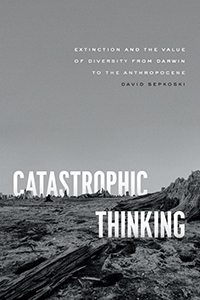
7 Questions with David Sepkoski, author of “Catastrophic Thinking”
The Chicago blog, NOVEMBER 23, 2020

We live in an age in which we are repeatedly reminded—by scientists, by the media, by popular culture—of the looming threat of mass extinction. Such apocalyptic talk feels familiar to us, but the current fascination with extinction is a relatively recent phenomenon. As David Sepkoski reveals, the way we value biodiversity depends crucially on our sense that it is precarious—that it is something actively threatened, and that its loss could have profound consequences. In his new book, Sepkoski uncovers how and why we learned to value diversity as a precious resource at the same time as we learned to think catastrophically about extinction. We asked him a few questions about it.

In the book, you explain how an “extinction imaginary” helps inform the way we see and value the world around us. Can you give us a quick introduction to that term?

A central claim of this book is that scientific ideas and cultural values can’t be cleanly separated: science doesn’t “cause” us to believe certain things about society or politics, nor do political or social values “explain” particular scientific theories. Rather, the science and culture of a particular place and time are tightly interwoven and reinforce each other by setting the conditions of possibility for thinking and believing certain things rather than others. In the 1980s and 1990s it was popular to apply Michel Foucault’s concept of “discourse” to describe this kind of multicausal interrelationship—and indeed, I sometimes refer to an “extinction discourse” that applied at different times—but I felt that this term misses the important element of imagination that is central to the way societies have conceived and worried about the consequences of extinction.
[…]

Mariaconcetta Costantini, Pandemics, Power, and Conspiracy Theories, Critical Quarterly
First published: 10 December 2020
https://doi.org/10.1111/criq.12578

Open access
Our culture is awash in conspiracy theories’, Joseph Uscinski recently observed to emphasise the crucial role the Internet plays in circulating a deluge of information and conjectures – including fake news – around the world.1 Sometimes created by powerful elites as parts of top‐down processes of mass control, other times developed by the weak in bottom‐up rebellions that ‘encourage transparency and good behavior by the powerful’, conspiracy theories may fulfil both dangerous and useful functions.2 For this reason, they should be considered in their complexity rather than be easily dismissed as irrational or delusive.3 The epistemic problems we face in determining whether these theories could be warranted are manifold. They include evaluating the risks of a priori dismissal or denialism, choosing between a generalist and a particularist approach, and dealing with the question of ‘secrecy’ – a basic condition of any conspiracy. This latter challenges us by definition: if conspirators manage to keep their activities properly secret, how could we come to believe in their existence?4 These issues suggest that we should be cautious in approaching the current proliferation of theories which, widely disseminated by social media, produce a large variety of responses ranging from total disbelief to blind support.
[…]

Richie Nimmo, (2020). Foucault, Power, and Nonhuman Animals, Society & Animals, 28(7), 835-838. doi: https://doi.org/10.1163/15685306-00001845

Open access

Matthew Chrulew & Dinesh Joseph Wadiwel (Eds.), Foucault and Animals (Human-Animal Studies). Leiden: Brill, 2017. 396 pp.

In their timely and well-curated collection, Matthew Chrulew and Dinesh Wadiwel (2017) succeed in their difficult aim of providing readers with a grounding in the complex intersection of Michel Foucault’s philosophy with human-animal studies. The publication reflects and augments the increasing interest in the usefulness and implications of Foucault in a still-emerging field in need of conceptual resources to more deeply expound upon its key questions and dilemmas. In this sense, the book’s main readership will be made up of human-animal studies scholars of all levels with an interest in power, knowledge, and ethics. It may also appeal to some Foucault scholars engaged with the posthuman turn and interested in exploring what new light may be cast on his work if it is read through the prism of species, animality, and the nonhuman. The collection is admirably interdisciplinary, with contributors from literary studies through the humanities to the social sciences. Each author contributes either explicitly or more obliquely to the overarching question of how and to what extent Foucault’s philosophy might be drawn upon to consider some aspects of human-animal relations. Chrulew and Wadiwel also consider a range of relationships such as those developed in labs and agriculture. While some of the essayists occasionally resort to theorizing about nonhuman animals or animality in general terms, several are explicitly critical of this tendency, and most focus on particular species in particular times, places, institutional and epistemic contexts, and relations of power.
[…]