Foucault News

News and resources on French thinker Michel Foucault (1926-1984)

Eric Schliesser, 28 March 1979: Foucault on Locke’s World Historical Conceptual Shift (XXXVII),Digressions & Impressions, 5 January 2021

[Editor: 11 March 2026. Link above is to the page archived on The Wayback Machine.]

[…]
Because most of lecture 11 is a brilliant analysis of the history of criminology and the (sometimes overlapping) significance of Gary Becker’s redefinition of homo oeconomicus, it is easy to miss how Foucault embeds his analysis in a narrative in which the least genius of the tradition, Locke, is a world-historical — “one of the most important mutations, one of the most important theoretical transformations in Western thought since the Middle Ages”* — figure (in Nietzsche’s sense). In my last post (episode 36), I had already observed that lecture 11 is tied by Foucault to the start of the lecture series and Locke’s conception of the liberal art of government.

As an aside, it is striking how conventional Foucault’s philosophical categories (e.g., ‘Western thought;’ ‘British Empiricism;’ ‘Middle Ages’ etc.”) can be sometimes. But as we know, artistic genius in this convention is characterized by the virtuosity of playing with the given constraints. And as Foucault teaches in this very lecture (recall), that fits the definition of rational agency.
[…]

Foucault/Derrida Fifty Years Later. The Futures of Genealogy, Deconstruction, and Politics, Edited by Olivia Custer, Penelope Deutscher, and Samir Haddad. Columbia University Press, 2016

Early in their careers, Michel Foucault and Jacques Derrida argued over madness, reason, and history in an exchange that profoundly influenced continental philosophy and critical theory. In this collection, Amy Allen, Geoffrey Bennington, Lynne Huffer, Colin Koopman, Pierre Macherey, Michael Naas, and Judith Revel, among others, trace this exchange in debates over the possibilities of genealogy and deconstruction, immanent and transcendent approaches to philosophy, and the practical and theoretical role of the archive.

ABOUT THE EDITORS
Olivia Custer is a Paris-based scholar and the author of L’Exemple de Kant (2012).

Penelope Deutscher is professor of philosophy at Northwestern University.

Samir Haddad is associate professor of philosophy at Fordham University.

Di Gesu A. The Cynic Scandal: Parrhesia, Community, and Democracy. Theory, Culture & Society. January 2021.
doi:10.1177/0263276420979036

Abstract
The aim of this article is to study parrhesia as a form of political performativity. The study of parrhesia as a speech act has been inaugurated by the researches of Lorenzini, who has proposed an in-depth analysis of the parrhesiastic speech act: we nonetheless believe that some features of parrhesiastic performativity urge us to broaden some aspects of his theory. In the first section of this article we will study the nature of parrhesiastic utterance, where Lorenzini’s theses will be discussed through the use of Butler’s approach. In the second section, we will examine the characteristics of Cynic performativity through our theoretical framework, in order to give an example of its effectiveness. We will put forward, then, an overall interpretation of parrhesia, which will be redefined as a communitarian performativity and, furthermore, as an innovative model of radical democracy.

Keywords
Butler, community, Foucault, performativity, radical democracy

Penelope Deutscher, Foucault’s Futures. A Critique of Reproductive Reason, Columbia University Press, 2017

In Foucault’s Futures, Penelope Deutscher reconsiders the role of procreation in Foucault’s thought, especially its proximity to risk, mortality, and death. She brings together his work on sexuality and biopolitics to challenge our understanding of the politicization of reproduction. By analyzing Foucault’s contribution to the politics of maternity and its influence on the work of thinkers such as Roberto Esposito, Giorgio Agamben, and Judith Butler, Deutscher provides new insights into the conflicted political status of reproductive conduct and what it means for feminism and critical theory.

ABOUT THE AUTHOR
Penelope Deutscher is Joan and Sarepta Harrison Professor of Philosophy at Northwestern University. She is the author or editor of a number of books, including Foucault/Derrida Fifty Years Later (2016) and Critical Theory in Critical Times: Transforming the Global Political and Economic Order (2017), both from Columbia University Press.

Sylvain Garniel, Michel Foucault: un philosophe des attitudes Collection : Ateliers populaires de philosophie, Editions Apogée, (2021)

« La vie de tout individu ne pourrait-elle pas être une œuvre d’art ? Pourquoi une lampe ou une maison sont-ils des objets d’art et non pas notre vie ? » C’est sur cette interrogation que se clôt l’œuvre de Michel Foucault, mort prématurément en 1984. Il ne s’agit pas seulement d’une ultime conversion esthétique, qui nous enjoindrait de devenir tous des artistes, mais bien d’une question éthique adressée à chacun. C’est une invitation à modifier nos comportements et nos manières d’être pour nous inventer nous-mêmes librement.

Francesca Peruzzo (2020) The Model Of Becoming Aware: disabled subjectivities, policy enactment and new exclusions in higher education, Journal of Education Policy
DOI: 10.1080/02680939.2020.1856415

ABSTRACT
This paper aims to present an analytical tool called Model of Becoming Aware, to explore the production of the subjectivities of disabled students and new forms of exclusions during the enactment of disability policies in the Italian higher education context. It deploys Foucault’s governmentality studies to frame the changing historical conditions from a welfarist to neoliberal governance, of the university and it draws upon qualitative data collected in an Italian university. The Model is the product of situational analysis of the enactment of inclusive policies and explores the mobilisation of authority, resources, practices, subjects, opportunities and knowledge by two technologies of power – autonomy and sensitivity. Findings illustrate how medical and economic truths in times of austerity are producing new forms of performative neoliberal subjectivities in higher education while subordinating forms of subjection based on expensive welfarist provisions. Through the Model of Becoming Aware, the article aims to supply a contingent tool to analyse current ableist and exclusionary practices in the enactment of disability higher education policies, providing an evidence-based space to rethink policies to support disabled students educational access and attainment in higher education.

KEYWORDS: Disability, Foucault, higher education, subjectivity, inclusion, ableism

Vol III, No 1: Governmentality, Liberalism, Biopower, Genealogy of the Modern Subject.

Foucault’s Lectures at the Collège de France 1978-80 Security, Territory and Population; The Birth of Biopolitics; On the Government of the Living.
Volume III of the Foucault Lecture Series.
Published: 2020-12-16

Open access

EDITORIAL [extract]
Sverre Raffnsøe, Alain Beaulieu, Barbara Cruikshank, Knut Ove Eliassen, Marius Gudmand-Høyer, Thomas Götselius, Daniele Lorenzini, Hernan Camilo Pulido Martinez, Johanna Oksala, Clare O’Farrell, Rodrigo Castro Orellana, Eva Bendix Petersen, Alan Rosenberg, Dianna Taylor, Signe Macholm Müller & Asker Bryld Staunæs.

The editors of Foucault Studies are pleased to publish this volume of Foucault Lectures containing three articles, each devoted to discussing one of Foucault’s yearly series of lectures at the Collège de France.

In “The Beginning of a Study of Biopower,” Verena Erlenbusch-Anderson (Syracuse University) centers the attention on Foucault’s 1978 lecture course at the Collège de France entitled Security, Territory, Population. The article “The Appearance of an Interminable Natural History and its Ends” by Sverre Raffnsøe (Copenhagen Business School) and Knut Ove Eliassen (Norwegian University of Science and Technology) examines Foucault’s Lectures on The Birth of Biopolitics at the Collège de France in 1979. Written by Daniele Lorenzini (Warwick University), “Anarcheology and the Emergence of the Alethurgic Subject” discusses Foucault’s 1980 lecture course entitled On the Government of the Living.

A NOVELTY
Rather than just a new publication continuing the row of previous issues of Foucault Studies, the present issue is to be regarded as a novelty in a more radical sense. It is a new kind of publication that broadens the scope or the range of Foucault Studies; and it is a new kind of publication that initiates a new series of publications in addition to Foucault Studies’ already existing programme.

Since the quite recently accomplished full publication of Foucault’s lectures at the Collège de France, completed in French in 2015 and in English in 2019, the editors of Foucault Studies have considered it timely to publish a series of articles introducing each year’s lectures in the context of and as a contribution to Foucault’s work while also highlighting crucial problems still of relevance in the discussed sequence of lectures. The present issue is the first volume to appear in the context of this series. The series is intended to be of value to the reader wanting to make her- or himself acquainted with the lecture series as well as to the more experienced scholar.

Provisionally, the series is envisaged to consist of four volumes.
[…]

Lars Erik Løvaas Gjerde (2021) Governing humans and ‘things’: power and rule in Norway during the Covid-19 pandemic, Journal of Political Power,
DOI: 10.1080/2158379X.2020.1870264

ABSTRACT
This text focuses on the mentalities and technologies of power employed by the Norwegian government as it attempts to control the Covid-19 pandemic. Utilizing governmentality studies and a Foucauldian discourse analysis, I find life itself to be given primacy within a biopolitical problem space where the government seeks to contain the spread of Covid-19. The government primarily rationalizes its exercises of power in a liberal manner while employing a complex set of liberal and coercive technologies, which it channels towards both the human population, which serves as an object of administration, and Covid-19, which serves as an object of domination.

KEYWORDS:
Covid-19 governmentality Foucault biopolitics actor-network

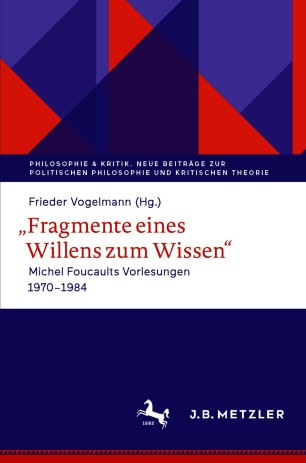
Frieder Vogelmann (ed.): “Fragmente eines Willens zum Wissen”. Michel Foucaults Vorlesungen 1970–1984. Stuttgart: Metzler (2020).

A new edited volume on the complete series of Foucault’s lecture courses. Includes a chapter on every lecture course from 1970 to 1984, as well as a comprehensive introduction.

Introduction
Von den Theorien und Institutionen des Strafens über die psychiatrische Macht bis zum modernen Staatsrassismus und der (neo)liberalen Gouvernementalität, von den Selbstbildungspraktiken der griechischen Antike über die Notwendigkeit des freimütigen Sprechens in der Demokratie bis zur kynischen Wahrheit einer anderen Welt reichen die Themen in Michel Foucaults Vorlesungen, die er am Collège de France von 1970 bis 1984 gehalten hat. Und quer durch alle hindurch ziehen sich die Fragen nach dem Zusammenhang von Wissen, Macht und Subjektivität sowie nach der Methode, um diese erhellen zu können.

Dieser Band nimmt die vollständige Veröffentlichung der 13 Vorlesungen zum Anlass, sie sowohl als Ganzes als auch jede einzelne Vorlesung zu betrachten. Damit bietet er tiefe Einblicke in Foucaults Vorlesungen und liefert zugleich eine umfassende Einführung in diesen Teil von Foucaults Werk.

Keywords
Foucault, Michel Biopolitik Subjekt Regieren Gouvernementalität

Emiliano Grimaldi & Stephen J. Ball (2020) Paradoxes of freedom. An archaeological analysis of educational online platform interfaces, Critical Studies in Education
https://doi.org/10.1080/17508487.2020.1861043

ABSTRACT
Many schools and students across the globe are now engaging with educational digital platforms in their teaching and learning experience. Platforms are changing what education is and how it is experienced. In response, educational research has devoted increasing attention to the so-called platformisation of education. This article contributes to this focus of attention, proposing a conceptual framework for the analysis of the configuration of platforms and the kinds of learning experience and learners they create the conditions of possibility for. Using Foucauldian archaeological methods, we present an analytics that focuses on three interrelated axes, the spatial, temporal and ethical configurations of educational platforms. We identify some theoretical tools for the analysis of the educational experience that platforms make possible, thinkable and desirable. We show how digital platforms produce a paradoxical kind of digital learner, whose autonomy and freedom to choose, connect, produce, accumulate, perform and enact is configured within an epistemological space demarcated by the tensions between modularisation and hypertextuality, linearity and co-existence, performance and character/potential. Reflecting on this, we consider the working of a careful, unrelenting, and empirically vigilant digital gaze, which secures a very specific educational experience.

KEYWORDS:
Educational online platforms digital learner digital gaze neoliberalism archaeology