
Foucault News

News and resources on French thinker Michel Foucault (1926-1984)

Daniel Verginelli Galantin, Experiencia e Politica no pensamento de Michel Foucault, Editora UFPR 2021.

SINOPSE
Certamente a noção de experiência que acompanhamos em diferentes momentos do pensamento foucaultiano não é um conceito diretamente reiterado e redefinido ao longo de todas as suas obras. Foucault nunca escreveu: eu disse que experiência era aquilo, mas na verdade queria dizer que é isso que digo agora. Logo, muito embora apresentemos algumas definições de experiência para Foucault, este livro não visa estabelecer semelhante mapa conceitual. Muito mais importante é acompanhar os tipos de questões em torno às quais a noção de experiência se organiza, o deslocamento dessas questões, e como podemos acompanhar certas facetas de toda a obra foucaultiana a partir dessas questões. Por conseguinte, percorreremos uma constelação de conceitos e reflexões foucaultianas que seriam como declinações da noção de experiência, a qual conduz nosso caminho. Investigar essas declinações passa por interrogar a apropriação de parte do pensamento de Georges Bataille e Maurice Blanchot por parte de Foucault.

English
“Certainly, the notion of experience that we follow in different moments of Foucault’s thought is not a concept directly reiterated and redefined throughout all of his works. Foucault never wrote: I said that experience was that, but I really wanted to say that it actually means what I saying now. So, even though we present some definitions of experience for Foucault, this book does not aim to establish such a conceptual map. Much more important is to follow the types of questions around which the notion of experience is organized, the displacement of these questions, and how we can follow certain facets of all Foucault’s work by following these questions. Therefore, we will go through a constellation of foucaultian concepts and reflections that would be like declinations of the notion of experience, which leads our way. Investigating these declinations involves questioning the appropriation of parts of the thoughts of Georges Bataille and Maurice Blanchot by Foucault.”
Goran Gaber, Small Words, Big Consequences. On Michel Foucault’s Genealogy of the Critical Attitude, The Philosophical Salon, 8 November 2021

Michel Foucault has been called many things, from a young conservative to a faux radical, from a neo-liberal to an infantile leftist. Whatever the hermeneutical value of these epithets may be, there is a term with which Foucault is almost unequivocally associated, namely, critique.

As for the latter, it is, almost as inevitably as with Foucault, tied with the notion of history. In other words, it is difficult to imagine a properly critical philosophical enterprise that would not, at least to some extent, investigate concrete historical phenomena or present its argument with reference to particular historical events or general historical processes.

read more

William Davies, Theory wars: how postmodernism became weaponised, New Statesman, 10 November 2021.

How did a philosophical movement embracing consumer culture become a target for today’s anti-woke brigade?

Postmodernism, as the journalist Stuart Jeffries demonstrates in Everything, All the Time, Everywhere, is a tricky phenomenon to describe. The term is usually assumed to originate in architecture in the early 1970s, where the work of Robert Venturi, Charles Moore and others defied the austere tenets of the modernist movement that had swept the world under the influence of Corbusier and Mies van der Rohe. As Venturi and his co-authors articulated in Learning from Las Vegas (1972), the carnivalesque opulence of consumerism and post-industrial capitalism is something to be enjoyed and appropriated. Postmodernism also mandated a remixing of past styles, which yielded such British peculiarities as Poundbury new town and Venturi’s Sainsbury Wing of the National Gallery.

[…]
In the past five years, however, the term “postmodern” has been revived, largely by people with no real interest in any of its historical movements or debates. Liberals have blamed “postmodernists” for the decline of “truth”, clearing the ground for opportunistic liars such as Boris Johnson and Donald Trump. Conservatives have constructed an enemy in the form of “postmodern Marxism”, that is alleged to inject “woke” ideology into the heads of the young at universities. The nadir of this paranoia in the UK was reached in 2020 when the Equalities Minister, Liz Truss, blamed the “fact” that children in Leeds in the 1980s were taught about racism, but not how to read and write, on “postmodernist philosophy – pioneered by Foucault”.

Read more

Martínez-Bello, V.E., Bernabé-Villodre, M.D.M., Cabrera García-Ochoa, Y., Torrent-Trilles, L., Vega-Perona, H.
The representation of athletes during Paralympic and Olympic Games: a Foucauldian analysis of the construction of difference in newspapers
(2021) Disability and Society

DOI: 10.1080/09687599.2021.1983413

Abstract
Our first aim was to evaluate the representation of athletes in the top newspapers in a continental European country during two editions of the Paralympics and Olympics Games (London 2012 and Rio 2016), by means of quantitative content analysis. The second aim was to critically analyse how athletes are constructed in newspapers using Michel Foucault’s theoretical framework on the construction of subjectivities and difference. The newspapers acting as an instrument, use a set of strategies to reinforce the differential treatment of Paralympic versus Olympic athletes: focusing on the effort, dedication and suffering only of athletes participating in the Paralympic Games, newspapers construct a discourse in which they separate, in an apparently natural way, some (Paralympic) athletes from other (Olympic) athletes. Two decades into the 21st century, even the newspapers of a liberal European democracy are using the same pathological model to cover Paralympic athletes who actively participate in sports competitions.

Points of interest
The newspapers analysed in this study and the way they represent athletes during the Paralympic Games reinforce discrimination. The way newspapers portray athletes participating in Paralympic games are almost exclusively based as victims or courageous people who suffer from personal struggles. By contrast, during the Olympic Games there is no evidence of a personal, social, or political history of suffering. In the newspapers analysed, women athletes participating in the Paralympic Games are underrepresented compared to women and men athletes participating in the Olympic Games. When athletes are shown in the newspapers during the Paralympic Games, they are not treated just as athletes, but also as professionals, doctors, good students, in other words, in order to become an athlete, the Paralympian must also be something else. Our study may provide information necessary for developing teaching strategies targeted at journalists and mass media students about inclusion and gender balance. © 2021 Informa UK Limited, trading as Taylor & Francis Group.

Author Keywords
body; disability; Foucault; newspapers; Paralympic and Olympic Games

Index Keywords
adult, article, competition, conceptual framework, content analysis, controlled study, democracy, disabled athlete, England, female, gender, human, human experiment, journalism, male, mass medium, quantitative analysis, teaching, victim

Marcelo Hoffman The FBI File on Foucault, Viewpoint Magazine, November 8, 2021

Open access

Nearly a decade ago, two Brazilian researchers, Heliana de Barros Conde Rodrigues and Maria Izabel Pitanga, made a remarkable discovery. They requested materials on the French philosopher Michel Foucault from the National Archive of the Ministry of Justice in Brasília and obtained a file on him compiled by an intelligence agency established by the Brazilian dictatorship, the National Intelligence Service (SNI). The file revealed that Foucault’s participation in a protest at a student assembly in São Paulo in 1975 had become the focal point of his surveillance by the SNI. Conde and Pitanga’s discovery left me with an elementary but irrepressible curiosity: did the Federal Bureau of Investigation (FBI) in the United States compile a file on Foucault? It did not seem outlandish to think that Foucault would have caught the attention of the FBI. He had visited the United States with great frequency in the 1970s and 1980s. Foucault had also established a reputation as a radical intellectual with a history of militant engagements at the time of his initial visits to the United States. He had thrown his support behind Marxist students in Tunisia who had revolted against the authoritarian regime of Habib Bourguiba in the late 1960s

read more

Eckstein, N.A.
Plague time: Space, fear, and emergency statecraft in early modern Italy
(2021) Renaissance and Reformation, 44 (2), pp. 87-111.

DOI: 10.33137/rr.v44i2.37522

Abstract
Michel Foucault argued famously that early modern European governors responded to plague by quarantining entire urban populations and placing citizens under minute surveillance. For Foucault, such sixteenth-and seventeenth-century policies were the first steps towards an authoritarian paradigm that would only emerge in full in the eighteenth century. The present article argues that Foucault’s model is too abstracted to function as a tool for the historical examination of specific emergencies, and it proposes an alternative analytical framework. Addressing itself to actual events in early modern Italy, the article reveals that when plague threatened, Florentine and Bolognese health officials projected themselves into a spatio-temporal dimension in which official actions and perceptions were determined solely by the spread of contagion. This dimension, “plague time,” was not a stage on the irresistible journey towards Foucault’s “utopia of the perfectly governed city.” A contingent response to a recurrent existential menace, plague time rose and fell in response to events, and may be understood as a season.

Maher, H.
Foucault against the Foucauldians? On the problem of the neoliberal state
(2021) Thesis Eleven

DOI: 10.1177/07255136211053377

Abstract
The survival of neoliberal forms of governance after their apparent repudiation during the Global Financial Crisis is a problem that continues to generate significant scholarly controversy. One of the most influential accounts of the survival of neoliberalism in the crisis draws on Michel Foucault’s The Birth of Biopolitics to claim that states intervening to support financial markets during the crisis was simply the neoliberal system working as expected. Returning to Foucault’s original text, I argue this account constitutes a systematic misreading because it treats Foucault as having developed an instrumentalist theory of the neoliberal state, a possibility Foucault explicitly rejected. I suggest that the reasons that led Foucault to reject an instrumentalist theory of the state remain just as relevant today, and accordingly argue for a return to Foucault’s methodological decision to treat neoliberalism not as a theory of state but as a discourse which constructs a novel bio-political governmentality. © The Author(s) 2021.

Author Keywords
discourse; Foucault; governmentality; neoliberalism; state

Thornton, E.
Unregulated Powers: The Politics of Metaphysics in French Post-Kantianism
(2021) European Legacy

DOI: 10.1080/10848770.2021.1987849

Abstract
For thinkers such as Foucault and Deleuze, it is not possible to engage with metaphysical questions without simultaneously considering other, more political problems concerning the power relations that are internal to thought. In this article I argue that, despite certain important ways in which this trend follows in the wake of Nietzsche’s polemic against the tyranny of Truth, to understand the political nature of metaphysics in late twentieth-century French philosophy we must see these thinkers as dealing with an explicitly Kantian problem. After some introductory material in the first section, I lay out the problem of legitimacy in Kant’s Critique of Pure Reason and assess his own solution to this problem. In the third section I explain Nietzsche’s critique of Kant’s solution, while in the fourth section I explain how Foucault and Deleuze each return and respond to the political foundation of Kant’s metaphysics in their own way.

Author Keywords
Deleuze; Foucault; French Philosophy; Kant; Metaphysics; Nietzsche; Politics

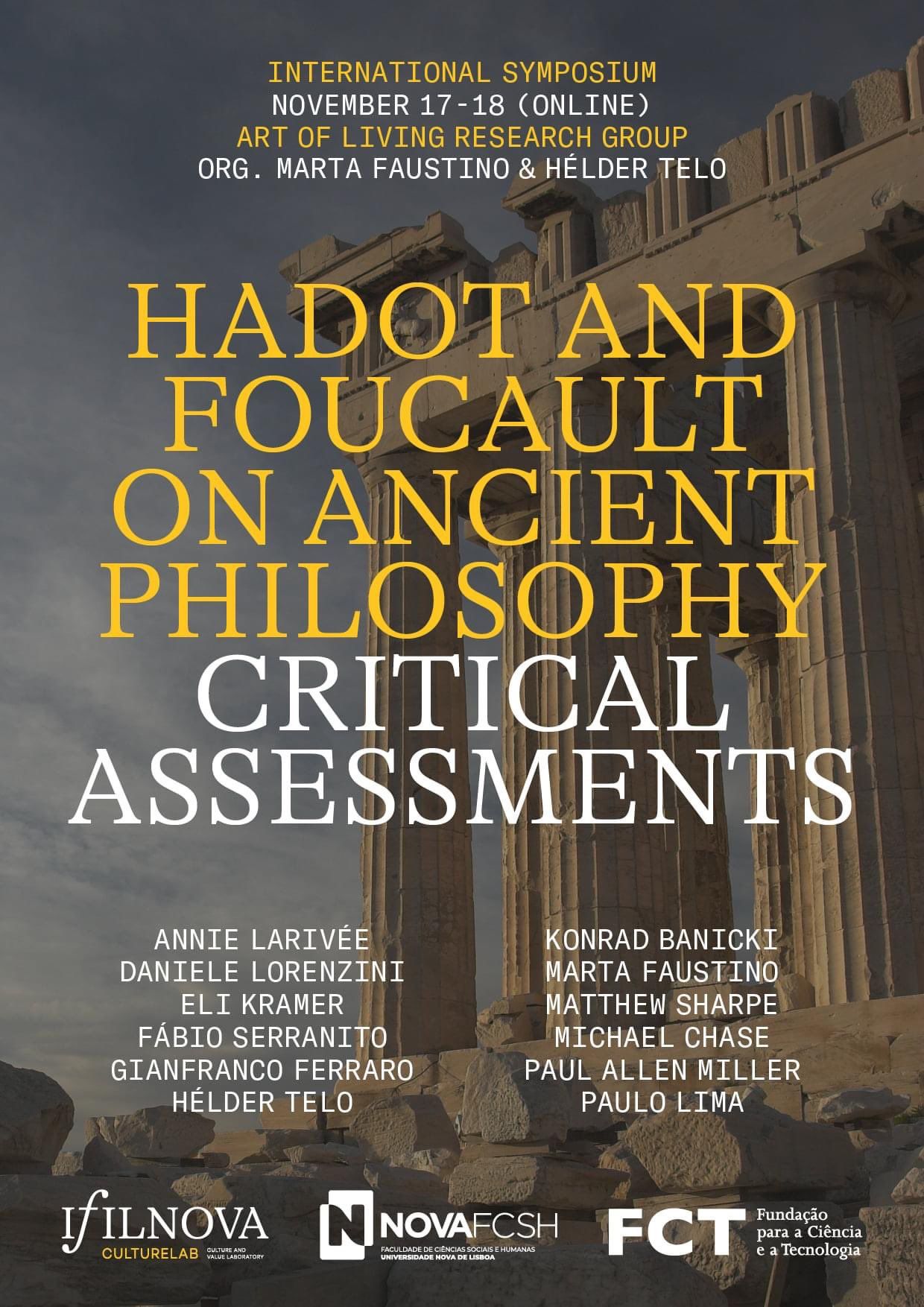
Hadot and Foucault on Ancient Philosophy: Critical Assessments
Symposium 17-19th November 2021

Register here for Zoom attendance

Call for papers
Michel Foucault and the Historiography of the Sciences

The June 2022 edition of Transversal: International Journal for the Historiography of Science will present a special issue dedicated to the work of Michel Foucault. The aim is to bring together analyses and reflections on the history of the relationship between Michel Foucault’s work and the historiography of the sciences.

Several axes may guide contributors to this special issue. The first axis concerns the classical relationship between Michel Foucault’s work and the French historical epistemology or philosophical history of the sciences (Gaston Bachelard, Alexandre Koyré, Jean Cavaillès, and Georges Canguilhem). From a methodological point of view, numerous commentators have already highlighted the significance of this tradition in the French philosopher’s books written in the 1960s. Foucault’s first important works on psychiatry, medicine, and the human sciences prolong but, at the same time, produce a series of significant displacements concerning this tradition.

A second axis connects the author of Les Mots et les Choses and the historiography of the sciences tout court. This axis can unfold in several ways. On the one hand, there were proximities, distances, and polemics between Michel Foucault and historians of medicine. The polemic with Jacques Léonard is perhaps the best-known controversy. Erwin Ackerknecht, a disciple of Sigerist, wrote a history of the hospital in France heralded as a counterpoint to Foucault’s theses in Naissance de la Clinique. On the other hand, Foucault’s interest in George Rosen’s work on social medicine shows that this relationship was not made only under the sign of polemics. Moreover, Foucault’s work had important effects on the reconfiguration of the history of science from that time onwards. One can remember the importance of the notion of practice, which became central in the work of many historians from then on, or even the debt that other researchers, such as Ian Hacking, François Delaporte, and, Lorraine Daston claim to have with the Foucauldian work.

A third axis deals with the renewal of the objects of the history of science. Michel Foucault introduced numerous new concepts that have become central to philosophical and historiographical discussions in recent decades and have often transformed the very status of the sciences. Thus, for example, one can think about the concept of biopolitics or in the Foucauldian notion of technology. At the same time, the French thinker opened new domains that have been little explored from a historiographical viewpoint. One can think about such as those linked to economic historiography and neoliberalism.

Finally, we cannot fail to remember the importance of the opening of the Michel Foucault Archives by the National Library of France and the possibilities that these documents open for researchers in the history of the historiography of science.

The expectation is that we will receive contributions that discuss all these possibilities above and other similar topics concerning Foucault’s thought.

Submission details:

Submissions must be received by April 15, 2022, via the journal webpage so they can be considered for the June 2022 issue.

Submissions must be prepared for double-blind review. Notification of acceptance will be sent on May 15, 2022.

Please, see the Author’s Guidelines here.

For any further information concerning this Call for Papers please contact:

Marlon J. Salomon – Universidade Federal de Goiás, Brazil
E-mail: marlonsalomon@ufg.br

Mauro L. Condé – Universidade Federal de Minas Gerais, Brazil
E-mail: mauroconde@ufmg.br