
Foucault News

News and resources on French thinker Michel Foucault (1926-1984)

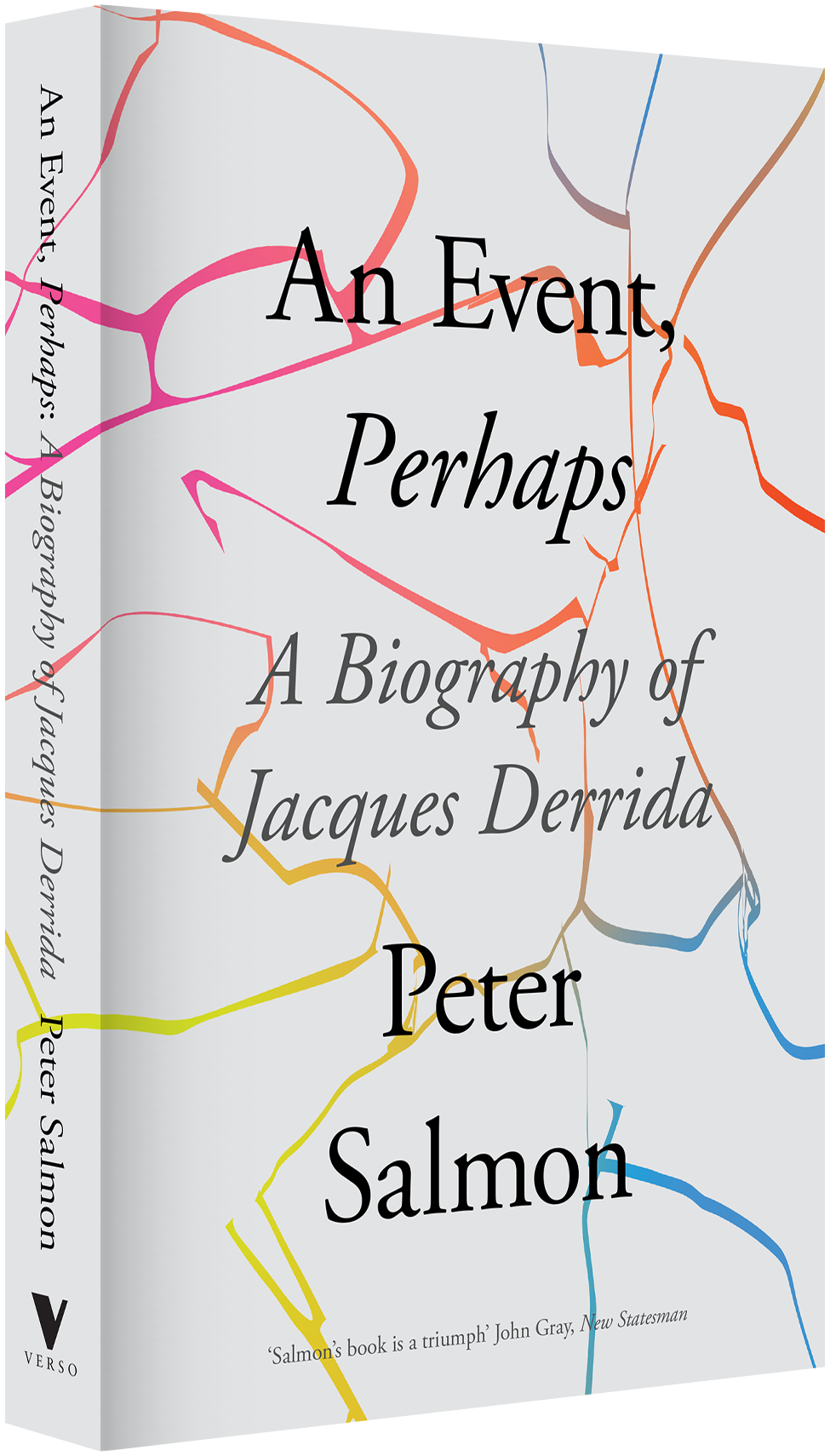
An Event, Perhaps: A Biography of Jacques Derrida by Peter Salmon
Omar Sabbagh on a biography of Jacques Derrida. Philosophy Now, 2021

Peter Salmon, An Event, Perhaps: A Biography of Jacques Derrida, Verso Books, 2020, 320 pages, £11.99 hb, ISBN 978-1788732802

Deciding to write a biog raphy of Jacques Derrida (1930-2004), even a predominantly intellectual biography like Peter Salmon’s, must, perhaps, involve a dilemma. As Salmon himself suggests in his Introduction, the temptation to mimic Derrida’s own ‘gnomic, allusive, elusive’ manner of writing can be overwhelming. Yet while saying that Salmon has written a superb intellectual biography that does a terrific job of humanizing a man and thinker often seen or imagined as arcanely inaccessible, we can also mention the more approachable way in which Salmon mirrors for his readers’ benefit some of the gnomic tics of his subject (or is it object?). If there really is, as Derrida says, ‘nothing outside the text’ – meaning that all meaning is text-based, and so susceptible to plural interpretations – then writing a biography in a predominantly plain-spoken manner might seem to be conceptually problematic, no? The book, however, hardly ever fails to intrigue, picking out and deploying moments of Derrida’s life and work, text and context, with a novelistic rhythm.

[…]
Michel Foucault, of course, is also a repeated presence. As one of Derrida’s doctoral examiners, he wonders whether, given the abstruseness (but brilliance) of Derrida’s work, he should be given an ‘F’ or an ‘A+’. This is the kind of paradox that typified Derrida’s public career. Later, Derrida, calling himself a ‘disciple’, critiques Foucault’s 1961 work Madness and Civilization ; but his criticisms are acknowledged by Foucault and duly applied by the early 1970s, by which time Derrida had already achieved wide fame.
[…]

Radford, G. P., Radford, M. L., & Lingel, J. (2015). The library as heterotopia: Michel Foucault and the experience of library space. Journal of Documentation, 71(4), 733-751.

doi:http://dx.doi.org/10.1108/JD-01-2014-0006

Abstract
Purpose
Using Michel Foucault’s notion of heterotopia as a guide, the purpose of this paper is to explore the implications of considering the library as place, and specifically as a place that has the “curious property of being in relation with all the other sites, but in such a way as to suspect, neutralize, or invent the set of relations that they happen to designate, mirror, or reflect” (Foucault, 1986a, p. 24).

Design/methodology/approach
The paper draws upon a range of literary examples and from biographical accounts of authors such as Alan Bennett, Michel Foucault, and Umberto Eco to show how the library space operates as a heterotopia.

Findings
The paper finds that drawing together the constructs of heterotopia and serendipity can enrich the understanding of how libraries are experienced as sites of play, creativity, and adventure.

Originality/value
Foucault’s concept of heterotopia is offered as an original and useful frame that can account for the range of experiences and associations uniquely attached to the library.

stuartelden's avatarProgressive Geographies

As thelast updateonthis booksaid, I was able to make a trip to Paris over reading week. I spent most of the time at the BNF working on archival materials related toThe Archaeology of Knowledge. There is a manuscript on philosophical discourse, probably written in 1966, which seems to be an abandoned book project; a complete early draft of what became the book; and substantial fragments of another draft. The record is incomplete, and there are a lot of question marks around dating and sequence, but this is more preparatory material than any other of Foucault’s published books, with the exception of the second and third volumes of theHistory of Sexuality. In that case, this seems to be because Foucault was in hospital and unable to destroy these draft materials. I discuss those inFoucault’s Last Decade.

Some parts of theArchaeology

View original post 1,327 more words

Deering, B. (2015). In the Dead of Night: A Nocturnal Exploration of Heterotopia in the Graveyard. In M.-J. Blanco & R. Vidal (Eds.), The Power of Death: Contemporary Reflections on Death in Western Society (1st ed., pp. 183–197). Berghahn Books.

http://www.jstor.org/stable/j.ctt9qd3qf.19

The photograph below shows a visitor to a Hallowe’en graveyard event.¹ Hundreds of flickering tealights lit up the tombstones, while storytellers enthralled the crowds with ghostly and ghastly tales. Having attended this annual event for several years I noticed that it attracted people from all over the city and beyond. On a night when there are myriad pop-up cultural events on offer, what could possibly be the lure of a dark and gloomy graveyard? This chapter explores the phenomenon of nocturnal graveyard visits and interrogates the motivations and experiences of the visitors. The study forms part of a larger PhD…

Sylvère Lotringer (1938–2021)
Art Forum, November 10, 2021

Renowned French thinker Sylvère Lotringer, a lodestar in the twin galaxies of literary criticism and cultural theory, died on November 8 at the age of eighty-three following an illness. Beginning in the 1970s, Lotringer reshaped the American literary scene through the journal Semiotext(e), which he began publishing while teaching at Columbia University. The journal evolved into an independent publishing house of the same name, which through its English translations of their texts introduced American readers to such French giants of philosophy as Jean Baudrillard, Gilles Deleuze and Félix Guattari, Michel Foucault, Jean-François Lyotard, and Paul Virilio.
[…]

Los Angeles Times

[…]

In November of 1975, a French literary scholar at Columbia University by the name of Sylvère Lotringer, along with a student, John Rajchman, organized a four-day colloquium that was intended to bring together a wave of avant-garde French theorists with various representatives of downtown New York City demimondes — presumably to discuss themes related to “prisons and madness.”
[…]
It remained delightfully eggheaded until the Village Voice featured the colloquium as its “pick of the week” and more than 2,000 people descended on Columbia for the event. Fights broke out. Panelists attacked each other. During Foucault’s presentation, an attendee stood up and accused him of being a paid agent of the CIA. (He was not.)
[…]
At the center of it all was the affable Lotringer. In the 2014 book, “Schizo Culture: The Book, The Event,” he recalled the chaos of the proceedings: “Foucault vented his furor and frustration at the conference. It was a scandal, he said; he had never seen a worse audience before; New Yorkers were horrible, the conference a sham.”
[…]

See also New York Times (paywall)

And Le Monde (paywall)

Un vrai passeur toujours s’efface devant ce qu’il fait passer ; il relie et fait converger tout en étant lui-même au bord de disparaître. Avec Sylvère Lotringer – qui pensait en ces termes, et est mort le 8 novembre dans sa résidence de Baja California, au Mexique – c’est un vrai passeur qui a disparu. Et quel passeur ! Le rayonnement nord-américain de la pensée française depuis un demi-siècle (dont cette « French Theory » qu’il rassembla, publia et baptisa même) lui doit beaucoup, de même que la popularité, dans certains milieux français, des avant-gardes culturelles américaines de la fin du XXe siècle. Et au-delà, il favorisa l’étonnante diffusion des théories philosophiques les plus subversives, ou les plus intempestives, dans des milieux connexes – artistiques, militants, universitaires, contre-culturels, qu’il aura contribué à inspirer et rapprocher les uns des autres.

Sylvère Lotringer est né à Paris le 15 octobre 1938, de parents juifs polonais émigrés de Varsovie en 1930. Confié par sa mère à des proches, il a passé la seconde guerre mondiale dans l’est parisien en « enfant caché » – comme beaucoup d’autres de sa génération, dont la philosophe Sarah Kofman et l’écrivain Georges Perec, avec lesquels il partagera le souvenir traumatique de cette enfance recluse.

Appréciation : Le Semiotext(e) de Sylvère Lotringer a changé de livre

Taşkale, Ali Rıza. “Thanatopolitics and Colonial Logics in Blade Runner 2049.” Thesis Eleven 166, no. 1 (October 2021): 109–17.
https://doi.org/10.1177/07255136211043944.

Abstract
This article critically engages with Denis Villeneuve’s Blade Runner 2049, focusing on the relationship between colonial logics and biological engineering that understands the natural world as property. First, it discusses the connections between the film and the shifting status of biopolitics becoming thanatopolitics, prompted by advances in synthetic biology. It argues that the film’s preoccupation with the reproductive capacity of its replicants retraces a racialized (post) colonialism and reconfigured slavery, or the voluntary labour of the occupied – as normalized in synthetic biology and the ongoing processes of devaluing of some lives over others for socioeconomic reasons. Second, and relatedly, the film reveals how deeply the thanatopolitics of a biopolitical economy is rooted in an intensification of racialized and colonial logics. The film thus doubles as a medium in which to grasp the centrality of colonial and racial logics to the ongoing real subsumption of life by capital, and the ways in which it continues to shape the present.

Keywords
bioeconomy, biopolitics, Blade Runner 2049, synthetic biology, thanatopolitics
Access Options

Clements, Paul. “Highgate Cemetery Heterotopia: A Creative Counterpublic Space.” Space and Culture 20, no. 4 (November 2017): 470–84.
https://doi.org/10.1177/1206331217724976.

Open access

Abstract
Highgate Cemetery is nominally presented as a heterotopia, constructed, and theorized through the articulation of three “spaces.” First, it is configured as a public space which organizes the individual and the social, where the management of death creates a relationship between external space and its internal conceptualization. This reveals, enables, and disturbs the sociocultural and political imagination which helps order and disrupt thinking. Second, it is conceived as a creative space where cemetery texts emplace and materialize memory that mirrors the cultural capital of those interred, part of an urban aesthetic which articulates the distinction of the metropolitan elite. Last, it is a celebritized counterpublic space that expresses dissent, testimony to those who have actively imagined a better world, which is epitomized by the Marx Memorial. Representation of the cemetery is ambiguous as it is recuperated and framed by the living with the three different “spaces” offering heterotopic alliances.

Keywords
cemetery texts, counterpublic, cultural capital, heterotopia, recuperation

Guilel Treiber, From Monster to Child. Ariès, Foucault, and the Constitution of Normality, Tijdschrift voor Filosofie, issue 2, vol 83, 2021, 323-354

Abstract :
This paper aims to destabilize the obvious, intrinsic value of childhood as one of the most morally potent values of our times and to trace its historical rise to dominance. I argue that a clear path to such a problematization of the value of childhood should pass through Foucauldian genealogy. Though rarely considered, I show how Foucault has actually already laid the foundations, following Ariès’ work, for such a genealogy of childhood. I reject feminist critiques arguing that whatever Foucault has to say of children or sexual abuse is tainted by an unconfessed machismo. I trace a possible history of how childhood gained its current value through Ariès and Foucault’s works. Through Ariès, I highlight that childhood did not have such an important value until quite recently. His formulation of the process of infantilization, of turning children solely into objects of sentimental value, attaching inherent vulnerability and innocence to their condition is the tacit beginnings of a process Foucault will end tracing. I reconstruct Foucault’s arguments in his lectures during the early seventies and demonstrate that, according to him, the increase in the value of childhood is related to the child becoming the condition of the healthy normalized adult through the generalization of psychiatry and the constitution of normality.

Boulton, M., Garnett, A., & Webster, F. (2021). A Foucauldian discourse analysis of media reporting on the nurse-as-hero during COVID-19. Nursing Inquiry, e12471.
https://doi.org/10.1111/nin.12471

Abstract
This study uses a Foucauldian discourse analysis to explore media reporting on the role of nurses as being consistently positioned ‘heroes’ during COVID-19. In so doing, it highlights multiple intersecting discourses at play, with the caring discourse acting as a central one in negatively impacting nurses’ ability to advocate for safe working conditions during a public health emergency. Drawing on media reports during the outbreak of COVID-19 in Ontario, Canada in the spring of 2020 and on historical information from SARS, this study seeks to establish caring as a discourse and examine if the caring discourse impedes nurses’ ability to protect themselves from harm. The results of this analysis explicate how public media discourses that position nurses as caring, sacrificial and heroic may have impacted their ability to maintain their personal safety as a result of the expectations put upon the nursing profession.

A. Pitsikali & R. Parnell (2019) The public playground paradox: ‘child’s joy’ or heterotopia of fear?, Children’s Geographies, 17:6, 719-731,

DOI: 10.1080/14733285.2019.1605046

ABSTRACT
Literature depicts children of the Global North withdrawing from public space to ‘acceptable islands’. Driven by fears both of and for children, the public playground – one such island – provides clear-cut distinctions between childhood and adulthood. Extending this argument, this paper takes the original approach of theoretically framing the playground as a heterotopia of deviance, examining – for the first time – three Greek public playground sites in relation to adjacent public space. Drawing on an ethnographic study in Athens, findings show fear to underpin surveillance, control and playground boundary porosity. Normative classification as ‘children’s space’ discourages adult engagement. However, in a novel and significant finding, a paradoxical phenomenon sees the playground’s presence simultaneously legitimizing playful behaviour in adjacent public space for children and adults. Extended playground play creates alternate orderings and negotiates norms and hierarchies, suggesting significant wider potential to reconceptualise playground-urban design for an intergenerational public realm.

Keywords: Playground paradox heterotopia fear Athens ethnography public realm