Foucault News

News and resources on French thinker Michel Foucault (1926-1984)

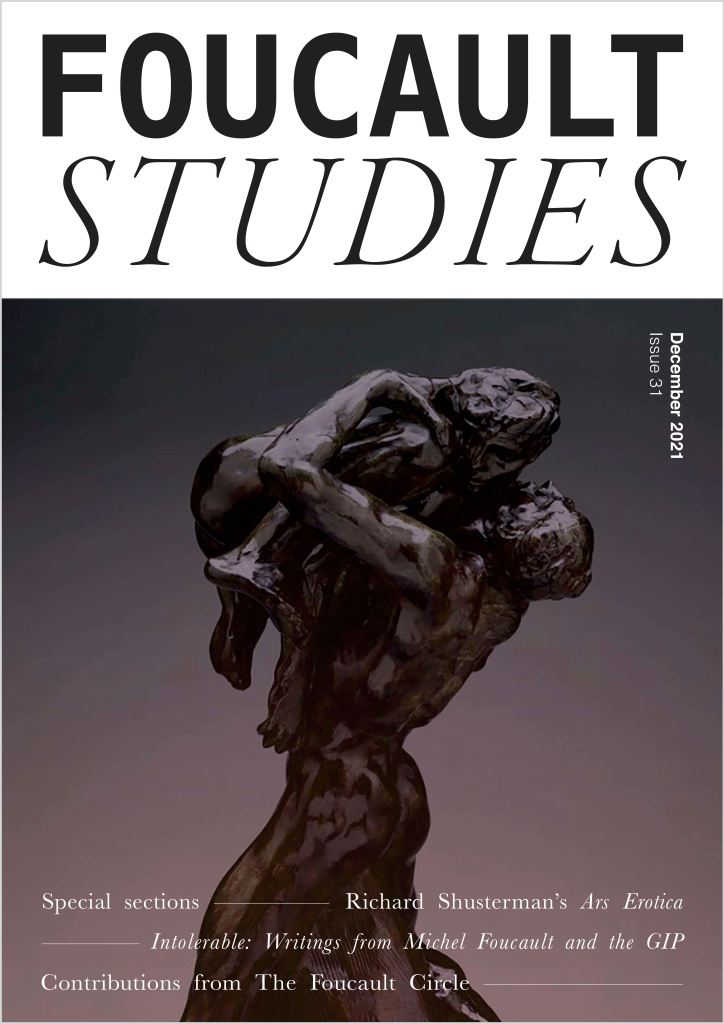
Foucault Studies. Issue 31, December 2021
Open access

Editorial
Sverre Raffnsøe et al.

Symposium: Ars Erotica
Sexuality and/as Art, Power, and Reconciliation
Preface to symposium on Richard Shusterman’s Ars Erotica. Sex and Somaesthetics in the Classical Arts of Love:
Stefano Marino

Ars Erotica and Sôphrosunê: Examining Shusterman’s Nietzsche
Catherine Botha

On the Interest in the Art of Loving: Richard Shusterman’s Ars Erotica
Leonardo Distaso

Beauty between Repression and Coercion: A Few Thoughts on Richard Shusterman’s Ars Erotica: Sex and Somaesthetics in the Classical Arts of Love
Leszek Koczanowicz

Sex, Emancipation, and Aesthetics: Ars Erotica and the Cage of Eurocentric Modernity
Response to Botha, Distaso, and Koczanowicz
Richard Shusterman

Symposium: Intolerable
Intolerable: A book symposium

“Let those who have an experience of prison speak”: The Critique & Praxis of the Prisons Information Group (1970-1980)
Bernard E. Harcourt

Challenge to What Is: The Effect and Aftermath of Exposing Intolerable Conditions of Confinement
Liat Ben-Moshe

The Problem of Concealment: Reformism, Information Struggles, and the Position of Intellectuals
Delio Vásquez

Shirts and Hearts
Sarah Tyson

Abolitionist Broken Windows and the Violence of Power Relations
Ren-yo Hwang

Reform, Abolition, Problematization
Kevin Thompson

Abolition and the Prophetic Imagination
Perry Zurn

Two Friends and a Camera: Foucault, Livrozet, and the Guerilla Art of Documentary Film
Perry Zurn

Special section: Contributions from The Foucault Circle

Coordinator’s introduction
Edward McGushin

The Forgotten Spanish Charity: Love, Government, and The Poor
Martin Bernales-Odino

Genopower: On Genomics, Disability, and Impairment
Joel Michael Reynolds

Articles

Foucault’s Outside: Contingency, May-Being, and Revolt
Luke Martin

Faux Amis, Vrais Amis? Amis.
Jonas Oßwald

Book Reviews

Dianna Taylor, Sexual Violence and Humiliation: A Foucauldian-Feminist Perspective (Interdisciplinary Research in Gender). London and New York: Routledge, 2020. Pp. 128.
ISBN: 978-1-138-58143-2 (hardback). ISBN: 978-0-429-50542-3 (e-book).
Sara Cohen Shabot

Pierre Hadot, The Selected Writings of Pierre Hadot: Philosophy as Practice. London: Bloomsbury, 2020. Pp. 320.
ISBN: 9781474272971 (hardback).
Émile Levesque-Jalbert

Mona Lilja, Constructive Resistance: Repetitions, Emotions, and Time. London: Rowman & Littlefield, 2021. Pp. 184.
ISBN: 9781538146484 (hardback).
Marco Checci

Robert Mitchell, Infectious Liberty. Biopolitics between Romanticism and Liberalism. New York, NY: Fordham University Press, 2021. Pp. 304.
ISBN: 9780823294596 (paperback).
Antonia Karaisl

Marco Checchi, The Primacy of Resistance: Power, Opposition and Becoming. London: Bloomsbury Academic, 2021.
ISBN: 9781350124462 (e-book).
Tomas Pewton

Mitchell Dean and Daniel Zamora, The Last Man Takes LSD: Foucault and the End of Revolution. London: Verso, 2021. Pp. 256.
ISBN: 9781839761393 (hardback).
Jasper Friedrich

Lynne Huffer, Foucault’s Strange Eros. Columbia: Columbia University Press, 2020. Pp. 280.
ISBN: 9780231197144 (hardback).
Theo Mantion

David Macey, The Lives of Foucault. A Biography. London: Verso, [1993] 2019. Pp. 613.
ISBN: 9781788731041 (hardback).
Mike Gane
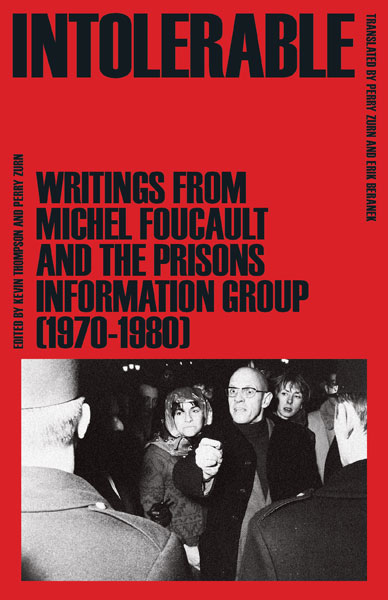
Interview podcast with Kevin Thompson and Perry Zurn, editors of Intolerable. Writings from Michel Foucault and the Prisons Information Group (1970-1980), UNIVERSITY OF MINNESOTA PRESS 2021, New Books Network, Dec 20, 2021

Intolerable: Writings from Michel Foucault and the Prisons Information Group (1970-1980) (University of Minnesota Press, 2021), edited by Kevin Thompson and Perry Zurn, is a groundbreaking collection of writings by Michel Foucault and the Prisons Information Group documenting their efforts to expose France’s inhumane treatment of prisoners

Founded by Michel Foucault and others in 1970-71, the Prisons Information Group (GIP) circulated information about the inhumane conditions within the French prison system. Intolerable makes available for the first time in English a fully annotated compilation of materials produced by the GIP during its brief but influential existence, including an exclusive new interview with GIP member Hélène Cixous and writings by Gilles Deleuze and Jean Genet.

These archival documents–public announcements, manifestos, reports, pamphlets, interventions, press conference statements, interviews, and round table discussions–trace the GIP’s establishment in post-1968 political turmoil, the new models of social activism it pioneered, the prison revolts it supported across France, and the retrospective assessments that followed its denouement. At the same time, Intolerable offers a rich, concrete exploration of Foucault’s concept of resistance, providing a new understanding of the arc of his intellectual development and the genesis of his most influential book, Discipline and Punish.

Presenting the account of France’s most vibrant prison resistance movement in its own words and on its own terms, this significant and relevant collection also connects the approach and activities of the GIP to radical prison resistance movements today.

Kevin Thompson is professor of philosophy at DePaul University. He is author of Hegel’s Theory of Normativity.

Perry Zurn is assistant professor of philosophy at American University. He is coeditor of Curiosity Studies: A New Ecology of Knowledge (Minnesota, 2020) and Active Intolerance: Michel Foucault, the Prisons Information Group, and the Future of Abolition.

Kirk Meighoo is Public Relations Officer for the United National Congress, the Official Opposition in Trinidad and Tobago. His career has spanned media, academia, and politics for three decades.

Teófilo Espada-Brignoni, The Performance of Authenticity, The Makings of Jazz and the Self in Autobiography, Rowman & Littlefield, 2021

In The Performance of Authenticity: The Makings of Jazz and the Self in Autobiography Teófilo Espada-Brignoni analyzes the autobiographies of New Orleans musicians (Baby Dodds, Sidney Bechet, Pops Foster, and Lee Collins) who throughout their texts construct New Orleans jazz as an authentic musical expression grounded in their experiences and culture. The author argues the autobiographies reproduce and reinterpret modernist conceptions of authenticity to assert and affirm authority over the public representations and discussions of jazz. Through the autobiographers’ use of ideas about authenticity, they establish the value of their narratives but at the same time reinforce some of the power dynamics they set out to criticize. Their narratives also reveal the complex ethics that emerged during the first decades of the music and problematize modernist values such as individualism, the dichotomy of work and life, as well as the self and the social. The book adopts Foucauldian and social-constructivist perspectives, complementing analysis of the autobiographies by drawing from literary theory, psychology, sociology, and jazz scholarship.

Caleb Smith, Disciplines of Attention in a Secular Age, Critical Inquiry 2019 45:4, 884-909

“Our inventions are wont to be pretty toys, which distract our attention from serious things,” Henry David Thoreau writes in Walden (1854).1 In the century and a half since Thoreau withdrew to the Massachusetts woods, his thinking about modernity and mental life has become our common sense. New machines of work and play, so the story goes, are destroying our capacity to pay attention. We are always in touch but never really intimate, always moving but never in a natural rhythm. “Why should we live with such hurry and waste of life?” (W, p. 90).
[…]
the distracted today turn to disciplines of attention, adapting the religious practices of older or distant societies to new situations that seem to have little to do with ritual or faith. Mindfulness training, transcendental meditation, regimens to sharpen our focus and extend our concentration—these are the spiritual exercises of our secular age.
[…]
In this essay I offer a genealogy of attentive reading as a secular spiritual exercise. Beginning with the transatlantic reform movements of the early nineteenth century, I take up a handful of sermons, lectures, and other texts that made the problem of attention their explicit topic. “The degree of attention we pay,” one minister preached in 1850, “depends upon our own disposition to attend. This shows us that the matter, after all, is very largely one of discipline.”14 I explore how reformers sought to capture and direct attention in the service of social control. I also dwell for a while with Thoreau, for whom a heightened attentiveness seemed to open a way out of the grips of power, toward a kind of redemption. As Theo Davis suggests, Thoreau’s work has become a touchstone for thinking about “reading as attending.”15 Our disciplines of attention were born, I argue, when reformers trained in an Anglo-Protestant tradition reconceived ancient religious practices for the purposes of secular pedagogy and self-culture, as a remedy to the psychic damage wrought by modernity.

[…]
The new spiritual exercises promised to repair the damage history does to the self—not by remaking historical conditions but by retraining will and perception. They are disciplines, but they are also therapeutic and ethical practices, in Michel Foucault’s sense.

Povinelli, Elizabeth A., Mathew Coleman, and Kathryn Yusoff. “An Interview with Elizabeth Povinelli: Geontopower, Biopolitics and the Anthropocene.” Theory, Culture & Society 34, no. 2–3 (May 2017): 169–85. https://doi.org/10.1177/0263276417689900.
Open access

Abstract
This article is an interview with Elizabeth Povinelli, by Mathew Coleman and Kathryn Yusoff. It addresses Povinelli’s approaches to ‘geontologies’ and ‘geontopower’, and the discussion encompasses an exploration of her ideas on biopolitics, her retheorization of power in the current conditions of late liberalism, and the situation of the inhuman within philosophical and anthropological economies. Povinelli describes a mode of power that she calls geontopower, which operates through the governance of Life and Nonlife. The interview is accompanied by a brief contextualizing introduction.

Keywords
Anthropocene, biopolitics, geontology, inhuman, liberalism

Technologies of Control and Infrastructures of Redistribution
Martina Tazzioli and Oana Pârvan, e-flux journal, Issue #123, December 2021

Open access

Martina Tazzioli

A well-known slogan that emerged from the disability movement during the 1990s goes: “Nothing about us without us.” It stresses that no policy should be adopted without fully involving those who are affected by that policy. Nowadays, it is a catchphrase used across different fields and institutional settings, signaling that “participation” has become a placeholder for inclusion, democracy, and horizontal decision-making processes. Yet, what does “participation” in a given system mean when the epistemic-political codes, the ability to maneuver, and the stakes of the participation are set in advance by the party in control? So-called “participatory programs,” like surveys and other forms of data acquisition, have been used extensively by humanitarian agencies since the 1990s, and more recently have shifted into systems for practicing what I instead call “participatory confinement.”
[…]
Modes of participatory confinement in refugee humanitarianism are inflected by clear-cut asymmetric relations between asylum seekers on one side, and humanitarian actors on the other. This initial condition and its trend towards reform by way of inviting participation is reminiscent of the diagnosis of prison reform by Michel Foucault in a lecture he gave in 1976. Furnishing an anticipatory example of participatory confinement, he writes: “There is an attempt to make prisoners themselves participate in devising the very programmes for their punishment, through the prisoners’ councils and so on. This is the idea that the individual, singly or collectively, is meant to accept the punitive procedure.” Nowadays, participatory approaches are center stage on the agendas of international agencies and NGOs in the context of the so-called “refugee crisis” in Europe.
[…]

To Read bell hooks Was to Love Her
By Tao Leigh Goffe, Vulture. DEC. 17, 2021

bell hooks taught the world two things: how to critique and how to love. Perhaps the two lessons were both sides of the same coin. To read bell hooks is to become initiated into the power and inclusiveness of Black feminism whether you are a Black woman or not. With her wide array of essays of cultural criticism from the 1980s and 1990s, hooks dared to love Blackness and criticize the patriarchy out loud; she was generous and attentive in her analysis of pop culture as a self-proclaimed “bad girl.” Sadly, the announcement of her death this week, at 69, adds to a too-long list of Black thinkers, artists, and public figures gone too soon.
[…]

Ain’t I a Woman: Black Women and Feminism (1981)
Publishing over 30 books over the course of her career, perhaps the most well-known is her first, Ain’t I a Woman. Referencing Sojourner Truth’s famous words, hooks drew a direct line between herself and the radical tradition of outspoken Black women demanding freedom. Before Kimberlé Crenshaw coined “intersectionality” in 1991, hooks exemplified the importance of the interlocking nature of Black feminism within freedom movements, weaving together the histories of abolitionism in the United States, women’s suffrage, and the Civil Rights era. She refused to let white feminism or abolitionist men alone define this chapter of America’s past. Finding power and freedom in the margins, she lived a feminist life without apology by centering Black women as historical figures.
[…]

Black Looks: Race and Representation (1992)
I love teaching the timeless essay “Eating the Other: Desire and Resistance” from this collection above all because it is the first one of hers I read as a college sophomore. In it, she reflects on what she overhears as a professor at Yale about so-called ethnic food and interracial dating. In some ways, the through-line of hooks’s writing can be summed up here, in the way she examines what it means to consume and be consumed, especially for women of color. In another essay from the collection, “The Oppositional Gaze,” hooks taught her readers the subversive power of looking, especially looking done by colonized peoples; drawing on the writings of Frantz Fanon, Michel Foucault, and Stuart Hall, she grappled with the power of visual culture and its stakes for domination in the lives of Black women, in particular. (She mentions that she got her start in film criticism after being grossed out by Spike Lee’s She’s Gotta Have It.) Her criticism shaped feminist film theory and continues to be celebrated as a crucial way to understand the politics of looking back.

Le cimetière de Montmartre à Paris : une pittoresque ville des morts, juin 2019. Eric Sergent

Eric Sergent, Les cimetières sont aussi des lieux de vie, The Conversation, October 22, 2021

S’il est évidemment le lieu où l’on inhume les morts, le cimetière est aussi un espace fort ambigu, que chacun investit de significations diverses, sans parvenir toujours à les formuler clairement. En témoignent les mots d’Edmond Texier qui, dans son Tableau de Paris, décrit l’impression qui étreint le visiteur pénétrant dans un grand cimetière urbain, le cimetière du Père-Lachaise en l’occurrence :

« Quand on a franchi ses portes funèbres, où sont inscrites des paroles d’espérance, la disposition de tristesse, de dévotion et de recueillement sévère que l’on apportait cède à une impression première plutôt agréable qu’attristante. »
[…]
Michel Foucault voit en ce lieu une illustration parfaite de son concept d’hétérotopie, c’est-à-dire un « lieu autre […] en liaison avec l’ensemble de tous les emplacements de la cité, ou de la société […] ». Le cimetière concerne chacun, il assure et matérialise le lien entre morts et vivants, lien entretenu par la visite au cimetière.
[…]

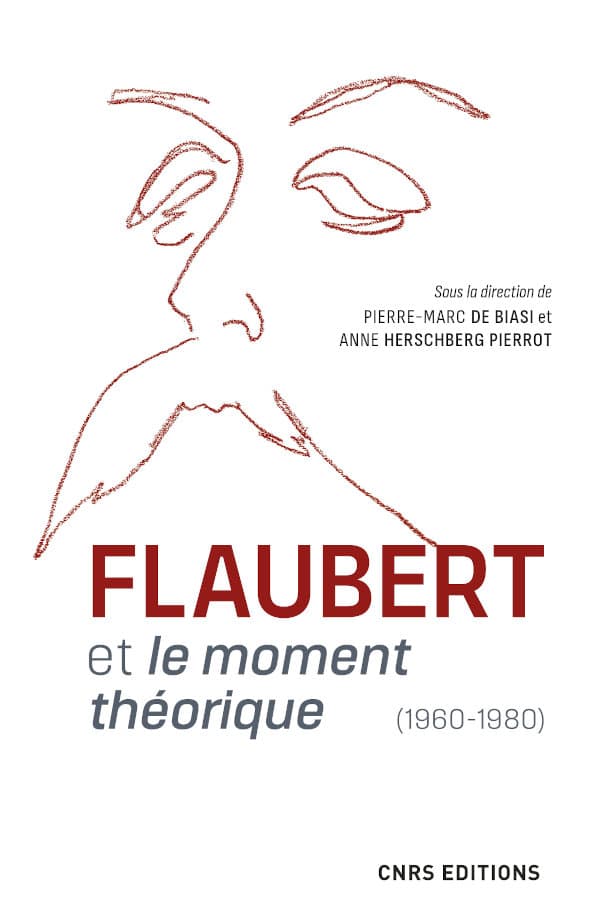
Frédéric Gros, Foucault, Flaubert, la tentation d’écrire. In Flaubert et le moment théorique (1960-1980), Sous la direction de Pierre-Marc de Biasi, Anne Herschberg Pierrot, CNRS éditions, 2021.

Et si Flaubert, dont on fête en 2021 le bicentenaire, n’était né, en réalité, qu’il y a une cinquantaine d’années ?

Entre 1960 et 1980, la France traverse une période d’intense effervescence intellectuelle : ce que l’on appellera le moment théorique. Les sciences de l’homme sont mises à contribution pour repenser la littérature selon les normes d’une axiologie formelle – le structuralisme – où prévalent les exigences de systématicité et de radicalité.

C’est dans ce contexte que Flaubert acquiert une notoriété de premier plan. En moins d’une décennie, il s’impose comme une référence dominante pour la nouvelle critique, l’Université et les jeunes romanciers qui découvrent sa flamboyante Correspondance à travers une anthologie, centrée sur sa poétique : Préface à la vie de l’écrivain de Geneviève Bollème, où il apparaît comme un véritable précurseur du roman contemporain et de l’esthétique conceptuelle.

De Roland Barthes à Michel Foucault, de Jean-Paul Sartre à Pierre Bourdieu ou à Jacques Rancière, de Michel Butor, Nathalie Sarraute et Alain Robbe-Grillet à Pierre Bergounioux ou Pierre Michon, de Jean-Pierre Richard à Gérard Genette, c’est toute une génération qui reconnaît en Flaubert la figure souveraine de l’écrivain, au sens absolu du terme, à la fois prophète du minimalisme, théoricien du style et du travail sur la prose, penseur du processus créatif et inventeur du roman moderne.

Sans chercher à être exhaustif, cet ouvrage suit l’ordre alphabétique pour explorer, à travers quelques grands acteurs du moment théorique, ce fascinant processus de réception créatrice dont nous continuons tous aujourd’hui à être les héritiers.

Feuilleter l’ouvrage et parcourir la table des matières…

Terry Eagleton, Everything, All the Time, Everywhere by Stuart Jeffries review – how we became postmodern, The Guardian, 10 November 2021

Stuart Jeffries, Everything, All the Time, Everywhere: How We Became Postmodern, Verso, 2021

For the past half-century, postmodernist thinkers have been trying to discredit truth, identity and reality. Identity is a straitjacket, and truth is just some middle-aged academic’s opinion. As for reality, it has become as obsolete as dressing for dinner. Objectivity is a myth in the service of the ruling powers. If only we could shed these illusions, we could revel in a world of infinite possibility. Instead of waking up to the same tedious old self each morning, we could flit from one identity to another as easily as David Bowie. The final liberation is that anything can mean anything else. Once you kick away fixed meanings and firm foundations, you are free to enjoy yourself. Postmodernism is meant to be fun, even if a current of nihilism runs steadily beneath it. As Stuart Jeffries suggests in this splendidly readable survey, there is something vacuous at the heart of its exuberance.
[…]

Some studies of postmodernism are cultural, some are historical and a few of them are philosophical. The achievement of this book is to roll all three approaches into one. This is rare, because those who know about Sid Vicious may not be avid readers of Michel Foucault, while those who are deep in Jacques Derrida are not always fans of Chris Kraus’s I Love Dick. Jeffries packs a remarkable knowledge of postmodern culture into these pages, from punk, hip-hop, film and photography to anti-psychiatry, the Rushdie fatwa and queer theory. All this is set in the context of the neoliberalism of the 1970s, showing how a revamped capitalism gave birth to a culture of the flexible and provisional – of short-termism, endless consumption and multiple identities.
[…]