Foucault News

News and resources on French thinker Michel Foucault (1926-1984)

Smeets, Koen, Neo-Liberalism, Neoclassical Economics, and Foucault: Dominant Schools of Economic Thought in American Anarcho-Liberalism and German Ordoliberalism (April 3, 2021). Available at SSRN: https://ssrn.com/abstract=3684056 or http://dx.doi.org/10.2139/ssrn.3684056

Abstract
This paper examines the influence of American and German neo-liberalism on the dominant school of economics in their respective countries based on an extended version of Foucault’s The Birth of Biopolitics. The analyses of the American neo-liberal economists, or anarcho-liberalists, legitimised the extension of the basic neoclassical model to non-economic, social phenomena and invalidated governmental intervention in both economic and social phenomena. In contrast, the assumption of the German neo-liberals, or Ordoliberals, of markets as artificial, imperfect constructs validated setting the right conditions for the market by the government. This analysis demonstrates and draws lessons from the historical conditions under which a school with divergent assumptions from the neoclassical assumptions of perfect rationality and perfect competition became dominant in a neo-liberal political-economic environment.

Keywords: neoliberalism; neoclassical; Foucault; The Birth of Biopolitics; economics

González, D.E., Galmiche, G.P., Sánchez, A.C.M.
Michel Foucault and his speech beyond the philosophical: A political analysis in the light of philosophy [Michel foucault y su discurso más allá de lo filosófico un análisis político a la luz de la filosofía]
(2021) HUMAN REVIEW. International Humanities Review / Revista Internacional De Humanidades, 10(1), pp. 131–141.

DOI: 10.37467/GKAREVHUMAN.V10.3006

Abstract
This article sums up the constantly debated issue of philosophical knowledge about power, called by Foucault: critical analysis of modernity. An analysis linked to other thinker is produced, under the guidance of the French thinker and also a debate is conducted around questions generated by the heritage of modernity or what he called, today. The objective is to analyze Michel Foucault’s thought in the light of various authors, generating a necessary theoretical framework. The question is asked: is Foucault’s position applicable today?. © 2021, Global Knowledge Academics. All rights reserved.

Author Keywords
Biopower; Philosophical knowledge

The Telos Press Podcast: Kyle Baasch on Adorno and Foucault in San Francisco
By Telos Press · Sunday, December 12, 2021

In today’s episode of the Telos Press Podcast, David Pan talks with Kyle Baasch about his article “Critical Theory in the Flesh: Adorno and Foucault in San Francisco,” from Telos 196 (Fall 2021). An excerpt of the article appears below. In their conversation they discussed how Foucault’s aversion to Marxism relates to his notion of the individual as endlessly transfiguring itself through acts of creative self-invention; how Adorno interprets the freedom of the subject within the context of consumer culture and exchange society; the influence of Adorno’s experience as a heartbroken lover on his conception of happiness, particularly in Minima Moralia; how Adorno’s notion of happiness relates to the conception of harmony that Foucault criticizes; and the extent to which the two thinkers can be put into conversation. If your university has an online subscription to Telos, you can read the full article at the Telos Online website.

Karnovsky, S., Gobby, B., O’Brien, P.
A Foucauldian ethics of positivity in initial teacher education
(2021) Educational Philosophy and Theory

DOI: 10.1080/00131857.2021.2016390

Abstract
This article explores ways pre-service teachers learn to work upon their positive emotional conduct during an initial teacher education course. The article argues that education practice today promotes the acting out of positive emotions, creating conditions within which pre-service teachers ethically shape their emotional conduct. Utilising Foucault’s four-part ethical framework, the article draws on longitudinal research of pre-service teachers in Western Australia to analyse the crafting of emotional conduct through techniques of the self. The techniques the participants came to employ during their course learning aligned with a telos of the resourceful, positive, and professional teacher. The article argues that this ethical enterprise relies on a certain model of teacher subjectivity which is inseparably linked with normalising governmental power. Such disciplining of emotions, however, is neither one-dimensional nor deterministic; rather, work at the intersection of the government of others and of oneself. We argue this allows pre-service teachers the freedom to care for the self as they seek to foster their own ethical practices as teachers. © 2021 Philosophy of Education Society of Australasia.

Author Keywords
emotions; ethics; Foucault; initial teacher education

PhD Course: Foucault: Organization, technology, and subject-formation
Copenhagen 27/06/2022 – 30/06/2022

More information and registration: https://phdcourses.dk/Course/88149

Faculty
Marius Gudmand-Høyer, Associate Professor, Department of Management, Politics and Philosophy, Copenhagen Business School.
Sverre Raffnsøe, Professor, Department of Management, Politics and Philosophy, Copenhagen Business School.
Ute Tellman, Professor, Department of Sociology, Darmstadt University.
Kaspar Villadsen, Professor (mso), Department of Management, Politics and Philosophy, Copenhagen Business School.

Prerequisites

Only PhD students can participate in the course.

Participation requires submission of a short paper (see more below). Papers must be in English. Deadline is 13 June 2022. We welcome PhD students who work with Foucault as well as PhD students who would like to integrate Foucauldian ideas.

It is a precondition for receiving the course diploma that the PhD student attends the whole course.

Aim

The course will provide the participants with:

a) An introduction to key analytical potentials reconstructed from Foucault’s authorship as well as the lecturers’ own research projects.
b) We will discuss different approaches to themes of organization, technology, and subject-formation, as they are deployed in state-of-the-art Foucault-inspired scholarship.

c) The particular way Foucauldian analytics can be applied in the participant’s research will be explored. Hence, both potentials and limitations will be discussed in relation to the participants’ current research.

Course content

Michel Foucault’s work continues to offer a major source of inspiration for PhD projects across a wide range of disciplinary domains. This PhD course explores how Foucault’s work speaks to three broad themes in contemporary business school research and beyond: Organization, technology, and subject-formation. A key aim of the course is to provide an overview of analytical possibilities in Foucault’s work, effective for deploying such analytics in their own research.

Overall, Foucault’s thinking can help to inquire into the organizations, technologies and self-techniques that condition our contemporary experiences. First, Foucault’s genealogical approach (1977, 1984) works by tracing how contemporary forms of organization emerged from past struggles, political strategies, and accidental events. From this perspective, the prevailing modes of organizing can be better grasped by recovering their historical conditions of emergence. Struggles around definitions and uses of appropriate management, leadership, accountability, transparency or sustainability make up pertinent material for genealogical inquiry.

Foucault developed his own notion of technology during the 1970s, namely the concept of “the dispositive”. A dispositive is defined as a historical configuration, which connects discursive and non-discursive elements such as laws, practices, material artifacts, procedures, and techniques (Foucault, 1980). It designates a propensity in knowledge production and social practice as well as a “dispositionality” in how institutions emerge and transform. The concept has recently been introduced into Foucauldian scholarship, and it opens for analyzing how our practices – for example, risk assessments or anti-pandemic strategies – are conditioned by dispositives that have been formed in historical processes often spanning several centuries.

Finally, Foucault’s late authorship in the early 1980s, often termed his “ethical turn”, took him back to techniques of self-formation in Early Christianity and Greco-Roman antiquity. There, Foucault noticed a “technical” notion of ethics less defined by submission to universal moral codes and instead focused more on the self’s work upon the self. Perhaps, the urgent issues of our time call for developing another form of ethics rather than models rooted in legal frameworks and Christian morality. The recent emergence of responsible consumers, ‘life-long learners’, climate conscious youths, “freeganism”, and fluid gender identity could be analyzed with inspiration from Foucault’s work on ethics and self-formation.

The theme of this PhD course requires that the participants engage in some way with Foucault’s historical work, his analytical frameworks, or his approach to organization, technology, and subjectivity. Papers that are not exclusively Foucauldian but also derive from other thinkers and traditions are welcome too.

Teaching style

The goal is to sharpen the participants’ knowledge of Foucault’s analytical toolbox and how it can be applied in PhD projects. To that end we dedicate sufficient time to carefully examine and discuss the submitted papers. The aim of the lectures is, first, to clarify the ways in which Foucault worked with his analytics and, second, to demonstrate how to put the analytics to work in specific analysis. The aim of the workshops is to explore how Foucauldian analytics function in each participant’s paper – with the aim of strengthening, deepening and nuancing the participants’ research. In the workshops, participants are divided into smaller groups that will be supervised by one of lecturers.

All participants are required to submit a paper that deals with the key theme(s) of the PhD project in question (maximum 10 pages).

Papers (and 300 word abstracts) must be in English.

Tracey Potts, Clutter and place
(2020) The Routledge Handbook of Place, Edited By Tim Edensor, Ares Kalandides, Uma Kothari, pp. 486-495.

DOI: 10.4324/9780429453267-43

Abstract
This chapter explores the complex relationship between stuff and place as a way of interrogating the contemporary media obsession with decluttering. While the very idea of place connotes order (as in the maxim ‘a place for everything and everything in its place’), place is also made via material means, made inhabitable with stuff. Things might get in the way, becoming clutter, but, equally, there is no getting way from things. By critically examining the five common steps to a decluttered life, the chapter shows how the wildness of things is drastically underestimated in bestselling self-help guides. More, the magic of decluttering and of remaining clutter-free for life can be critically reframed as the operations of what Michel Foucault terms ‘technologies of the self’. Doreen Massey, with her notion of ‘throwntogetherness’, is, further, brought in to offer an object lesson to the likes of Kondo, showing how a messier encounter between people and things might help to allow clutter to speak back to, rather than simply unsettle, place. © 2020 selection and editorial matter, Tim Edensor, Ares Kalandides and Uma Kothari.

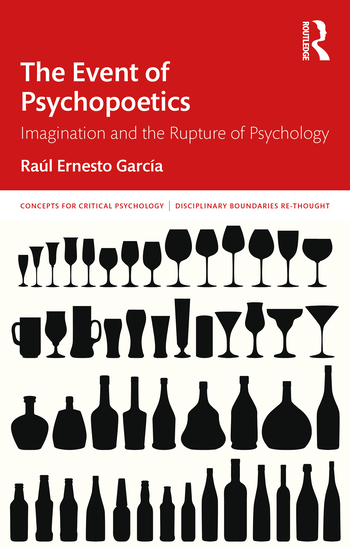
Raúl García, The Event of Psychopoetics. Imagination and the Rupture of Psychology, Routledge, 2021

The Event of Psychopoetics overviews and investigates the notion of psychopoetics, a sociopsychological event that involves re-creative slips and that emerges under certain cultural conditions and power relations in the context of everyday interaction and through certain modes of dialoguing and conversing.

This transdisciplinary text takes the reader through the thought processes of Deleuze, Guattari, Agamben, Maffesoli, Foucault, Butler, Haraway, and Braidotti, among others, addressing debates that are integral to the critique of psychology and its devices of subjectivization and normalization. Garcia takes a unique approach by reflecting on how psychopoetics contrasts institutionalized dialogues, while constantly emphasizing the generative and transformative potency of social worlds effectuated in the impetuous play of poetics. The book combines the rigor of academic research with the creative display of ideas that open diverse, suggestive lines of reflection on everyday interlocution and its possibilities of reinvention, modes of social existence, and the relation between subjectivity and the designs of power.

A truly unique reading experience, this book is ideal for students, instructors, and researchers in the fields of philosophy, social psychology and sociological thought, discourse studies, literary theory, and cultural analysis.

Raúl Ernesto García is a tenured, full-time professor/researcher in the Faculty of Psychology at the Universidad Michoacana de San Nicolás de Hidalgo in Morelia, México. His general areas of research include theory and critique of cultural and discursive processes and subjectivization; and studies of the concept of dialogue and conversation and their current utilization in interventive apparatuses of the psychological complex. García has also published numerous specialized articles and book chapters on the aforementioned topics, as well as the book El diálogo en descomposición (2008), an essay on the emergence and transformations of the concept of dialogue in philosophical milieus and social thought.

stuartelden's avatarProgressive Geographies

My optimistic idea of having a complete, even if very rough, draft of The Archaeology of Foucault before Christmas didn’t happen. I’d liked the idea of having a complete text, which I could then print and leave for a while when on holiday, and return to edit before term started again. But end of term stuff, a pile of marking, and some home renovation work which meant I couldn’t work properly derailed that plan. In addition, I was given access to some lectures which I didn’t know still existed, and that took up a lot of time – valuable, certainly, but unexpected.

I did have a good break over Christmas, without looking at the files or Foucault books, and returned to work for two weeks either side of the New Year before the start of term. The break helped get the momentum to complete the draft of the chapter on

View original post 797 more words

Daher-Nashif, S. (2021). In sickness and in health: The politics of public health and their implications during the COVID-19 pandemic. Sociology Compass,
https://doi.org/10.1111/soc4.12949

Abstract
Politics is a major player in health, sickness, and death affairs. This article reviews the role of politics in public health and its impact on health outcomes, mortality ratios, and death scenarios amongst the most vulnerable populations. Furthermore, the article explains the reasons behind the absence of politics from health and public health discourses; and examines the role of politics during the mis/management of COVID-19 pandemic. Drawing on Foucault’s biopower, Mebmbe’s necropolitics, and Butler’s precarity, the article illuminates how public health policies are highly political insofar as they offer some individuals access to life but create possibilities of death for others. During COVID-19, politics enabled governors to put at risk the most vulnerable groups, the precariat, namely refugees, asylum seekers, stateless, and immigrants, the majority of whom were impoverished. The article presents COVID-19 as an example of a crisis that unmasks these politics, claiming that these politics are not new but rather a continuum of previous invisible policies that COVID-19 unmasked and intensified. The article describes how the politics of health entail privileging individuals with capital value who can benefit the state’s interests and maintains its power.

Kaveh Dastooreh, The Aesthetics of Life: More than Ethics and Morality -video documentary (2022)
In Kurdish with subtitles.