
Foucault News

News and resources on French thinker Michel Foucault (1926-1984)

20th Annual Meeting of the Foucault Circle
Emory University Atlanta, GA
May 13-15, 2022

Foucault Circle 2022 Program PDF

All sessions will be held in the Jones Room, Robert W. Woodruff Library

Friday, May 13th
3-5pm
Session 1: Affect and Materialism
Moderator: Samantha Wrisley, Emory University

Selin Islekel, Fordham University
“’Fables that Stir the Mind’: Autopoeisis and Heterotopias of Death”

Daniel Perlman, DePaul University
“Posthuman Power and the Historicity of Matter: Developing Han’s Critique of Foucault Through Barad”

Lauren Guilmette, Elon University
“The Weight of Papier Mâché: Affect and Emotion in the Archives of Infamy”

5:15pm
Reception, Jones Room, Robert W. Woodruff Library

Saturday, May 14th
9-11am

Session 2: Biopower Today
Moderator: Dian Dian, Emory University

Eyo Ewara, Loyola University Chicago
“Flattening the Racial Curve: Foucault, Anti-Racism, and Inoculation”

Patrick Gamez, Missouri University of Science and Technology “Reading Biopolitics Through Big Data”

Stephen Seely, Newcastle University
“Locating the Question Concerning Technology in the History of Sexuality”

11:15am-1:15pm
Session 3: Foucault and Race
Moderator: Shelley Feller, Emory University

Taryn Jordan, Colgate University
“Du Bois, Foucault, and Soul: The Shadow of the Color Line and the Production of Soul through Modern Power”

Daniel Schultz, Whitman College
“Foucault and the Theo-Political Technologies of Race”

Sabeen Ahmed, University of Illinois at Urbana-Champaign “Law and the Imperial Genealogy of Modern Power”

1:15-2:45pm
Lunch (not provided; please see information for options)
Business Meeting (box lunch provided for participants)

3-5pm
Session 4: Care of the Self and the Speaking Subject
Moderator: Aobo Dong, Emory University

Vilde Lid Aavitsland, DePaul University
“Foucault’s Politics of Conditions: On the Political Aspect of Transforming Ourselves”

Richard DeSantis, Fordham University
“Whither the Speaking Subject? Behaviorism, Biologism, and the Biopolitics of the Psyche”

Robert Leib, Elon University
“The Importance of Legopolitics Today”

5:15-6:30pm
Round Table Discussion: Foucault in Fragments
Moderator: Lauren Guilmette, Elon University

Speakers: Michael Eng, Appalachian State University Lynne Huffer, Emory University
Nicole Ridgway, The University of Wisconsin–Milwaukee

7pm
Dinner and S’mores, Emory Campus Life Pavilion
All conference participants are invited to dinner at our lovely outdoor pavilion. After dinner, grab a marshmallow and make your s’mores in the pavilion fireplace.

Sunday, May 15th
9-11am

Session 5: Rethinking Genealogy
Moderator: Shiv Datt Sharma, Emory University

Kevin Thompson, DePaul University “Genealogy: Object, Causality, Purpose”

Zeinab Nobowati, University of Oregon
“Foucauldian Genealogy and the Ambivalence of Subjectivation: Towards a Postcolonial Genealogical Critique”

Haylee Harrell, Rutgers University
“From Juridico-Biological to Juridico-Political: The Emergence of the Mulatta as a Racial and Sexual Monster in the United States”

11:15am-12:35pm
Session 6: Askesis Today
Moderator: Edward McGushin, Stonehill College

Stéphanie Martens, York University
“’Politics of Discomfort’ against ‘Neo-Liberalism of Enjoyment’: Foucault’s Nietzschean Politics Today”

Strand Sheldahl-Thomason, Purdue University Fort Wayne “Toward a Foucaultian Environmentalism”

*******

Foucault Circle 2022 Program Committee:
Sam Binkley, Emerson College
Lynne Huffer, Emory University (Conference host) Edward McGushin (Foucault Circle Director)
Dayne Alexander, Emory University, conference assistant dayne.brenna.alexander@emory.edu

The Foucault Circle would like to thank the following departments at Emory University for their generous support of the 2022 conference: Women’s, Gender, and Sexuality Studies, Philosophy, History, Religion, French & Italian, and Comparative Literature.

Hotel Information:
Emory Conference Center Hotel 1615 Clifton Rd, Atlanta, GA 30329
(800) 933-6679

The Emory Conference Center Hotel is located across from the Emory campus and is walkable. We have a courtesy rate of $152 per night for Foucault Circle participants, anytime between the evening of Thursday, 5/12 and the morning of Sunday, 5/15. The rooms and rate are available on a first-come, first-served basis, so please secure your accommodations ASAP.

Reservation link for Foucault Circle:

Other nearby accommodations options include Airbnb and hotels in Druid Hills and Decatur.

Transportation Information:
Flights can be booked to the Hartsfield-Jackson Atlanta International Airport. Ground transportation is available via Lyft and Uber. Atlanta’s lightrail system, MARTA, does not have stops near the Emory campus and is therefore not a good option.

The Emory Conference Center Hotel is within walking distance (15 minutes) of the conference venue at the center of Emory University’s campus. Lyft and Uber are readily available for transportation from the hotel and from other locations in Atlanta.

For those traveling to campus by car, paid visitor parking is available in the Fishburne deck (see #3260 on the interactive map below).

Dining Information:
We will serve hors d’oeuvres for Friday’s reception and provide dinner and dessert at Saturday’s party. Light refreshments will be provided throughout the conference. Participants in Saturday’s business meeting will be provided box lunches.

For other meals, we will provide information on campus dining locations/hours and nearby restaurants.

Campus Map:
An interactive campus map is available at this link.

The conference venue is inside the main library (#1980 on the map). You will need to sign in at the front desk to be given access to the library. Once inside, go up one flight and to the back for the Jones Room on your right.

The Saturday night dinner will be held at the Emory Campus Life Pavilion on Peavine Creek Drive (off of Eagle Row), across the baseball field (#7470 on the interactive map.)

The Emory Conference Center Hotel is just off Clifton Road (#8760 on the map).
Jessica Whyte, Neoliberal Freedom as Stoic Resignation, LSE Events, podcast, 10 Feb 2022

In this talk, Jessica Whyte will trace the development of neoliberal attitudes to the subjective comportment required for a functioning competitive market. Her focus is on the irony by which a neoliberal movement that emerged as a critique of the stoic resignation of previous liberals in the face of poverty, mass unemployment and economic misery, ultimately came to counsel what Friedrich Hayek termed “submission” to our market-dispensed fates.

Neoliberalism is commonly understood as a philosophy embracing free trade or laissez-faire. And yet, a key impetus for its development was the rejection of the earlier liberal idea that markets operated in a realm of natural freedom. Walter Lippman, the American journalist who inspired the early neoliberals, believed that liberals had become simple apologists for the miseries of the existing legal order because they neglected the role of law and the state in consolidating the liberal capitalist order. By doing so, he argued, they were reduced to preaching “stoic resignation” in the face of the human suffering that resulted from the market.

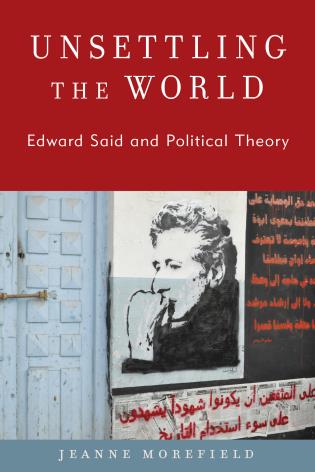
Jeanne Morefield, Unsettling the World. Edward Said and Political Theory, Forthcoming 2022

Unsettling the World is the first book-length treatment of Edward Said’s influential cultural criticism from the perspective of a political theorist. Arguing that the generative power of Said’s thought extends well beyond Orientalism, the book explores Said’s writings on the experience of exile, the practice of “contrapuntal” criticism, and the illuminating potential of worldly humanism. Said’s critical vision, Morefield argues, provides a fresh perspective on debates in political theory about subjectivity, global justice, identity, and the history of political thought. Most importantly, she maintains, Said’s approach offers theorists a model of how to bring the insights developed through historical analyses of imperialism and anti-colonialism to bear on critiques of contemporary global crises and the politics of American foreign policy.

Foucault and the Study of Religion Seminar
Call for Proposals
(2022)

We invite papers for the inaugural year of our seminar on Foucault and the Study of Religion. Following our exploratory session at the 2021 AAR on Michel Foucault’s posthumously published Confessions of the Flesh (2018), we seek to gather scholars engaging the work of Foucault and the study of religion from a number of approaches and traditions.

Methodologically, this can include critical analyses of Foucault’s use of religious sources, including his engagement (or lack thereof) with secondary literature in his published works. It may include analyses or approaches to particular forms of religious thought and practice from Foucault’s theoretical and philosophical perspectives, as well as research carried out in a critical-genealogical spirit in the same or adjacent religious sources that Foucault takes up.

We encourage submissions that raise questions around Foucault’s engagement with traditions beyond Catholic Christianity including: Jewish traditions, Foucault’s brief engagements with Islam in Iran, parallels and discontinuities between the “ethics of the care of the self” in western antiquity and South- and East-Asian traditions, among other possibilities. We are interested in exploring the ways that Foucault may help us challenge notions of “tradition” and “religion” that have been so central to both the study of religion and religious life more broadly. Over the five years of our seminar, we hope to co-sponsor panels with other AAR program units, starting this year with the Ethics Unit, on questions of “care of the self.”

● Foucault and methodology in the study of religion
● The unique role of Christian sources in Foucault’s œuvre, including prominent Christian traditions–especially Protestant, Orthodox, and others–which are at times absent from his work
● Foucault and Islam, including but not limited to Foucault’s engagements with Iran or questions opened up by ethics as care of the self
● Foucault and Asian religions, including but not limited to Buddhist and Hindu traditions
● Foucault’s engagement with the construction of “religion” in critical philosophy and theology from the modern period to the present
● Proposals which continue to engage Confessions of the Flesh through the framework of “sexuality” across the four extant volumes of the History of Sexuality, or further themes and sources in ancient Christianity, Judaism, Islam, and Indian traditions (amongst others)
● Proposals for a possible co-sponsored session with the Ethics Unit, inviting individual proposals, pre-arranged paper sessions, and roundtables addressing what Foucault might mean by ethics and the ways that he connects or fails to connect ethics with religion. We are particularly interested in proposals examining how Foucault’s notion of “care of the self” may relate to, challenge, or enrich religious ethics

Statement of Purpose
The Foucault and the Study of Religion Seminar is dedicated to collaborative research in a public setting, gathering scholars of religion whose research engages theoretical and historical approaches to the work of Michel Foucault. During his lifetime, Foucault was a force in public discourse, and his works have been transformative for scholarship in the humanities and social sciences over the last fifty years. We aim to continue Foucault’s tradition of public intellectual discourse in a way that illuminates the importance of the study of religion for understanding and critiquing his work on questions of gender, race, sexuality, and class. We hope to convene scholars of various religious practices and traditions to expand Foucault’s critical approach and enliven the contributions of this research for the public domain.

We understand this work to be ongoing, developing the complex questions that emerge from Foucault’s analytics of power, knowledge, and subjectivity central to many disciplines. The 2018 posthumous publication of his History of Sexuality volume on early Christian sexual ethics (Confessions of the Flesh) foregrounds the need for such critical and constructive engagement by scholars with expertise across religious traditions and methodologies. We hope to bring together scholars within the AAR and SBL—particularly those in philosophy of religion, queer theory, black studies, feminist theory, religion and literature, Caribbean and diasporic studies, affect studies, African American religion, religion and ecology, and the history of Christianity (ancient and early modern)—in order to pursue work that is historically and theoretically rigorous, reflecting Foucault’s own interdisciplinarity and the relevance his work has had across fields.

Chairs
Niki Clements, Rice University
niki.clements@rice.edu
1/1/2022 – 12/31/2027

Daniel Wyche,
dwyche@albion.edu
1/1/2022 – 12/31/2027

Steering Committee Members
Brandy Daniels, University of Portland
brandydaniels@gmail.com
1/1/2022 – 12/31/2027

Biko Gray, Syracuse University
bmgray@syr.edu
1/1/2022 – 12/31/2027

Maureen Kelly, University of Chicago
makelly@uchicago.edu
1/1/2022 – 12/31/2027

David Maldonado-Rivera,
dvdmaldonado@gmail.com
1/1/2022 – 12/31/2027

Review Process
Proposer names are visible to chairs but anonymous to steering committee members

Schultz, D.J. (2022), Revolutionary Spectatorship and Subalternity: Foucault In Iran. History & Theory.
https://doi.org/10.1111/hith.12249

ABSTRACT
In this article, I offer a novel reading of Michel Foucault’s Iranian writings and probe their unexplored linkages with longstanding historiographical debates. I argue that these writings run headlong into the conceptual aporias of political modernity by contesting the assumed parallelism between consciousness and history and between subjects of history and history as Subject. I take up this problem through the double frame of revolutionary spectatorship and subalternity. In the first instance, I analyze Kant’s contradictory reflections on the French Revolution and Marx and Engel’s response to the (failed) revolutions of 1848 to show how uprisings are made to conform to a theory of the subject. In the second instance, in conversation with subaltern studies (Guha, Chakrabarty, and Spivak), I focus on the problem of representing the revolutionary subject or insurgent consciousness. Foucault’s Iranian writings problematize the particular way the revolutionary subject (the person who rises up [se lève], in Foucault’s vocabulary) is represented, or historiographically phrased. I argue that the confounding factor in this phrasing, the hard object that resists integration, is religion. I build a set of relays between genres of writing—philosophical journalism, philosophy of history, and subaltern historiography—that are subtended by this problem of incommensurability in order to illustrate the double bind of phrasing a religious subject in revolt. Across these heterogeneous conceptual grammars of historical analysis, I track “religion” and the “colonial” as différends in relation to what counts as a subject of history or history as Subject, and I show how religious and colonial phrasings (of history and subjectivity) find themselves in a position that has lost the capacity to claim a position.

Carlos Palacios,
Skeptically Self-governed Citizens: The ‘Volunteer!’ Injunction as a Predicament of Neoliberal Life
(2022) Citizenship Studies

DOI: 10.1080/13621025.2022.2053837

Abstract
The idea that anyone, with the right critical knowledge and a certain amount of spare time and resources, could become a globally responsible citizen has been skeptically questioned at least since the time of Rousseau. But, during the last two decades, the specific concern that has troubled critical qualitative researchers has been the possible complicity of the active citizen with a neoliberal regime of governmentality, a regime that often uses the injunction to volunteer as a political tactic of responsibilization. The article seeks to address this latent concern through the study of a particularly marketized act of global citizenship: the immersive experience of volunteer travel. Through an innovative Foucauldian analysis and original qualitative method, designed to excavate deeply seated skeptical insights among returned volunteers in Australia, this study elucidates, first, how a personal sense of complicity actually surfaces within the market-mediated volunteer experience, and, second, how the ensuing predicament can be tackled, both from the perspective of the critical academic and of the citizen on the ground.

Keywords
Foucault; neoliberalism; governmentality; volunteering; global citizenship; active citizenship

Isobel Roele, Articulating Security: The United Nations and Its Infra-Law , (Cambridge University Press, 2022)

Doi: https://doi.org/10.1017/9781316856468

Abstract:
Counter-terrorism proliferates, conscripting actors and institutions in a dizzying range of educational, infrastructural, cultural, scientific, legal, and civic endeavours. This monograph draws on Foucault’s work on disciplinary power, especially the figure of infra-law, to analyse the United Nations’ attempts to impose order on the swarm of global counter-terrorism endeavours. Articulating Security describes the organization’s endeavour to join up proliferating initiatives into all-of-government, all-of-society, and all-of-UN composites, which bear long-range resemblance to the disciplinary machines discussed by Foucault. The UN’s success in this regard is patchy compared to that of the disciplinary society identified by Foucault, and takes place on markedly different terms.

The stakes of this monograph lie in teasing out the implications of juridico-political complicity with managerial governance and showing, in particular, how associations between juridical and managerial modes of law give rise to an inarticulate and disarticulating form of infra-law. Reading Foucault’s discussion of infra-droit alongside Freud and Kristeva, the book analyses infra-law as an uncanny form of the juridical and cautions against attempts to redeem the latter by expelling managerialism from the law.

Collier, Stephen J, and Andrew Lakoff. “Vital Systems Security: Reflexive Biopolitics and the Government of Emergency.” Theory, Culture & Society 32, no. 2 (March 2015): 19–51.
https://doi.org/10.1177/0263276413510050.

Abstract
This article describes the historical emergence of vital systems security, analyzing it as a significant mutation in biopolitical modernity. The story begins in the early 20th century, when planners and policy-makers recognized the increasing dependence of collective life on interlinked systems such as transportation, electricity, and water. Over the following decades, new security mechanisms were invented to mitigate the vulnerability of these vital systems. While these techniques were initially developed as part of Cold War preparedness for nuclear war, they eventually migrated to domains beyond national security to address a range of anticipated emergencies, such as large-scale natural disasters, pandemic disease outbreaks, and disruptions of critical infrastructure. In these various contexts, vital systems security operates as a form of reflexive biopolitics, managing risks that have arisen as the result of modernization processes. This analysis sheds new light on current discussions of the government of emergency and ‘states of exception’. Vital systems security does not require recourse to extraordinary executive powers. Rather, as an anticipatory technology for mitigating vulnerabilities and closing gaps in preparedness, it provides a ready-to-hand toolkit for administering emergencies as a normal part of constitutional government.

Keywords
beck, biopolitics, disaster, emergency, Foucault, risk, security

Saunders, N., Al-Om, T.
Slow Resistance: Resisting the Slow Violence of Asylum
(2022) Millennium: Journal of International Studies

DOI: 10.1177/03058298211066339

Abstract
In this article we seek to expand on the developing interest in Slow Violence and how it relates to immigration and asylum, by exploring how such violence is resisted. Following Foucault’s insight that in order to better understand power, it helps to study resistance to it, we draw on original research into acts of protest by refugees and asylum seekers in Scotland, and connect this to existing research on experiences of and resistance to the UK asylum system. In so doing we offer ‘Slow Resistance’ as a potentially useful concept with which to understand resistance not just to a particular configuration of power relations, but to a particular form of violence. The conceptual utility of Slow Resistance lies in its ability to illuminate: the particular operations of power/violence in the UK asylum system; the multiple forms of resistance to this violence/power; how these forms of resistance may be connected (thus discouraging the ‘silo-ing’ of analysing different forms of resistance); and how time is creatively engaged with by such forms of resistance. If, as has been argued, a particular challenge of slow violence is representational – how to devise arresting images and stories adequate to this form of violence – then resistance has the potential to focus our attention on it, and to gradually prepare the ground for meaningful change. While developed here in relation to the UK asylum system, slow resistance is a concept that we think can be useful in a wide range of contexts in which slow violence operates. © The Author(s) 2022.

Author Keywords
asylum; protest; refugees; resistance; slow violence; UK

Jesse Swann-Quinn, More-than-human government and the Tbilisi zoo flood Geoforum, Volume 102, 2019,Pages 167-181,
https://doi.org/10.1016/j.geoforum.2019.03.007.

Abstract:
On 17 June 2015, an unprecedented series of rain events caused a wall of water to tear through an affluent urban neighborhood in the Georgian capital Tbilisi. The flood damaged 700 homes, displaced 67 families, killed 19 people, left 3 more unaccounted for – while also leaving nearly 300 animals either drowned or killed as the flood destroyed the Soviet-era Tbilisi Zoo. Deadly and headline grabbing interactions among humans and non-humans continued surprising those in Tbilisi as diverse actors tried to control the precarious situation unfolding in this post-Soviet urban landscape, and survivors of all sorts roamed the streets. I illustrate these relationships by analyzing news coverage, government statements, technical reports, archival resources, and my own experiences as a participant observer within the events surrounding the flood. In doing so I extend arguments by Foucault and his interlocuters to present a case of more-than-human government, requiring the arrangement of non-human elements to maintain the life of a political population such as the Tbilisi citizenry. As I demonstrate, such governmental practices require not only calculations of what life to protect and what to destroy via sovereignty, discipline, and biopolitics, but also a constellation of other powers, including historically embedded regimes of truth and authority. From this perspective, the security of a human population may at times rely on its imbrication with the government of animals and infrastructure alike, and vice versa – by securing, disciplining, knowing, and at times destroying our material environments and companion species, however we may be related.

Keywords: More-than-human; Zoos; Flood; Post-Soviet; Government; Georgia