Foucault News

News and resources on French thinker Michel Foucault (1926-1984)

Bronwyn Fredericks, Abraham Bradfield Signifying Aboriginal Identity, Culture and Country in Central Queensland Through a Public Art Project, Borderlands journal. Volume 20, Issue 1, 2021, Pages 89-115,
DOI: https://doi.org/10.21307/borderlands-2021-004

ABSTRACT
Alongside Toonooba (the Fitzroy River) in central Queensland, a series of Aboriginal flood markers are embedded within the earth, commanding attention to the river that flows on one side and the colonial infrastructure of Rockhampton that lies on the other. The flood markers are part of an arts project commissioned by the Queensland Government in 2013 to mark Rockhampton’s history and its relationship to the river. The flood markers, named Honouring Land Connections, assert Indigenous voices into discourses of place, particularly discourses about the significance of rivers on Country. This article explores how art represents wider socio-cultural and politicised contexts of Indigenous and non-Indigenous discourse. The authors discuss the artworks as a form of social action that signifies Rockhampton as an Indigenous space with a history that cannot be neatly divided into three time periods. Any suggestion that Honouring Land Connections represents Rockhampton’s precolonial period disregards Indigenous people’s ongoing connections with and responsibilities for Country. The artworks signify contested spaces, places and knowledge of Country, culture, and waterways. Honouring Land Connections maintains cultural connections and speaks back to White preconceptions of Indigeneity. The artists wage war on the selective readings and colonial amnesia in Australia to directly challenge notions of terra nullius and intellectual nullius. This article shows how art can facilitate interaction through which Aboriginal artists can affirm, negotiate, share, and explore their identities while challenging dominant Eurocentric preconceptions of place and identity.

Keywords : identity, Aboriginal, Indigenous Australia, art, public art

Graphical ABSTRACT

Becker, Per. “Fragmentation, Commodification and Responsibilisation in the Governing of Flood Risk Mitigation in Sweden.” Environment and Planning C: Politics and Space 39, no. 2 (March 2021): 393–413.
https://doi.org/10.1177/2399654420940727.

Open access

Abstract
The purpose of this paper is to increase our understanding of the governing of flood risk mitigation in advanced liberal society, through an in-depth Swedish case study. By combining social network analysis and genealogy, this paper investigates who is involved, how they organise, their modes of thinking, how they mitigate flood risk, as well as how such regime of practises have come into being. The findings suggest dominant rationalities that reduce the actual complexity of flood risk in spatial and temporal terms to fit the legal and institutional environment. The resulting fragmentation is associated with a commodification of flood risk mitigation, in which actors expect to be able to procure modules of safety and sustainability on the market. This commodification materialises in a vacuum of responsibilisation, when obligations are imposed without commensurate guidelines. These processes of fragmentation, commodification, and responsibilisation are core constituents of neoliberalisation, which is clearly shaping the governing of flood risk mitigation even in Sweden; a bastion of the strong welfare state. Regardless of the notable individual capacities of the involved actors, systemic constraints in the governmentality have generated these detrimental processes in the face of overwhelming complexity. These systemic constraints must be removed or overcome for the governing of flood risk mitigation to match the complexity of flood risk in the catchment area. This paper thus provides input that can inform policy changes for a more sustainable future in the face of unprecedented change.

Keywords
Governmentality, governing, flood risk, fragmentation, commodification

Cantrell, Sarah K. “”I solemnly swear I am up to no good”: Foucault’s Heterotopias and Deleuze’s Any-Spaces-Whatever in J. K. Rowling’s Harry Potter Series.” Children’s Literature 39 (2011): 195-212.

doi:10.1353/chl.2011.0012.

Abstract
It is no secret that we live on an endangered planet. In the past year, we have witnessed catastrophic earthquakes, oil spills, floods, and mine collapses, all of which lend urgency to calls for greater care of our environment. As the spaces we inhabit become more endangered, it is not surprising that fictional spaces are also increasingly imperiled. J. K. Rowling’s Harry Potter series is not an ecology oriented fantasy, but it does dramatize the tenuous existence of space and place that we confront in our world. From the bridge collapse, crime wave, and hurricane that threaten Muggle London in the opening chapter of Harry Potter and the Half-Blood Prince, to the devolution of Hogwarts into a dystopic battleground, I argue that the movement from stable, fixed places to ambiguous ones teaches protagonists and readers how to cope with the demands and difficulties of a wider, more complex world.

I contend that reading the spaces in the Harry Potter books in light of Michel Foucault’s theory of heterotopias or “other spaces,” and Gilles Deleuze’s espace quelconque or any-space-whatever, highlights the ways in which ambiguous spaces in our world require the same mental agility and critical flexibility that Harry, Hermione, and Ron learn throughout the series. In this article, I argue that Hogwarts functions as a heterotopia, a space at once other and separate but also intimately connected to the world beyond its walls. Still more ambiguous spaces like 12 Grimmauld Place, the tent that Harry, Ron, and Hermione share in volume seven, and most notably, the Room of Requirement—a space within the place of the school proper—occupy positions similar to Deleuzian any-spaces-whatever.

Because these spaces exist at the margins of safety and danger, their liminality requires Harry and his friends to be “up to no good”: to resist and subvert adult authority, but also to confront the limits of agency. These shifts from order to disorder and from safety to danger suggest that participation and activism—particularly on the part of young adults—can be powerful means of opposing the abuses that permeate the spaces in our own world.

Dobbie, Meredith, Ruth Morgan, and Lionel Frost. “Overcoming Abundance: Social Capital and Managing Floods in Inner Melbourne during the Nineteenth Century.” Journal of Urban History 46, no. 1 (January 2020): 33–49.
https://doi.org/10.1177/0096144217692984.

Abstract
Before effective drainage and flood protection systems were built in the early twentieth century, areas of inner Melbourne close to the Yarra River were prone to flooding. An overabundance of water and a need to limit its impact on lives, livelihoods, and the built environment drove changes in the engineered structure of a rapidly growing city. Through a case study of a working-class district, we consider how private citizens, drawing on stocks of social capital, responded to major floods in 1863 and 1891. In addition to the process of “top-down” governing, as revealed in public documents, less visible “bottom-up” pressure from local communities played an important role in influencing improvements in water-related infrastructure, such as flood mitigation works. By the turn of the twentieth century, this local pressure increasingly manifested in a centralist approach to water management, whereby metropolitan-wide public authorities took greater charge of local environmental problems.

Keywords
floods, water management, social capital, governance, housing, Melbourne, urban history

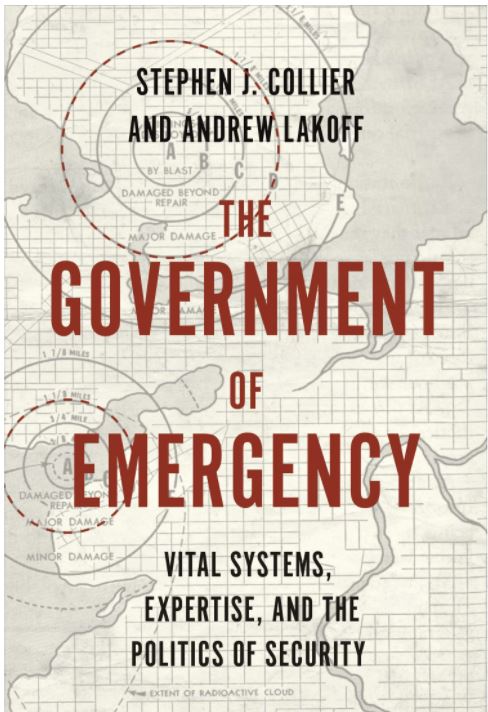
Stephen J. Collier and Andrew Lakoff, The Government of Emergency: Vital Systems, Expertise, and the Politics of Security, Princeton University Press, 2022.

From pandemic disease, to the disasters associated with global warming, to cyberattacks, today we face an increasing array of catastrophic threats. It is striking that, despite the diversity of these threats, experts and officials approach them in common terms: as future events that threaten to disrupt the vital, vulnerable systems upon which modern life depends.

The Government of Emergency tells the story of how this now taken-for-granted way of understanding and managing emergencies arose. Amid the Great Depression, World War II, and the Cold War, an array of experts and officials working in obscure government offices developed a new understanding of the nation as a complex of vital, vulnerable systems. They invented technical and administrative devices to mitigate the nation’s vulnerability, and organized a distinctive form of emergency government that would make it possible to prepare for and manage potentially catastrophic events.

Through these conceptual and technical inventions, Stephen Collier and Andrew Lakoff argue, vulnerability was defined as a particular kind of problem, one that continues to structure the approach of experts, officials, and policymakers to future emergencies.

Victor Marchezini, The Biopolitics of Disaster: Power, Discourses, and Practices, Human Organization, Vol. 74, Iss. 4, (Winter 2015): 362-371.
https://doi.org/10.17730/0018-7259-74.4.362

Abstract
With the increase in frequency and visibility of disasters in contemporary state societies, national governments have developed a collection of agencies to manage catastrophic events. These institutions invariably deal with human populations as a political, scientific, and biological problem, an approach Michel Foucault described as biopolitical. In this article, I discuss some aspects of disaster governance, focusing on the long-term recovery process. Specifically, I analyze the fundamental biopolitical assumptions of the discourses and practices on the part of governmental disaster response agencies in Sào Luiz do Paraitinga, Brazil. In this case of biopolitical response to disaster, the discourses and practices implemented by governmental agencies created the illusion that state agencies successfully responded to the disaster by saving biological lives. This article shows how these biopolitcal discourses and practices also had the unintended and unacknowledged effects of devaluing social lives and abandoning disaster-affected populations. By calling attention to the unintended and unacknowledged effects of biopolitical governance, this article demonstrates how disaster anthropology can document and address the shortcomings of governmental disaster recovery policy and practice.

Ritter, S.
Fat bodies, intimate relationships and the self in finnish and American weight-loss TV shows
(2022) Fat Studies

DOI: 10.1080/21604851.2022.2031579

Abstract
As sites where the construction of identity and selfhood take place, relationship-focused weight-loss TV shows reproduce the notion of a correlation between a woman’s body size, her ‘success’ in romantic relationships, and the appropriate self. I analyze the weight-loss shows Revenge Body with Khloé Kardashian from the US, and Rakas, Sinusta on Tullut Pullukka (Honey, You’ve Become Chubby) from Finland, investigating how relationship and body size norms, gender, and the self intertwine. I examine the shows in light of Foucault’s theory of normalization. Here, normalization not only refers to the normalization of the body but also of the relationship(s) required to achieve a valid self. I suggest that the shows express a parallel between being single and on the verge of society and being fat and being on the verge of society; through solving one of the deviations (in this case, becoming thin) the other deviation (being single) can be changed and thus a “normal” life can be achieved. People learn how to normalize their bodies and their relationships, which in the end paves the way for the idea that a good body/dieting is the precondition for a relationship and an acceptable self. The shows thus reinforce that a thin body is the basis for an appropriate self and fulfilling life. © 2022 Taylor & Francis.

Author Keywords
fat; Foucault; Makeover; normalization; relationships

Elisabetta Basso, Michel Foucault, Le confessioni della carne. Storia della sessualità 4, edizione stabilita da F. Gros, trad. it. di D. Borca, Milano, Feltrinelli, 2019, Alverium, Anno XIII, n. 13 – dicembre 2020

Open access

La pubblicazione nel 2018 di Les aveux de la chair (Paris, Gallimard), l’ultima opera composta da Michel Foucault prima della sua morte nel giugno del 1984 – ora nella versione italiana –, può essere considerata un vero e proprio evento editoriale, tanto atteso quanto discusso. Rimasto inedito per più di trent’anni, il manoscritto è stato finalmente pubblicato grazie alla decisione dei detentori della proprietà intellettuale dell’opera di Michel Foucault, in seguito all’acquisizione da parte della Bibliothèque nationale de France, nel 2013, dell’intero archivio di lavoro del filosofo1 . Nell’intenzione del suo autore, questo volume doveva aggiungersi agli altri tre concepiti tra il 1976 e il 1984 (La volontà di sapere, L’uso dei piaceri, La cura di sé) come parti di una Storia della sessualità il cui progetto avrebbe subito diversi rimaneggiamenti nel corso di quel decennio. Secondo quanto indicato da Foucault nella quarta di copertina della Volontà di sapere (1976), la serie doveva comprendere altri cinque titoli: La chair et le corps, La croisade des enfants, La femme, la mère et l’hystérique, Les pervers, Population et races, nessuno dei quali tuttavia verrà pubblicato. Le confessioni della carne viene menzionato per la prima volta da Foucault in una scheda inserita nei due volumi della Storia della sessualità usciti nel 1984, dove annuncia uno studio che, dopo l’analisi dei comportamenti sessuali nel pensiero greco classico e nei testi greci e latini dei primi due secoli della nostra era, affronterà «l’esperienza della carne nei primi secoli del cristianesimo e il ruolo che in essa giocano l’ermeneutica e la decodifica purificatrice del desiderio» (Nota del curatore, p. 4). In realtà, come viene spiegato da Frédéric Gros nella breve nota che accompagna il volume, la redazione del manoscritto può essere situata già tra il 1981 e 1982, allorché il progetto iniziale della storia della sessualità moderna dal XVI al XIX secolo viene abbandonato «in un primo tempo (1979-1982), a vantaggio di un ricentramento in direzione di una problematizzazione storica della carne cristiana […] e poi, in un secondo tempo (1982-1984), a vantaggio di un decentramento verso le arti di vivere greco-romane e il posto che occupano in esse gli aphrodisia» (p. 7).
[…]

CALL FOR ABSTRACTS

International Workshop
Nietzsche, Genealogy, Foucault: History between between Life and Power
School of Arts and Humanities – University of Lisbon
14th June 2022
Event organized as part of the Praxis-CFUL 

Keynote Speakers:
Keynote Speakers:
João Constâncio (NOVA University Lisbon)
Daniele Lorenzini (Warwick University)

Much has been written regarding genealogy, either as a new philosophical interpretation of History, a methodology or as a critical project. The number of published works on the issue is even more outstanding when compared to the scarcity of references to genealogy in primary literature, especially in Nietzsche, but in Foucault as well, when compared to the rest of his oeuvre. Despite the proliferation of books, chapters and articles regarding genealogy, the confusion surrounding this term and its application is far from being overcome and dissipated.

Given the recent 50th anniversary of the seminal article: “Nietzsche, Genealogy, History”, written by Michel Foucault and published in 1971 in the volume Homage à Jean Hyppolite, we would like to re-open the discussion on genealogy, its formulation, and its possible influence in contemporary philosophy. The aim of the workshop is to investigate the philosophical interpretations of genealogy in Nietzsche and Foucault. By doing so, we wish to highlight possible resemblances and differences between its employment in both authors, its significance, and the ends it meets, with a special emphasis on its relation and divergence with history. This way, we hope to enrich the understanding upon this topic and to explore the possibility for a new engagement of the genealogical project as a tool for practical philosophy.

We invite papers that engage with the question of genealogy with reference to the work of Friedrich Nietzsche and Michel Foucault. Special attention will be devoted to the relationship that subsists between History and genealogy.

Possible topics are, but not limited to:

  • What is the relationship between genealogy and History?
  • How genealogy differs from History?
  • What is/are the object/s of study of genealogy?
  • What is the relation between genealogy and power?
  • What are the purposes and ends of genealogy? If there are any at all?
  • Can genealogy be understood as a philosophical methodology, a critical project or a source for interpretations?
  • What is it the role and the significance of genealogy within the philosophy of Nietzsche and/or Foucault?
  • Does genealogy bear the same significance in Nietzsche and Foucault? If not, how does it differ within the two authors?
  • Can genealogy, in either Nietzsche or Foucault, have an impact in contemporary philosophy?
  • Can genealogy, broadly speaking, provide a different perspective regarding contemporary issues?

Format: The workshop will be held in-person. Each speaker will have 30 minutes to present their papers, followed by additional 15 minutes for questions and discussion. We invite submissions for abstracts which address one or more of the questions exposed. New angles and perspectives on the topic are also welcomed.

Those interested in participating should send a 400-word abstract to maura.ceci.91@gmail.com or rochatedapalma@gmail.com by 31st March 2022, including: 1) the title of the paper, 2)their institutional affiliation, and 3) their preferred email contact address. Please exclude any identifying information from the abstract itself.
Accepted abstracts will be notified not before 15th April 2022. The conference will be in English and attendance is free.

This event is funded by Portuguese national funds through FCT – Fundação para a Ciência e a Tecnologia, I.P., in the scope of the project UIDB/00310/2020.

French, A.
Sites of Re-Enchantment: Sacred Space and Nature in Early 20th Century Europe
(2022) Religions, 13 (2), art. no. 110

DOI: 10.3390/rel13020110

Abstract
This essay analyses the relationship between healing, nature, and the sacred in the construction of “sacred space” or heterotopies at the beginning of the 20th century in Europe. Two examples of these spaces are provided: the Kurorte in Bad Reichenhall, Germany, and the back-to-nature site Monte Verità in Ascona, Switzerland. The focus is on sacred space, alternative lifestyles, and the natural environment through the use of “light and air” cabins and community organization, as described by the founders of the colony at Monte Verità. The healing garden and the Gradierhaus—a special type of building designed for breathing salted air—in Bad Reichenhall are explored through the lens of “air cure” and “climate cures”, which became popular in Central Europe at the end of the 19th century. Such buildings and healing sites were designed for the express purpose of healing through disconnection from the chaos of the modern industrial world in order to reconnect with nature and the elements. Drawing on Foucault’s concept of heterotopia, a striking affinity between buildings and the natural environment at these sites is revealed, resulting in a “special” or “sacred” location that is somehow both “in” and “out” of everyday life, capable of ostensibly producing forms of healing in the visitors and inhabitants. © 2022 by the author. Licensee MDPI, Basel, Switzerland.

Author Keywords
Alternative healing; Climatic cures; Heterotopia; Modernity; Monte Verità; Nature; Sacred space