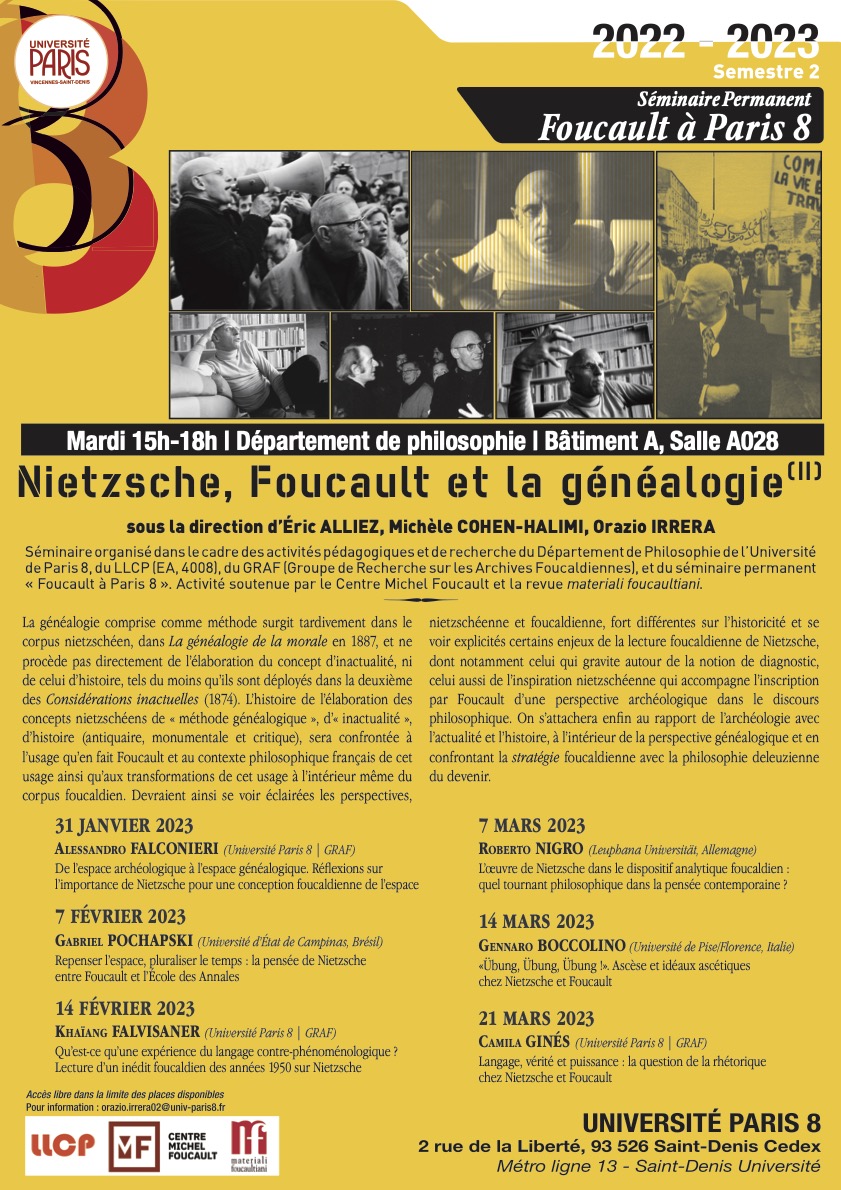
Foucault News

News and resources on French thinker Michel Foucault (1926-1984)

Coloquio Internacional «Las Confesiones de la carne»
El Instituto de Teología y Estudios Religiosos (ITER) de la Universidad Alberto Hurtado invita a participar del Coloquio Internacional “Las Confesiones de la Carne”, que tendrá lugar los días lunes 26 y martes 27 de Septiembre en la UAH.

Program

El Coloquio se propone realizar una recepción crítica de «Las confesiones de la carne», el cuarto volumen de la Historia de la sexualidad de Michel Foucault. Publicado póstumamente, este texto contiene un estudio sobre la conformación la experiencia de la carne en el pensamiento de los padres de la Iglesia y en las prácticas del primer cristianismo.

Los y las invitamos a inscribirse en el Coloquio en el siguiente link.

Luego del Coloquio, los días miércoles 28 y jueves 29 de septiembre, se realizará un Workshop interno titulado «Foucault y las religiones». Esta será una instancia para discutir las posibilidades que ofrece la metodología de M. Foucault y sus conclusiones sobre el problema religioso a partir del estudio histórico filosófico. Esto será un aporte para investigar cuestiones del fenómeno religioso en el presente.

Tanto el Coloquio como el Workshop contarán con la participación de académicos y académicas nacionales, como Carlos Álvarez (UAH), Martín Bernales (UAH), Vicente Cortés (UAH), Claudia Leal (UC), Xavier Morales (UC), Roberto Saldías (UAH), Adán Salinas (UAHC), Tuillang Yuing (UAHC), Ximena Zabala (UAH) y Felipe Orellana (UAH) y de académicos internacionales, como Philippe Büttgen (U. Paris 1), César Candiotto (PUC Paraná), Orazio Irrera (U. Paris 8), Edward McGushin (U. StoneHill), Marcelo Raffin (UBA) y Philippe Sabot (U.de Lille).

El Coloquio cuenta con el patrocinio del Centro Michel Foucault, la Iniciativa Franco-Chilena de Altos Estudios, el programa de doctorado de Filosofía UAH y el Fondecyt nº 11180085.

Additional links

https://iter.uahurtado.cl/coloquio-internacional-las-confesiones-de-la-carne/
https://www.uahurtado.cl/coloquio-las-confesiones-de-la-carne/
https://sites.google.com/uc.cl/coloquioiterlasconfesiones/espa%C3%B1ol

Francesca Peruzzo and Aaron Kuntz are calling for abstracts for a special issue of
Philosophy and Theory in Higher Education titled: Foucault and Contemporary Theory in Higher Education: New approaches, theories, and conditions of possibility.

The idea behind this special issue is to expand Foucault’s analytical toolbox, intersecting new epistemological and analytical approaches to explore and problematize the current situation of higher education. The special issue aims to make visible experiences, methods, practices, epistemologies and ontologies that value and recognize modalities of being and doing in higher education that challenge and go beyond its present neoliberal and performative conformation.

You can find more information here:

The call can also be found here

The deadline to submit an extended abstract is November 1st, 2022. The completed manuscript (if the abstract is selected) is due November 1st, 2023.

A Workshop on Foucault’s Historical Method

Tuesday 27 September 2022

Due to a high level of interest, please note the change of venue. Now at:
To be held from 1.00 to 5.00 p.m. in the Seminar Room 201, Level 2, Michie Building (9), University of Queensland, Brisbane, Australia
G8 on the UQ St Lucia Campus Map brochure

Institute for Advanced Studies in the Humanities

Foucault’s historical method is often understood to have had two overlapping phases or alternating modalities: an archaeological one and a genealogical one. His accounts of historical “biopower,” of scholarly “ascesis” and of “history of the present” have all stimulated new historical forms of inquiry in several disciplines in the twenty-first century.

We propose to delve beneath the widespread influence of Foucault in historical inquiry to ask what it means to engage with history in a Foucauldian manner.

For example, the notion of a genealogical method is now in widespread use among historians. While Nietzsche often serves in that regard as a philosophical predecessor, that does not in itself provide a circumstantiated account of what “genealogical method” might mean in historical practice. Can we begin to provide one by referring to Foucault’s approach? Is there conversely some possibility of a revival of Foucault’s earlier, “archaeological” method? Or does the logic of Foucault’s thought indeed point beyond either of these programmatic methodologies, as indicated in the less doxastic historical inquiries of Foucault produced in his last years?

We are open broadly to questions relating to Foucault’s engagements with the historical past, for example:

• The status of Foucault’s individual works, such as:
o The Birth of the Clinic, not the most widely read of Foucault’s texts, but one to which some historians have attached particular importance;
o the methodology of Foucault’s Order of Things, and its relation to structuralism and post-structuralism in France;
o Foucault’s most quoted and most sloganised work, the first volume of his History of Sexuality, and its influence in the history and cultural studies of gender and sexuality;
o the recently, posthumously published fourth volume of Foucault’s History of Sexuality, Les Aveux de la chair (Confessions of the Flesh). What can be said about the significance of this volume for its practice of historical method?
• Foucault’s observations about the formation of biomedicine and how they have helped to shape subsequent critical and historical studies of it.
• Historical approaches to understanding Foucault’s ideas themselves as historical artefacts.

There will be a series of short presentations interspersed with discussion.

Presenters will be:
Mark Kelly (Philosophy, Western Sydney)
Alison Downham Moore (Humanities and Communication Arts, Western Sydney)
Lucia Pozzi (IASH and Historical and Philosophical Inquiry, UQ) (tbc)
Andrea Josipovic (IASH)
Cassie Byrnes (Historical and Philosophical Inquiry, UQ)
Karin Sellberg (Historical and Philosophical Inquiry, UQ)
Peter Cryle (IASH)

Afternoon tea will be provided. It will help with our planning if you indicate by email to the following address that you are planning to attend iash.ea@uq.edu.au

Stephen Reicher, God save the Queue: how the wait to see the Queen’s coffin transformed people, The Conversation, Tue 20 Sep 2022

strange thing has happened since last week, when I wrote about how myself and other social psychologists were studying the crowds of people queueing to watch the ceremonials following the death of Queen Elizabeth – finding out the many reasons and motivations for taking part in this mass event. It seems the Queue itself – and what it supposedly tells us about the state of our nation – has become as big a story as the ceremonies. We stopped watching the pageantry and started watching ourselves watching the pageants.
[…]

Most of the discussion of the response to the Queen’s death has focused simply on what it tells us about ourselves as a society. But that is to miss the importance of how these events actively change people. We do not come out of the last 10 days as we went in. But that is the whole point of such ceremonials. They are technologies for engineering souls. And by investigating them, we gain crucial insights into how that process works.

Stephen Reicher is a professor of psychology at the University of St Andrews, a fellow of the Royal Society of Edinburgh and an authority on crowd psychology

Jackson, B.
Putting Neoliberalism in Its Place
(2022) Modern Intellectual History, 19 (3), pp. 982-995.

DOI: 10.1017/S1479244321000032

Abstract
Neoliberalism is an ideal subject for intellectual historians. It is an ideological movement that has been both theoretically sophisticated and influential, ensuring that excursions along the highways and byways of neoliberal thought can always be justified practically, as disclosing the ideas that have shaped contemporary politics. There is also no shortage of source material, as the voluble characters who generated neoliberal ideology wrote innumerable books and articles and left behind extensive archival collections that preserve their correspondence, drafts and records of meetings.

Furthermore, there is abundant evidence of the collaboration (and tensions) between the key neoliberal thinkers, since they worked together in their long years in the wilderness as members of the Mont Pèlerin Society (MPS), the invitation-only discussion group formed by Friedrich Hayek in 1947 to restate the case for market liberalism, and with various associated think tanks scattered across the globe. Given all this, it is surprising that more historical research hadn’t focused on neoliberalism earlier, but the field was largely left clear for philosophers and social scientists until the 2000s. Much of this work was in any case historicist in character, notably the influential lectures of Michel Foucault, delivered in 1979 but only published in French in 2004 and in English in 2008, which scrutinized certain key texts of neoliberal theory some time before other scholars had focused on them.

The years around the 2008-9 financial crisis-by a mixture of accident and design- marked the point at which intellectual historians (and social scientists with an interest in the history of ideas) followed Foucault by diving more systematically into tracing the origins and trajectory of neoliberal thought. Much of this research has concentrated on the MPS, although the MPS itself is probably best understood as a useful entry point for exploring several distinct strands of market liberalism that emerged in different places in the 1930s and 1940s before being woven together into a broader transnational movement of ideas in the course of the 1950s and 1960s. In spite of skeptical voices claiming either that neoliberalism does not exist, or that if it does exist it is best analyzed as the assertion of class interests rather than as an ideology, this work has cumulatively demonstrated that tracing the history of neoliberal thought is an indispensable exercise if we are to understand how we have reached the present conjuncture.

Maynard, Steven. “Queer Parrhesiast.” PUBLIC: Art/Culture/Ideas, 65 (2022): 120-161.
DOI: https://doi.org/10.1386/public_00097_1

Abstract
Drawing on and contextualizing the papers of Alexander Wilson (1953-1993), a Toronto-based writer, activist, and horticulturalist, this article explores the reciprocal relationship between Wilson’s intellectual and political work. It focuses on Wilson’s involvement with The Body Politic during the late 1970s and early 1980s, and highlights Wilson’s role in interviewing Michel Foucault in Toronto in 1982. Encompassing feminism, socialism, and environmentalism as part of a critique of narrow notions of ‘gay’ identity and aesthetics, Wilson’s project, it is suggested, prefigured the emergence of queer politics. At the same time, Wilson enacted a queer parrhesia in keeping with Foucault’s Toronto lectures on “speaking the truth about oneself.” The article includes a reproduction of the marked-up manuscript of Wilson and Bob Gallagher’s interview with Foucault, which was found among Wilson’s papers. The well-known interview, “Sex, Power, and the Politics of Identity,” appeared in The Advocate in August of 1984.

Keywords
AIDS crisis; Alexander Wilson; Michel Foucault; The Body Politic; environmentalism; feminism; parrhesia; queer archive; socialism

Genealogy. Advisory Editor: Daniele Lorenzini
The Monist, Volume 105, Issue 4, October 2022

CONTENTS

Articles
Genealogy, Evaluation, and Engineering
Matthieu Queloz
Genealogy as Meditation and Adaptation with the Han Feizi
Lee Wilson
Dripping with Blood and Dirt from Head to Toe: Marx’s Genealogy of Capitalism in Capital, Volume 1
Amy Allen
Psychology, Physiology, Medicine: The Perspectivist Interpretation of Nietzsche’s Genealogy of Morality
Daniel R. Rodrıguez-Navas
Is Heidegger’s History of Being a Genealogy?
Sacha Golob
On Moral Unintelligibility: Beauvoir’s Genealogy of Morality in the Second Sex
Sabina Vaccarino Bremner
Reason Versus Power: Genealogy, Critique, and Epistemic Injustice
Daniele Lorenzini
Vindicating Reasons
Guy Longworth

Gane, Nicholas. “Neoliberalism and the Defence of the Corporation.” Theory, Culture & Society, (September 2022).
https://doi.org/10.1177/02632764221113727.

Abstract
This article addresses a little-known event in the history of neoliberalism: a conference at Stanford University held in 1982 to reconsider Adolf Berle and Gardiner Means’ The Modern Corporation and Private Property 50 years after its initial publication. This event is important as it is where key members of the neoliberal thought collective sought to define and defend the powers and freedoms of the corporation. First, this article outlines the political commitments of Berle and Means by considering the core arguments of The Modern Corporation and Private Property; second, it addresses key papers from the event published subsequently in the Journal of Law and Economics; and third, it analyses the neoliberal defence of the corporation that emerged from these papers, and reflects on the limitations of the work of Berle and Means for developing a response to their neoliberal critics.

Keywords
corporations, firms, libertarianism, neoliberalism, ownership, power, value

Zhang, Z. and Moore-Cherry, N. (2022), Urban Redevelopment, Displacement, and Governmentality in Nanjing’s Historic Inner-City. Antipode, 54: 979-999.
https://doi.org/10.1111/anti.12801

Abstract
Housing-related urban development has become a core plank of China’s economic policy since the mid-1990s. Reports of resistance to displacement and resettlement associated with urban restructuring, once widespread, have dissipated since the early-2010s. Using the framework of governmentality and through qualitative empirical fieldwork in the historic inner-city of Nanjing, we try to understand the dynamics of this change. This research draws attention to how governments deploy new technologies and rationalities to regroup and push forward urban transformation. We highlight how more “advanced” disciplinary apparatuses both encourage neoliberal subjectivities among displacees and use authoritarian features to maintain the “order of things” in line with the desires of the Chinese state.

Terri Bourke, Mary Ryan, Leonie Rowan, Joanne Lunn Brownlee, Susan
Walker & Lyra L’Estrange (2022): Teacher educators’ knowledge about diversity: what enables and constrains their teaching decisions?, Asia-Pacific Journal of Teacher Education,

DOI: 10.1080/1359866X.2022.2119369

ABSTRACT
Internationally and in Australia, there is growing evidence that graduate teachers feel under prepared to teach diverse groups of children. This study, using a social lab and drawing on theories from Archer and Foucault examined Australian teacher educators’ views on knowledge about diversity and the enabling and constraining factors that influenced their teaching around diversity in their universities. Eleven discourses emerged, revealing knowledge associated with teaching about and to diversity, rather than teaching for diversity. The authors argue that all three facets are necessary for thorough preparation of preservice teachers for today’s diverse classrooms.

KEYWORDS
Diversity; reflexivity; discourse; knowledge; decision-making; initial teacher education