Foucault News

News and resources on French thinker Michel Foucault (1926-1984)

Ilott, Luke. “Generalizing Resistance: The Coalition Politics of Foucault’s Governmentality Lectures.” The Review of Politics, 2022, 1–25.

doi:10.1017/S0034670522000882.

Abstract
This article interprets Michel Foucault as a thinker of political coalition. While Foucault is often associated with a localist “micro-politics,” he also sought to help dispersed struggles “generalize” themselves into bigger, cohesive movements. Foucault gave his fullest account of the politics of generalization in manuscripts and drafts associated with two courses at the Collège de France, entitled Security, Territory, Population (1978) and The Birth of Biopolitics (1979), which are well known to political theorists for their discussions of “governmentality.” Intellectual historians have recently generated controversy by proposing that Foucault used his governmentality lectures to flirt with neoliberal positions. By reconstructing Foucault’s coalitional project in the late 1970s, this article offers an alternative contextualist account of his purposes, while encouraging political theorists to reappraise the lectures as the basis for a Foucauldian theory of large-scale alliance politics.
Strassheim, J. (2022). Neoliberalism and Post-Truth: Expertise and the Market Model. Theory, Culture & Society
https://doi.org/10.1177/02632764221119726

Abstract
Contrary to widespread assumptions, post-truth politicians formally adopt a rhetoric of ‘truth’ but turn it against established experts. To explain one central factor behind this destructive strategy and its success with voters, I consider Walter Lippmann and Friedrich Hayek, who from 1922 onwards helped develop and popularize a political rhetoric of ‘truth’ in terms of scientific expertise. In Hayek’s influential version, market economics became the crucial expert field. Consequently, the 2008 financial crisis impacted attitudes towards experts more generally. But even sweeping rejection of experts continues to use the rhetoric, by now dominant, of expert truth. Paradoxically, this bipartisan language fuels division as opponents accuse each other of disregarding ‘truth itself’. Against the underlying metaphysics of context-free ‘facts’, John Dewey and Alfred Schutz recommend understanding truth as ‘presumptive’ knowledge produced within human practices, which can be robust but requires a readiness to engage in pluralistic and open-ended processes of (re-)contextualization.

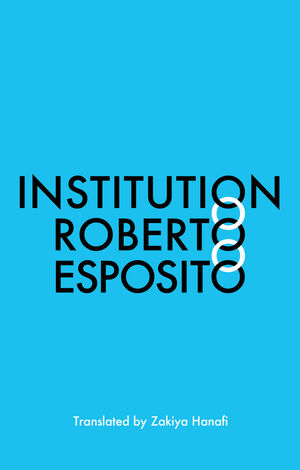
Roberto Esposito, Institution
Translated by Zakiya Hanafi, Polity Press, 2022.

Offer Details: To get 20% off this title, go to www.politybooks.com and use code PPBK1 at checkout.
Applies to paperback edition only. Offer expires 31 December 2022.

The pandemic has brought into sharp relief the fundamental relationship between institution and human life: at the very moment when the virus was threatening to destroy life, human beings called upon institutions – on governments, on health systems, on new norms of behavior – to combat the virus and preserve life. Drawing on this and other examples, Roberto Esposito argues that institutions and human life are not opposed to one another but rather two sides of a single figure that, together, delineate the vital character of institutions and the instituting power of life. What else is life, after all, if not a continuous institution, a capacity for self-regeneration along new and unexplored paths? No human life is reducible to pure survival, to “bare life.” There is always a point at which life reaches out beyond primary needs, entering into the realm of desires and choices, passions and projects, and at that point human life becomes instituted: it becomes part of the web of relations that constitute social, political, and cultural life.

See webpage as well
“Uncovering lines of escape: towards a concept of concrete utopia in the age of catastrophes,” by Étienne Balibar
1/13 | CRITICAL THEORETIC FOUNDATIONS FOR CONCRETE UTOPIAS WITH ÉTIENNE BALIBAR

Columbia Center for Contemporary Critical Thought
Wednesday, September 28, 2022
Maison Française, Columbia University

Etienne Balibar and Bernard E. Harcourt
read and discuss
Ernst Bloch, The Spirit of Utopia (1918)
Michel Foucault, “Of Other Spaces: Utopias and Heterotopias” (1967/1984)
Fredric Jameson, Archaeologies of the Future (2005)
Marx and Engels, The Communist Manifesto (1847)
Alex Williams and Nick Srnicek, Manifesto for an Accelerationist Politics (2013)
Erik Olin Wright, Envisioning Real Utopias (Verso 2010)
and Zapatista Army of National Liberation, Sixth Declaration of the Selva Lacandonia (2005)

~ ~ ~

~ ~ ~
In his lecture, “Uncovering lines of escape: towards a concept of concrete utopia in the age of catastrophes,” the philosopher Étienne Balibar develops three dimensions of the urgency of rethinking concrete utopias in these times of crises: first, Balibar discusses the dilemmas surrounding the concept of utopia and utopian thinking, without which there could be no “radical” politics, but at a time and in an age of at least three major catastrophes (the climate, the nuclear, and the digital); second, Balibar explores “real” or “concrete” utopias in light of the Foucauldian distinction between “utopias” and “heterotopias,” which could also be interpreted as a conversion of utopia into heterotopias; third, Balibar concludes on the transcendental problems of the different modalities of the “possible,” the “impossible,” the “necessary,” the “inevitable,” in their relationship to a concept of time (e.g. Bloch’s time of “not-yet”), as displaced by the questioning of “utopia” in today’s catastrophic circumstances.

Interviews with Foucauldians – Dr Perry Zurn
Overthink Podcasts
Jan 19, 2022

In this video, philosophy professor David M. Peña-Guzmán interviews Dr. Perry Zurn about his work about Michel Foucault, prison abolition, and curiosity studies.

This video was created as part of a series for a graduate seminar at San Francisco State University on the philosophy of Michel Foucault.

For more from David, check out Overthink Podcast at https://www.overthinkpodcast.com

Gordon Hull (2022) How Foucault Got Rid of (Bossy) Marxism, Critical Review,

DOI: 10.1080/08913811.2022.2121516

ABSTRACT
Foucault distanced himself from Marxism even though he worked in an environment—left French theory of the 1960s and 1970s—where Marxism was the dominant frame of reference. By viewing Foucault in the context of French Marxist theoretical debates of his day, we can connect his criticisms of Marxism to his discussions of the status of intellectuals. Foucault viewed standard Marxist approaches to the role of intellectuals as a problem of power and knowledge applicable to the Communist party. Marxist party intellectuals, in his view, had developed rigid and universal theories and had used them to prescribe action, which prevented work on the sorts of problems that he uncovered—even though these problems were central to the development of capitalism.

Keywords: Althusser, anticolonialism, communism, Fanon, Foucault, Marx, Marxism, Rancière, Parti Communiste Français

Open HistoryThe Archaeology of Retrocomputing
KULTURVERLAG KADMOS 2021
New Books network, Podcast
, Sep 16, 2022

Today I talked to Stefan Höltgen about his book Open History: The Archaeology of Retrocomputing (Kulturverlag Kadmos, 2021).

How can historical computers be described properly from the viewpoint of computer science? By considering media archaeology’s theory of operative and thus a-historical media computer archaeology combines an interdisciplinary set of theories and methods to answer this question. At first, the problems of computer historiography (technical inaccuracy, inconsistency, and idiosyncrasy) will be deconstructed with the help of history criticism (H. Whyte, R. G. Collingwood), discourse archaeology (M. Foucault), and media archaeology (W. Ernst). Following that, technology–oriented tools and methods are gathered for describing ‘old’ computers within an ‘archaeography’ and analyzing them within a mid-range theory. Methods of computer science (from theoretical, practical, and technical c.s.), electronics, logics, mathematics, and diagrammatics supersede hermeneutical methods of historiography. Additional tools (re-enactment, demonstration, computer philology) from media science and other disciplines complement this set of methods. The objects of the following analyzation are early microcomputers (1975-95).
[…]

Foucault and Epistemic Injustice (part 1)
By Gordon Hull, New APPS: Art, Politics, Philosophy, Science, 27 September 2022

Those of us who have both made extensive use of Foucault and made a foray into questions of epistemic injustice have tended to sweep the question of the relation between the two theoretical approaches under the rug. Miranda Fricker’s book, which has basically set the agenda for work on epistemic injustice, acknowledges a substantial debt to Foucault, but in later work she backs away from the ultimate implications of his account of power on the grounds that his historicism undermines the ability to make normative claims. In this her argument makes a fairly standard criticism of Foucault (whose “refusal to separate power and truth” she aligns with Lyotard’s critique of metanarratives (Routledge Handbook of Epistemic Injustice, 55). As she describes her own project:

“What I hoped for from the concept of epistemic injustice and its cognates was to mark out a delimited space in which to observe some key intersections of knowledge and power at one remove from the long shadows of both Marx and Foucault, by forging an on-the-ground tool of critical understanding that was called for in everyday lived experience of injustice … and which would rely neither on any metaphysically burdened theoretical narrative of an epistemically well-placed sex-class, nor on any risky flirtation with a reduction of truth or knowledge to de facto social power” (Routledge Handbook, 56).

[…]

The Confessions of the Flesh

The Institute of Theology and Religious Studies (ITER) of Alberto Hurtado University, Chile, organized the International Colloquium “The Confessions of the Flesh”, on
Monday 26 and Tuesday 27 September 2022.

Link to program

The Colloquium aimed at a critical reception of “The Confessions of the Flesh”, the fourth volume of Michel Foucault’s History of Sexuality. Published posthumously, this text contains a study on the shaping of the experience of the flesh in the thought of the Church Fathers and in the practices of early Christianity. The inaugural conference was given by Phillepe Butggen and was broadcasted on Youtube, so you can check it out at the following link.

Following the Colloquium, an internal workshop entitled “Foucault and Religions” was held on Wednesday 28 and Thursday 29 September. In this instance, the possibilities offered by the methodology of M. Foucault and his conclusions on the religious problem from the historical-philosophical study were discussed, being a contribution to investigate questions of the religious phenomenon in the present.

The following academics participated in the Colloquium and workshop:
• Carlos Álvarez (Universidad Alberto Hurtado, Chile),
• Martín Bernales (Universidad Alberto Hurtado, Chile),
• Vicente Cortés (Universidad Alberto Hurtado, Chile),
• Xavier Morales (Universidad Católica, Chile),
• Roberto Saldías (Universidad Alberto Hurtado, Chile),
• Adán Salinas (U. Academia Humanismo Cristiano, Chile)
• Tuillang Yuing (U. Academia Humanismo Cristiano, Chile),
• Mariana Galvéz,
• Felipe Orellana (Universidad Alberto Hurtado, Chile),
• Philippe Büttgen (U. Paris 1, France),
• César Candiotto (PUC Paraná, Brazil),
• Orazio Irrera (U. Paris 8, France),
• Edward McGushin (U. StoneHill, USA),
• Marcelo Raffin (UBA, Argentina),
• Philippe Sabot (U. de Lille, France).

The Colloquium is sponsored by the Michel Foucault Center, the French-Chilean Initiative for Higher Studies, the PhD program in Philosophy UAH and the Fondecyt nº 11180085.
In the following link you can find the program of the colloquium and the workshop.