Foucault News

News and resources on French thinker Michel Foucault (1926-1984)

Rencontres Michel Foucault 2022
Du 7 au 10 novembre 2022

Après tant d’éloges, tant de condamnations, tant de textes dont ceux de Michel Foucault (Histoire de la folie à l’âge classique – 1961 ou Les Anormaux – 1975), tant d’images, qu’elle soit furieuse, douce, prémonitoire, enfermée ou protégée, la folie nous oblige. Elle participe à la définition de la normalité, de nos rapports sociaux, elle questionne aussi les œuvres artistiques.
Alors comment regarder, vivre, accompagner ou soigner les troubles mentaux ?

Si les vagues soulevées par l’antipsychiatrie dans les années 1970 ont bousculé les représentations de la folie, les récentes querelles entre neurosciences, psychiatrie et psychanalyse, et la situation des établissements spécialisés, soulignent bien que cette question demeure ouverte et source de visions différentes de la normalité, de la cure, de la tolérance sociale, du sens.
Pour leur 11e édition, les Rencontres Michel Foucault plongent dans ce sujet sans fond et proposent à toutes et à tous les entrées multiples qui ont façonné leur ouverture et leur notoriété.

Conférences et tables rondes, portées par les universitaires de Poitiers, personnalités invitées et artistes, spectacles, films, expositions ainsi que visites au musée deviennent parfaitement complémentaires et à votre disposition.
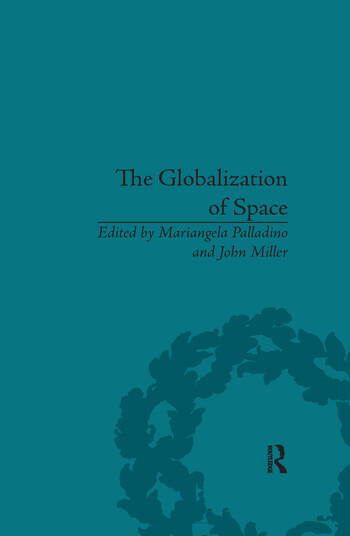
The Globalization of Space. Foucault and Heterotopia
Edited By Mariangela Palladino and John Miller, Routledge, 2015.

Book Description
The work of Michel Foucault has been influential in the analysis of space in a variety of disciplines, most notably in geography and politics. This collection of essays is the first to focus on what Foucault termed ‘heterotopias’, spaces that exhibit multiple layers of meaning and reveal tensions within society.

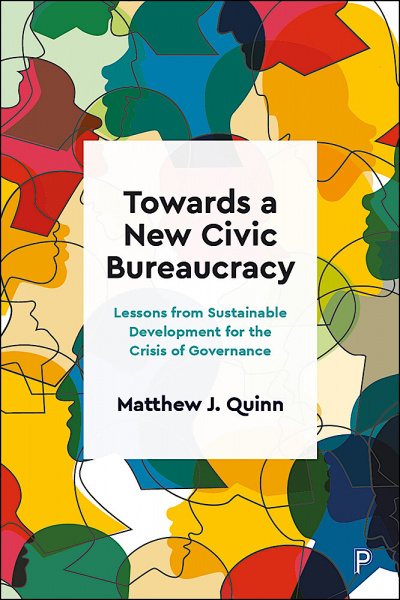
Matthew J. Quinn, Towards a New Civic Bureaucracy. Lessons from Sustainable Development for the Crisis of Governance, Policy Press, 2022

In this timely analysis, Matthew J. Quinn plots a landmark reimagination of governance and public administration, underpinned by sustainable development and civic republicanism.

He draws on governance literature and Foucault’s concept of governmentality to demonstrate the anachronism of existing bureaucratic norms and how these have thwarted sustainability and fuelled right-wing populism. Using international examples and the author’s own extensive experience in sustainability governance as a senior UK official, the book proposes a new civic bureaucracy which fosters societal engagement and dialogue. It sheds new light on debates about the emerging crisis of governance, the role of public bureaucracy and the means to embed sustainability in governance.

Matthew J. Quinn has over 30 years of experience of work on sustainability governance as a senior UK official. He is Distinguished Visiting Fellow at Cardiff University.

Mark Murphy, ed. Social Theory and Education Research. Understanding Foucault, Habermas, Bourdieu and Derrida, 2nd edition, Routledge, 2022

Book Description
Social Theory and Education Research is an advanced and accessible text that illustrates the diverse ways in which social theories can be applied to educational research methodologies. It provides in-depth overviews of the various theories by well-known and much-debated thinkers – Michel Foucault, Jürgen Habermas, Pierre Bourdieu and Jacques Derrida – and their applications in educational research.

Updated throughout and with new extended introductions to each theorist and a new chapter on the application of socio-theoretical concepts in education research methodologies and the how-to of research practice, this second edition assists education practitioners and researchers in their acquisition and application of social theory. This book contextualizes the various theories within the broader context of social philosophy and the historical development of different forms of thought.

Social Theory and Education Research will be incredibly useful to postgraduate students and early career researchers who wish to develop their capacity to engage with these debates at an advanced level. It will also prove of great interest to anyone involved in education policy and theory.

Table of Contents

Part I: Introduction

Social theory and education research: An introduction (Mark Murphy)
Social theory and methodology in education research: From conceptualisation to operationalisation (Mark Murphy and Cristina Costa) 

Part II: Foucault 

Foucault and his acolytes: Discourse, power and ethics (Julie Allan)

Retooling school surveillance research: Foucault and (post)panopticism (Andrew Hope)

Using Foucault to examine issues of girls’ education in a religiously driven postcolonial-security state (Ali Sameer)

Part III: Habermas

Jürgen Habermas: Education’s increasingly recognized hero (Terence Lovat)

Between the state and the street: Habermas and education governance (Mark Murphy)

Applying Habermas’ theory of communicative action in an analysis of recognition of prior learning (Fredrik Sandberg)

Part IV: Bourdieu

Bourdieu and educational research: Thinking tools, relational thinking, beyond epistemological innocence (Shaun Rawolle and Bob Lingard)

Research in Christian Academies: Perspectives from Bourdieu (Elizabeth Green)

Bourdieu applied: Exploring perceived parental influence on adolescent students’ educational choices for studies in higher education (Irene Kleanthous)

Part V: Derrida

Derrida and educational research: An introduction (Jones Irwin)

‘Derrida applied’: Derrida meets Dracula in the geography classroom (Christine Winter)

Engaging with student teachers on reflective writing: Reclaiming writing (Duncan Mercieca)

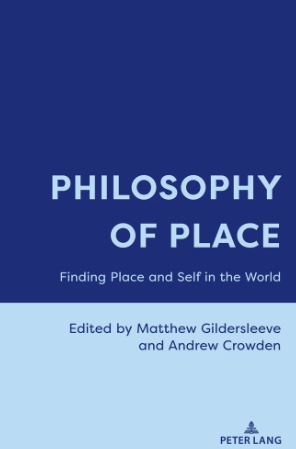
Gildersleeve, Matthew, Crowden, Andrew. Philosophy of Place. Finding Place and Self in the World (New York: Peter Lang Verlag, 2022

Summary
This book discusses the philosophy of place and the implications for understanding ourselves authentically. It sets out to investigate this by providing a review of the phenomenological and humanistic views of place as background reading for the chapters that follow. This contributed book offers unique chapters from international scholars on place in relation to individual philosophers such as Nietzsche, Sloterdijk, Foucault, as well as more broad areas of research including Ecology, Ontogenesis, Bioethics and Metaphysics. The book then presents an integration of the arguments of the contributing authors to give a better and fresh insight to the relationship between place and self. This fusion of chapters amplifies each to show how they all have an important contribution to an expanded understanding of place and self. This combination of topics as well as each author’s view of place makes this book an important contribution to the literature. The book is intended for philosophers but would also be of interest to a general audience.

Fay, W.
Neoliberalism and Radical Rights: On the Work and Theory of Law and Organising
(2022) International Journal for the Semiotics of Law

DOI: 10.1007/s11196-022-09931-4

Abstract
This article aims to contribute to scholarship regarding the critique of rights through the examination of the role of rights discourse in the furtherance of what is generally termed ‘community organising’—in particular, tenant organising—in the social and political context of neoliberalism. Conceptions of neoliberalism advanced in the work of David Harvey, Michel Foucault, Wendy Brown, and Bonnie Honig are synthesised to explicate the material and discursive role of law in the maintenance and furtherance of the neoliberal project. The article assesses the left-legal critique of rights presented primarily through the Critical Legal Studies Movement alongside the role of legal practice and legal discourse in countering neoliberalism. The article argues that rights claims concerning collective organisation, such as those commonly afforded to workers and trade unions, present a unique exception to the left-legal critique of rights in providing the means by which oppressive social relations may not only be remedies, but overcome. The works of Chantal Mouffe and of Roberto Unger are instructive in this regard and are placed in conversation with theories of community and labour organising. The article concludes by sketching the application of this conception of organising rights to the problem of housing and tenants’ rights under neoliberalism. © 2022, Crown.

Author Keywords
Community organizing; Critical legal studies (CLS); Labour law; Law; Legal rights; Neoliberalism; Rights discourse; Tenant unionism

stuartelden's avatarProgressive Geographies

There are two recent reviews of The Early Foucaultby Colin Koopman at The Review of Politics (requires subscription) and Jasper Friedrich at Foucault Studies (open access). They are generous and appreciative, though not uncritical. I’m grateful to both for taking the time to engage.

Here’s the first two paragraphs of Koopman’s review:

Stuart Elden’s The Early Foucault is the third offering in a planned series of four volumes on the work of Michel Foucault. Succeeding Elden’s Foucault: The Birth of Power and Foucault’s Last Decade in terms of publication order, the book’s subject matter is chronologically first with respect to Foucault’s life, tracing his earliest thought in the 1950s up until the publication of his first major book, History of Madness. The fourth volume will be published next year and will be concerned with Foucault’s archaeological writings of the subsequent decade. The entire collection of four volumes will offer…

View original post 770 more words

Edmund White witnessed the Stonewall riots, just the beginning of a revolutionary life
By John Russell, LGBTQ Nation, Tuesday, October 11, 2022

The author shares intimate details of his life as a writer and activist, including the new graphic novel adaptation of ‘A Boy’s Own Story.’

[…]
You also co-founded Gay Men’s Health Crisis (GMHC).

I was the first president of [GMHC], and I thought we were kind of cowardly and dim-witted because all we could think to do was to have a disco party to raise some money. Whereas in ’83, I moved to France, and I was already friends with [French philosopher] Michel Foucault. He died in ’84 of AIDS, so with his surviving partner, I helped to start the gay organization over there, which was called AIDES. And whereas [in the U.S.] we threw a disco party, they went to the minister of health and worked out a whole plan. In other words, everything was much more grown-up and professional in France, whereas in America, I think it was a sign of how beaten down we were that we didn’t think big at all.


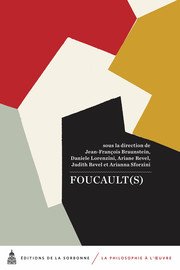
FOUCAULT(S)
| Jean-François Braunstein, Daniele Lorenzini, Ariane Revel, et al. Éditions de la Sorbonne (2022)

TABLE DES MATIÈRES
Jean-François Braunstein, Daniele Lorenzini, Ariane Revel et al.
Introduction

Première partie. Les puissances du langage

Étienne Balibar
Pensée du dehors ?
Foucault avec Blanchot

Dominique Lecourt
Le sadisme de Michel Foucault

Arianna Sforzini
Pouvoir risible, pouvoir du rire
Le grotesque et l’ubuesque selon Michel Foucault

Deuxième partie. L’histoire et l’actualité

Jean-François Braunstein
Michel Foucault, de l’histoire des sciences à l’épistémologie historique
FOUCAULT, HISTORIEN DES SCIENCES ?
FOUCAULT, HISTORIEN DES SCIENCES « À LA FRANÇAISE »
FOUCAULT AVEC CANGUILHEM
ÉTHIQUE ET POLITIQUE EN HISTOIRE DES SCIENCES : L’ÉPISTÉMOLOGIE HISTORIQUE

Jacques Revel
Michel Foucault, histoire et discontinuité

Bertrand Binoche
La généalogie de la généalogie de la…

François Hartog
Michel Foucault, guetteur du présent
LA MONTÉE DU SOUCI DU PRÉSENT
L’ONTOLOGIE DU PRÉSENT

Troisième partie. « Usages » de Foucault ?
Ann Laura Stoler
L’éclat de Foucault dans les études (post) coloniales
Trop « prêt-à-porter » ?

Orazio Irrera
Racisme et colonialisme chez Michel Foucault

Sandro Mezzadra
Foucault dans les études des frontières et des migrations

Quatrième partie. Pouvoirs et normes

Bernard E. Harcourt
Spectacle, surveillance, exposition
Relire Foucault à l’ère numérique

Jean-François Kervégan
Foucault, le droit, la norme

Paolo Napoli
Au-delà de l’institution-personne

Christian Laval
Foucault, ou l’obligation de la liberté
CE QU’IL Y A DE NOUVEAU DANS LE NÉOLIBÉRALISME
RELIRE MARX À PARTIR DE FOUCAULT
DES CONTRE-CONDUITES AU PROJET D’ÉMANCIPATION

Cinquième partie. L’aveu, le corps, la sexualité

Philippe Sabot
Sexualité, identité, vérité
ÊTRE DANS LE VRAI QUANT AU SEXE
DIRE ET POUVOIR ÊTRE QUI L’ON EST EN VÉRITÉ

Michel Senellart
Gouverner l’être-autre
La question du corps chrétien

Judith Butler
Mal faire, dire vrai : le cas de l’aveu sexuel
Sixième partie. De l’assujettissement à la subjectivation

Pascale Gillot
Michel Foucault et le marxisme de Louis Althusser

Sandro Chignola
L’alternative wébérienne
Sciences sociales, éthique et philosophie dans le dernier Foucault

Daniele Lorenzini
La parrêsia et la force perlocutoire

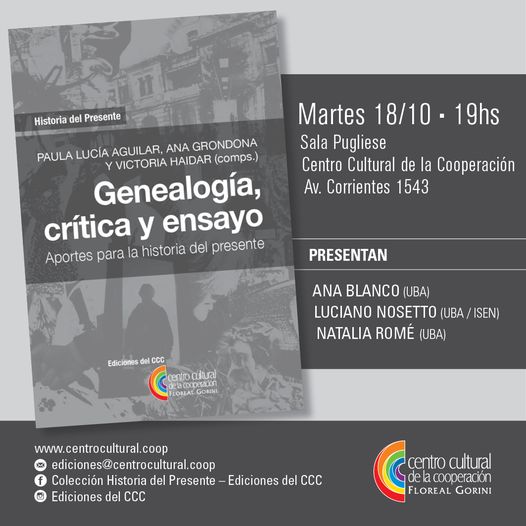
Genealogía, crítica y ensayo. Aportes para la historia del presente

Compiladoras: Paula Lucía Aguilar, Ana Grondona y Victoria Haidar.
Textos de : Mitchell Dean, David Garland, William Walters, Victoria Haidar, Ethan Kleinberg, Joan Wallach Scott, Gary Wilder, Diego Giller, María Pia López, Timothy Mitchell, Ana Grondona

Acompañan: Ana Blanco (IIGG-FSOC-UBA), Luciano Nosetto (IIGG-FSOC-UBA) Natalia Romé (IIGG-FSOC-UBA)

Este libro reúne un conjunto de textos que, desde diversas coordenadas (la tradición del ensayo latinoamericano, la teoría crítica, la genealogía foucaultiana), se interesan en interrogar la historia a contrapelo para asir mejor las múltiples procedencias y los singulares ensamblajes de aquello que se nos presenta como evidente. Sin asumir el formato típico de un manual de metodología, se propone, sin embargo, más que como caja de herramientas, como una serie de inspiraciones para la investigación.