Foucault News

News and resources on French thinker Michel Foucault (1926-1984)

Llewellyn, A.
“A Space Where Queer Is Normalized”: The Online World and Fanfictions as Heterotopias for WLW
(2022) Journal of Homosexuality, 69 (13), pp. 2348-2369.

DOI: 10.1080/00918369.2021.1940012

Abstract
In the current society, the online and fictional worlds are important spaces for both the identity construction and wellbeing of LGBTQ people. Connecting these spaces are fandoms (and fanfictions), which can operate as places of resistance for marginalized groups. Through the collection of survey data completed by 79 women loving women (WLW), this study therefore asks, in what ways does the online world, particularly in relation to fandoms, open up spaces for WLW. Employing a Foucauldian analysis, findings suggest communities online are crucial for affirmative support, and fanfictions are places where queerness is normalized. As such, through the displacement of time and space, online spaces (and particularly fanfictions) operate as heterotopias that significantly disrupt normative societal discourses. Accordingly, empathetic communities and the normal queer are notably absent from many WLW’s physical worlds. However, caution is urged as these results are less clear for women of color. © 2021 The Author(s). Published with license by Taylor & Francis Group, LLC.

Author Keywords
fandom studies; Fanfiction; Foucault; heterotopia; LGBTQ; online; WLW

Index Keywords
female, gender identity, human, lesbianism, sexual and gender minority; Female, Gender Identity, Homosexuality, Female, Humans, Sexual and Gender Minorities
Andrä, C.
Problematising war: Towards a reconstructive critique of war as a problem of deviance (2022) Review of International Studies, 48 (4), pp. 705-724.

DOI: 10.1017/S0260210522000274

Abstract
This article redirects extant critiques of the modern problem of war at this problem’s underlying logic of deviance. According to this logic, war constitutes a kind of international conduct that contravenes behavioural norms and that can be corrected through diagnostic and didactic means. Thereby, war is rendered into a problem falling within the scope of human agency. However, this agency rests on and reproduces this logic’s constitutive blind spots. Therefore, it seems imperative to develop ways of problematising war otherwise. The article provides two starting points for (critical) IR scholarship seeking to undertake such a project. Firstly, it combines two Foucaultian tools, the concept of problematisation and the method of genealogy, to direct critique at the logics underlying our evaluative-analytical, ethical, and political-judgements. Secondly, it uses these tools to trace the contingent emergence of the logic of deviance in a crucial example within the wider genealogy of the problem of war: The Carnegie Endowment’s commission of inquiry into the Balkan Wars of 1912 and 1913. Based on original archival research, I highlight different elements of this inquiry’s problematisation of war-its frames, assumptions, ways of knowing, and subjects of knowledge-to make them available for reconstruction.

Author Keywords
Balkan Wars; Critique; Foucault; Genealogy; Problematisation; War

Wright, L.
Erin’s sons and decent daughters: The biopolitics of rural masculinities in Patrick Kavanagh’s Tarry Flynn (1948) In Aida Rosende-Pérez, Rubén Jarazo-Álvarez (eds.) The Cultural Politics of In/Difference: Irish Texts and Contexts, Peter Lang (2022) pp. 28-47.

Abstract
In the years leading up to the foundation of the Irish Republic and the Irish Constitution in 1937, a series of legislations were passed leading to separatist gender dynamics between men and women. Many of the ideals promoted and culturally inculcated by de Valera through legislature presented paradoxical concepts of Irish manhood, of men as virile but chaste, and financially independent in an increasingly impoverished landscape. Patrick Kavanagh’s novel Tarry Flynn, published in 1948 and consequently banned until the 1960s for its obscenity, presents the realities of these state-sanctioned ideals of manhood. Kavanagh depicts the rural landscape of men perpetually striving to achieve these ideals and the consequences of these unattainable values. This chapter will interrogate Kavanagh’s depiction of manhood in Cavan in the 1930s and demonstrate to what extent, if any, these performances of manhood are moulded and shaped by attempts to conform to the state-sanctioned ideals of masculinity promulgated by Éamon de Valera and Archbishop John McQuaid. Drawing on R. W. Connell’s Masculinities and Michel Foucault’s work, I will investigate the hegemonic masculinities of the men in Cavan in the 1930s as well the relationship between Tarry and these ideas of manhood. By investigating Tarry’s perception of hegemonic masculinities, I will be analysing the correlation between the series of legislature passed in the preceding decade and the consequent cultures of rigid patriarchal dominance and in many cases, state-sanctioned misogyny.
Source: Scopus

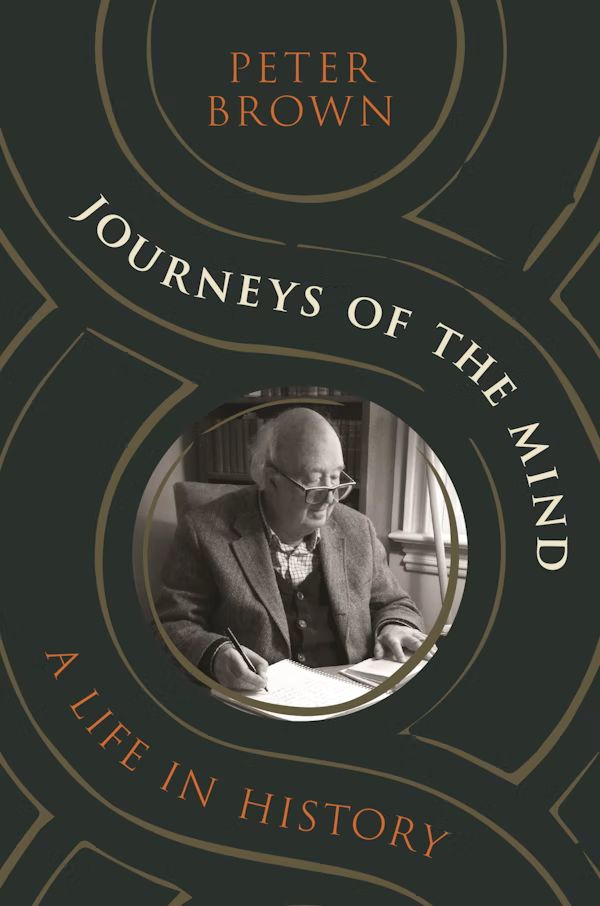
Peter Brown, Journeys of the Mind: A Life in History, Princeton University Press, 2023 (forthcoming)

A beautifully written personal account of the discovery of late antiquity by one of the world’s most influential and distinguished historians

The end of the ancient world was long regarded by historians as a time of decadence, decline, and fall. In his career-long engagement with this era, the widely acclaimed and pathbreaking historian Peter Brown has shown, however, that the “neglected half-millennium” now known as late antiquity was in fact crucial to the development of modern Europe and the Middle East. In Journeys of the Mind, Brown recounts his life and work, describing his efforts to recapture the spirit of an age. As he and other scholars opened up the history of the classical world in its last centuries to the wider world of Eurasia and northern Africa, they discovered previously overlooked areas of religious and cultural creativity as well as foundational institution-building. A respect for diversity and outreach to the non-European world, relatively recent concerns in other fields, have been a matter of course for decades among the leading scholars of late antiquity.

Documenting both his own intellectual development and the emergence of a new and influential field of study, Brown describes his childhood and education in Ireland, his university and academic training in England, and his extensive travels, particularly in the eastern Mediterranean and the Middle East. He discusses fruitful interactions with the work of scholars and colleagues that include the British anthropologist Mary Douglas and the French theorist Michel Foucault, and offers fascinating snapshots of such far-flung places as colonial Sudan, midcentury Oxford, and prerevolutionary Iran. With Journeys of the Mind, Brown offers an essential account of the “grand endeavor” to reimagine a decisive historical moment.

Lorenzini, D. (2021). Philosophical Discourse and Ascetic Practice: On Foucault’s Readings of Descartes’ Meditations. Theory, Culture & Society, First published online January 14, 2021

https://doi.org/10.1177/0263276420980510

Abstract
This paper addresses the multiple readings that Foucault offers of Descartes’ Meditations during the whole span of his intellectual career. It thus rejects the (almost) exclusive focus of the literature on the few pages of the History of Madness dedicated to the Meditations and on the so-called Foucault/Derrida debate. First, it reconstructs Foucault’s interpretation of Descartes’ philosophy in a series of unpublished manuscripts written between 1966 and 1968, when Foucault was teaching at the University of Tunis. It then addresses the important shifts that took place in Foucault’s thought at the beginning of the 1970s, which led him to elaborate a new approach to the Meditations in terms of ‘discursive events’. Finally, it argues that those shifts opened up to Foucault the possibility of developing an original reading of Descartes’ philosophy, surprisingly close to his own interest in ancient askēsis and the techniques of the self.

stuartelden's avatarProgressive Geographies

In 1975, Foucault was interviewed by Jacques Chancel on the radio. It is reprinted in Dits et écrits as text 161, “Radioscopie de Michel Foucault”. The French text is here and the recording here.

Comparing the transcription and the recording shows that it has been cleaned up quite a bit – the recording is a bit more informal in places, and some of the hesitations or the bits where Foucault and Chancel talk over each other have been tidied.

The translation which I knew about before is included in Foucault: Live as ‘Talk Show’. Like other translations in that collection it isn’t always entirely reliable, and it’s possible that it was made direct from the recording, rather than the publication. Especially towards the end, some bits are not translated.

But there is a different, albeit heavily edited, translation of this interesting interview, which appeared in Impulse, Vol 15…

View original post 58 more words

Jen A. Walklate, Time and the Museum. Literature, Phenomenology, and the Production of Radical Temporality, Routledge, 2022

Book Description
Time and the Museum: Literature, Phenomenology, and the Production of Radical Temporality, is the first explicit in-depth study of the nature of museum temporality.

It argues as its departure point that the way in which museums have hitherto been understood as temporal in the scholarship – as spaces of death, othering, memory, and history – is too simplistic, and has resulted in museum temporality being reduced to a strange heterotopia (Foucault) – something peculiar, and thus black boxed. However, to understand the ways in which museum temporalities and timescapes are produced, and the consequences that these have upon display and visitor response, is crucial, because time is itself a political entity, with ethical consequence.

Time and the Museum highlights something we all experience in some way – time – as a key ethical and political feature of the museum space. Utilizing the fields of literature and phenomenology, the book examines how time is experienced and performed in the public areas of three museum spaces within Oxford – the Ashmolean, Pitt Rivers, and Oxford University Museum of Natural History. Using concepts such as shape, structure, form, presence, absence, authenticity, and aura, the book argues for a reconsideration of museum time as something with radical potential and political weight. It will appeal to academics and postgraduate students, especially those engaged in the study of museums, culture, literature, and design.

Author
Jen A. Walklate (University of Aberdeen) is a museologist, historian, and literary theorist, studying the intersections between museums and other cultural media, including literature, drama, and comics. She utilizes novelistic and poetic forms and concepts to open new ways of considering visitor experience in museum contexts, and literature as an analytical framework for understanding the construction and performance of museums. Drawing upon this study, she is looking at new ways to create more representative, inclusive, egalitarian, and intellectually open institutions.

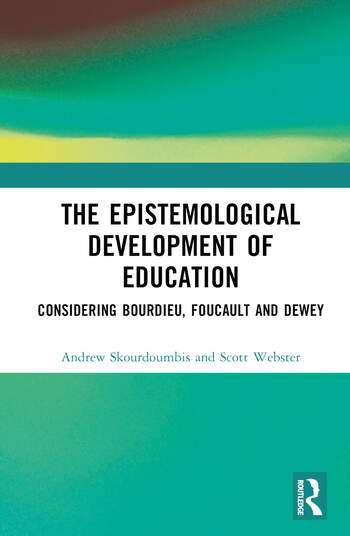
Andrew Skourdoumbis, Scott Webster, The Epistemological Development of Education. Considering Bourdieu, Foucault and Dewey, Routledge, 2023 forthcoming

Book Description
This book documents the political and economic ramifications of the policy impetus for a “science of education” and what this means for classroom teachers, their teaching practices and for the field of education.

In a critical exploration of current research and policy articulations of the purposes of education, with attention given to Australia, the UK and the USA, this book delineates the evaluative mechanisms involved in the strategic science as method adoption of accountability, competitiveness and test-driven criteria used in major education policy. It brings together the disciplines of sociology and philosophy by drawing on the theoretical insights of Michel Foucault, Pierre Bourdieu and John Dewey. In addition, the book argues for the deliberate use of the theoretical in education and is against the contemporary unquestioning advocacy that often accompanies a narrowly defined master narrative of a science of education.

This book will be of special interest to post-graduate students as source material in general education courses and is also intended for academics with an interest in educational theory/philosophy and the sociology of education.

Authors
Andrew Skourdoumbis is an associate professor of education. His research interests include teacher effectiveness research, critical policy analysis, teacher practice and educational performance, curriculum theory and research methodology. Andrew is interested in how reforms in the economy influence and impact teacher practice and the way that exacting methods of research govern teacher performance and effectiveness.

Scott Webster was formally an associate professor in education and currently works in the field of higher education within the area of higher degree research methodology. His areas of research include educational philosophy, curriculum theory, teacher education and spirituality. He has written and edited books such as Caring Confrontations for Education and Democracy, Educating for Meaningful Lives, Understanding Curriculum: The Australian Context, Theory and Philosophy in Educational Research and Rethinking Reflection and Ethics for Teachers. He has also published in various international education research journals and presented at various international conferences.

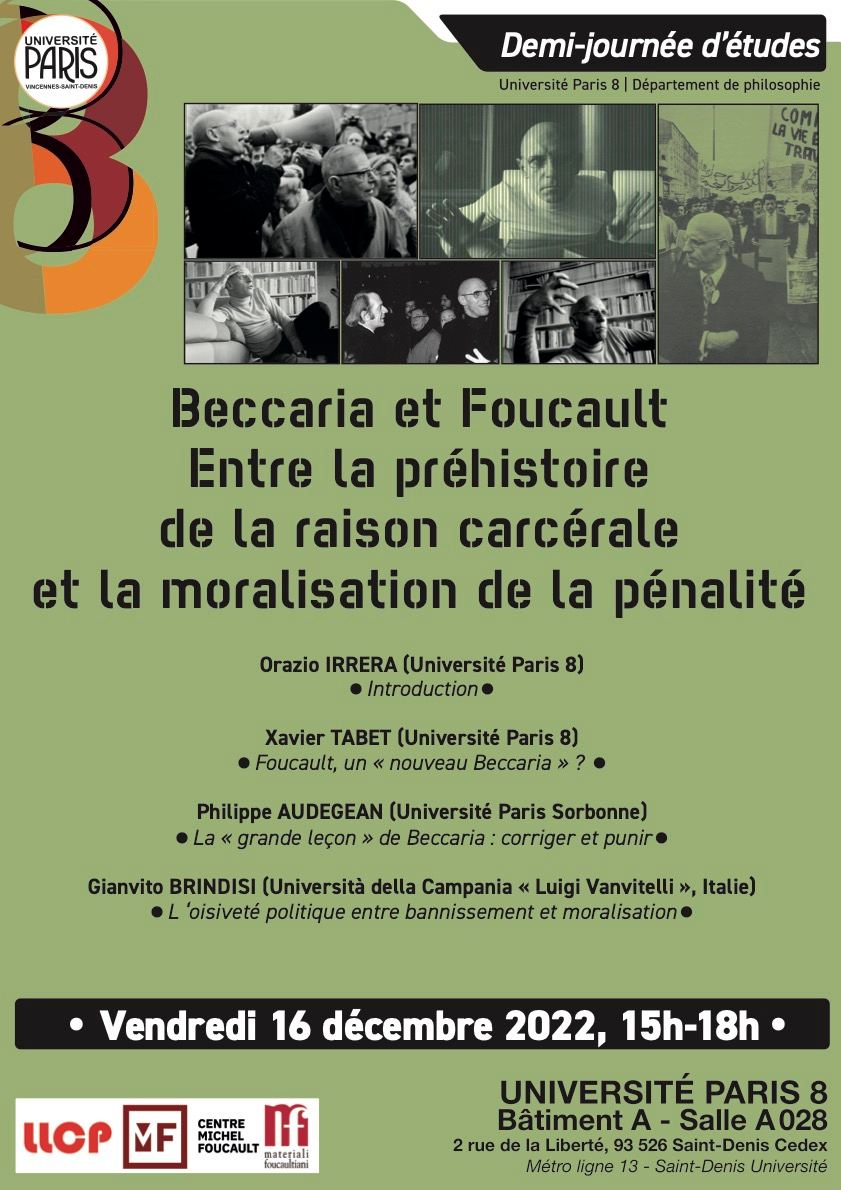
Beccaria et Foucault : Entre la préhistoire de la raison carcérale et la moralisation de la pénalité

Demi-journée d’études
Université Paris 8 | Département de philosophie
Vendredi 16 décembre 2022, 15h-18h, Salle A028

Programme :
– Orazio IRRERA (Université Paris 8 ) – Introduction
– Xavier TABET (Université Paris 8 ) – Foucault, un « nouveau Beccaria » ?
– Philippe AUDEGEAN (Université Paris Sorbonne) – La « grande leçon » de Beccaria : corriger et punir
– Gianvito BRINDISI (Università della Campania « Luigi Vanvitelli », Italie) – L ‘oisiveté politique entre bannissement et moralisation
Évènement organisé en collaboration avec le Département de Philosophie de l’Université Paris 8 Vincennes – Saint-Denis, le Laboratoire des Logiques Contemporaines de la Philosophie (LLCP, EA 4008), le Centre Michel Foucault et la revue « materiali foucaultiani »

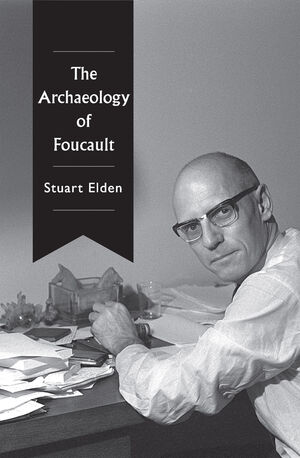
Stuart Elden, The Archaeology of Foucault, Polity, 2022

On 20 May 1961 Foucault defended his two doctoral theses; on 2 December 1970 he gave his inaugural lecture at the Collège de France. Between these dates, he published four books, travelled widely, and wrote extensively on literature, the visual arts, linguistics, and philosophy. He taught both psychology and philosophy, beginning his explorations of the question of sexuality. Weaving together analyses of published and unpublished material, this is a comprehensive study of this crucial period. As well as Foucault’s major texts, it discusses his travels to Brazil, Japan, and the USA, his time in Tunisia, and his editorial work for Critique and the complete works of Nietzsche and Bataille.It was in this period that Foucault developed the historical-philosophical approach he called ‘archaeology’ – the elaboration of the archive – which he understood as the rules that make possible specific claims. In its detailed study of Foucault’s archive the book is itself an archaeology of Foucault in another sense, both excavation and reconstruction.This book completes a four-volume series of major intellectual histories of Foucault. Foucault’s Last Decade was published by Polity in 2016; Foucault: The Birth of Power followed in 2017; and The Early Foucault in 2021.

About the Author
Stuart Elden is Professor of Political Theory and Geography at the University of Warwick.

Reviews
“This final volume of Elden’s magisterial history offers a fascinating insight into Foucault’s life and work throughout the 1960s.”
Camille Robcis, Columbia University

“For we students of Foucault and avid readers of his books, the articulation with debates of the time and the reorientations of his thought seemed clear enough. What an illusion! Building on the new archive and testimonies with amazing intellectual empathy, Stuart Elden recreates the latent discourse. We can embark on a new reading and understanding of the great archaeologist of our culture.”
Étienne Balibar, author of On Universals

“Stuart Elden concludes his series on Foucault with another work of meticulous scholarship, unearthing archival sources, variants of Foucault’s publications, and links to his contemporaries in the exciting intellectual context of the 1960s.”
Clare O’Farrell, Queensland University of Technology