Foucault News

News and resources on French thinker Michel Foucault (1926-1984)

Mulberg, Jon. “The Challenge of Environmental Governance: Ecology and the Need for a Heterodox Political Economy.” The Journal of Australian Political Economy, no. 80 (2017): 129–54.
https://search.informit.org/doi/10.3316/informit.308610660985029.

Extracts
AThis article will investigate the problem of environmental governance. It will question the scientific status of the discipline of economics, and suggest that economics is best viewed as a form of political governance. It maintains that the discipline performs an ideological function to enable justification of what are essentially political decisions.
[…]

Rather than employ orthodox economics to develop policies on environment, the article will attempt to show how ideas from the green movement, such as discontinuity and tipping points, social limits and defensive expenditures, and holistic approaches as opposed to individualistic methodologies, could be employed in the formation of a Green political economy, which the article suggests is what is required rather than slight changes to current environmental policy. Orthodox economics could be viewed as an example of what Habermas referred to as the ‘scientization of politics’, whereby political questions are reframed as scientific debates, and removed from the political agenda (Habermas 1969: ch. 6). The article employs the work of Foucault to argue that the discipline of economics and the discourse it promotes form part of a power network and are a major part of modern governance. For Foucault it is the discourse which has replaced domination as the main form of contemporary power, and political economy is a major discourse legitimising the social order.

Niesche, R. (2022). The Archaeology of Educational Leadership as an Enunciative Field. In: English, F.W. (eds) The Palgrave Handbook of Educational Leadership and Management Discourse. Palgrave Macmillan, Cham.

https://doi.org/10.1007/978-3-030-99097-8_4

Abstract
This chapter explores the notions of archaeology and discourse as central aspects of Michel Foucault’s method and considers how these concepts can be used to explore educational leadership. The work of Foucault has been increasingly used to understand and interrogate a number of issues related to educational leadership. However, there has been less writing “using” his approaches rather than simply applying some of his concepts. This chapter considers how one might go about drawing on Foucault’s methods to educational leadership so that a number of overlooked and hidden assumptions of leadership can be critically interrogated and new and genuinely different approaches can be developed for theory building in the field. The power of Foucault’s discourse, it is argued, lies less in the application of his concepts but rather in the methodology to his archival writing and research that can provide new insights and understandings of knowledge formation in the field of educational leadership.

Keywords
Educational leadership, Archaeology, Discourse, Michel Foucault

Translation and the Archive in the Continental Tradition,
A workshop hosted by the RHUL Centre for Continental Philosophy
Royal Holloway University of London

The workshop will take place in Senate House, Central London, on May 19th, 2023
To register for the conference, please use the following link:

https://www.eventbrite.co.uk/e/translation-archive-and-nachlass-in-the-continental-tradition-tickets-600187185027

We have put together this workshop to explore those aspects of the project of philosophy that are often seen as simply the groundwork or condition for the philosophical project itself, namely those processes of translating, editing, compiling, and those of the archive, both its constitution and consultation. This workshop will explore themes of the nature and operation of these processes in the continental tradition, both in terms of how they constitute the territory of philosophical thought, but also the ways in which the specificity of continental philosophy affects the process of translation, and how these projects of translation have affected the philosophical work of the translators themselves.

The workshop brings together a number of internationally recognised researchers to discuss the role of these themes in their own work, both as translators and editors, and as thinkers.

The workshop will take place in Senate House, Central London, on May 19th, 2023.

Organised by Dr Henry Somers-Hall (RHUL) and Dr Danielle Sands (RHUL) and supported by the Centre for Continental Philosophy.

Schedule

10am-11.10am Dr. Julia Ng (Goldsmiths): “The ultimate undecidability of all legal problems”: Translating Benjamin’s philosophy of law

11.20am-12.30pm Prof. Daniel Smith (Purdue) and Prof. Charles J. Stivale (Wayne State – attending via zoom): “Texts, Lines and Videotapes: Constructing the Deleuze Seminars”

12.30pm-1.30pm Lunch

1.30-2.40pm Prof. Stuart Elden (Warwick): “From the Archive to the Edited Translation: Lefebvre, Foucault, Dumézil”

2.50-4pm Prof. Alan D. Schrift (Grinnell): “The Complete Works of Friedrich Nietzsche: An Editor’s Tale”

4.15-5pm Roundtable discussion

Prof. Stuart Elden is Professor of Political Theory and Geography at the University of Warwick. His most recent books are The Early Foucault (2021), and The Archaeology of Foucault (2023), which examine Foucault’s largely unknown work of the 1950s, leading up to his first major book History of Madness in 1961, and then his work of the 1960s. The research has been conducted with archives in Paris, Normandy, Switzerland, Germany, Sweden and the United States, and is funded by the British Academy and the Leverhulme Trust. These two books continue the work of his earlier books Foucault’s Last Decade (2016) and Foucault: The Birth of Power (2017). His next major project will be a study of Indo-European thought in twentieth-century France, looking at both French and émigré scholars, with a particular focus on Emile Benveniste, Georges Dumézil, Mircea Eliade and Julia Kristeva.

Dr. Julia Ng  is Reader in Critical Theory at Goldsmiths and founding Co-Director of the Centre for Philosophy and Critical Thought. She specialises in the links between modern mathematics, political thought, and theories of history and language in the 20th century, particularly in the work of Walter Benjamin. She is the co-editor (with Peter Fenves) of the critical edition of Walter Benjamin’s “Toward the Critique of Violence” and associated fragments (2021), which contains her new translation of the essay, as well as an edition of Werner Hamacher’s writings on Friedrich Hölderlin (2020), both published with Stanford University Press. With support from the British Academy, she is currently completing a book entitled Daoism and Capitalism, which explores early Critical Theory’s conceptual debts to the Daoist thought that was translated into the German and German-Jewish philosophy, poetry, art theory, and musicology of the late nineteenth and early twentieth centuries.

Prof. Alan D. Schrift is F. Wendell Miller Professor of Philosophy Emeritus at Grinnell College. His scholarship focuses on 19th- and 20th-century French and German philosophy. In addition to over 80 published articles or book chapters on Nietzsche and 20th-century European philosophy, he is the author of Twentieth-Century French Philosophy: Key Themes and Thinkers (Blackwell 2006; Choice Magazine Outstanding Academic Title), Nietzsche’s French Legacy: A Genealogy of Poststructuralism (Routledge 1995), and Nietzsche and the Question of Interpretation: Between Hermeneutics and Deconstruction (Routledge 1990). Most recently, he co-edited Transcendence and the Concrete: Selected Writings of Jean Wahl (Fordham 2016). He was General Editor of the eight-volume History of Continental Philosophy (Acumen Publishing/University of Chicago Press/Routledge 2010), and is General Editor of The Complete Works of Friedrich Nietzsche, the Stanford University Press 19-volume translation of Nietzsche’s Kritische Studienausgabe.

Prof. Daniel Smith is Professor of Philosophy at Purdue University. He is the author of Essays on Deleuze (Edinburgh 2012), the co-editor of the Cambridge Companion to Deleuze (2012, with Henry Somers Hall), and has translated, from the French, books by Gilles Deleuze, Pierre Klossowski, Isabelle Stengers, and Michel Serres. He is the co-director of “The Deleuze Seminars” project (deleuze.cla.purdue.edu), which is translating Deleuze’s seminar lectures and is supported by grants from the National Endowment of the Humanities. He is currently working on a book entitled Technicity and Thought.

Prof. Charles J. Stivale is Distinguished Professor Emeritus of French at Wayne State University. His research interests include 19th-century French novels, contemporary critical theory and cultural studies, and writings of Gilles Deleuze and Félix Guattari, and he has has authored six books in nineteenth and twentieth-century French and Francophone studies, has edited or co-edited three volumes of studies and six journal issues, has prepared translations of two major works, a half-dozen article, and the eight hour video interview with Gilles Deleuze, published (by MIT Press/Zone) as Gilles Deleuze, From A to Z (2012). He is currently co-director, with Prof. Daniel W. Smith, of the Purdue University “Deleuze Seminars” project, developing transcriptions and translations of Deleuze’s university seminars.

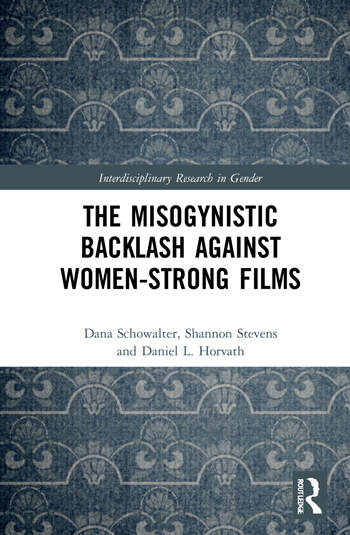
Dana Schowalter, Shannon Stevens, Daniel L. Horvath, The Misogynistic Backlash Against Women-Strong Films, Routledge, 2022

Description
This book is an exploration of the political struggle for visibility engendered by the growing number of women-centered popular films and a critical analysis of the intensifying misogynistic backlash that have accompanied such advances in the depiction of women on screen.

The book draws from a variety of theoretical and methodological tools to provide critical cultural analysis and alternative readings of women-strong films and their important role in society. The authors engage with popular culture and the popular press, media studies, and rhetorical criticism examining new modes of communication while providing historical context to help make sense of these oppositional readings. The book includes case studies on Mad Max: Fury Road, Wonder Woman, Atomic Blonde, Star Wars, and Ghostbusters to analyze critical responses, men’s-rights activist boycotting campaigns, online harassment, and the political economy that precede and accompany the creation and presentation of these films.

This is an accessible and timely analysis of the rise of feminist-friendly and women-led films and the inevitable counterculture of misogyny. It is suitable for students and researchers in Media and Communication Studies, Gender and Media, and Cultural Studies.

Dana Schowalter is Associate Professor of Communication Studies at Western Oregon University. Her research interests include feminist media studies, feminist political economy, and global philanthropy. Her work has been published in Neoliberalism in the Media, Women and Language, and Communication Review.

Shannon Stevens, Associate Professor of Journalism in the Department of English at California State University, Stanislaus, advises the student newspaper. A former journalist, she is a feminist rhetorician who researches media, popular culture, and policy. “The Rhetorical Significance of Gojira: Equipment for Living Through Trauma” appeared in The Atomic Bomb in Japanese Cinema: Critical Essays (2015).

Daniel L. Horvath is a Part-Time Faculty in Communication Studies at California State University, Stanislaus. His research focuses on the way representation warps around critical categories of gender, race, class, etc. He published research on Michael Moore documentaries in Michael Moore and the Rhetoric of Documentary (2015) and on the rhetorical conditions of whistleblowing as a public act of parrhesia in Whistleblowing, Communication and Consequences (2021).

Leclercq-Vandelannoitte, Aurélie, ‘Foucault and Phenomenology, a Tense and Complex Relationship: From Anti-Phenomenology to Post-Phenomenology’, in François-Xavier de Vaujany, Jeremy Aroles, and Mar Pérezts (eds), The Oxford Handbook of Phenomenologies and Organization Studies, Oxford Handbooks (2023; online edn, Oxford Academic, 26 Jan. 2023),
https://doi.org/10.1093/oxfordhb/9780192865755.013.13

Abstract
In line with observers that have recently reconsidered the relationship between Foucault and phenomenology, this chapter argues that Foucault’s philosophy inevitably falls within the scope of phenomenology, by rediscovering and extending its potentialities (Legrand, 2008). To do justice to the real nature of the relationship between Foucault and phenomenology, this chapter aims to highlight the possible affiliation and peculiar significance that phenomenology has taken in Foucault’s approach, and to show how Foucault extended the potentialities and richness of phenomenology towards a new approach of phenomenology, known as ‘post-phenomenology’. To that end, we consider Foucault’s three main theses (Burrell, 1988) through the prism of phenomenology: we first consider the relationship between the young Foucault and the phenomenology developed by Husserl, in terms of historicity and archaeology; we then analyse Foucault’s relationship with phenomenology through the prism of the historicization of the transcendental, expressed in Foucault’s genealogy of the subject, revealing unexpected resemblances between Foucault’s and Merleau-Ponty’s views; last, we explore Foucault’s reconsideration of the subject, through his developments of the hermeneutics and ethics of the self, revealing an active mode of experimentation largely influenced by Heidegger’s approach, and further inscribing his work in the wake of Ricoeur and Merleau-Ponty.

Keywords: Foucault, phenomenology, post-phenomenology, Heidegger, Ricoeur, Merleau-Ponty
Subject Organizational Theory and BehaviourBusiness and Management

Now available for pre-order on the University of Chicago Press website.
Michel Foucault, What Is Critique? & The Culture of the Self
Edited by Henri-Paul Fruchaud, Daniele Lorenzini, and Arnold I. Davidson
Translated by Clare O’Farrell
, University of Chicago Press, forthcoming 2024,
ISBN-13: 9780226383446, Publication date: 01/15/2024, 208pp, Hardcover (First Edition): $35.00

Newly published lectures by Foucault on critique, Enlightenment, and the care of the self.

On May 27, 1978, Michel Foucault gave a lecture to the French Society of Philosophy where he redefines his entire philosophical project in light of Immanuel Kant’s 1784 text, “What Is Enlightenment?” Foucault strikingly characterizes critique as the political and moral attitude consisting in the “art of not being governed in this particular way,” one that performs the function of destabilizing power relations and creating the space for a new formation of the self within the “politics of truth.”

This volume presents the first critical edition of this crucial lecture alongside a previously unpublished lecture about the culture of the self and three public debates with Foucault at the University of California, Berkeley in April 1983. There, for the first time, Foucault establishes a direct connection between his reflections on Enlightenment and his analyses of Greco-Roman antiquity. However, far from suggesting a return to the ancient culture of the self, Foucault invites his audience to build a “new ethics” that bypasses the traditional references to religion, law, and science.

Un inédit de Michel Foucault publié en mai
AFP, 10 mars 2023

Un inédit de Michel Foucault, “Le Discours philosophique”, réflexion sur les rapports entre philosophie et actualité, sera publié le 12 mai, ont annoncé jeudi les éditions du Seuil.

Cet essai permettra de lire un manuscrit quasi achevé que le philosophe entama en 1966 et ne publia jamais, pour une raison non précisée.

L’édition de ce livre est assurée par deux universitaires, Orazio Irrera de Paris 8 Vincennes-Saint-Denis et Daniele Lorenzini de l’Université de Pennsylvanie, aux Etats-Unis.

Le premier y a consacré un semestre de cours à Paris 8 fin 2022. Le second avait publié la table des matières sur Twitter en février.

Michel Foucault (1926-1984), auteur prolixe, avait écrit dans son testament qu’il refusait de faire l’objet de publications posthumes.

Toutefois, son dernier compagnon et légataire, Daniel Defert, décédé mardi, et l’ancien assistant de Foucault, François Ewald, ont souhaité que des écrits éclairant sa pensée voient tout de même le jour. Ils ont été nombreux ces 30 dernières années, y compris les quatre volumes de ses “Dits et Écrits”.

Foucault, considéré comme l’un des grands penseurs de la “French Theory”, un mouvement de renouveau de la philosophie à partir des années 1960, reste connu pour ses travaux sur la psychiatrie et la médecine, la sexualité, le pouvoir politique et la répression.

“Le Discours philosophique”, selon la présentation de l’éditeur, propose une “analyse archéologique” de la philosophie, avec “ses mutations historiques, d’une métaphysique de la représentation (Descartes) à une anthropologie (Kant), jusqu’au retour d’un langage venant occuper le vide laissé par l’effacement de l’homme (Nietzsche)”.

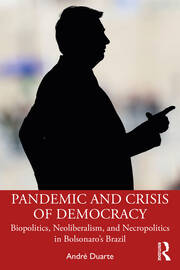
André Duarte, Pandemic and Crisis of Democracy. Biopolitics, Neoliberalism, and Necropolitics in Bolsonaro’s Brazil, Routledge, 2023

Book Description
In this incisive book, André Duarte examines the health crisis resulting from the COVID-19 pandemic and the contemporary crisis of democracy.

Reflecting on President Jair Bolsonaro’s misgovernment of Brazil, as evidenced by his political actions, speeches and omissions from March 2020 to September 2021, and using concepts like biopolitics, neoliberalism and necropolitics, Duarte proposes three interrelated hypotheses to demonstrate Bolsonaro’s sharp distrust of democracy. First, that Bolsonaro’s rhetoric, actions and omissions during the first year and a half of the pandemic revealed a dangerous mixture of biopolitical, neoliberal and necropolitical governmentality strategies. Second, that the pandemic in Brazil intensified the damaging side-effects against democracy brought by neoliberalism and biopolitics, once the necropolitical vector assumed precedence. And third, that Bolsonaro’s political agenda is either to revoke the Brazilian democracy by violent means or to implement a façade democracy by slowly distorting it from within, blurring the differences between democracy and authoritarianism.

Conceptualizing democracy as power of the demos and not exclusively as a political regime organized around a definite set of political institutions, Duarte argues that Bolsonaro’s misgovernment of Brazil is related to his antidemocratic viewpoints. Pandemic and Crisis of Democracy is an important book for researchers, students, and anyone concerned about the dangers that surround the democratic experience in the contemporary world.

Table of Contents
Introduction

1. The image of hell: understanding Brazil’s pandemic hell under Bolsonaro

2. Biopolitics, neoliberalism, necropolitics and the crisis of democracy

3. Brazil’s pathway to hell

4. Bolsonaro’s power apparatus

5. Rethinking democracy

Author
André Duarte is a full professor in the Philosophy Department at the Federal University of Paraná, Brazil. His research interests include contemporary philosophy and political theory, specializing in the works of Hannah Arendt, Michel Foucault and Judith Butler, among others.

Reviews
“This brilliantly written, provocative book offers an original analysis and a poignant critique of Bolsonaro’s Brazil. It is a timely, much-needed contribution to current debates in political theory on the notions of biopolitics and necropolitics, and their relationship to democracy, neoliberalism, and the government of the COVID-19 pandemic.”
Daniele Lorenzini, University of Warwick

“This urgent project brands President Jair Bolsonaro’s pandemic politics as ‘façade democracy’: an authoritarian leader stirring up populist resentment toward vaccines and masks in the name of democratic responsiveness. Duarte painstakingly charts the erosion of Brazilian democracy from within and proposes techniques for democratic renewal.”
Lisa Disch, Political Science, University of Michigan, Ann Arbor

“This insightful book is an original and important contribution to philosophical and political discussions of the contemporary world. The Brazilian example of Jair Bolsonaro’s presidency, crossed with the global event of the COVID-19 pandemic, is particularly relevant to address not only the situation in Brazil today, but also the authoritarian drifts that undermine the ‘democratic experience’.”
Philippe Sabot, Full Professor of Contemporary Philosophy, University of Lille, and President of the Michel Foucault Center.


Special Issue: Foucault Before the Collège de France, Theory, Culture and Society, Volume 40 Issue 1-2, January-March 2023

Foucault Before the Collège de France
Stuart Elden
Orazio Irrera
Daniele Lorenzini

Did Foucault Find a ‘Way Out’ of Hegel?
Pierre Macherey

Foucault and the History of Anthropology: Man, before the ‘Death of Man’
Arianna Sforzini

Michel Foucault in the 1950s: Beyond Psychology towards Radical Ontology
Philippe Sabot

Foucault’s Critique of the Human Sciences in the 1950s: Between Psychology and Philosophy
Elisabetta Basso

Foucault as Translator of Binswanger and von Weizsäcker
Stuart Elden

Foucault in Hamburg: Notes on a One-Year Stay, 1959–60
Rainer Nicolaysen

Philosophical Discourse and Ascetic Practice: On Foucault’s Readings of Descartes’ Meditations
Daniele Lorenzini

Foucault on Raymond Roussel: The Extralinguistic Outside of Literature
Azucena G. Blanco

Painting for Fools
Catherine M. Soussloff

Nietzsche, Ontology, and Foucault’s Critical Project: To Perish from Absolute Knowledge
Aner Barzilay

Five Modalities of Michel Foucault’s Use of Nietzsche’s Writings (1959–73): Critical, Epistemological, Linguistic, Alethurgic and Political
Bernard E. Harcourt

Literature and Madness: Madness in the Baroque Theatre and the Theatre of Artaud
Michel Foucault

Linguistics and Social Sciences
Michel Foucault

Foucault’s 1960s Lectures on Sexuality
Alison Downham Moore
Stuart Elden

Michel Foucault, Madness, Language, Literature
Edited by Henri-Paul Fruchaud, Daniele Lorenzini, and Judith Revel
Translated by Robert Bononno
The University of Chicago Press, 2023

Newly published lectures by Foucault on madness, literature, and structuralism.

Perceiving an enigmatic relationship between madness, language, and literature, French philosopher Michel Foucault developed ideas during the 1960s that are less explicit in his later, more well-known writings. Collected here, these previously unpublished texts reveal a Foucault who undertakes an analysis of language and experience detached from their historical constraints. Three issues predominate: the experience of madness across societies; madness and language in Artaud, Roussel, and Baroque theater; and structuralist literary criticism. Not only do these texts pursue concepts unique to this period such as the “extra-linguistic,” but they also reveal a far more complex relationship between structuralism and Foucault than has typically been acknowledged.