Foucault News

News and resources on French thinker Michel Foucault (1926-1984)

Ákos Cseke, La vie pour la vérité. Etudes sur le dernier Foucault, Collection : Ouverture Philosophique, L’Harmattan, 2023

La transcription des derniers cours de Michel Foucault donnés au Collège de France a sans doute bouleversé notre vision de sa pensée. Comment interpréter le changement de style et de contenu inhérent à ses œuvres finales ? Le présent ouvrage essaie d’attirer l’attention sur quelques aspects moins étudiés de cette « philosophie tardive », en particulier sa lecture du cynisme antique et du christianisme patristique et médiéval, notamment de saint Augustin, en mettant l’accent sur le thème de la vraie et belle vie dans l’esthétique foucaldienne de l’existence.

Ákos Cseke est docteur en philosophie médiévale par l’Université de Sorbonne Paris-IV. Habilité à diriger des recherches, il était professeur à l’Université catholique de Budapest entre 2005 et 2021. Actuellement, il vit à Paris. Traducteur hongrois de Michel Foucault, Jean-Luc Marion ou Pierre Hadot, il est auteur de huit livres de philosophie en hongrois, dont une monographie sur le dernier Foucault.

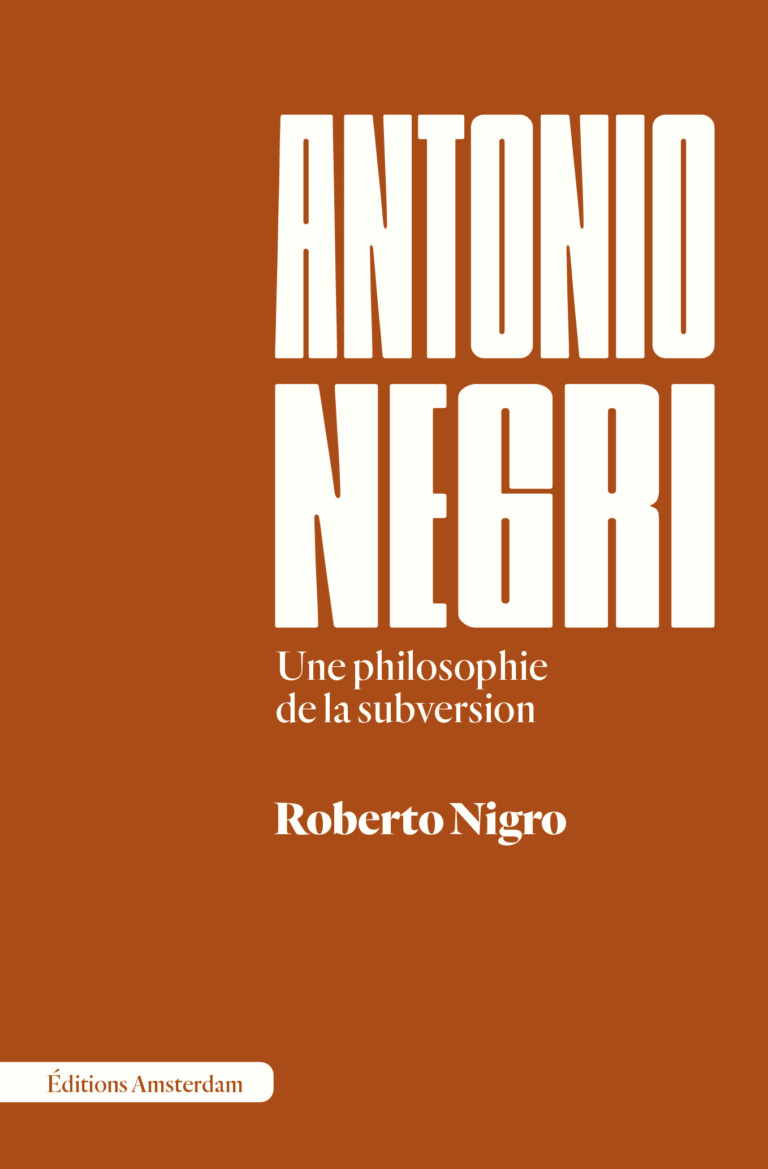
Roberto Nigro, Antonio Negri. Une philosophie de la subversion (Éditions Amsterdam, 2023)

« Le nouveau marxisme de Negri est un rempart contre les dérives post-modernes, contre l’idée d’une fin de l’histoire et de la lutte des classes. Il s’oppose à la représentation de la domination capitaliste comme totale et absolue. »

Cet ouvrage est la première introduction en langue française à l’ensemble de l’œuvre du philosophe et militant Antonio Negri : en effet, ses commentateurs se sont jusqu’à présent en général intéressés exclusivement ou bien à sa période italienne ou bien à ses développements ultérieurs. Son auteur, Roberto Nigro, s’attache à en montrer la cohérence et à la resituer dans ses contextes historiques changeants. Il en souligne le caractère fondamentalement politique, y compris dans ses moments les plus « philosophiques ». Il ne néglige pas les débats qu’elle a suscités, et il relance la discussion sur certaines des thèses de Negri qui ont le plus prêté à discussion. Il insiste sur le dialogue nourri par le philosophe italien avec certains auteurs, en particulier Spinoza, Marx, Althusser, Foucault et Deleuze, pour dégager l’originalité de son intervention dans les champs théorique et politique. Enfin, il insiste sur l’actualité des thèses et des outils conceptuels élaborés par Negri, notamment son affirmation d’un primat de la puissance de la multitude sur toutes les opérations de capture dont elle fait l’objet par les appareils du pouvoir.

Andrey Gordienko, The Epistemic State of Exception, The Philosophical Salon, 3 April 2023

Agamben’s “Configuration of Facts” and Foucault’s “Regime of Truth”

In “The Central Bankers’ Long COVID,” Fabio Vighi observes that the contemporary paradigm of government by crisis fosters a rhetoric of exclusion, which neutralizes dissensus and positions the official narrative of emergency capitalism as the sole bearer of truth. A permanent epistemic state of exception establishes a watertight regime of opinions, which blocks any potentially heretical inquiry into the “ideological sickness” of our socioeconomic system.[i] Before developing this concept further, it is important to note that the expression “epistemic state of exception” constitutes a useful pleonasm. As Giorgio Agamben demonstrates, every state of exception presupposes “the ultimate configuration of facts” that authorizes a suspension of the rule.[ii]

read more

Artificial Intelligence | Beyond right and wrong
News editor, Global News, 1 April 2023

The question of artificial intelligence (AI) concerns me both as a doctor and as a fiction writer. And not only since she promises to take my place in these two professions that I love!

I welcome the recent proposal by AI luminaries for a moratorium on its development⁠, time to let humanity realize what is happening, reflect on it, and Act in consequence.
[..]

The power of medicine also comes from the fact that it alone determines what it looks at, as Michel Foucault has shown.
[…]
In all fields, it will produce as an oracle astonishing and very useful ideas, which will have nothing to do with the human senses, will go beyond the understanding. Without being able to be considered true or false, these ideas will have a profound impact on human life.
[…]
What is at stake is the possibility for human beings to establish a relationship with their world governed by thought.

Tauzer, J., CSR and the Hermeneutical Renovation of Foucault’s Toolbox
(2023) Sustainability (Switzerland), 15 (5), art. no. 4682, .

DOI: 10.3390/su15054682

Abstract
This article aims to examine Foucault’s conceptual toolbox (methodology, conceptual tools, and conceptual meta-tools) in relation to the socio-historical analysis of Corporate Social Responsibility (CSR) and of the corporation. The article has a bidirectional purpose: it aims to use Foucault’s toolbox to analyze CSR, and to use the occasion of applying Foucault to CSR to reflect on the interpretation, critical potential, and adequacy of Foucault’s conceptual toolbox. It starts with some preliminary work: a review and rework of an interpretation of Foucault’s conceptual toolbox by Koopman and Matza. With this interpretationally revised toolbox in mind, it then initiates a Foucauldian approach to the research field of ‘the corporation’ and the sub-field of CSR. Most of the first half of this article demonstrates that Foucault’s toolbox offers a fruitful start to tackling these fields. The second half of the article takes up a counterpoint in the reverse direction, namely that Foucault’s toolbox is not equipped for adequately apprehending the interpretative play and flexibility operating within CSR discourse. This leads to a suggestion of three ways to incorporate hermeneutic tools into Foucault’s toolbox, and to an exemplification of how such toolbox renovation sheds new light on the tactics and power dynamics of CSR discourse. © 2023 by the author.

Author Keywords
concepts; corporation; CSR; discourse; dispositive; Foucault; hermeneutics; methodology

Index Keywords
corporate social responsibility, corporate strategy, hermeneutics, tool use, type of article

Brosnan, C., Tickner, C., Davies, K., Heinsch, M., Steel, A., Vuolanto, P.
The salutogenic gaze: Theorising the practitioner role in complementary and alternative medicine consultations
(2023) Sociology of Health and Illness.

DOI: 10.1111/1467-9566.13629

Abstract
Research on why people use complementary and alternative medicine (CAM) shows clients value the CAM consultation, where they feel listened to and empowered to control their own health. Such ‘empowerment’ through CAM use is often theorised as reflecting wider neoliberal imperatives of self-responsibility. CAM users’ perspectives are well studied, but there has been little sociological analysis of interactions within the CAM consultation. Specifically, it is unclear how user empowerment/self-knowledge relates to the CAM practitioner’s power and expert knowledge. We address this using audio-recorded consultations and interviews with CAM practitioners to explore knowledge use in client-practitioner interactions and its meaning for practitioners.

Based on our analysis and drawing on Foucault (1973), The Birth of the Clinic: an archaeology of medical perception and Antonovsky (1979), Health, Stress and Coping, we theorise the operation of power/knowledge in the CAM practitioner-client dyad by introducing the concept of the ‘salutogenic gaze’. This gaze operates in the CAM consultation with disciplining and productive effects that are oriented towards health promotion. Practitioners listen to and value clients’ stories, but their gaze also incorporates surveillance and normalisation, aided by technologies that may or may not be shared with clients. Because the salutogenic gaze is ultimately transferred from practitioner to client, it empowers CAM users while simultaneously reinforcing the practitioner’s power as a health expert. © 2023 The Authors. Sociology of Health & Illness published by John Wiley & Sons Ltd on behalf of Foundation for the Sociology of Health & Illness.

Author Keywords
clinical consultations; complementary and alternative medicine; Foucault; patient empowerment; power/knowledge; salutogenesis

Index Keywords
alternative medicine, archeology, article, consultation, drawing, gaze, health promotion, human, human experiment, interview, patient empowerment, perception, physician, physiological stress

Salmenkari, T., Aldawoodi, S.
Papers of the Paperless: Governmentality, Technologies of Freedom, and the Production of Asylum-Seeker Identities
(2023) International Migration Review.

DOI: 10.1177/01979183231154502

Abstract
Refugees become asylum-seekers not only because the receiving country gives them the bureaucratic-legal status but also because they start to identify with the status. This article examines how refugees learn to be asylum-seekers even when they question asylum decisions. It uses Foucault’s idea of governmentality to assess how governmental policies become translated into asylum-seekers’ collective and personal conducts as asylum-seekers, sometimes in ways that undermine the official policy. This article introduces the idea of papered governmentality, in which the production of papers is a governmental technology to manage not only populations but also personal identities and conducts. It investigates how asylum-seekers’ own role in papered governmentality as receivers, producers, and users of various papers in the asylum process transforms their conducts and identities in ways that reshape how they are governed. The empirical research site was an asylum-seekers’ protest in Finland where the first author conducted participant observation about how papers included in the asylum process were collected, read, discussed, circulated, and co-produced. The article finds that when migration control utilizes laws, bureaucratic documents, and other liberal governmental technologies designed to modify autonomous individuals’ own decisions to migrate, it produces not only control but also identification with the host country and some freedom to choose how to act with governmental decisions. © The Author(s) 2023.

Author Keywords
anthropology of documents; asylum-seekers; counter-conducts; governmentality; technologies of freedom

stuartelden's avatarProgressive Geographies

I discuss my recent book The Archaeology of Foucault(Polity, 2023) on the New Books Network with Dave O’Brien (audio)

Dave has now generously discussed all the books in this series:

Foucault’s Last Decade, 21 September 2016

Foucault: The Birth of Power, 6 November 2017

The Early Foucault, 11 February 2022

we also discussed Shakespearean Territories, 18 December 2020

Many thanks Dave!

More information on all the Foucault books, discussions, reviews and research updates here.

The Polity books page is here.

View original post

Di Pierro, M. (2022). Archaeology or interpretation: Michel Foucault and Claude Lefort. Constellations, 29, 434– 446.
https://doi.org/10.1111/1467-8675.12606

INTRODUCTION: LA POLITIQUE AND LE POLITIQUE
On February 2, 1983, during his lecture at Collège de France, Michel Foucault criticizes the concept of the political (le politique). According to Foucault, the shift from politics (la politique) to the political masks “the specific problem and set of problems of politics, of dunasteia, of the practice of the political game, and of the political game as a field of experience with its rules and normativity, of the political game as experience inasmuch as it is indexed to truth-telling and involves a certain relationship to oneself and to others for its players” (2010, p. 159). According to Foucault, le politique is an unnecessary dimension of transcendence that covers the comprehension of politics in its relationship between dunasteia and politeia. The first term indicates the constitutional framework that defines the statute of citizens and their rights, as the rules of the political game. The second, instead, names the actual exercise of power, the political game as it happens, as experience. These two spheres determine what politics is in a democratic society. Therefore, the dimension of the political is not necessary at all and hides politics as actual experience.

Foucault’s text is an explicit attack on the positions of Claude Lefort, who in those same years worked on defining his theory of the political. According to Lefort, le politique shows the structure of modern and democratic society on which the actual rules of politics depend. It is the name of a symbolic dimension, a framework of references, that explains the difference of modern society to the society of the Ancien regime, which is marked by a religious and organic structure. In other words, if an external and transcendent reference founded premodern society, the political is the characteristic of modern societies without foundation. In the latter, conflict replaces an already impossible unity.

[…]

Paul Rutherford, The Problem of Nature in Contemporary Social Theory, PhD thesis, Australian National University, 2000

Abstract
This work examines the ways in which the relationship between society and nature is problematic for social theory. The Frankfurt School’s notion of the dialectic of enlightenment is considered, as are the attempts by Jurgen Habermas to defend an ‘emancipatory’ theory of modernity against this. The marginalising effect Habermas’ defence of reason has had on the place of nature in his critical social theory is examined, as is the work of theorists such as Ulrich Beck and Klaus Eder. For these latter authors, unlike Habermas, the social relation to nature is at the centre of contemporary society, giving rise to new forms of modernisation and politics.

Michel Foucault’s work on biopolitics and governmentality is examined against the background of his philosophical debate with Habermas on power and rationality. The growth of scientific ecology is shown to have both problematised the social relation to nature and provided the political technology for new forms of regulatory intervention in the management of the population and resources. These new forms of intervention constitute a form of ecological governmentality along the lines discussed by Foucault and others in relation to the human sciences. However, Foucault’s work is not sufficiently critical of the relationship between the natural sciences and power. Extending Foucault’s biopolitics to environmental discourse is consistent with his general approach to power, but his incomplete critique of political sovereignty meant that for him agency remained tied to an idealised notion of the autonomy of the human subject. He therefore made too strong a distinction between the human and natural sciences and between power and the capacities of non-human entities, and continued to view the natural sciences as separating themselves from power in a way that was not possible in the human sciences.

A more general critique of epistemic sovereignty reveals that the natural sciences (including ecology) are subject to disciplinary and normalising practices similar to those of the human sciences. Foucault’s key inadequacy is that he linked agency to human autonomy and sovereignty. The work of Bruno Latour and other actor network theorists show that an unambiguous ontological distinction between nature, material technologies and active human subjects is highly problematic. In the place of a separate ‘society’ and ‘nature’, this thesis argues that it is preferable to see these as a single socio-nature populated by the hybrid products of translation networks.

By drawing together the insights of recent governmentality studies and the approach of actor network theory to agency and translation, Foucault’s concept of biopolitics can be adapted to provide a theoretical framework for understanding the ecological programs of government that have emerged around the problem of nature in second half of the twentieth century.