Foucault News

News and resources on French thinker Michel Foucault (1926-1984)

PDF Programa coloquio 2023

PDF Programa coloquio 2023

Michael, R., Donnar, G.
Crosshatch Fantasy: Unsettling Portals, Crisis Heterotopias, and Comings-of-Age
(2023) in Elana Gomel, Danielle Gurevitch (eds) The Palgrave Handbook of Global Fantasy, Palgrave, 2023, pp. 71-83.

DOI: 10.1007/978-3-031-26397-2_6

Abstract
This chapter introduces an intriguing concept of ‘crosshatch’ fantasy: another world that is superimposed upon consensus reality. Using Michel Foucault’s notion of heterotopia and examining two influential examples of coming-of-age crosshatch fantasy, The Dark is Rising (Susan Cooper 1973) and Elidor (Alan Garner 1965), their essay considers ‘crosshatch’ worlds as ‘counter-sites’ of crisis, transition, and maturation. In contrast to classic ‘portal’ fantasy, the heterotopic worlds in which these occur do not stay safely ‘over there’ in crosshatch fiction; they return to and irrevocably disrupt the ‘real’ world. This unsettling, transformative potential is equally true of the act of (re)reading itself. That is, entering the ‘portal’ of the fantasy text similarly constitutes a heterotopic space for the younger reader-especially when it comes to crosshatch fantasies. For protagonist and reader alike, crosshatch fantasy provides productive opportunities to come into power ‘out of sight’ before returning to a world changed ‘for ever and ever.’

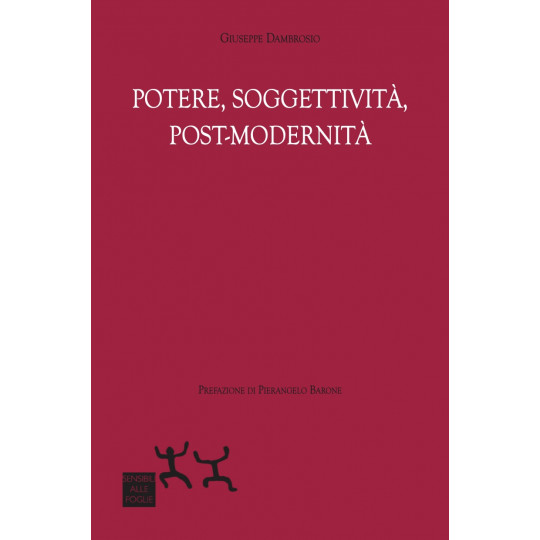
Giuseppe Dambrosio, Potere, Soggettività, Post-Modernità, Sensibili alle foglie, 2021

Nella prima parte di questo libro vengono ripresi e attualizzati gli studi di Michel Foucault sul potere disciplinare, a cui è connesso il concetto di dispositivo, per indagare le forme assunte da assoggettamento e soggettivazione nella post-modernità. È evidenziata, sul piano sia filosofico sia pedagogico che politico, l’inquietante esasperazione della disciplina di normalizzazione, particolarmente osservabile nei contesti di tipo educativo e formativo, che si concretizza nell’eccessiva e progressiva medicalizzazione della società e finisce per tratteggiare una nuova figura di «anormale 2.0» a fronte delle epocali trasformazioni antropologiche e sociali del mondo globalizzato, retto dalle leggi del neoliberismo. Nella seconda parte si osservano i processi di ibridazione tecno-digitale dei corpi, finalizzata a rapirne insieme il tempo storico e lo spazio fisico, il nodo forte del disciplinamento a mezzo di contesti strutturati di assoggettamento e de-soggettivazione. L’Autore propone i concetti di “non-corpo”, “non-tempo” e “non-spazio” per identificare l’evoluzione degli effetti dei processi di “deformazione” legati alla globalizzazione e alle derive tecnologiche e tecnocratiche del neoliberismo. E ci invita a sperimentare la costruzioni di altre e diverse forme di soggettività, in particolare a dare vita a sempre nuovi percorsi educativi di soggettivazione in un’ottica di “resistenza” al potere.

Description in English

POWER, SUBJECTIVITY, POST-MODERNITY
The first part of this book investigates the forms of subjection and subjectivation in post-modernity, and focus on Michel Foucault’s studies of disciplinary power and the associated concept of dispositif. The disciplinary notion of normalisation is highlighted from a philosophical, pedagogical and political point of view particularly as it operates in educational contexts.

The form of in the excessive and progressive medicalisation of society culminates in outlining a new figure, the ‘abnormal 2.0’, in the frame of the epochal anthropological and social transformations of a globalised world, ruled by the neo-liberal paradigm.

The second part of this book looks at the processes of techno-digital hybridisation of bodies, aimed at abducting both historical time and physical space; that is, the main node of disciplining by means of structured contexts of subjugation and de-subjectivation.

The author proposes the concepts of ‘non-body’, ‘non-time’ and ‘non-space’ to identify the evolution of effects of the ‘deformation’ processes caused by globalisation and technological and technocratic drifts of neo-liberalism. The author invites us to experiment with new and different forms of subjectivity, in particular to give life to ever new paths of subjectivation in educaation from a perspective of ‘resistance’ to power.

GIUSEPPE DAMBROSIO è laureato in Filosofia e in Scienze Pedagogiche. In passato ha lavorato come educatore nell’ambito del disagio adolescenziale. Da diversi anni insegna al liceo. Per le Edizioni Mimesis ha pubblicato: “L’alienato pastore dell’Essere”, in M. Bellini (a cura di) Corpo e rivoluzione. Sulla filosofia di Luciano Parinetto, (2012) e Heidegger, a destra della verità, (2021).

PIERANGELO BARONE è docente di Pedagogia della marginalità e della devianza presso l’Università degli Studi di Milano Bicocca. Tra le sue pubblicazioni: La materialità educativa (Unicopli, 1997), L’animale, l’automa, il cyborg (Mimesis, 2004), Vite di flusso. Fare esperienza di adolescenza oggi (Franco Angeli, 2018).

From Stuart Elden’s blog

Turnbull, M. Assembling the Crisis of COVID-19 in Australia: A Foucauldian Analysis of Prime Ministerial Press Conferences in March 2020
(2023) Genealogy, 7 (3)

DOI: 10.3390/genealogy7030066

Abstract
In this article, I present a Foucauldian analysis of the speeches made by the then Prime Minister of Australia (Mr. Scott Morrison) in March 2020. This analysis sets out to explore the political rationalities that assembled COVID-19 as a particular type of ‘problem’ that warranted unprecedented governmental intervention into the everyday lives of citizens. I believe that the insights provided by such an analysis are relevant to ongoing examination of governing in liberal democracies both during a crisis and afterwards. © 2023 by the author.

Author Keywords
Australia; COVID-19; Foucault; press conferences

CALL FOR PAPERS
The twenty-second annual meeting of the Foucault Circle
Emerson College
Boston, MA, USA
May 17-19, 2024

We seek submissions for papers on any aspect of Foucault’s work, as well as studies, critiques, and applications of Foucauldian thinking.

Paper submissions require an abstract of no more than 750 words. All submissions should be formatted as a “.doc” or “.docx” attachment, prepared for anonymous review, and sent via email to the attention of program committee chair Patrick Gamez (pgamez@nd.edu) on or before December 18, 2023. Indicate “Foucault Circle submission” in the subject heading. Program decisions will be announced during the week of January 22, 2024.

We expect that the conference will begin Friday afternoon and will conclude around lunch time on Sunday morning. Presenters will have approximately 40 minutes for paper presentation and discussion combined; papers should be a maximum of 3500 words (20-25 minutes reading time).

Logistical information about lodging, transportation, and other arrangements will be available after the program has been announced.

For more information about the Foucault Circle, please see our website: http://www.foucaultcircle.org or contact our Coordinator, Edward McGushin: emcgushin@stonehill.edu

Michael Ure, Michel Foucault’s Rhetorical Practice: The 1961 Preface to History and Madness (2023) Philosophy and Rhetoric, 52 (6), pp. 142-167.

Abstract
This article examines Foucault as a rhetorician rather than as a historian of parrhesia and rhetoric. It explores what we can learn about his philosophy by examining it through the lens of his rhetorical practices. Focusing on his famous 1961 preface to History and Madness, it suggests that Foucault’s model of philosophy entails a rhetoric of conversion or transformation.

Author Keywords
Foucault; limit-experiences; philosophy as a way of life; prefaces; rhetoric

Interview/podcast Daniele Lorenzini, The Force of Truth, Critique, Genealogy, and Truth-Telling in Michel Foucault, Hosted by Richard Grijalva, New Books Network, Nov 1, 2023

A groundbreaking examination of Michel Foucault’s history of truth.

Many blame Michel Foucault for our post-truth and conspiracy-laden society. In this provocative work, Daniele Lorenzini argues that such criticism fundamentally misunderstands the philosopher’s project. Foucault did not question truth itself but what Lorenzini calls “the force of truth,” or how some truth claims are given the power to govern our conduct while others are not. This interest, Lorenzini shows, drove Foucault to articulate a new ethics and politics of truth-telling precisely in order to evade the threat of relativism. The Force of Truth: Critique, Genealogy, and Truth-Telling in Michel Foucault (U Chicago Press, 2023) explores this neglected dimension of Foucault’s project by putting his writings on regimes of truth and parrhesia in conversation with early analytic philosophy and by drawing out the “possibilizing” elements of Foucault’s genealogies that remain vital for practicing critique today.

Host
Dr. Richard Grijalva is an ACLS Emerging Voices Postdoctoral Fellow with the Center for Mexican American Studies (CMAS) at the University of Texas at Austin.

Hannah Lyn Venable – Madness in Experience and History. Interview with Giorgi Vachnadze on the Silence of Savoir channel, October 28 2023

Professor Venable is an Assistant Professor of Philosophy at University of Mary. Dr. Venable specializes in History of Philosophy, Continental Philosophy (including Phenomenology, Post-modernism, Recent French philosophy), Aesthetics, Ethics, Philosophy of Psychology and Philosophical Theology.

In this installment of the Silence of Savoir we discuss Professor Venable’s latest contribution to Foucault and Merleau-Ponty studies, Phenomenology, Psychology and Genealogical History as we dive into her new book: “Madness in Experience and History: Merleau-Ponty’s Phenomenology and Foucault’s Archaeology“

Giorgi Vachnadze, Review: Hannah Lyn Venable: Madness in Experience and History, Phenomenological Reviews, Tuesday October 31st 2023

Open access

It would be fitting, perhaps to start speaking of Madness in Experience and History by refusing to begin at the beginning and stepping right into the centre oscillating towards the periphery through a long and patient outwards spiral. The battleground of reason and unreason, the site of power and resistance; a space where the inside of the embodied subject meets the outside of institutional constraints; the structures offered up by history to consciousness – is the concept of the Flesh. “Flesh, for Foucault, unifies the discursive practices of society and the techniques of the self, bringing together the practices which act on the self with those which are acted by the self” (Venable, 2021).

read more