Foucault News

News and resources on French thinker Michel Foucault (1926-1984)

Legg, S. (2023). Carceral and colonial domesticities: Subaltern case geographies of a Delhi rescue home. Environment and Planning D: Society and Space
https://doi.org/10.1177/02637758231174453
Open access

Abstract
This article explores a relatively rare archival account of female subjectivity, experience, mobility, and voice within a carceral institution in late-colonial Delhi. The capital’s “Rescue Home” was created to house women and girls removed from the city’s brothels under new legislation. While no brothels were closed in the first year of the laws functioning, the home accepted 18 women and girls and detailed their circumstances and experiences in its 1940 report. It was able to forcibly detain girls and was run upon disciplinary and racial lines, like other colonial institutions. But its inhabitants were not subject to detailed surveillance. Rather, their lives were ones usually beyond recording or whose stories were actively silenced. The 1940 Rescue Home report provides us with rich details of the commonplace, quotidian struggles which women and girls faced in colonial Delhi. The 18 case geographies of the Home’s inhabitants help us understand how sexuality and motherhood, education and character, and race all shaped routes into the home and destinations when people left. The accounts tell us of a carceral governmentality with influence beyond the disciplinary institution’s walls, but also of female subjects who resisted, spoke back, and absconded. This relationship between forced immobility and willed mobility suggests that brothels and rescue homes were not just connected, through the intended transfer of inhabitants, but can be directly compared as carceral domesticities.

Inédit de Michel Foucault : le discours philosophique, Radio France, podcast Samedi 13 mai 2023

Dans un texte inédit, le penseur français fait l’histoire du discours philosophique et l’aborde avec un regard critique.

Avec
Judith Revel Philosophe, traductrice, professeure des universités au département de philosophie de l’université Paris Nanterre, spécialiste de Michel Foucault et directrice du laboratoire Sophiapol

Orazio Irrera éditeur, maître de conférence à Paris 8

Comment la philosophie peut-elle nous aider à appréhender l’actualité ?
Dans un texte inédit rédigé en 1966, Michel Foucault se demande quel est le rôle de la philosophie. Il questionne le développement de la pensée philosophique, s’attarde sur Descartes, Kant et Nietzsche. Pas encore penseur du pouvoir, il esquisse déjà un regard critique et poursuit son travail de penseur de la pensée.

Circle U. Masterclass in History with Michelle Perrot, 27 March 2023. In French with option of English subtitles.

Discover on replay the Circle U. Masterclass in History with Michelle Perrot that took place on January 26, 2023 at the Carnavalet Museum as part of the Circle U. Week for the Future of Higher Education and Research.

Michelle Perrot is a renowned French historian, Emeritus Professor of contemporary history at Université Paris Cité and French feminist activist.
Through her pioneering work and gender studies, she is one of the leading figures in French women’s history.

This event was co-organised by the Circle U. European University Alliance and the Laboratoire Identités Cultures et Territoires – Les Europes dans le Monde (ICT) of Université Paris Cité.

Mark G.E. Kelly, The farce of the fifteen-minute city. Foucault and petty utopianism, IAI News, 17th May 2023

The 15 minute city has become a byword for modern planning, sustainability and the good life. To some it is a conspiracy designed to keep people in their place. However, through an understanding of Foucault, the allure of the 15 minute city is shown to be a modernist solution to a postmodern world writes professor Mark G.E. Kelly.

The concept of the 15-minute city, though based on rather older ideas in urban planning, has risen to quite sudden prominence in the context of the COVID-19 pandemic, having been first proposed as a way to improve cities that leans into the pandemic-associated movement restrictions by trying to reimagine urban living to eliminate lengthy commuting, and then become in turn a magnet for conspiracy theories that already understood the very pandemic itself as an exercise in social engineering. In sorting out this mess, I would recommend you to consider the thought of Michel Foucault, who understood contemporary societies in terms of the interaction of power and knowledge to discipline the bodies of individuals and thereby minutely to regulate populations, as allowing a critical view of such ideas that does not require us to believe in a grand conspiratorial narrative.
[…]

Ian Hacking, Anthropologie philosophique et raison scientifique, Textes réunis par Matteo Vagelli. Traduction de Aude Bandini, Vincent Guillin ,Marc Kirsch, Louis Quéré, Matteo Vagelli, Vrin, 2023.

Présentation
Des calculs de probabilité aux troubles de la personnalité, des électrons à la maltraitance des enfants, de la logique de l’induction aux fous voyageurs, l’éventail des objets abordés par Ian Hacking peut sembler déroutant. Cependant, dans toutes ses recherches, à l’intersection de la philosophie et de l’histoire des sciences, il s’attache à examiner, en toutes leurs nuances et variétés, le rôle joué par l’expérimentation dans les sciences de la nature et la spécificité des « espèces humaines » comme objets des sciences humaines et sociales.
Les textes réunis dans ce volume – dont certains publiés pour la première fois ici en français – montrent que les différents aspects de la production philosophique de Ian Hacking s’entre-répondent et dessinent ensemble un portrait complexe et articulé de la raison scientifique.
Son approche originale, au croisement (entre autres) de l’analyse conceptuelle, de la philosophie du langage ordinaire, de l’archéologie foucaldienne et de l’histoire des sciences, a contribué à ouvrir de nouveaux chantiers de réflexion, faisant de Ian Hacking l’une des figures les plus dynamiques et influentes non seulement dans le domaine de l’épistémologie philosophique, mais aussi en sociologie, en anthropologie et en histoire.

Pierre Dardot, Haud Guéguen, Christian Laval et Pierre Sauvêtre: Macron and Civil War in France, Diakritik, 1 mai 2023
English translation by Colin Gordon (PDF)
French original in Diakritik

We say a lot of bad things about Macron and the recent forced passage through France’s parliament of the pensions reform law. He is said to be egotistical, arrogant and inept. We forget that he is the actor of a wider situation, whose historical function today consists in pursuing a project greater than his own person. It is in fact necessary to set aside micro-scale “psychological” analysis, to objectively consider a policy which, for all its brutality and sometimes tragic irrationality, nevertheless has a precise meaning in the history of our societies. The personal and even sociological characteristics of an individual clearly matter but only through having made Macron this warlord whom we admire or hate.
[…]

Some people have mistakenly believed that neoliberalism was too variegated and incoherent a thing to pose a serious threat. Others thought its doctrine was already discredited, along with the political actors and governmental fashions that clothed themselves in its rationality, as if it was enough to observe its catastrophic effects on nature and society to be conclusively liberated from its spell. So many mistaken analyses, so many things overlooked and missed.

We now urgently need to understand how neoliberalism is a doctrine of civil war, in the sense that Michel Foucault suggested as a way of analyzing certain forms of power in his lecture series The Punitive Society. Course at the College de France, 1972-1973, Palgrave Macmillan 2015, p. 13): “civil war is the matrix of all power’s struggles and strategies”.

The current government knows this perfectly well, since it knowingly and systematically pursues that course, while at the same time blaming various “enemies of the republic”, using an inversion of truth which works at the same time as a denial of responsibility.
[…]

We therefore see that the Foucauldian invitation to consider all power – and therefore neoliberal power itself – according to the “matrix” of civil war contains something decisive, in a conjuncture like ours. It avoids giving in to the illusion that the state has, in essence, the function of harmonizing differences and points of view through a “dialogue”, rational if possible, between “partners”, in order, on the contrary, to consider the state as a leading player in the conduct of civil war. But it also enables full appreciation of the scope of the mobilizations in progress, by bringing to light the profound coherence which links the policy of regression of the social state and Macron’s ecocidal politics.
[…]

Jasper Friedrich & Rachel Shanks (2023) ‘The prison of the body’: school uniforms between discipline and governmentality, Discourse: Studies in the Cultural Politics of Education, 44:1, 16-29.

DOI: 10.1080/01596306.2021.1931813

ABSTRACT
This article asks what uniform practices in schools can tell us about how power functions through a comprehensive analysis of the uniform policies of all Scottish state secondary schools (n = 357). Against the backdrop of large-scale shifts from disciplinary societies to ones dominated by ‘neoliberal governmentality’ identified by Foucault and others, we investigate how these modes of power seem to be entangled in school uniform policies. The analysis reveals the specification of detailed uniform policies that both homogenise, divide and hierarchise the school body, suggesting that disciplinary techniques are alive and well. However, in the justifications that schools provide, we see uniform policies framed not as a tool to enforce discipline, but rather as a technique for pupils to fashion themselves into respectable and employable future adults. We suggest the rise of a ‘neoliberal governmentality’ has shaped how schools justify their practices of control more than it has shaped the practices themselves.

KEYWORDS: School uniform policies, school dress codes, discipline, governmentality, Foucault, content coding analysis

Eric Schliesser, Hume, Husserl and Foucault’s The Order of Things, Digressions & Impressions blog, 12 May 2023

As I have noted before (recall), Hume plays a triple role in Foucault’s (1966) Les mots et les choses (hereafter: The Order of Things).* First, alongside a number of other familiar philosophers Hume’s works are treated as illustrations for Foucault’s claims about the nature of representation and knowledge in the episteme of the so-called ‘classical’ period. In such cases Foucault assumes considerable knowledge about Hume among his implied audience. That Foucault can do so is explained by the second role Hume has, that is, of being a familiar steppingstone in a narrative that undergirds the self-understanding of phenomenology which is treated as the ruling philosophical status quo by Foucault. This narrative is one of Foucault’s main targets in The Order of Things. However, and this is the third role, in characterizing the distinctive nature of the classical age, Foucault does single out Hume individually. And this is so because he can both assume familiarity with Hume (given the familiarity of Foucault’s audience with Hume as a steppingstone in their standard narrative) as well as render Hume unfamiliar in virtue of his retelling of the story of early modern philosophy. In today’s post I am focused on Husserl’s role in these matters, especially the second role.
[…]

Arar, K., Örücü, D. (2022). A Foucauldian Analysis of Culturally Relevant Educational Leadership for Refugees as Newcomers. In: English, F.W. (eds) The Palgrave Handbook of Educational Leadership and Management Discourse. Palgrave Macmillan, Cham. https://doi.org/10.1007/978-3-030-99097-8_114

Abstract
This chapter aims to deconstruct culturally relevant leadership (CRL) and social justice leadership (SJL) frameworks in newcomers’ education using the Foucauldian lens, based on extensive research on refugee and newcomers’ education and its leadership. The way the Foucauldian lens on enunciative fields will be utilized in this chapter draws on the proposition of its authors that implementing social justice policies in schools and that existing educational leadership theory (mostly developed in “Western” societies) cannot simply be adopted without revisiting and contextualized into all other world societies, rather a critical form of educational leadership is needed that grounds educators’ work in their cultural and social heritage and enables them to understand and carry out their responsibilities in the local educational field.

Keywords
Culturally relevant leadership
Social justice
Refugee and newcome

stuartelden's avatarProgressive Geographies

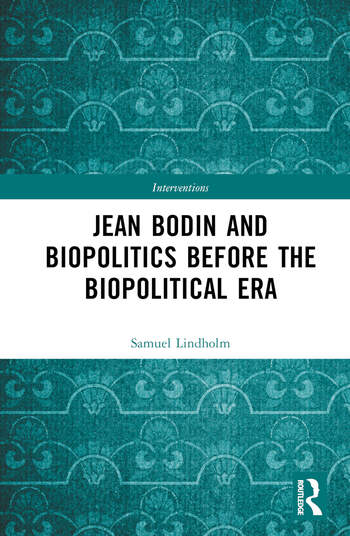
Samuel Lindholm, Jean Bodin and Biopolitics Before the Biopolitical Era – Routledge, September 2023

A prohibitively priced hardback only at this point…

This book offers fresh perspectives on the history of biopolitics and the connection between this and the technology of sovereign power, which disregards or eliminates life.

By analyzing Jean Bodin’s political thought, which acts as a prime example of early modern biopolitics and proves that the two technologies can co-exist while maintaining their conceptual distinction, the author combines Foucauldian genealogy with political theory and intellectual history to argue that Michel Foucault is mistaken in presuming that biopolitics is an explicitly modern occurrence. The book examines Bodin’s work on areas such as populationism; censors; climates, humors, and temperaments; and witch hunts.

This pioneering book is the first English-language volume to focus on the biopolitical aspects of Bodin’s work, with a Foucauldian reading of his political thought. It will appeal…

View original post 10 more words