Foucault News

News and resources on French thinker Michel Foucault (1926-1984)

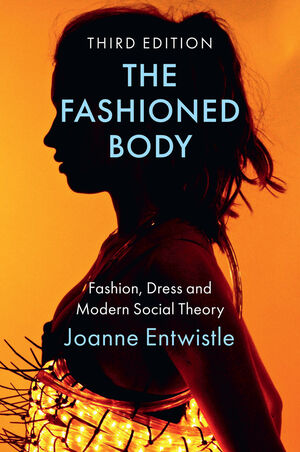
Joanne Entwistle, The Fashioned Body: Fashion, Dress and Modern Social Theory, 3rd Edition, Polity, 2023

The Fashioned Body provides a wide-ranging and original overview of fashion and dress from an historical and sociological perspective. Where once fashion was seen as marginal, it has now entered into core economic discourse focused around ideas about ‘cultural’ and ‘creative’ work as a major driver of developed economies.

This third edition of The Fashioned Body, the most comprehensive revision to date, revisits the classic works on fashion, dress and the body, and introduces contemporary issues and debates in the area. With new sections and revisions to all chapters, the major updates pick up on recent debates on fashion from the perspective of decolonising the curriculum, diversity, queer studies, sustainability, the environment, and digital fashion. A newly expanded bibliography of contemporary studies of fashion and dress is also included. The book continues to show how an understanding of fashion and dress requires analysing the meanings and practices of the dressed body in culture. Moreover, its central premise – that fashion is a ‘situated practice’ articulated through everyday dressed bodies – has become established orthodoxy within fashion studies since publication of the first edition in 2000.

Remaining a seminal text in the field, this book will be essential reading for anyone interested in the social role of fashion and dress in modern culture.

From the 1st edition description
In examining fashion in relation to the body, the book offers amuch needed synthesis between the literature on fashion and dress, which has tended to ignore the body, and the sociology of the body, which has tended to marginalize fashion and dress. Entwistle shows how an understanding of fashion and dress requires an understanding of the meanings acquired by the body in culture – since it is the body that fashion speaks to and which is dressed in almost all social situations and encounters. She argues that while fashion refers to a specific system of dress originating in the west, all cultures ′dress′ the body in the same way, making it a crucial feature of social order. Drawing on the work of Douglas, Foucault, Merleau–Ponty, Goffman and Bourdieu, the book offers insights into the connections that need to be made between the body, fashion and dress, arguing for an account of fashion and dress as ′situated bodily practice′.
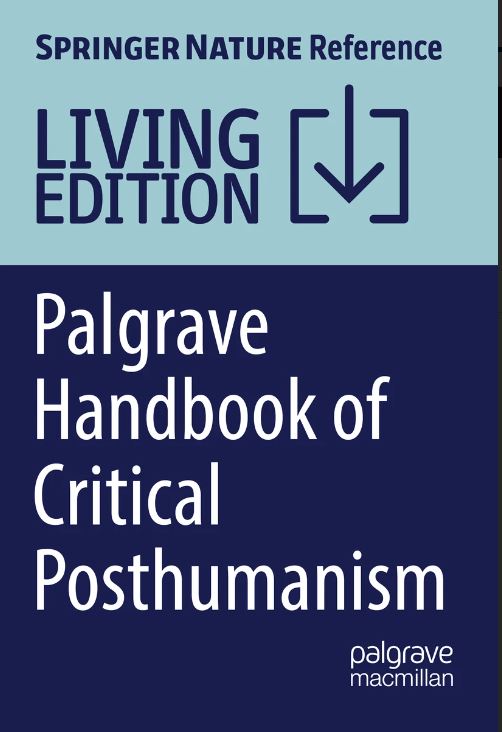
Palgrave Handbook of Critical Posthumanism
Editors: Stefan Herbrechter, Ivan Callus, Manuela Rossini, Marija Grech, Megen de Bruin-Molé, Christopher John Müller, Lving Reference Work, Palgrave, 2020

About this book
Presents a comprehensive view of posthumanism, the posthuman and their genealogies. Critically discusses important strands and issues raised within the discourse of posthumanism. Highlights the ways in which posthumanism has affected the relationship between the humanities and the sciences.

Palgrave Handbook of Critical Posthumanism is a major reference work on the paradigm emerging from the challenges to humanism, humanity, and the human posed by the erosion of the traditional demarcations between the human and nonhuman. This handbook surveys and speculates on the ways in which the posthumanist paradigm emerged, transformed, and might further develop across the humanities. With its focus on the posthuman as a figure, on posthumanism as a social discourse, and on posthumanisation as an on-going historical and ontological process, the volume highlights the relationship between the humanities and sciences. The essays engage with posthumanism in connection with subfields like the environmental humanities, health humanities, animal studies, and disability studies. The book also traces the historical representations and understanding of posthumanism across time. Additionally, the contributions address genre and forms such as autobiography, games, art, film, museums, and topics such as climate change, speciesism, anthropocentrism, and biopolitics to name a few. This handbook considers posthumanism’s impact across disciplines and areas of study.

Moon, K., Cho, H.D. Biopolitics and a right to tourism
(2023) Current Issues in Tourism

DOI: 10.1080/13683500.2023.2203852

Abstract
Tourism as a right was officially stated in the Global Code of Ethics for Tourism (1999) and it would be granted normative status once the Framework Convention on Tourism Ethics (2020) is legally binding. As such, the importance of the rights discourse in tourism has been largely acknowledged and its status is increasingly being reinforced. The rights discourse of tourism is particularly important as the world is facing at the Fourth industrial revolution, which can lead to a societal transformation like previous industrial revolutions. However, the position of tourism as a right has still been confronted with an ambivalent conjuncture and it still requires the relevant etudes to provide diverse perspectives for its justification or its discursive construction within a philosophical approach. By applying a Foucauldian discourse analysis for a close reading of international statements and demonstrating the relevance and applicability of biopolitics to the rights discourse in tourism, this article argues that a fuller understanding of the discourses and arguments made regarding a right to tourism is possible through a deeper consideration of biopolitics and that its legitimation needs to take place within the realm of biopolitical production. © 2023 Informa UK Limited, trading as Taylor & Francis Group.

Author Keywords
Biopolitics; Michel Foucault; right to tourism; rights discourse; social tourism policy

Paolucci, C.
Pre‐Truth: Fake News, Semiological Guerrilla Warfare, and Some Other Media and Communication “Revolutions”
(2023) Media and Communication, 11 (2), pp. 101-108.

DOI: 10.17645/mac.v11i2.6628

Abstract
In this article, I will work on the idea of Pre‐Truth (as opposed to post‐truth) and Semiological Guerrilla (as opposed to fake news), claiming that these two concepts are better equipped to explain what is happening in our contemporary societies, especially if we take into account the world of media and communication. In the first part of the article, I will frame the problems of fake news and post‐truth within the dynamics characterizing the relationships between knowledge and power. Taking into account Foucault and Latour’s perspectives, I argue that the problem of fake news can be understood as a new kind of relationship between these two instances, previously stably coupled and in the hands of institutional power. Later, I will deal with three different meanings of “fake news,” that are usually blended and confused: (a) serendipity, (b) false belief, and (c) mendacity. Consequently, I will deal with the problem of “Semiological Guerrilla Warfare,” arguing that the new shape of the “knowledge‐power relationship” rendered alternative and non‐institutionally certified interpretations the norm. Eventually, I will identify the deep cause of this effect in the machinic production of documents provided by new technologies, causing a return of the medieval sense of “truth” as “trust,” independent from knowledge and strictly related to anecdotes and personal experiences. Finally, I will work on the concept of “truth” connected to technology, trying to reveal its genealogy with the aim of explaining some misleading contemporary beliefs on “post‐truth.”. © 2023 by the author(s); licensee Cogitatio Press (Lisbon, Portugal).

Author Keywords
experience and knowledge; fake news; post‐truth; semiological guerrilla warfare; semiotics

Critical global citizenship: Foucault as a complexity thinker, social justice and the challenges of higher education in the era of neo-liberal globalization – A conversation with Mark Olssen,
Authors: Emiliano Bosio, Mark Olssen
Citizenship Teaching & Learning, Volume 18, Issue Philosophical, Ethical and Pedagogical Visions of Global Citizenship Education: Critical Perspectives from International Educators, Jun 2023, p. 245 – 261
DOI: https://doi.org/10.1386/ctl_00123_1

Abstract
This article presents a remarkable conversation on critical global citizenship education (GCE) between Mark Olssen, emeritus professor of political theory and higher education policy in the Department of Politics at the University of Surrey, and Emiliano Bosio, guest-editor of Citizenship Teaching & Learning. In developing the concept for this dialogue, we thought it necessary to frame GCE within a critical perspective that examines the political, economic, ideological and cultural conditions of super-complex societies, particularly in relation to notions of neo-liberal globalization and global justice. Olssen’s copious work has complemented postmodern philosophy by drawing on the work of Nietzsche, Foucault, Deleuze, and it has brought him high regard in Europe, the United Kingdom and worldwide; his insights, perspectives, concerns and outlooks bring to the centre of international educational debates on critical GCE relevant thoughts through which we can better understand the complex roots and history of global citizenship and cosmopolitanism particularly in relation to notions of democracy, equity, ethics and social responsibility.

Keyword(s): democracy; ethics; global citizenship education; global social justice; higher education; neo-liberalism; philosophy; politics

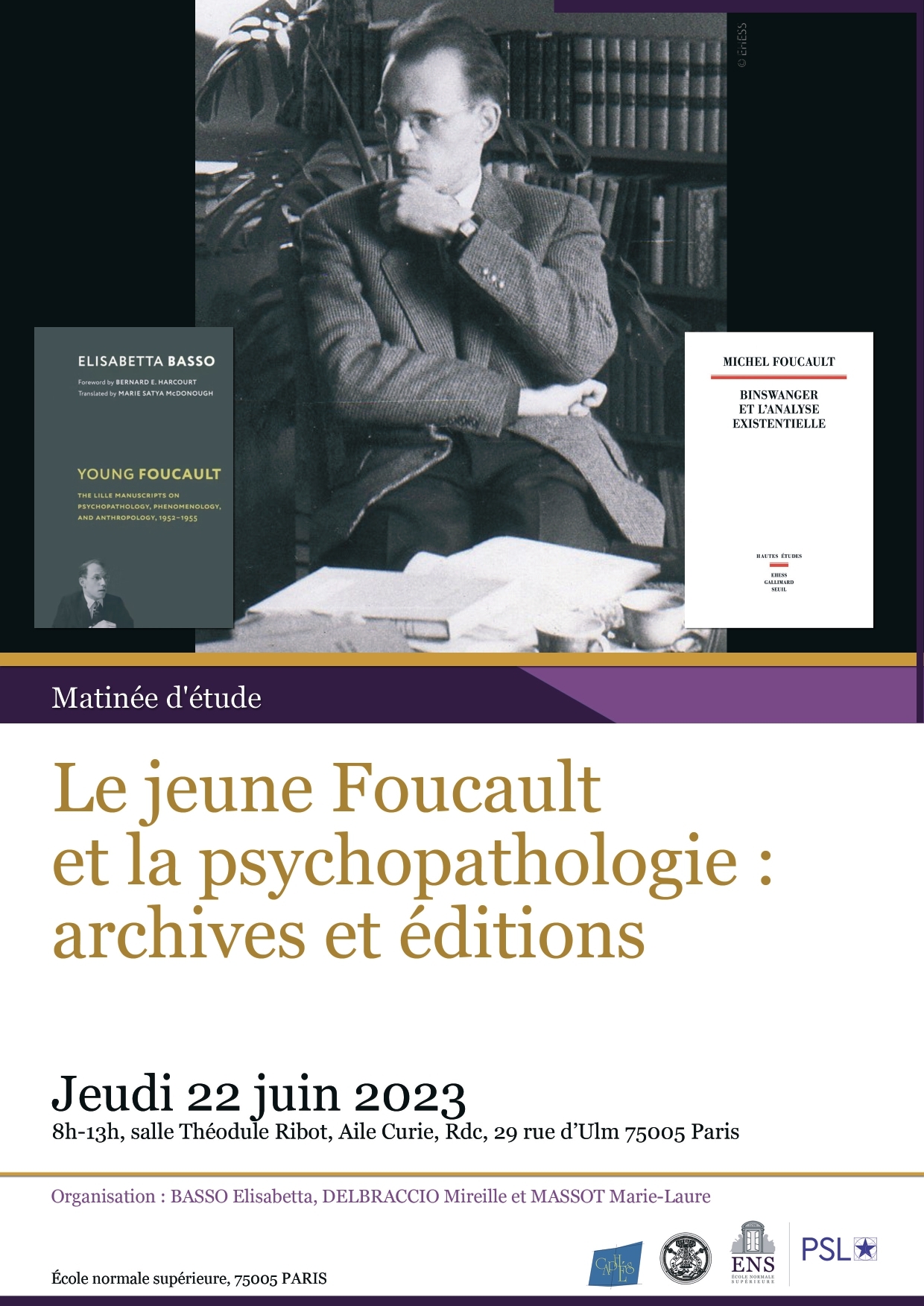
Le jeune Foucault et la psychopathologie: archives et éditions (2023)
22 juin 2023
ENS de Paris
Intervenants : Elisabetta Basso (Université de Pavie et Caphés), Claude Debru (Caphés), Mireille Delbraccio (Caphés), Henri-Paul Fruchaud, Marie-Laure Massot (Caphés), Vincent Ventresque (ENS Lyon).

Melissa Pawelski, Michel Foucault’s Figure of les corps dociles Following a Critique of the Cartesian Cogito, French Studies Bulletin, Volume 43, Issue 164, Winter 2022, Pages 10–13,
https://doi.org/10.1093/frebul/ktac017
Open access

If we adhere to Michel Foucault’s argument that modern societies are governed by disciplinary power, we must take a critical stance on the Cartesian cogito, which Foucault understands not as a philosophical liberation but as a form of cognitive governance of the body and its senses. Thus the cogito, as a central rationalistic principle, fits within the development of modern discipline. Les Corps dociles are bodily figures modelled by disciplinary mechanisms, which Foucault depicts in the chapter of the same name in his Surveiller et punir. Naissance de la prison (1975).1 Features such as docility and utility characterize this body, and their development can be traced back to René Descartes:

Le grand livre de L’Homme-machine a été écrit simultanément sur deux registres: celui anatomo-métaphysique, dont Descartes avait décrit les premières pages et que les médecins, les philosophes ont continué; celui, technico-politique, qui fut constitué par tout un ensemble de règlements militaires, scolaires, hospitaliers et par des procédés empiriques et réfléchis pour contrôler ou corriger les opérations du corps. (Œuvres II, p. 400)

This is the only time that Descartes gets mentioned in the book. I shall place my focus on the father of French rationalistic philosophy, leaving aside works such as Julien Offray De La Mettrie’s L’Homme-machine (1748) that Foucault mentions in the quotation above, to examine the way in which the meditative components of Descartes’s method translate into Foucault’s docile bodies. I want to suggest that Surveiller et punir can be read as exposing the political implementation, in part, of the Cartesian understanding of the body in the form of disciplinary governance.

[…]

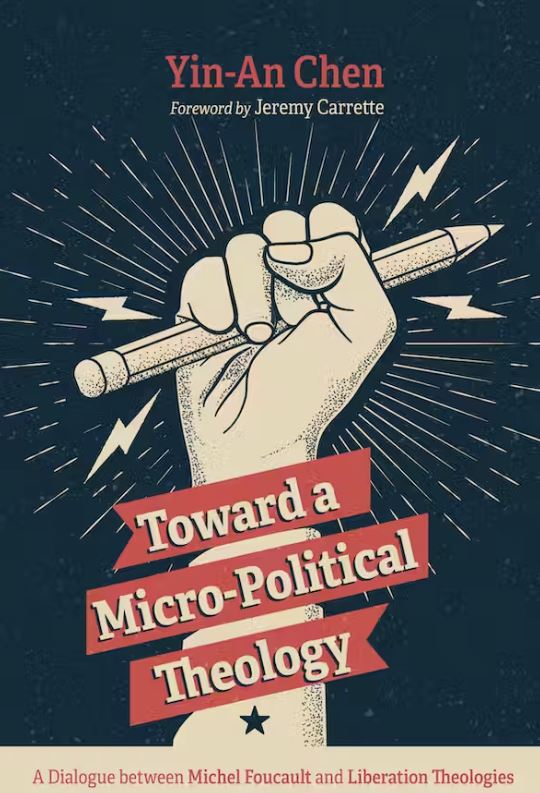
Yin-An Chen, Toward a Micro-Political Theology. A Dialogue between Michel Foucault and Liberation Theologies
Foreword by Jeremy Carrette, Pickwick Publications, 2022

Has liberation theology reached a dead end? Has the time come to propose another strategy of political resistance, one that considers and takes account of the complexity of power relationships in daily life? How can we explore the deeper meaning of freedom and liberation? This book begins with a reflection on the “failure” of social movements and revolutions and a review of the methodologies of liberation theologies. Offering a brand-new micro-political theology, it attempts to demonstrate how Michel Foucault can help us recognize the limitations of our standard definitions of liberation. Continuing Foucault’s critical engagement with desire, sexuality, and the body, this book opens a fresh dialogue between Althaus-Reid’s indecent theology, Latin American liberation theology, and radical orthodoxy, leading to an exploration of how that dialogue can remind us that spirituality and the transformative practice of the self can themselves be fully political. It also urges prayer as both the radical root of political resistance and its action.

Yin-An Chen is research associate at Cambridge Centre for Christianity Worldwide and lecturer of theology and Anglicanism in Taiwan. He received his MPhil in theology from Kent, an MA in Christian theology from Durham, and an MA in anthropology from National Taiwan University. He is interested in queer theology, political theology, and critical theory.

Dalgliesh, B. (2023). The idea of the university as a heterotopia: The ethics and politics of thinking in the age of informational capitalism. Thesis Eleven, 175(1), 81–107. https://doi.org/10.1177/07255136231169061

Abstract
Drawing on struggles within academe between faculty that promote critical education and advocates of New Public Management (NPM) who endorse instrumental learning, I reimagine the university as a counter-space that positions it as a counter-power to informational capitalism. Initially, I outline its twin threats: ethical, as self-entrepreneurial academics are valorised by NPM; and political, with informationalisation conflating spaces of thinking. I then detail Scott Lash’s specific account of how the info-comm society negates critique. However, his monistic understanding of informationalisation means Lash’s alternative of Informationskritik risks subsumption by it. I therefore defer to Jacques Derrida’s idea of the university. To ensure the autonomy of the principle of reason in a world of info-comm flows, the university is a supplementary body to society, yet intimately linked to it by its critical reflexivity, which is on behalf of society. Because Derrida does not elaborate the requisite institutional architecture, I conclude with Michel Foucault’s notion of heterotopia as a quasi-illicit site that is different and other. Such an institutional design enables the university as a counter-space that is a bank of reason and an archive of its manifestation in social practices. It also upholds a space for thinking, which in the form of nominalist critical history proffers a counter-power to society as an informational homotopia.

“Theoretical Puppets” use puppets of Deleuze and Foucault to discuss social theory and philosophy
Jennifer Sandlin, Boing Boing, May 10 2023.

[Editor: See the Theoretical Puppets category on this blog for all the Foucault related episodes]

If you’re a social theory and philosophy nerd who also loves puppets, have I got a YouTube channel for you—”Theoretical Puppets.” The folks who run the channel describe it like this: “Every month we release a new video and invite you to share our passion for puppets, social science and philosophy! Have fun!”

This isn’t just surface level analysis or a joke, though—whoever plays the puppets clearly has a deep knowledge of the work of the various puppet philosophers featured in their videos. The channel is heavy on French philosophers Gilles Deleuze and Michel Foucault, so they’re clearly two of their favorites (and I’m just speculating here, but most likely the philosophers they studied in whatever humanities or social science graduate degree they probably hold). They’ve also made videos highlighting the work of Hannah Arendt, Bruno Latour, Sigmund Freud, Salvador Dali, Walter Benjamin, and more.
[…]