
Foucault News

News and resources on French thinker Michel Foucault (1926-1984)

Morag Carol Paton, Carving Space for Staff Agency in a Faculty of Medicine: A Foucauldian-inspired discourse analysis of administrative staff and faculty relations, PhD. Ontario Institute for Studies in Education, University of Toronto, 2023

Abstract
Administrative staff in higher education have been described as invisible (Eveline, 2004; Szekeres, 2004) and often characterized as being “non-academic, nonfaculty, non-teaching, [and] non-professional” (Losinger, 2015, p. 157). These characterizations manifest within health professions education (HPE) contributing to the undervaluing of staff and staff contributions.

While administrative staff are present on campuses or within the virtual workspace, staff often remain absent when it comes to HPE documents, literature, and reports. With few exceptions, if staff appear in the HPE literature it is as a passive object, often as a resource, a possession, or a liability. If staff appear in institutional reports, it is often within an acknowledgement section rather than a list of authors. These absences are also felt in the everyday staff experience: staff are sometimes overlooked in meetings, may not feel comfortable contributing knowledge, and may feel devalued or invisible in their roles.

At the same time, the neoliberal university system has led to the increasing professionalization of staff roles, occurring as health professionals experience their own shifts in power and prestige. These changes affect staff and faculty relationships in the health professions education space – at times, leading to tensions if not toxicity.

Throughout this thesis I build and examine an archive of published literature, archival documents, interview data, and my reflections and lived experience as a staff member to conduct a Foucauldian-inspired discourse analysis. Specifically, I conduct a “history of the present” (Foucault, 1977; Garland, 2014) to identify discourses that regulate the work of and power relations between administrative staff and faculty in a faculty of medicine. I discuss what these discourses make possible for staff to do, be, or say and what these discourses now make impossible. I explore the material effects of discourse, very purposefully centering staff voices within this text. Using feminist and decolonial critical theories throughout my analysis, I engage with the historic and hierarchical structure of academic medicine that constructs the largely feminized administrative staff cohort as having limited agency in HPE. To navigate the tensions produced by discourses and structure, I work to rebuild agency through staff voices, resistance, and recommendations for practice.

Kaufman, S.R., Morgan, L.M.
The Anthropology of the Beginnings and Ends of Life (2023) Medical Anthropology, pp. 465-490.

DOI: 10.4324/9781315249360-40

Abstract
This essay reviews recent anthropological attention to the “beginnings” and “endings” of life. A large literature since the 1990s highlights the analytic trends and innovations that characterize anthropological attention to the cultural production of persons, the naturalization of life, and the emergence of new life forms. Part I of this essay outlines the coming-into-being, completion and attenuation of personhood and how life and death are attributed, contested, and enacted. Dominant themes include how connections are forged or severed between the living and the dead and the socio-politics of dead, dying, and decaying bodies. The culture of medicine is examined for its role in organizing and naming life and death.

Part II is organized by the turn to biopolitical analyses stimulated by the work of Foucault. It encompasses the ways in which the biosciences and biotechnologies, along with state practices, govern forms of living and dying and new forms of life such as the stem cell, embryo, comatose, and brain dead, and it emphasizes the production of value. Much of this scholarship is informed by concepts of liminality (a period and state of being between social statuses) and subjedification (in which notions of self, citizenship, life and its management are linked to the production of knowledge and political forms of regulation). © Cecil G. Helman 2008.

Author Keywords
biopolitics; birth; death; Medical anthropology; personhood; social studies of science

Iguchi, Y., Rashid, A., Afiqah, S.N.
Female Genital Cutting and the “Medical Gaze” in Southeast Asia, In Kyoko Nakamura, Kaori Miyachi, Yukio Miyawaki, Makiko Toda (eds)
Female Genital Mutilation/Cutting: Global Zero Tolerance Policy and Diverse Responses from African and Asian Local Communities, Springer (2023), pp. 127-140.

DOI: 10.1007/978-981-19-6723-8_9

Open access

Abstract
This article discusses female genital cutting (FGC) in Southeast Asia in the context of the increasing medical control over the female body. It questions and evaluates medicine’s role in controlling women’s bodies through informing and underpinning the public health policies enforced them. Using a cultural studies methodology of text analysis, we have focused on the specific discourses on FGC in Southeast Asia. There were three findings in the study. Firstly, although overt state medical control over FGC does not appear to exist in Southeast Asia, the medical gaze has been adopted and perpetuated by the religious community in their resolutions. Secondly, we contend that whether they are promoting FGC or attempting to stop it, medical practitioners are equally/similarly involved in objectifying the female genitalia, and sharing what the well-known French theorist, Michel Foucault termed “the medical gaze.” Either way, they are implicitly contributing to medical control over the female body. Our third focus regards how local people view FGC. We found that local people had initially thought that FGC functioned as a mark of religious identity, but to a large extent they eventually came to adopt the same medical gaze as that of the European ideology of their colonizers. In this respect Southeast Asia presents an interesting example of a site of negotiation and contestation between the local traditional views of FGC based on custom or religion, and global discourses on FGC. © The Editor(s) (if applicable) and The Author(s) 2023.

Eugene B. Young, Cinematic Art and Reversals of Power. Deleuze via Blanchot, Bloomsbury, 2022

Description
Bringing together Deleuze, Blanchot, and Foucault, this book provides a detailed and original exploration of the ideas that influenced Deleuze’s thought leading up to and throughout his cinema volumes and, as a result, proposes a new definition of art.

Examining Blanchot’s suggestion that art and dream are “outside” of power, as imagination has neither reality nor truth, and Foucault’s theory that power forms knowledge by valuing life, Eugene Brent Young relates these to both Deleuze’s philosophy of time and his work with Guattari on art. In doing so, he uses case studies from literature and popular film, including Kafka’s Castle, Villeneuve’s Arrival, and Kubrick’s Eyes Wide Shut.

Providing important new insights for those working in literary and cinematic studies, this book advances a new definition of art as that which reverses the realities and truths of power to express obscure ideas and values beyond both our exterior and interior worlds.

Table of Contents
Introduction: How the True World Finally Became a Bad Film

PART ONE: Power and the Outside
I. Power and the (In)Visible: Foucault and Deleuze
II: From Menace to Passion in Blanchot & Deleuze: ‘The Sovereignty of the Void’ & Experience of the Imaginary
III. Dreams: The Eclipse of the Day & its Incessant Return

PART TWO: Art, Literature, & Ideas
IV. The Conceptual Composition of the Work of Art: Chaos & the Outside
V. Literature’s Radical Reversal: from Absence of Origin to Deterritorialized Future
VI. Kafka’s Castle: A Case Study-Conceptual Inexistence & Obscure Value

PART THREE: Cinema
VII. Cinematic Worlds of Truth and Reality: Deleuze’s Movement Image via Foucault
VIII. Radical Reversals of Cinematic Art: The Dissociative Force of Blanchot’s Outside in Deleuze’s Time-Image
IX. “Is Anyone Seeing This?”

Conclusion: Artistic Fiction and the Thought of Eternal Return

Eugene B. Young is Professor of Practice in Philosophy and English at Le Moyne College, Syracuse, USA. He is the primary author and editor of The Deleuze and Guattari Dictionary (Bloomsbury, 2013).

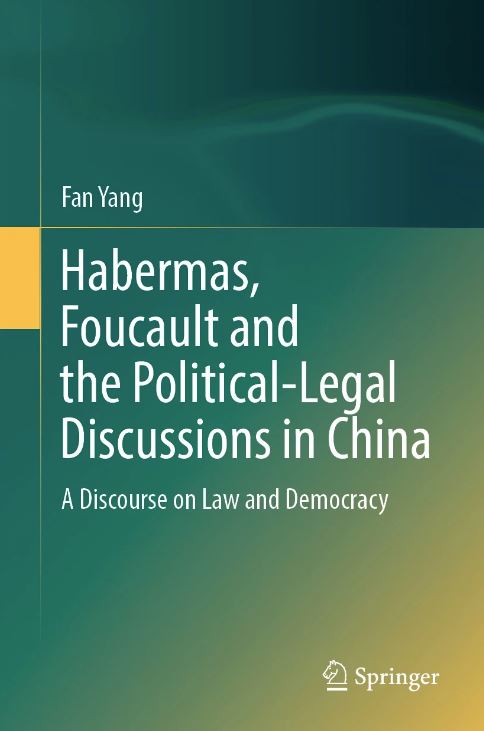
Fan Yang, Habermas, Foucault and the Political-Legal Discussions in China. A Discourse on Law and Democracy, Springer 2022

About this book
This book revisits the discourse theories of Habermas and Foucault in a Chinese context. After arguing that Habermas’s Discourse Theory of Law and Democracy is too normative and idealistic, it presents Foucault’s Discourse Theory of Power Relations to illustrate the tensions between different Western discourse theories. The book then draws on the normative concept of Confucian Rationality from traditional Chinese cultural sources in order to investigate how adaptable these two discourse theories are to the Chinese society, and to balance the tension between them. Presenting these three dimensions of discourse theory, as well as the relations between them, it also uses empirical descriptions of certain facts of political-legal discussion both in traditional China and in the country’s new media age to explain, supplement and question this theoretic framework.

The book asserts that, because of the diverse modes of thinking in specific cultures, there might be different normative paradigms of discorse and different political-legal discussion modes across corresponding cultural contexts. Normative discourse theories provide guidance for the practices of deliberative democracy and legal discussions, which can in turn verify, supplement, improve and challenge the normative discourse theories. In addition to demonstrating the multiple dimensions of discourse theories, this research also promotes an approach to the Discourse Theory of Law and Democracy that combines elements of both Chinese and modern society.

Fan Yang is an associate professor of law and a fellow of the Center for Jurisprudence Research and the Research Center for Judicial Data Application at Jilin University, China. He holds a PhD degree of social science from Ecole Normale Supérieure de Paris-Saclay in France, and another PhD degree of philosophy from East China Normal University. His teaching experiences and studies focus on sociology of law, legal philosophy and comparative law.

Kjaran, J.I., Kristinsdóttir, G.
Working on violent self: how perpetrators of IPV narrate about and position themselves during and after therapy? An example from Iceland (2023) Nordic Social Work Research, 13 (2), pp. 348-361.

DOI: 10.1080/2156857X.2021.1991443

Abstract
In this paper the aim is to explore how men who have been violent and abusive in their intimate relationships reconstituted their violent behaviour, by working on the self. How did they change or transform themselves through therapy? Which strategies did they use when caring for the self and which subject positions were adopted? The paper also explores how interviewees draw on therapeutic discourse when talking about themselves and their violent practices. To seek answers, the narratives of seven research participants are interpreted by drawing on Foucault´s work on the ethics of the self and how subjects apply various techniques when taking care of and working on it.

Our findings indicate that by confessing to violence and abuse in intimate relationships, these men become recognized as intelligible subjects who can change themselves by working on the self through therapy and self-inspection. Most of them came to be reflective and tried to find explanations for their violent acts. Some were partly repentant. However, as discussed in the paper, they also made excuses for the violence committed and did not critically question their own privileges and entitlements as men. Instead, they often blamed external factors or own mental illnesses for their actions. These can have implications for service providers as discussed further in the paper. Despite considerable therapeutic insights these men still need guidance and increased awareness of gendering aspects of IPV and insights into how they are constituted by the dominant discourses of masculinity. ©, Informa UK Limited, trading as Taylor & Francis Group.

Author Keywords
ethics of the self; fathering; Foucault; gender; Iceland; IPV; masculinity; therapeutic discourse

Menard, R., Törrönen, J.
Immigration, Multiculturalism and Biopolitical Projects on ‘Difference’: Negotiating Intersecting Social Divisions From Positions of Privilege and Disadvantage (2023) Nordic Journal of Migration Research, 13 (1), pp. 1-23.

DOI: 10.33134/njmr.513

Abstract
Informed by Foucault’s concept of biopolitics, in this study we examine how lived experiences of privilege and disadvantage may be at play in respondents’ negotiations of Finnish discourses on immigration, multiculturalism and ‘difference’. The main research material was produced by Finnish citizens whose practices around sociability and gender/sex have been formally marked as ‘abnormal’ by welfare state and health care institutions: Asperger’s diagnosed persons and persons with transgender life experiences. We analyse the research material – which was elicited using vignettes – using tools from critical discourse analysis that we implement through an intersectional lens. In their negotiations of the vignettes, participants partly identify with conflicting views. On the one hand, they approach discourses and practices on and around ‘difference’, immigration and multiculturalism through homogenising and subjugating categorisations, viewpoints and assumptions. On the other hand, they also question some of them, leaving potential openings for social transformation. COPYRIGHT: © 2023 The Author(s). This is an open-access article distributed under the terms of the Creative Commons NonCommercialNoDerivatives Attribution 4.0 International License (CC-BY-NC-ND 4.0), which permits unrestricted distribution, and reproduction in any medium, provided the original author and source are credited, the material is not used for commercial purposes and is not altered in any way. See https://creativecommons.org/licenses/by-nc-nd/4.0/.

Marx, S., Lavigne, A.L., Braden, S., Hawkman, A., Andersen, J., Gailey, S., Geddes, G., Jones, I., Si, S., Washburn, K.
“I didn’t quit. The system quit me.” Examining why teachers of color leave teaching
(2023) International Journal of Leadership in Education

DOI: 10.1080/13603124.2023.2218113

Abstract
Teachers of color leave the teaching profession at nearly three times the rate of their white counterparts. This qualitative study examines the stories of four former teachers of color who left the teaching profession. Participants’ decisions to leave teaching are contextualized with literature on the role of school leadership and teacher attrition and a conceptual framework of critical race theory and Foucault’s notion of the body as text. Journey maps and interviews are the main data sources. Findings include the lack of control participants had over their bodies, their language, and their relationships in teaching, as well as the resilience they found in leaving the profession. © 2023 Informa UK Limited, trading as Taylor & Francis Group.

Erbilen, S.Ü., Uysal, M.
The Common Point of Countries Successful Policies in the Struggle Against COVID-19: Women Leaders (2023) SAGE Open, 13 (2)

DOI: 10.1177/21582440231179458

Abstract
During the COVID-19 pandemic, which is one of the biggest epidemics of the last century and can be regarded as a global tragedy, leaders had to mobilize many resources of their countries quickly and persuade their citizens to change their routine behavior. The approach followed by the leaders of the country in their efforts to convince their people has been an important factor in their success or failure. This paper aims to examine with Michel Foucault’s notion of biopower, and discourses and behaviors of women leaders in countries against the global pandemic which cost high life tool gave harsh messages to the humanity. For this purpose, leadership examples in Finland, Iceland, Taiwan and New Zealand will be examined in detail using the discourse analysis technique. As a result, in current times when populist and autocratic leader style is on the rise, women leaders not only took their countries to success, but they also managed to inspire other countries. More importantly, the struggle of women leaders against the pandemic revealed that a different management style is possible. © The Author(s) 2023.

Author Keywords
biopower; COVID-19; discourse analysis technique; leadership qualities; women leaders

Isike, C.
Foucault’s Panopticon as a Theoretical Frame for Understanding the Big Brother Reality Show in Christopher Isike, Olusola Ogunnubi, Ogochukwu Ukwueze (Eds). Big Brother Naija and Popular Culture in Nigeria: A Critique of the Country’s Cultural and Economic Diplomacy, pp. 17-30. Palgrave Macmillan (2023)

DOI: 10.1007/978-981-19-8110-4_2

Abstract
The idea of the Panopticon concept presents a useful theoretical framework to understand the Big Brother Reality show generally and the Big Brother Naija (BBN) is not precluded. From its physical architectural form as a surveillance structure to its metaphoric and Foucauldian conception as norms, laws and policies which regulate behavior and compliance including its contemporary meaning in a digital world, the Panopticon concept sheds light into the BBN show. This chapter therefore deploys it to make sense of the reception and criticism of the show by Nigerians in ways that can help understand and measure the socio-political, cultural, and economic value of BBN against the intrusive gaze of the Big Brother panopticon. In this way, the chapter presents a good theoretical anchor of the arguments presented in the chapters of this book. © The Author(s), under exclusive license to Springer Nature Singapore Pte Ltd. 2023.

Author Keywords
Bentham; Big Brother Naija; Big Brother Reality Show; Foucault; Panopticon