Foucault News

News and resources on French thinker Michel Foucault (1926-1984)

Hafeez, G.A.
Counter-conduct and Persistence in Selected Works by Egyptian Women Writers
(2023) Jordan Journal of Modern Languages and Literatures, 15 (1), pp. 347-363.

DOI: 10.47012/jjmll.15.1.18

Abstract
In this paper, Michel Foucault’s concept of “counter-conduct” and Judith Butler’s concept of “persistence” are deployed, explored, and applied to rethink the relationship between the dominant patriarchal power and women’s dissent as represented in the writings of Latifa al-Zayyat (1923-1996), Nawal El Sadaawi (1931-2021), and Salwa Bakr (1949). Analyzing al-Zayyat’s The Open Door [al-Bāb al-maftūḥ], El Sadaawi’s short story “The Picture” [al-Sura] and Bakr’s “Thirty-one Beautiful Green Trees” [Ihdā wa thālathūn shajarah jamīlah khadrā] in terms of the twofold approach allows in-depth explorations of various strategies of dissent and different modes of counter-conduct and persistence in the selected literary texts. It also allows for rigorous and authentic evaluation of how the female protagonists-Layla, Narjis and Kareema – endeavor to carve out other ways of being that lead to the emergence of their new subjectivities and their gendered identities. © 2023 JJMLL Publishers/Yarmouk University. All Rights Reserved.

Author Keywords
Agency; Counter-Conduct; Everyday Acts of Resistance; Persistence; Women’s Writing

Stephanie Cox, Showers: Discourse, Disability, and the State, PhD thesis, Auckland University of Technology, Aotearoa New Zealand, 2023

Open access

Abstract
Showering is a pleasurable part of a daily hygiene routine for many people. However, for those who are unable to stand or step up into the typical shower unit, it is a space of exclusion. In Aotearoa New Zealand, occupational therapists can apply to the State for funding to modify shower units so that people may wheel into their shower, shower while seated, or be assisted with showering. However, this funding comes from a limited budget in which the need always exceeds the allocation. As such, a system for assessing who is able to get funding has been established. From the outside, it seems that this funding solves the issue of inaccessible showers. Although not everyone can get what they need, one could presume that the system for prioritisation addresses the needs of those whose are the greatest. However, disabled people’s access to suitable housing in Aotearoa New Zealand has recently been described as grim. Issues with inaccessible housing and showers appear frequently in mainstream media, and numerous studies have found that the need for accessible houses is far from being met.

In this study, I use a Foucauldian genealogical approach to interrogate the history of the shower. This reveals the discursive construction of the typical shower unit and shows the shower to be a political actor in the exclusion of disabled people from private dwellings. I have gathered texts from the birth of showers through to modern day to show how the government of individuals and populations shaped the shower and produced the idea of showering as an essential everyday activity. I analysed these texts using the concept of the dispositif to reveal the governmentalities that have shaped where and how disabled people live. I conclude that the current system of housing modification maintains biopolitical disablism, and is part of excluding disabled people from neoliberal life. I argue that this is an extremely dangerous practice, pushing disabled people (including the elderly) into institutional living where they are excluded from life.

This study provides a unique contribution to the argument for radical change to the way housing is governed. It shows how the shower has become a technology for investment in human capital for those who can stand and step up. While the possibility of showers that can be accessible for all has been realised, the established order has remained; and the very system that is supposed to address problems with access contributes to the dangerous exclusion of disabled people from community life. However, the recent establishment of the Ministry of Disabled People provides some hope that discriminatory practices will be confronted, and practices such as Ministry of Health housing modifications will be rethought or done away with entirely.

Paige Allen, What is Biopower & Biopolitics? Perlego Study Guides, 2023

Definitions and origins: types of power

Biopower and biopolitics, terms associated with Michel Foucault, describe the political regulation of life processes. Foucault writes in The History of Sexuality, Volume 1 (1976, [1990]) that biopower employs “numerous and diverse techniques for achieving the subjugation of bodies and the control of populations” by entangling itself with biological processes and cultivating life deemed socially useful. Biopolitics can be defined as “politics that deals with life.” However, this feels overly simplistic or even redundant. Doesn’t all politics deal with life? In Biopolitics: An Advanced Introduction (2011), Thomas Lemke investigates how the relationship between life and politics has been historically understood in two ways — life as the basis of politics and life as the object of politics — and presents Foucault’s ideas as an explicit break with these traditions (Lemke, 2011). Foucault first mentions biopolitics in a 1974 essay, and he most systematically outlines the theory in his lectures at the Collège de France from 1975 to 1978 and in The History of Sexuality. In these works, Foucault articulates a new understanding of the relationship between life and politics that continues to inform critical theory today.

Read more

Paige Allen, What is Necropolitics?, Perlego Study Guides, 2023

Necropolitics: origins and definitions

Necropolitics describes a form of political power that functions by bringing about the social and literal deaths of individuals and populations through direct action or deadly neglect. According to Michel Foucault, the essential engine of power is the right to life and death. Necropolitics is interested in how life is subjugated to the power of death in extreme and everyday ways.

The concept of necropolitics is rooted in Foucault’s theories of biopolitics. Foucault proposes that, before the eighteenth century, power functioned through the right to “take life or let live” (The History of Sexuality, Volume 1, 1976, [1990]), or sovereign power (see our study guide on Foucault’s theories of power).

[read more]

Chandwani, R., Edacherian, S., Sud, M.
National Digital Infrastructure and India’s Healthcare Sector: Physicians’ Perspectives (2023) Qualitative Report, 28 (2), pp. 360-386.

DOI: 10.46743/2160-3715/2023.4964

Abstract
Patient-centric digital infrastructure can potentially enhance the efficiency of healthcare systems. However, even in developed nations, evidence suggests low adoption rates for such infrastructure and lack of support from clinicians is considered as one of the most critical hindering factors. In this study, we examine physicians’ perceptions of the proposed large-scale information technology initiative in India that aims to transform the health sector and provide universal health coverage to all residents of India. We employed the information ecology lens to understand the broader changes in the healthcare system that could result from the initiative. We use focus group discussion and in-depth interviews to comprehend the perceptions of doctors about the initiative. Drawing upon Foucault’s conceptualization of power, we find that physicians, the key stakeholders in this initiative, are skeptical about the changes in the locus of power in the new ecosystem. Specifically, they perceive that knowledge power has shifted from a historical “expert knowledge power” to power related to “data management.” The physicians believe that changes are expected to manifest through monitoring, controlling, and managing the data rather than providing knowledge-based services. We present recommendations to engage physicians’ perspectives in implementing large-scale patient-centric digital infrastructure. Copyright 2023: Rajesh Chandwani, Saneesh Edacherian, Mukesh Sud, and Nova Southeastern University.

Author Keywords
Aadhaar; change management; India; information ecology; interpretive research; large scale health IT project; power dynamics

Mattioni, F.C., Rocha, C.M.F. (2023). Health Promotion in Primary Care: Michel Foucault’s Genealogy to Analyse Changes in Practices. In: Jourdan, D., Potvin, L. (eds) Global Handbook of Health Promotion Research, Vol. 3. Springer, Cham. pp. 69-81.

DOI: 10.1007/978-3-031-20401-2_7

Abstract
This chapter aimed to present the methodological path of research that attempted to analyse Health Promotion in Primary Care based on Foucauldian theorisations. We described the characteristics of Michel Foucault’s genealogical method and the techniques employed in the research. At the end of the study, we concluded that Health Promotion activities in the studied setting derive from the possibilities generated by different, discontinuous, historical events. We identified a heterogeneous field in which different knowledge and practices coexist. We highlighted the practices aligned with a neoliberal discourse where individuals and communities must be solely responsible for their health. On the other hand, resistance resides in the activities inscribed in the Social Determination of Health, where Health Promotion was understood as an effort involving different actors to build better living conditions in the communities. © The Author(s), under exclusive license to Springer Nature Switzerland AG 2023.

Author Keywords
Counter-conduct; Emergencies; Genealogy; Governmentality; Michel Foucault; Primary Health Care; Provenance; Resistance

Kneipp, S.M., Drevdahl, D.J., Canales, M.K.
Philanthropic Foundations’ Discourse and Nursing’s Future: Part I: History and Agency (2023) Advances in Nursing Science, 46 (2), pp. 158-168.

DOI: 10.1097/ANS.0000000000000450

Abstract
In this article, we examine external agents’ effect on nursing’s professional evolution and the consequences for the discipline’s collective agency, social contract, and self-regulation. Situated within Foucault’s theories of power, we review how the power of organizations reaches into the fabric of everyday life and explore how philanthropic foundations have influenced a diverse array of disciplines, including nursing. Through a genealogic lens, we examine nursing history and professionalization and conclude with concerns surrounding nursing’s exercise of its collective agency during one of the most significant, discipline-shaping activities of modern times – Robert Wood Johnson Foundation’s Future of Nursing initiatives. © 2023 Lippincott Williams and Wilkins. All rights reserved.

Author Keywords
collective agency; nursing profession; philanthropic foundations; power; self-regulation; social contract

Index Keywords
article, autoregulation, exercise, human, human experiment, modern times, nursing, occupation, organization, social contract, financial management, forecasting; Forecasting, Fund Raising, Humans

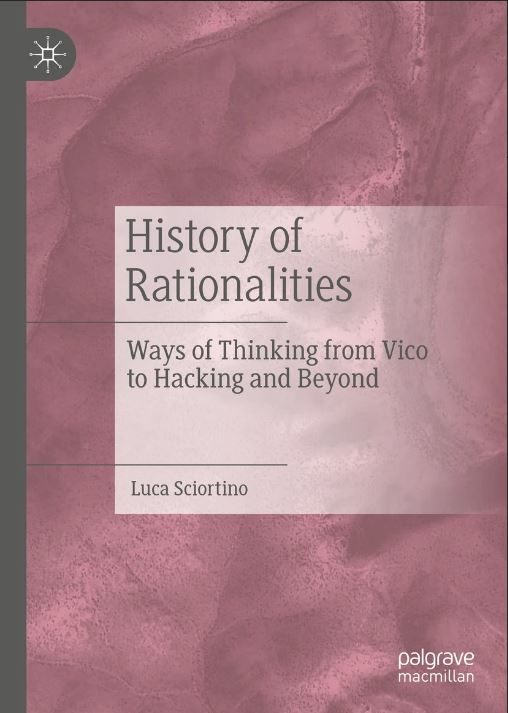
Luca Sciortino, History of Rationalities. Ways of Thinking from Vico to Hacking and Beyond, Palgrave Macmillan, 2023

About this book
Over time, philosophers and historians of science have introduced different notions of ‘ways of thinking’. This book presents, compares, and contrasts these different notions. It focuses primarily on Ian Hacking’s idea of ‘style of reasoning’ in order to assess and develop it into a more systematic theory of scientific thought, arguing that Hacking’s theory implies epistemic relativism. Luca Sciortino also discusses the implications of Hacking’s ideas for the study of the problem of contingency and inevitability in the development of scientific knowledge.

About the author
Luca Sciortino teaches history and philosophy of science at eCampus University (www.uniecampus.it/en) and at Unitreedu Milan. His research focuses primarily on historical epistemology.

McDaid, E., Andon, P., Free, C.
Algorithmic management and the politics of demand: Control and resistance at Uber (2023) Accounting, Organizations and Society

DOI: 10.1016/j.aos.2023.101465

Abstract
Arguably the world’s most iconic platform organization, Uber relies on a disaggregated labour force and a technology application accessible to users on mobile devices. The company contracts with over three million drivers worldwide and has curated an infrastructure of platform-based control characterized by algorithmic processes. The effects of this new wave of control on the driver-led workforce are unclear. Drawing on interviews with 36 Uber drivers, mainly from Australia and France, this research investigates how the ‘gig economy’ workforce engages with platform-based control. We find that the platform organization’s control algorithms operate with strong disciplinary effects. Drawing on Foucault’s concept of self-formation, we examine worker responses to the new order of work. We highlight the way workers engage in practices to ‘take care of oneself’, by enduring, subverting or exiting the conditions of algorithmic management. We find that these practices are related to the distance embedded in the field between management and the workforce. In this way, we argue that the gig economy operates differently upon the ‘governable self’ and urge caution in relation to the use of algorithms to control at a distance. © 2023 The Author(s)

Author Keywords
Algorithmic management; Algorithms; Governable self; Platform organizations; Self-formation; Uber

Sunendar, D., Adriany, V.
‘It’s all about the product’: doing research in neoliberal times in Indonesian higher education
(2023) Globalisation, Societies and Education

DOI: 10.1080/14767724.2023.2212438

Abstract
This article explores Indonesian academics’ experiences in navigating the research process amidst the pressure of neoliberal ideology in higher education institutions in the country. Using Foucault’s concept of governmentality, this study seeks to understand how research schemes in Indonesia operate to self-discipline academics. Hence, they become neoliberal individuals that serve the interest of the market. This research adopts a qualitative design with ten academics from a university in Indonesia participating in it. Using interviews and focus group discussion, the result yields the intersection between positivism, knowledge economy and neoliberalism in shaping the research agenda in Indonesia. The findings suggest how research schemes in Indonesia focus on the research product that can be measured and marketed to the industrial sector. The findings also demonstrate the pervasiveness of the audit regime that constantly monitors Indonesian academics to conform to the neoliberal agenda. This article serves as an invitation for policy makers and academics to rethink research beyond the neoliberal agenda. © 2023 Informa UK Limited, trading as Taylor & Francis Group.

Author Keywords
governmentality; higher education; knowledge economy; neoliberalism; positivism; Research