Foucault News

News and resources on French thinker Michel Foucault (1926-1984)

Aurora Cathrin Eidem Adolfsen, Queer Case of Dr Jekyll’s Double Life. A Queer Reading of R. L. Stevenson’s Strange Case of Dr Jekyll and Mr Hyde (1886)

Bachelor’s thesis in English for teacher training students, NTNU, Norwegian University of Science and Technology, Supervisor: Wassim Rustom, May 2023

Abstract
This bachelor’s thesis is a queer reading of Robert Louis Stevenson’s 1886 novella Strange Case of Dr Jekyll and Mr Hyde. The discussion explores the motif of the double in context of Michel Foucault’s concept of discipline and the Labouchère Amendment of 1885. This exploration is carried out through analyses of the three following character dyads: Dr Lanyon and Mr Utterson, Mr Utterson and Dr Jekyll, and Dr Jekyll and Mr Hyde. The analyses paint a holistic picture of the effects of discipline, which reveals substantial connections between the double life conducted by Dr Jekyll and the double life conducted by homosexuals in late 19th century London.

mghamner's avataraffecognitive

Lectures on the Will to Know (Leçons sur la volonté de savoir) contains Michel Foucault’s inaugural lectures at the Collège de France from December 1970 to March 1971. The published text gathers Foucault’s written notes and manuscripts into a considered presentation of what his oration might have been. I stress the form of the text, not only because its tone differs starkly from the later recorded lectures that capture the grain of Foucault’s speaking voice and his delightful asides, but also because the notion of something “beneath” or in “excess” of his written statements vibrates at the core and throughout these lectures. By the end of these lectures, he will call this beneath a “discursive event.” I consider it the central logic of his genealogical method.*

Foucault tasks himself here with clarifying the jeu of truth, that is, the game or play entailed in our desire for, appeal…

View original post 3,209 more words

van der Merwe, Tania Rauch, Elelwani Lara Ramugondo, and André Keet. 2023. “Crafting a Foucauldian Archaeology Method: A Critical Analysis of Occupational Therapy Curriculum-as-Discourse, South Africa” Social Sciences 12, no. 7: 393.
https://doi.org/10.3390/socsci12070393

Abstract
South Africa has a colonial and apartheid past of social injustice, epistemological oppression, and exclusion. These mechanisms are historically inscribed in the designs, practices, and content of higher education—including in occupational therapy curriculum. If these historical markers are not consciously interrogated, patterns of reproduction are reified along the fault lines that already exist in society. The focus of this article is to demonstrate how an archaeological Foucauldian method was crafted from foundational Foucauldian archaeology analytics and existing approaches of Foucauldian discourse analysis to unearth the rules of the formation of the occupational therapy profession. These rules pertain to the formation of (a) the ‘ideal occupational therapist’; (b) who had a say about the profession; (c) the ways of preferred reasoning; and (d) underlying theoretical themes and perspectives about the future. Data sources for this archaeology analytics included commemorative documents of universities on the origin of their programmes; historical regulatory documents; and the South African Journal of Occupational Therapy archive from the period 1953–1994. The analysis rendered two subthemes for each of the rules of formation including ‘white exceptionalism’, white male national, and international, regulatory bodies, the profession’s know-how practical knowledge, and its need for recognition within a bio-medical paradigm. Unearthing the historical markers of a curriculum and viewing it as discourse may enable a conscious reconfiguration thereof.

Keywords: critical discourse analysis; Foucauldian archaeology; occupational therapy curriculum

Bommenel, E., Richard, E., Reid, S.
Using teaching and learning regimes in the international classroom to encourage student re-subjectification
(2023) Journal of Applied Learning and Teaching, 6 (1), pp. 81-92.

DOI: 10.37074/jalt.2023.6.1.14

Abstract
This paper addresses one of the pedagogical challenges that followed the presence of increasingly multinational student groups, particularly the increased diversity of academic backgrounds among students. Theoretically, this challenge can be understood as an encounter between different teaching and learning regimes (TLRs). TLR, coined by Trowler and Cooper (2002), implies a constellation of assumptions, rules, relationships, and practices regarding the conduct of higher education that colours academic staff members’ performance in their profession. It has become a widely used heuristic tool in the reflection process among university staff. It is shown in this paper that TLRs are not only a heuristic tool that can be applied in teacher reflection but may also be fruitfully applied in the classroom in student-teacher interaction. Consequently, we decided to bring the TLR into the classroom. The written student reflections constitute the empirical material that this analysis is based on. We approach these reflections as expressions of confessions of the Self, as laid out by Michel Foucault. We conclude that it is useful for the students to reflect upon TLR’s, but simultaneously, such an approach runs the risk of enhancing pedagogical and epistemological conformism at the neoliberal university. © 2023. Elin Bommenel, Richard Ek and Stuart Reid.

Author Keywords
Foucault; multinational classroom; neoliberal university; power; student subjectification; teaching and learning regime

He, Q.
Avowal or Obedience: Foucault on the Solution to the Dilemma of Examination of Conscience and Its Influences
(2023) Logos and Pneuma – Chinese Journal of Theology, 2023 (58), pp. 169-195.

Note: This article is in Chinese

Abstract
Michel Foucault analyzed the ideas of John Cassian, a Church Father who lived in the 4th century. His interpretation focused on Cassian’s doubt concerning the authenticity of the examination of conscience, practiced by monks during their ascetic life, and Cassian’s solution to this. However, using the theory of imperfection proposed by Anthony Manicki as our perspective, we would propose that Foucault has overemphasized the role of avowal in his interpretation. and at the same time, he has underestimated the role of obedience. However, on the positive side, Foucault’s biased interpretation has inspired many new theological studies on Cassian, as well as proposed a new starting point for further research on Cassian’s understanding of the hermeneutics of the self, the avowal and the test. © 2023, Logos and Pneuma Press. All rights reserved.

Author Keywords
Avowal; Examination of Conscience; Obedience; Test; Theory of Imperfection

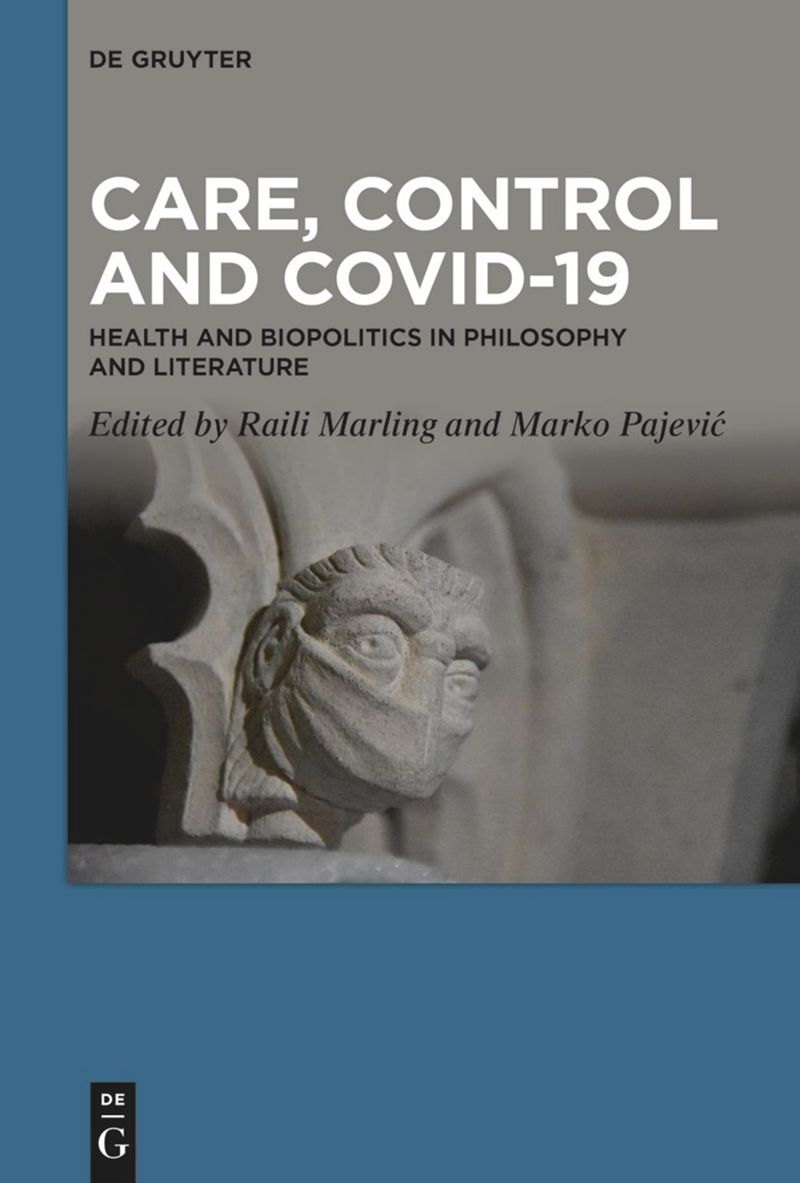
Raili Marling and Marko Pajević (eds), Care, Control and COVID-19. Health and Biopolitics in Philosophy and Literature, de Gruyter, 2023

https://doi.org/10.1515/9783110799361

About this book
This volume sheds light on the social and cultural transformations that accompanied the Covid-19 crisis by looking at health and biopolitics from a philosophical and literary perspective.

The biopolitical measures taken globally in response to the crisis have led to previously unheard-of restrictions in liberal societies, resulting in deep and potentially lasting transformations both in social structures and interpersonal relationships. Many researchers have addressed the Covid-19 crisis as a political or epidemiological challenge, but few have paid sufficient attention to the culturally specific reactions and cultural representations of the human beings at the centre of events. Literary analyses capture this human component and give insights into different reactions to, and protests against, the health-political measures addressing the crisis.

This book puts the notion of biopolitics, first extensively theorised in the 1970s, to work in the context of the Covid-19 pandemic, and uses literary case studies as starting points for discussions of contemporary politics, media, and legal and surveillance regimes. It brings together eleven scholars from six countries with the shared aim of combining literary and philosophical expertise to create a better understanding of the changes in society and political attitudes induced by the ongoing pandemic.

Editor information
Raili Marling, University of Tartu, Tartu, Estonia; Marko Pajević, University of Tartu, Tartu, Estonia.

Højme, Philip. 2022. “Biopolitics and the COVID-19 Pandemic: A Foucauldian Interpretation of the Danish Government’s Response to the Pandemic” Philosophies 7, no. 2: 34. https://doi.org/10.3390/philosophies7020034

Abstract
With the coronavirus pandemic and the Omicron variant once again forcing countries into lockdown (as of late 2021), this essay seeks to outline a Foucauldian critique of various legal measures taken by the Danish government to cope with COVID-19 during the first year and a half of the pandemic. The essay takes a critical look at the extra-legal measures employed by the Danish government, as the Danish politicians attempted to halt the spread of the, now almost forgotten, Cluster 5 COVID-19 variant. This situation will serve as a critical point from where to start using Foucault’s writings on life and biopolitics in order to expose various legally problematic governmental decisions that became visible during the handling of COVID-19 in general and the Cluster 5 mutation in particular. Reframing the pandemic within Foucault’s concept of biopolitics, this essay concludes that the state of exception has led to an increase in biopolitical logic, where some lives have come to matter more than others. As a critical counterpoint to this logic, the conclusion suggests that the notion of biocommunism could provide a suitable reconfiguration of communism. A reconfiguration that could mitigate some of the issues related to biopolitics is uncovered earlier in the essay.

Keywords: G. Agamben; J. Butler; biopolitics; biocommunism; COVAX; COVID-19; Denmark; M. Foucault; pandemic; vaccine nationalism

Gabriel Rockhill, The Myth of 1968 Thought and the French Intelligentsia: Historical Commodity Fetishism and Ideological Rollback, Monthly Review, 1 June 2023

Like any major social and political movement, the events referred to as those of May 1968 have multiple different aspects and internal contradictions. They cannot be easily summed up in terms of a single significance, and they were themselves the site of class struggles, with various groups vying for power, pushing and pulling in different directions. This is as true of the past as it is of the present, in the sense that the battle over historical meaning continues long after the event itself has passed.
[…]

In the dominant historical ideology, there is such a close affiliation between what is known as French theory and the uprisings of 1968 that there is often no need to demonstrate the existence of any concrete material connections between them. Given the rising prominence, through the course of the mid- to late 1960s, of the intellectuals affiliated with the problematic but predominant labels of structuralism and poststructuralism—including the major market successes of books like Foucault’s The Order of Things (1966) and Lacan’s Écrits (1966)—it is frequently presumed, moreover, that there is a causal relationship between these theoretical developments and the practical contestation of the status quo.
[…]

See also this associated discussion

Pennacchia, J.
Exclusionary tactics in English secondary education: an analysis of fair access protocols
(2023) Journal of Education Policy
DOI: 10.1080/02680939.2023.2222409

Abstract
Although all young people in England are entitled to a full-time, state-funded education suitable to their needs, every year some are without a school place and must be found one through local fair access protocols. This paper uses the enactment of fair access protocols in one local authority to examine the impacts of policy shifts to increase the power of self-governing schools and reduce the role of local authorities in ensuring local educational inclusion. Drawing on observations of two fair access panel meetings and a school’s preparations for these meetings, alongside Foucault’s theorisation of relationships between local practices and wider policy conditions, I argue that particular tactics are produced through fair access practices, which prioritise procedural fairness to schools and serve to categorise perceived risky young people. This interpretation of fairness arises out of a policy landscape of tensions, which requires schools to balance individual performance priorities alongside collective duties for inclusive and equitable education, and turns what should be an inclusive policy into another facet of the increasingly nuanced exclusionary architecture of English education. The findings are internationally relevant given global support for self-governing schools which is creating new issues for the educational inclusion of marginalised populations. © 2023 Informa UK Limited, trading as Taylor & Francis Group.

Author Keywords
Fair access protocols; Foucault; inclusion, exclusion; self-governing schools

Devi Akella, Looking beyond the gaze. A reflective faculty learning experience
In Anteliz, E. A., Mulligan, D. L., & Danaher, P. A. Eds. The Routledge international handbook of autoethnography in educational research, Routledge, 2023

Extract from introduction
Numerous articles emphasising the need for international cultural immersion and community engagement experiences which encourage students to be active participants in the learning process leading to advanced critical thinking and global competency skills have been published in the last few years (Lessor, Reeves & Andrade, 1997; Vande Berg, Connor-Linton & Paige, 2009). However, less attention has been focused on the faculty members who take the lead by internationalising their curriculum and exposing their students to global exploration through travel expeditions, where they too might face similar learning situations as their own students (Akella, 2016; Coryell, 2016; Fischer, 2008; Hall, 2007; Mohamed, 2016; Todd, 2016).

However, faculty just like their student counterparts, acquire intercultural expertise through “teaching and research opportunities abroad and by building relationships with peers in other countries” (ACE, 2012, p. 4). An understanding of international settings and respect for cultural differences would place faculty members in an advantage in classrooms and when interacting with their students. It would allow faculty members to teach students cultural sensitivity and equip them with multicultural competencies. For faculty members these travel experiences can be “transformative” (Fischer, 2008, p. 2), resulting in “intellectual dynamism” (Hall, 2007, p. 54) and “academic refueling” (Festervand & Tillery, 2001, p. 110) forcing them to “rethink [about their] professional self-definitions and boundaries” (Hall, 2007, p. 54). In fact, traveling abroad for faculty members could involve painful moments, of moving beyond their comfort zone, challenging their mental schemas, acknowledging past misconceptions and prejudices, trying to deconstruct happenings, and rebuilding one’s external picture of the world. A process of going beyond one’s professional gaze, of evolving into a new person outside the disciplinary gaze of one’s own political system and country. A process of self-transformation gradually resulting in the creation of a more knowledgeable teacher, broad-minded academic, intellectually stimulated researcher, and a more open-minded person (Eddy, 2014; Festervand & Tillery, 2001; Fischer, 2008; Hall, 2007; Keese & O’Brien, 2011).

Integrating Foucault’s (1997) philosophies of disciplinary gaze and the model of situated learning, along with the research method of autoethnography, this chapter endeavors to capture my transformation process.