Foucault News

News and resources on French thinker Michel Foucault (1926-1984)

Boland, T., Moore-Ponce, J.
Confessional critiques: Parrhesia and avowal in contemporary anti-racist discourses
(2023) European Journal of Social Theory

DOI: 10.1177/13684310231179150

Abstract
Confessional critiques proliferate in contemporary culture, remodelling critical politics as self-purification. Within Foucault’s work, critique is associated with resistance to power and subjectification, whereas confession appears a technique of disciplinary and pastoral power. However, genealogy creates hybrids, and herein we observe how critique and confession are entangled in contemporary social justice discourses, focusing empirically on contemporary anti-racist texts. These critique their imagined readers and society more generally, demanding confessions, castigating denials and exhorting interminable purificatory self-work. This analysis draws from Foucault’s genealogies of parrhesia and avowal, through his latter works on the problem of ‘truth-telling’ and how it forms subjects, even by critique. Recognising this historical hybridisation of critique and confession within discourses such as anti-racism may help to clarify the political stakes of critique. © The Author(s) 2023.

Author Keywords
Confession; critique; Foucault; parrhesia

Gerardo Ienna & Matteo Vagelli, Bourdieu e Foucault: un confronto critico a proposito dei fondamenti della spazializzazione del potere, Quaderni di Teoria Sociale, V. 2 N. 1, 27 June 2023

DOI: https://doi.org/10.57611/qts.v2i1.237
Open access

Abstract
Our aim in this paper is to carry out a comparative analysis of Pierre Bourdieu and Michel Foucault – two figures traditionally opposed in the French academic field – in order to highlight the areas in which their respective aims and methods partially overlapped. Tacking stock of Bourdieu’s analyses in Homo academicus, we wish to argue that the opposition between the two concerns more the empirical individuals – resulting from the respective disciplinary and academic positionings – than the epistemic individuals. Bourdieu, in conceiving of the notion of social space and consequently of field, focuses on the dimension of power and describes the space of the positionings according to principles which are relative to force relations. It is in these latter that he finds the source of sense relations. Foucault, following a different but complementary trajectory, begins with the analysis of the order of discourse and then articulates its implications on the level of power relations and of subjection and subjectivation practices.

Keywords
Social space, Order of discourse, Power relations

Servalli, S., Gitto, A., Gandelli, F.
Florence flood and the rescue of the Florence state archives: The role of accounting and accountability (2023) Accounting History

DOI: 10.1177/10323732231175711

Abstract
This archival research aims to explore the role of accounting for natural disasters. It is focused on the 1966 Florence flood. Considering the role of Florence in the worldwide cultural context, our attention is focused on the cultural patrimony in the Florence State Archive and on the role that accounting and accountability had in its rescue. The work refers to Foucault’s and Derrida’s concept of the archive and draws on the notion of accounting as ‘naming and counting’ practices. The investigation highlights the pivotal role of accounting in the rescue process of archival documents. Using ‘naming and counting’ practices, the damaged documentation was identified and inventoried and the accountability activities offered researchers knowledge of historical documents not available for investigation. These accounting practices realised the exercise of the power of re-‘consignation’ permitting an invaluable cultural patrimony to be re-consigned to the community. © The Author(s) 2023.

Author Keywords
accountability; accounting; archive; Derrida; flood; Foucault; Italy; natural disasters

Editor: These passages are from Foucault’s original manuscript for “What is critique?” but weren’t included in his presentation to the Société française de Philosophie – the version that was published in 1978 in French and later in two separate English translations in 1996 and 1997. These passages appear in the new edition and translation of “What is Critique?” published in English in 2024.

This quick genealogy of the “critical way,” and its location within the great process of governmentalization, has of course been done with the aim of resituating it within a broader history than simply the Kantian moment, making it something other than the legacy of a particular stream of philosophical thought. But it was also to link it to those elements of religious life that I think have marked it from the beginning:

-Critique as something that [challenges] governmentality (in either its general or particular forms) and its principles, methods, and results, and raises the question of the salvation of each and all: whether salvation means eternal bliss or simply happiness.
-Critique as the suspension of the combined effects of power and truth, by the person who is subjected to it.

[…]

– The roots of critique in the history of Christian spirituality also explain why the critical attitude is not content to demonstrate and refute in general. It doesn’t speak to everyone in general, it is addressed to each and all. It tries to establish a general consensus or in any case a community of scholars, scientists, and enlightened minds. It’s not enough for it to say what it has to say for once and for all. It needs to be heard, to find allies, to have converts to its own conversion, to have followers. It works and battles. Or rather, its work is inseparable from a battle against two orders of things: on the one hand, an authority, a tradition, or an abuse of power; on the other, its complement—inertia, blindness, illusion, or cowardice. In short, it is against excess and for awakening.

In a word, critique is the attitude of challenging the government of people understood as the combined effects of truth and power, and this in the form of a battle which, starting as an individual decision, aims at salvation for all.

[…]

There is no owner or theoretician when it comes to critique. The universal and radical critic doesn’t exist. The critic in himself and of himself doesn’t exist. But in the West, every activity of reflection, form of analysis, or knowledge bears within itself the dimension of a possible critique. In any case, it is a dimension that is perceived as necessary, desirable, and useful; but it leaves one wanting, it’s not sufficient in itself and as a result provokes mistrust and, as it happens, critique.

Beloved and despised critique, mocked mockery; its assaults are ceaselessly attacked by those it attacks, because all it does is attack and because its whole existence is about being attacked.

Michel Foucault, “What Is Critique?” & “The Culture of the Self”. Edited by Henri-Paul Fruchaud, Daniele Lorenzini, and Arnold I. Davidson. Translated by Clare O’Farrell, Chicago University Press, 2024, pp.26-7, 21.

Lorenzini, D., Tiisala, T.
The architectonic of Foucault’s critique (2023) European Journal of Philosophy

DOI: 10.1111/ejop.12877

Abstract
This paper presents a new interpretation of Michel Foucault’s critical project. It is well known that Foucault’s genealogical critique does not focus on issues of justification, but instead tackles “aspectival captivity,” that is, apparently inevitable limits of thought that constrain the subject’s freedom but that, in fact, can be transformed. However, it has not been recognized that, according to Foucault, critique can proceed along two distinct paths. In a key passage of “What Is Critique?,” Foucault states that critique is tasked with questioning truth about its effects of power and with questioning power about its discourses of truth. We show that this “double movement” organizes Foucault’s critical project as a whole, giving it a significantly wider scope and a more complex structure than has been previously acknowledged. At the heart of the above-mentioned bifurcation lies an apparent tension between two contrastive roles Foucault assigns to truth-telling in the context of critique: on the one hand, truth-telling (as avowal) is a target of critique; on the other, truth-telling (as parrhesia) is one of critique’s methods. We argue that combining these two dimensions in a unified account is crucial for understanding and re-evaluating Foucault’s critical project as a whole. By showing that truth-telling remains an essential element of Foucauldian critique, this paper also rectifies some influential misinterpretations according to which Foucault’s critical project seeks to eliminate truth from the picture. © 2023 The Authors. European Journal of Philosophy published by John Wiley & Sons Ltd.

Yang, X., Hu, N.
#girls help girls#: feminist discussions and affective heterotopia in patriarchal China (2023) Feminist Media Studies

DOI: 10.1080/14680777.2023.2229967

Abstract
In June 2021, a girl named Du Meizhu revealed on Weibo (Chinese Twitter) of having been emotionally and sexually abused by the top-tier idol Kris Wu. The incident gained publicity over the month and climaxed in mid-July, when netizens started the hashtag #girls help girls# on Weibo. Rapidly topping the trending list, this incident led to heated discussions around the case and women’s social status in contemporary Chinese patriarchy. Yet unlike its #MeToo counterpart, the hashtag had been taken down hastily within hours, cutting its practitioners off from further engagements. In this paper we nonetheless propose a more positive interpretation of the incident. Combining Massumi’s affect theory with Foucault’s heterotopia, we argue that Weibo users constructed themselves an affective heterotopia in the hashtag #girls help girls#. Through an affective textual analysis of the posts in the hashtag, we argue that while vulnerable to censorship, the affective force in this heterotopia is ultimately untameable to the discursive regime, potentially leading to concrete feminist ends. In so doing, we offer methodological insight for understanding online feminist discussions in the particular context of contemporary China, adding to scholarship that transcends the global North orientation in feminist theory and politics. © 2023 Informa UK Limited, trading as Taylor & Francis Group.

Author Keywords
affective heterotopia; China; feminism; methodology; Weibo

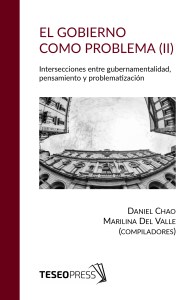
Daniel Chao y Marilina Del Valle (compiladores), El gobierno como problema (II), TeseoPress, 2023
Intersecciones entre gubernamentalidad, pensamiento y problematización

Open access

Sinopsis
Resultado de la labor conjunta, que lleva casi una década, en torno a la obra de Michel Foucault y sus derivas, este libro reúne las propuestas de los miembros del Grupo de Estudios en Gubernamentalidades de la Universidad Nacional del Nordeste (GEG-UNNE). Los capítulos elaborados por Guillermo Vega y Marilina Del Valle avanzan en la identificación de un posible método analítico en una serie de textos de Foucault de fines de la década de 1970 que tratan un racimo de conceptos: problematización, problema, eventualización, acontecimiento, veridicción, pensamiento, etc. El capítulo de Aldo Avellaneda madura lo que el autor −siguiendo a Foucault− llama una historia de las formas de pensamiento que dialogan con, pero se distancian de, otras perspectivas que se las han visto con ideas, conceptos o culturas y sus historias. Finalmente, las propuestas de Joaquín Bartlett y Daniel Chao se preguntan por esos objetos que se dibujan desde la grilla y desde la interacción entre el gobierno, la gubernamentalidad, la problematización y sus “formas”, ya sea lo estatal y el Estado o los modelos de sujeto autorrealizado y “coacheado” dentro de un tipo de racionalidad.

Finalmente, el libro contiene la traducción de una entrevista realizada por Martina Tazzioli y William Walters a Colin Gordon, una referencia en los estudios angloparlantes en gubernamentalidad.


Hilt, R.
Gifted and On the Move: The Impact of Losing the Gifted Label for Military Connected Students (2023) Journal for the Education of the Gifted

DOI: 10.1177/01623532231180882

Abstract
Society is becoming increasingly mobile, which impacts all facets of the educational experience, including gifted education. Military students attend several different schools in their educational careers, and inconsistent criteria and identification practices among states and school districts result in a fluid gifted label for many of these students. While some aspects of school mobility are highlighted in existing research, limited attention has been paid to school mobility within gifted education. This research works to address this gap by exploring the impact of losing the gifted label on children of military members, whose relocations frequently require mobility across state and district boundaries, utilizing a unique framework, Foucault’s technologies of self. Research findings explore student perspectives on the impact of their own effort or hard work on their ability to retain the gifted label and serve as a launching point from which to explore the issue of school mobility in gifted education. © The Author(s) 2023.

Author Keywords
gifted identification; identity; qualitative; research