Foucault News

News and resources on French thinker Michel Foucault (1926-1984)

Kutay, A.
From Social Sphere to Intermediary Association: A Critical Analysis of Civil Society’s Neoliberal Transformation (2023) Critical Sociology

DOI: 10.1177/08969205231180263

Abstract
In this paper, I examine the neoliberal transformation of civil society through Mitchel Foucault’s insights concerning knowledge, power, and governmentality. The objective of this paper is to trace the evolving understandings of civil society and how they relate to governmental rationalities and technologies of power. The traditional notion of civil society as a distinct and autonomous sphere has shifted toward an intermediary associations approach under neoliberalism. I posit that the mobilization of non-governmental organizations and civil society organizations by states, international organizations, and donor agencies since the 1990s constitutes a form of governmental technology, influenced by neoliberal rationalities. This technology serves the neoliberal agenda of undermining the social state, promoting market creation, and encouraging non-partisanship. This argument suggests that the rise of civil society as intermediary associations coincides with the decline of society. © The Author(s) 2023.

Author Keywords
civil society; governmentality; Michel Foucault; neoliberalism; power; society

Nyman, S., Bødker, M., Blegind Jensen, T.
Reforming work patterns or negotiating workloads? Exploring alternative pathways for digital productivity assistants through a problematization lens (2023) Journal of Information Technology,

DOI: 10.1177/02683962231181602

Abstract
Digital trace data can be used to capture organizational practices in granular detail and enable the automation of a wide range of managerial tasks. One example is Digital Productivity Assistants (DPA) that harness digital trace data about knowledge workers’ performance and make targeted suggestions for how to improve and optimize their work patterns. Previous research shows that despite benevolent intentions to increase workers’ wellbeing, DPA tend to introduce novel forms of exploitation and control. Inspired by Michel Foucault’s philosophical strategy of ‘problematization,’ which emphasizes how practices are constructed in the form of problems that subsequently shape certain solutions, this paper takes a critical yet constructive view of DPA. Specifically, we conduct a genealogical reading of the DPA tool, Microsoft MyAnalytics, to investigate the problematics that have structured its emergence, as well as how its uses imply certain discursive commitments to philosophical and ethical questions. In the prevailing discourse, DPA cast digital trace data as a learning opportunity and thereby commit to individualizing the responsibility for handling the paradoxical nature of increasingly fluid work arrangements. Conversely, in our account of the history of MyAnalytics, we uncover a ‘lost discourse’ committed to trace data as a resource that can help knowledge workers negotiate excessive workloads. We propose the problematization lens as a way critically to articulate alternatives and speculate about instantiations of digital technology that today seem ‘unthinkable’. © Association for Information Technology Trust 2023.

Author Keywords
algorithmic management; critical IS; Digital productivity assistants; Foucault; management of knowledge work; problematization lens

Index Keywords
Knowledge management; Algorithmic management, Algorithmics, Critical IS, Digital productivity assistant, Foucault, Knowledge work, Management of knowledge work, Problematization lens, Trace data, Work patterns; Philosophical aspects

Franziska Humphreys, « L’histoire des idées au prisme de ses traductions. L’exemple de la Medientheorie (Heidegger/Foucault/Kittler) », Revue des sciences humaines 350 | 2023, 93-104. URL : http://journals.openedition.org/rsh/2224 ; DOI : https://doi.org/10.4000/rsh.2224

Introduction
Les pratiques des sciences humaines s’inscrivent aujourd’hui dans des espaces transnationaux et ne se laissent plus limiter à un seul domaine linguistique. Par conséquent, la traduction est un aspect essentiel de la « survie » d’un texte du point de vue des créations conceptuelles et des contextes de réception, mais aussi du point de vue des transferts culturels opérés par les traductions et retraductions. Cet argument a une pertinence très actuelle au regard du contexte présent de publication et de diffusion des sciences humaines, mais il a également une portée épistémologique et historique essentielle à laquelle nous nous intéresserons dans cet article. Si l’on admet l’influence déterminante de la traduction sur l’émergence et la circulation d’une nouvelle terminologie et de nouvelles manières de penser, l’histoire des idées peut en effet être considérée comme l’histoire – non-continue et non-linéaire – des traductions de ses textes clés. […]

Armstrong, L. (2023). Understanding reform discourses in complex times of change: Positions and practices of early childhood professionals from Victorian kindergarten settings. Australasian Journal of Early Childhood
https://doi.org/10.1177/18369391231212686

Abstract
Australian early childhood education and care [ECEC] has faced a series of change and reform since 2009, including the introduction and later revisions of key curriculum and qualify frameworks, increased qualifications, shifting theoretical knowledge and pedagogies, and challenges from the COVID-19 pandemic. Consequently, early childhood professionals [ECPs] have been confronted with a succession of substantial changes impacting their professional practice. This paper reports on a qualitative, post-structural study identifying workplace and learning discourses as key influences for the reform engagement of eleven ECPs from kindergarten settings in Victoria, Australia. Foucauldian Discourse Analysis [FDA] revealed specific subjective positions and discursive practices among participants. Recommendations are offered to address issues related to the uptake of reform initiatives. It is anticipated that these findings may generate greater opportunities to support our existing, emerging and future generations of ECPs as they lead the transformation of ECEC and transition through complex times of uncertainty.

Keywords
Foucauldian discourse analysis, organisational change, educational change, discursive practices, subject positions, kindergarten settings, reform engagement, early childhood professionals, early childhood education and care

“El Foucault que viene” | Conversatorio con Daniele Lorenzini (2023)
Streamed live on Oct 4, 2023
Discusión sobre “El discurso filosófico” (1966), editado por Daniele Lorenzini y Orazio Irrera

Di Cimbrini, T., Musella, A. M., & Corsi, C. (2023). Accounting for and of the epidemic in Bologna in 1855: The medicus-politicus in the Papal States. Accounting History, https://doi.org/10.1177/10323732231205646

Abstract
This study investigates the confluence between accounting and natural disasters by examining the case of the cholera epidemic that occurred in Bologna in 1855, a city of the Papal States, where there was a strong (medical) intellectual class critical of the central government exercised by the Pope and clergy. We analysed primary and secondary sources available in Bologna in the Municipal Library of the Archiginnasio, State Archive, and Municipal Historical Archive to demonstrate how the accounting for and of the epidemic overturned the traditional power structures of the Papal States. Specifically, the medical establishment, leveraging the medical-administrative accounting technologies, replaced the clergy and local aristocracy as the governing body of the city, paving the way for the future secularisation of the administration. The study contributes to the literature by providing political implications of accounting technologies for natural disasters.

Now published and on the shelves!
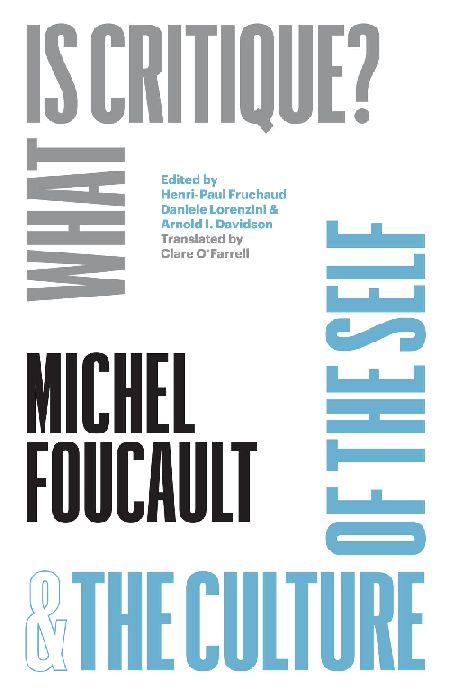
Michel Foucault, What Is Critique? & The Culture of the Self.
Edited by Henri-Paul Fruchaud, Daniele Lorenzini, and Arnold I. Davidson
Translated by Clare O’Farrell
, University of Chicago Press, January 2024

ISBN-13: 9780226383446, Publication date: 2 January 2024, 208pp, Hardcover (First Edition): $35.00. Also published in multiple other formats. In the series The Chicago Foucault Project

Newly published lectures by Foucault on critique, Enlightenment, and the care of the self.

On May 27, 1978, Michel Foucault gave a lecture to the French Society of Philosophy where he redefines his entire philosophical project in light of Immanuel Kant’s 1784 text, “What Is Enlightenment?” Foucault strikingly characterizes critique as the political and moral attitude consisting in the “art of not being governed in this particular way,” one that performs the function of destabilizing power relations and creating the space for a new formation of the self within the “politics of truth.”

This volume presents the first critical edition of this crucial lecture alongside a previously unpublished lecture about the culture of the self and three public debates with Foucault at the University of California, Berkeley in April 1983. There, for the first time, Foucault establishes a direct connection between his reflections on Enlightenment and his analyses of Greco-Roman antiquity. However, far from suggesting a return to the ancient culture of the self, Foucault invites his audience to build a “new ethics” that bypasses the traditional references to religion, law, and science.

Table of contents
Editors’ Note
Henri-Paul Fruchaud and Daniele Lorenzini
Translator’s Note
Clare O’Farrell
Abbreviations of Works by Michel Foucault
Introduction
Daniele Lorenzini and Arnold I. Davidson
What Is Critique? (Lecture to the Société française de Philosophie | May 27, 1978)
Michel Foucault
The Culture of the Self (Lecture at the University of California, Berkeley | April 12, 1983)
Michel Foucault
Discussion with the Department of Philosophy
Discussion with the Department of History
Discussion with the Department of French
Notes
Index

Reviews
“Between 1978 and 1983, Foucault’s work underwent a dramatic and much-discussed shift from a focus on governmentality and biopolitics to an exploration of ancient techniques and practices of the self. This new volume juxtaposes two texts that chart this transformation and situate it in relation to Foucault’s simultaneously emerging interest in reanimating Kantian notions of critique and enlightenment. This volume will be an invaluable resource for anyone interested in Foucault’s late work and its relevance for the practice of critical theory, broadly construed.”
— Amy Allen, Penn State University

“In his lectures, Foucault often sharply sums up essential ideas about his work. These two seminal lectures, ‘What Is Critique?’ and ‘The Culture of the Self,’ are no exception. They reveal the stakes of his inquiry: philosophy has always been, since its inception, a practice of critique and a technology of the self. It is in this dual task that we must still find its meaning today.”
— Johanna Oksala, Loyola University Chicago

Theoretical Puppets: K is for Knowledge, 20 November 2023
In this video, Foucault addresses a distinction crucial for his understanding of “knowledge,” namely the difference between “knowledge” in general (savoir) and “scientific knowledge” (connaissance). Knowledge tends to be something like a system of belief, even a kind of ideology. At the same time, it is required for establishing the very objects and topics that will be investigated in science. And of course, all of this has someting to do with issues of power and truth, not to mention “fake news,” “post truth” and the like – all of this very complex and not easy, you know?!

Navazhylava, K., Peticca Harris, A., Elias, S.R.S.T.A.
YouTube’s Yoga with Adriene as a somametamnemata: Exploring experiences of self-care and wellness in times of crisis (2023) Organization, 30 (3), pp. 573-596.

DOI: 10.1177/13505084221145543

Abstract
Drawing on the Foucauldian technologies of the self, this study explores how individuals re-envision practices of wellbeing outside of traditional organizational contexts during extreme events. Based on a thematic analysis of 7234 comments posted on the Yoga with Adriene YouTube channel in 2020, this study unpacks a technologically mediated practice of self-care, which we conceptualize as somametamnemata. Our findings illustrate three entangled aspects of somametamnemata relating to yoga, a form of bodywork: Caring about self through practicing yoga online; caring about self and others through sharing about yoga in written comments; and caring about self and others through responding to shared verbalizations of yoga. This study distinguishes somametamnemata from known practices of self-care, advancing existing literature on technologies of self by overcoming the dichotomy between negative views of ill-being and positive views of wellbeing. By situating the potentiality of individual wellbeing within ill-being, we shift debates and discussions of “corporate wellness” beyond organizational boundaries. © The Author(s) 2023.

Author Keywords
bodywork; crisis; Foucault; ill-being; self-care; self-writing; technologies of self; technology; wellbeing; yoga

Chicolino, Martín, Las violencias masculinas en la psico-sexo política de Michel Foucault. Brujas, posesas, locas, intersexuales y prostitutas, Nuevo Pensamiento 13 (22). https://p3.usal.edu.ar/index.php/nuevopensamiento/article/view/6829
Open access

Resumen
En torno a la teoría del poder foucaultiana sobrevuela una recriminación, aún vigente: Foucault habría problematizado la sexualidad desde la perspectiva de un sujeto indiferenciado y de género neutro. Dicha ―neutralización sexo-genérica‖ explicaría por qué su teoría del poder ―omite‖ referirse al fenómeno de la caza de brujas (como tecnología patriarcal de disciplinamiento específicamente dirigida contra el cuerpo de las mujeres). El presente trabajo se propone una inversión completa del problema: no nos preguntamos si Foucault caracterizó a las mujeres en tanto que ‗víctimas‘ de las violencias patriarcales, sino que nos preguntamos si (y cómo) caracterizó Foucault a los varones, es decir, a los ‗sujetos‘ activos que ejercieron dichas violencias patriarcales contra las mujeres (creadores de los dispositivos y tecnologías de poder). No nos preguntamos si en sus obras Foucault ―nombra‖ o habla ―acerca de‖ las mujeres, sino si politizó el papel de los varones en el ejercicio psico-sexual del poder, y si politizó el carácter masculino inmanente a todo ejercicio del poder (tanto en la sociedad antigua, moderna, o contemporánea). Este estudio en torno al papel y la función activa que Foucault atribuyó a los varones nos permitirá contrastar si aquellas recriminaciones constituyen (o no) un malentendido. Para ello, reconstruiremos el itinerario foucaultiano en torno a las violencias masculinas (patriarcales) para así hacer visible y audible al mismo tiempo a las fugas femeninas, a las resistencias, luchas y militancias femeninas (las máquinas de guerra amazónicas) en contra de dichos poderes patriarcales de disciplinamiento, normalización, cuerdismo y patologización.