Foucault News

News and resources on French thinker Michel Foucault (1926-1984)

Michel Foucault | History of Sexuality | Philosophers Explained | Stephen Hicks, Feb 10, 2024

“The History of Sexuality” is Michel Foucault’s examination of the history of discourse about and practice of sexuality over the past three centuries. While sexuality was open in the seventeenth century and relatively closed through the Victorian era, it might appear that sexuality in the modern era has been open. In fact, with the increase in the discourse about sexuality in modern times, Foucault argues we live in a new age of repression.

Jacobs, K., Malpas, J.
Politics, Sociology, and the “Inevitability” of Failure
Routledge International Handbook of Failure, Edited By Adriana Mica, Mikołaj Pawlak, Anna Horolets, Paweł Kubicki, Routledge, (2023) pp. 423-432.

DOI: 10.4324/9780429355950-36

Abstract
The chapter begins by pointing out the contribution of sociological interpretations that focus on failure’s discursive and normative effects; for example, as an instrument to advance governmental action, a means to exert control or as an obstacle to be overcome. The main part of the chapter sets out an argument that failure is not something that should necessarily be conceived of in terms of overcoming. It is here the chapter draws attention to a strand of literature that includes Michel Foucault, Max Weber and Hans-Georg Gadamer to illustrate the inevitability of failure across all forms of social interaction such as politics, bureaucracy and science. The final part of the chapter extends a view of failure as ‘inevitable’ that draws on the work of the playwright Beckett and asks what direction politics might take if failure were to be conceived of as a condition for action.

Papoli-Yazdi, L., Hogland, W.
Wreckage Installation: Towards an Archaeology of Southern Sweden’s Heterotopias (2023) European Journal of Archaeology, 26 (2), pp. 189-208.

DOI: 10.1017/eaa.2022.44

Abstract
During a survey on the island of Öland in south-eastern Sweden, whose aim was to study the local waste-disposal practices, the authors recorded abandoned machinery and cars dating from the 1940s to today in locations close to residential areas and farms, and complemented the investigation by interviewing informants. This led them to conclude that dumping redundant objects in the surroundings of villages forms an entangled network with other behaviour, i.e. collecting things which had outlived their usefulness and embedding them in the landscape. The behaviour observed in Öland is compared with two other cases of collecting abandoned objects in Öland and southern Sweden. Using the location and chronology of the finds, the authors interpret the behaviour by borrowing the concept of heterotopia, as defined by Foucault.

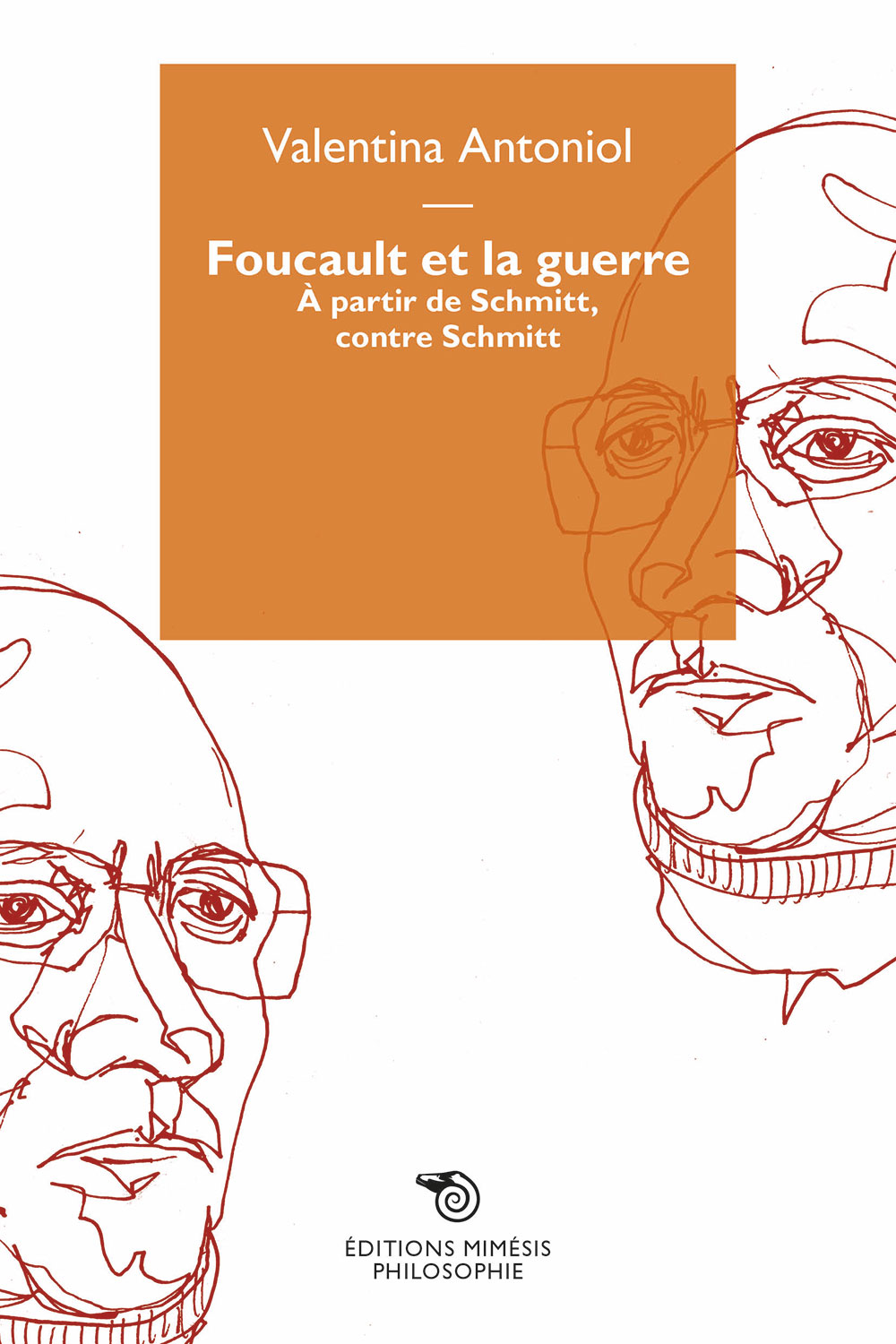
Valentina Antoniol, Foucault et la guerre. À partir de Schmitt, contre Schmitt, Éditions Mimésis, 2023

Cet essai est consacré aux analyses de Michel Foucault sur la guerre, un sujet qui n’a pas toujours reçu l’attention qu’il mérite et qui joue pourtant un rôle déterminant dans l’œuvre de l’auteur. Les réflexions de Foucault sont ici mises en relation avec celles de Carl Schmitt – une comparaison rarement établie, et sur laquelle la littérature critique reste encore faible aujourd’hui. À partir de matériaux inédits (archives du « Fonds Michel Foucault », conservées à la BnF), ce travail montre que le modèle polémocritique foucaldien se construit sur la base de certaines proximités avec la formulation schmittienne de la théorie du politique, et se développe comme une critique radicale de celle-ci. Considérer Foucault comme critique de Schmitt se révèle non seulement décisif pour comprendre la pensée du philosophe français, mais aussi fondamental pour saisir l’actualité de ces deux auteurs par rapport à la question de la guerre.

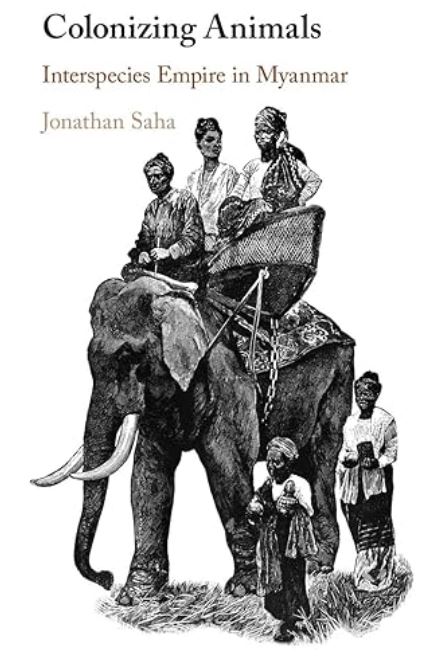
Jonathan Saha, Colonizing Animals. Interspecies Empire in Myanmar. Cambridge: Cambridge University Press, 2021.

Book description
Animals were vital to the British colonization of Myanmar. In this pathbreaking history of British imperialism in Myanmar from the early nineteenth century to 1942, Jonathan Saha argues that animals were impacted and transformed by colonial subjugation. By examining the writings of Burmese nationalists and the experiences of subaltern groups, he also shows how animals were mobilized by Burmese anticolonial activists in opposition to imperial rule. In demonstrating how animals – such as elephants, crocodiles, and rats – were important actors never fully under the control of humans, Saha uncovers a history of how British colonialism transformed ecologies and fostered new relationships with animals in Myanmar. Colonizing Animals introduces the reader to an innovative historical methodology for exploring interspecies relationships in the imperial past, using innovative concepts for studying interspecies empires that draw on postcolonial theory and critical animal studies.

Robert Badinter, a just man for posterity
EDITORIAL
Le Monde, 10 February 2024

The former French justice minister died on Friday. It is salutary to recall his righteousness and intransigence at a time when France’s interior minister is pitting politics against law, the role of the Constitutional Council is being challenged, and prison overcrowding is reaching worrying records.

Few men embody the universality of human rights, the defense of civil liberties, and a certain idea of justice and the Republic as clearly during their lifetime as Robert Badinter, who died on the night of February 9, aged 95. If the abolition of the death penalty – the battle of his life, won in 1981 – will remain attached to his name in the history of France, it is because the idea was highly controversial at the time, and by no means a foregone conclusion, even after the election of President François Mitterrand.

[…]
But his time at the Ministry of Justice is also to be applauded for the adoption of a multitude of laws reinforcing the rights of many individuals, from the abolition of the “offense of homosexuality,” in 1982, to the authorization granted to prisoners to watch television, to citizens’ right to a direct referral to the European Court of Human Rights.

See also Badinter sur France Inter!, Lundi 29 janvier 2018. Radio Interview

Sur Foucault
Robert Badinter explique : “Quand Foucault dénonce la prison, il dénonce la civilisation du XIXe, de la civilisation industrielle. Le système carcéral est une invention d’à peu près de la même époque que les usines. Avant, c’est le châtiment corporel, c’est le corps qui paye pour le crime.

La prison sert d’instrument parce qu’on lui prête des vertus qui, en réalité, sont empruntées à celles qu’ont aux couvents au Moyen Âge. On croit aux vertus de l’incarcération.

Michel Foucault était un très grand écrivain et un grand érudit. Nous étions liés par des combats identiques. Et le lendemain du jour de l’abolition de la peine de j’ai reçu une lettre de Foucault, que j’ai conservée, qui disait : “La fin de la peine de mort, c’est très bien. Ce qui compte maintenant, c’est l’abolition de la prison”.

Après tant d’années de combat s’entendre dire ce qu’il fallait faire ! Mais comme je suis assez d’accord, que j’ai du mal à rédiger l’exposé des motifs et notamment par quoi, on la remplacera la prison, je lui réponds : “Vous m’envoyez l’exposé des motifs. Je suis sûr qu’il sera d’une qualité littéraire incomparable. Mitterrand sera sûrement ravi. Et puis, j’ajouterai le dispositif juridique. Il ne l’a jamais fait. Il a éclaté de son [rire] presque satanique. J’ai d’ailleurs chez moi un admirable portrait de Foucault par Fromanger, où c’est le diable qui a l’air de jaillir du tableau !

Greer, K., King, H., Glackin, M.
‘Standing back’ or ‘stepping up’? Exploring climate change education policy influence in England (2023) British Educational Research Journal

DOI: 10.1002/berj.3888

Abstract
This paper explores the nature of climate change education-related policy influence in England at a time when public consciousness about the need to accelerate climate change action was heightened, and as the 2018 climate strikes gathered momentum around the world. Informed by Foucault’s concept of ‘governmentalities’, and using data generated through 24 exploratory interviews and reflexive thematic analysis, we examine the extent to which influential individuals were advocating for policy change. We discuss the nature of policy influence with particular reference to the ‘stances’ that individuals adopted relative to climate change education policy influence and noting a common tendency exhibited amongst participants which was a tendency towards ‘deference’. Coupling our insights with theorisations of dissent, we consider how ‘infra-political dissent’ could support key individuals to ‘step up’ and influence for more effective policy relative to climate change education, and to other areas of education or environment policy. © 2023 The Authors. British Educational Research Journal published by John Wiley & Sons Ltd on behalf of British Educational Research Association.

Author Keywords
activism; climate change education; influence; infra-political dissent; policy

Bahmanteymouri, E., Mohammadzadeh, M.
‘Neoliberalism is dead’: Traversing neoliberal planning education is an exigency
(2023) Policy Futures in Education

DOI: 10.1177/14782103231181241

Abstract
Neoliberalism has been the hegemonic ideology that has fundamentally transformed planning over the last four decades. Neoliberalism has significantly restructured pre-existing organisations, such as universities that were initially expanded during the period of industrial capitalism. From Foucault’s perspective, universities work as components of the dominant control apparatus to subjectively normalise people to docile bodies in the capitalist society. In planning schools, new planning students are introduced to the discipline and its values, norms, knowledge, and practices. This article explores how neoliberalism has changed planning education and subsequently practice in favour of the market operation by detaching planning from its intellectual and theoretical context, and used planning as its scapegoat to conceal its failures. Following the Global Financial Crisis (GFC) in 2008 and the global pandemic of COVID-19, several thinkers, economists and politicians have declared that ‘neoliberalism is dead’ and pointed to the necessity of a new doctrine to address the adverse side effects of neoliberalism that include social inequality and climate change. Planning was initially developed to address the environmental issues and social inequality that resulted from industrial capitalism. This article suggests that planning education should traverse neoliberalism by retrieving its critical and theoretical knowledge to redefine its role in the post-neoliberal era. © The Author(s) 2023.

Author Keywords
critical thinking; education; Neoliberalism; planning; planning theory

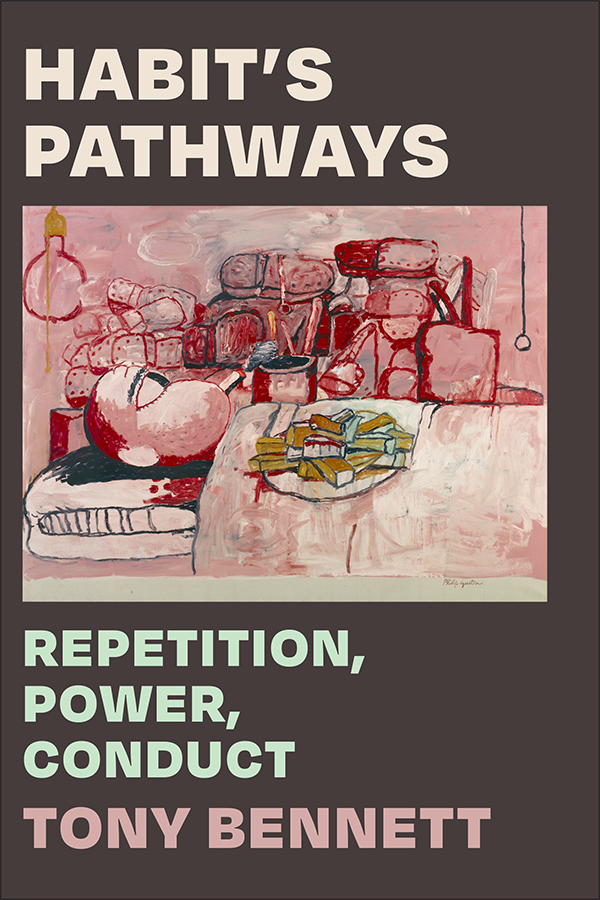
Tony Bennett, Habit’s Pathways. Repetition, Power, Conduct, Duke University Press, 2023

Habit has long preoccupied a wide range of theologians, philosophers, sociologists, psychologists, and neuroscientists. In Habit’s Pathways Tony Bennett explores the political consequences of the varied ways in which habit’s repetitions have been acted on to guide or direct conduct. Bennett considers habit’s uses and effects across the monastic regimens of medieval Europe, in plantation slavery and the factory system, through colonial forms of rule, and within a range of medicalized pathologies. He brings these episodes in habit’s political histories to bear on contemporary debates ranging from its role in relation to the politics of white supremacy to the digital harvesting of habits in practices of algorithmic governance. Throughout, Bennett tracks how habit’s repetitions have been articulated differently across divisions of class, race, and gender, demonstrating that although habit serves as an apparatus for achieving success, self-fulfillment, and freedom for the powerful, it has simultaneously served as a means of control over women, racialized peoples, and subordinate classes.

Tony Bennett is Emeritus Professor at the Institute for Culture and Society at Western Sydney University and Honorary Professor in the Humanities Research Centre at the Australian National University. Among his many books are Making Culture, Changing Society and, as coauthor, Collecting, Ordering, Governing: Anthropology, Museums, and Liberal Government.

Tony Bennett on habit, culture as a way of life, Bourdieu, Foucault, and decolonization – podcast (February 2024) The date is not listed on the site
Interview with Toby Miller as part of his Cultural Studies podcast interviews

Tony Bennett on habit, culture as a way of life, Bourdieu, Foucault, and decolonization

You can read more about Tony’s work here:

https://www.westernsydney.edu.au/ics/people/researchers/tony_bennett

https://www.dukeupress.edu/Assets/PubMaterials/978-1-4780-2498-9_601.pdf