Foucault News

News and resources on French thinker Michel Foucault (1926-1984)

Matthieu Potte-Bonneville et Philippe Artières, “Michel Foucault n’est pas un trésor” Le Monde des Livres, 17 May 2012.

Le classement comme « trésor national » des 37000 feuillets (manuscrits, textes, notes dactylographiées) dont seraient composées les archives de Michel Foucault soulève une série de questions quant au devenir de ce fonds, dans un débat où se croisent des considérations financières, des enjeux nationaux (puisqu’on a évoqué l’acquisition de ces archives par une bibliothèque universitaire américaine), et une concurrence entre plusieurs institutions françaises. Lecteurs de Foucault, il ne nous revient pas de trancher ces litiges. Toutefois, nous aimerions introduire dans la discussion une remarque très simple : l’oeuvre de Michel Foucault est de part en part traversée par le souci de l’archive ; il dédia à celle-ci son « archéologie du savoir » et hanta, sa vie durant, les bibliothèques. Il y aurait alors un peu d’aveuglement à ne pas interroger le destin de ses propres archives à la lumière de ses travaux, pour imaginer les formes de conservation et de valorisation de cette masse de choses dites qu’il a laissée dériver jusqu’à nous.

Première remarque : le surgissement de ces feuillets fait justice de la tentation de croire que nous pourrions un jour disposer à propos de Foucault de quelque chose comme des « œuvres complètes ». Ces milliers de pages, en effet, interviennent à la manière d’un énième ressac, dans l’histoire d’une publication de Foucault où, depuis trente ans, chaque nouvelle vague éditoriale jette à bas les digues que l’on avait cru pouvoir bâtir autour de l’oeuvre, les bornes au sein desquelles il semblait possible de la contenir. Dès 1994, les quatre tomes des Dits et écrits adjoignaient aux ouvrages publiés du vivant de l’auteur un pêle-mêle de préfaces, d’entretiens, d’interventions et d’articles qui en modifiaient la compréhension ; la publication, engagée en 1997 et encore inachevée, des cours au Collège de France excède de beaucoup le volume des livres que l’auteur des Mots et les choses avait choisi de faire paraître. A chaque fois, loin de se compléter, le puzzle se mélange de nouveau. Les archives de Foucault vérifient ainsi la définition qu’il donnait du discours, en s’arrachant peu à peu à l’intention de l’Auteur et à l’horizon de l’Oeuvre – nul ne saurait se prétendre maître de leur dispersion, et elles s’offrent de plus en plus clairement à un nombre indéfini de parcours possibles.

Or, de ces parcours d’interprétation, le tracé n’est pas préfiguré dans les archives elles-mêmes ; leur défrichage revient essentiellement aux lecteurs. Il faut ici se souvenir de la manière dont Foucault affirmait écrire « pour des utilisateurs », ou évoquait son goût des « textes pratiques, qui sont eux-mêmes l’objet de pratiques ». Cette figure du lecteur-usager est essentielle : d’abord, elle met hors-jeu toute notion de propriété et de lecture autorisée, invite à nouer avec les textes une relation d’emprunt, qui les laisse libres pour d’autres usages possibles comme on rapporte sagement son livre à la bibliothèque commune. Ensuite, l’idée d’usage trace une oblique entre lectures savantes ou profanes, désintéressées ou engagées, spécialisées ou exotiques ; cela ne veut pas dire que toutes les lectures soient également intéressantes, mais que l’on ne peut décider de leur intérêt qu’« à l’usage », et non a priori. Parce que le sens d’un texte n’est pas réserve à découvrir, mais instrument à inventer, on ne saurait au nom de la science en restreindre l’accès à telle ou telle communauté interprétative, disposant du droit exclusif à s’en faire l’intermédiaire. Enfin, que Foucault ait écrit pour des utilisateurs suggère qu’il n’entendait pas voir ses travaux cantonnés au champ clos des controverses théoriques, mais espérait aussi les voir produire des effets dans le vif des questions culturelles, sociales et politiques, devenir (selon ses propres termes), « à la fois bataille et arme, stratégie et choc ».

Comment être fidèles à cet impératif ? En affirmant ceci : du point de vue des usagers, l’enjeu n’est pas de savoir si les archives de Foucault doivent devenir étrangères ou rester nationales ; le problème est de faire entendre qu’elles ne constituent en rien un « trésor ». Les trésors appellent les coffre-forts, excitent les collectionneurs, attirent les chasseurs de trésor – et l’on peut redouter, de même, qu’un tel traitement des archives relance la tension entre la tentation d’en réserver l’accès, d’en faire un objet de prestige plutôt que de recherche, et celle d’en faire circuler plus ou moins clandestinement des fragments disparates, éclats brillants arrachés à l’ensemble lorsqu’au contraire, ce sont les circulations au sein du corpus qui sont fécondes. Permettre aux lecteurs l’accès le plus direct à cet ensemble documentaire est un enjeu primordial, qui ne se déduit pas mécaniquement des considérations marchandes, institutionnelles ou patriotiques : par exemple, faudrait-il se réjouir que les archives Foucault demeurent sur le territoire français, si les chercheurs du Sud se trouvaient du même coup, faute de visas, interdits de consultation comme c’est souvent le cas aujourd’hui ? Quelle que soit la solution finalement retenue pour l’accueil matériel de ce fonds, nous appelons à ce que l’ensemble de ces archives fasse l’objet d’une numérisation globale qui en permette la consultation internationale la plus large, conformément à cette communauté mondiale d’usagers de la pensée que les technologies de l’information contemporaines font naître et dont Foucault aura peut-être été le premier penseur. Alors que la marchandisation des archives intellectuelles tend à s’imposer comme la norme, et face à des débats promis à revenir à propos d’autres fonds, il y aurait là l’indication d’une manière différente d’aborder le problème – manière plus conforme aux moyens et aux enjeux de la recherche aujourd’hui, que le seul fétichisme des feuillets jaunis, la recherche de la perle rare ou l’émotion suscitée par la graphie du Maître.

L’usage, plutôt que le trésor. Rééditant, en 1972, L’Histoire de la folie, Foucault écrivait à propos de son livre : « Quant à la nouveauté, ne feignons pas de la découvrir en lui, comme une réserve secrète, comme une richesse d’abord inaperçue: elle n’a été faite que des choses qui ont été dites sur lui, et des évènements dans lesquels il a été pris ». Les nouvelles lectures ne sont pas embaumées dans des sarcophages de papier, comme un secret à préserver ou à piller ; elles sont encore à inventer, pourvu que ses usagers futurs puissent les dessiner à même des archives largement disponibles.

– Philippe Artières est historien (CNRS) et président de l’Association pour le Centre Michel Foucault.

– Mathieu Potte-Bonneville est philosophe (ENS de Lyon) et président de l’Assemblée Collégiale du Collège International de philosophie.

Dernier ouvrage paru : P.Artières, M.Potte-Bonneville, D’Après Foucault – gestes, luttes, programmes, Points, coll. « Essais », 2012.

Sources: FuckYeahGillesDeleuze blog, Variazioni foucaultiane blog
Call for Papers : Foucault and Mobilities Research

A Two-Day Symposium, 6th and 7th of January 2013, Lucerne, Switzerland

The publication in English and in German of Michel Foucault’s lectures at the Collège de France in the years 1970-1984 has been a key driver of the recent renaissance of research inspired by his work across the social sciences. As part of this, sociologists, geographers and others in the academic world have begun to draw on and work with a wider range of Foucauldian concepts than in earlier studies. Foucault’s thinking on power/knowledge, panopticism, discourse, the role of the sciences, and so on still resonates strongly across the social sciences but it is the topics that he lectured on at the Collège that arguably attract the bulk of attention: a surge of interest has occurred among social scientists in his writings on apparatuses/dispositifs, governmentality, self-government and ethics to name but a few concepts. The translation of the lectures into German and English has also brought to the fore a greater focus on the liveliness of the world, the non-discursive realm, materiality and resistance than Foucault is usually credited for. In fact, and as Philo (2012) has noted, the lectures show more than his published books that Foucault was closer to Deleuze than is often assumed.

Foucault’s work has been employed and embraced enthusiastically by ‘mobilities’ scholars (e.g. Adey, 2009; A. Jensen, 2011; Merriman, 2007; Paterson, 2008, Richardson and Jensen, 2008; Schwanen et al, 2011; Manderscheid, 2012). It can nonetheless be argued that mobilities researchers have not yet fully explored or exhausted the potential of Foucault’s philosophy for understanding mobilities. Against this background we seek to bring together scholars from across the social sciences with a shared interest in both mobilities and Foucauldian thinking. Mobilities are here understood broadly as the flows (or lack thereof) of people, artefacts, money, ideas, practices, and so on across a wide variety of spatial and temporal scales, both in contemporary societies or in the past. More specifically, we are soliciting conceptual and/or empirical papers that address one or several of the following topics or a related theme:

–          The governmentalities that shape mobilities

–          The government of im/mobile others and selves

–          Mobility dispositifs

–          Mobile subjectivities

–          Formation and contestation of material landscapes of mobilities

–          Ethics of mobility and mobile ethics

–          Discourses surrounding and underpinning mobilities

–          Mobilities as an object of knowledge

–          The ‘disciplining’ of mobilities

–          Techniques of im/mobility and im/mobile techniques

–          Conceptualisation of mobilities in regards to biopolitics and territory

The two-day symposium aims at connecting scholars from different disciplines with an interest in this range of topics. If you are interested in participating in this event with a paper, we ask that you prepare an abstract of no more than 250 abstract and send this to one of the organisers no later than 10th of June 2012.

Katharina Manderscheid, Lucerne University(katharina.manderscheid@unilu.ch)

Tim Schwanen, University of Oxford(tim.schwanen@ouce.ox.ac.uk)

David Tyfield, Lancaster University(d.tyfield@lancaster.ac.uk)

Source: Via Stuart Elden’s blog Progressive Geographies

Reardon, Jenny (2012). “The Democratic, Anti-Racist Genome? Technoscience at the Limits of Liberalism”. Science as culture , 21 (1), 25-47.
https://doi.org/10.1080/09505431.2011.565322

Abstract
The opening decade of this millennium witnessed genome scientists, policy makers, critical race theorists and world leaders standing together to pronounce the anti-racist democratic potential of human genomics. Understanding and assessing this rise of ‘anti-racist, democratic genomics’ requires distinguishing between two problems of power and science: the first characterized by what Michel Foucault labeled states of domination; the second by what he described as relations of power. When states of domination exist, as in the case of Nazi science, liberal efforts to extend new powers of participation and autonomy to research subjects may play important roles in redressing power imbalances between researchers and their subjects. However, when distinctions between scientist and research subject blur, as in the case of much human genomics, efforts to extend liberal rights to subjects of genomic studies-or genomic liberalism-may produce novel problems, including: (1) human genome scientists’ loss of capacity to describe their objects of study; (2) disruption of research subjects’ abilities to define themselves; and (3) lack of accountability for the unintended effects of efforts to democratize genomics. In these ways genomic liberalism may foster, at the same that it impedes, the co-constitution of knowledge and democratic subjects. It may create new forms of racism at the very moment that it explicitly seeks anti-racist ends. Addressing the problems created by this paradoxical position will require more sustained attention to and critique of the anti-racist and democratic imaginaries that increasingly animate technoscience.

Peter Johnson has just launched a new site on Foucault’s notion of Heterotopia titled Heterotopian Studies.
Update August 2025. This site is now only available on the Wayback Machine
https://web.archive.org/web/20191224045207/http://www.heterotopiastudies.com/

The site includes definitions, resources, discussions and a blog. The author notes:

This web site is devoted to Michel Foucault’s ideas on heterotopia. Foucault outlines the notion of heterotopia on three occasions between 1966-67. He attempts to explain certain principles and features of a range of cultural and institutional spaces that are somehow ‘different’ from the ones we inhabit day-to-day.

Foucault simply presents a few thumb-nail sketches which he never develops into a coherent idea. And yet his tantalisingly brief words on the subject have provoked a cottage industry of interpretations and applications from many disciplines and professions throughout the world.

Over the years a dazzling variety of spaces has been explored as illustrations of heterotopia, including: Arab-Islamic architecture, environmental installations, libraries, museums, Masonic lodges, early factories, gardens, performance prototypes, women’s colleges, sites in Fascist Italy, landscapes, gated communities, Buddhist sites, bandrooms, pornographic sites, cybercafés, shopping malls, burial sites and the body of the vampire!

Writers, artists, academics and many others have shown an interest in heterotopia. The web seems a particularly suitable place to explore Foucault’s diverse notion of ‘different spaces’.  Rather than trying to draw together a definitive understanding of this curious spatial concept, the site will explore its possibilities (warts and all!).

This site offers background information, reviews of various interpretations and applications, specific studies of sites related to gardens and cemeteries and a full bibliography.

This site aims to be the hub of a network of contributions.  Please add comments to individual pages and send in your own text and suggested links. The site is self-funded, so any financial contributions from individuals or organisations would greatly help to sustain the site and develop its potential.

Presentation & Discussion of the book by Michel Foucault,
“Sull’origine dell’ermeneutica del sé”, edited by mf / materiali foucaultiani (Cronopio, 2012)


See mf site for further details

with Carla Benedetti (Università di Pisa), Antonella Moscati (Edizioni Cronopio), Laura Cremonesi (Università di Pisa) and Martina Tazzioli (Goldsmiths College, London)
Thursday, May 24, 2012, 2:30pm

Introduction by Arnold I. Davidson (University of Chicago/Università Ca’Foscari Venezia)

Where: Università di Pisa, Dipartimento di Filosofia, via Paoli 15, Aula Barone

Rajkovic, Nikolas M. (2012). “‘Global law’ and governmentality: Reconceptualizing the ‘rule of law’ as rule ‘through’ law”. European journal of international relations , 18 (1), 29-52.
https://doi.org/10.1177/1354066110380966

Abstract
This article challenges the optimism common to liberal IR and IL scholarship on the ‘rule of law’ in global governance. It argues that the concept of the ‘rule of law’ is often employed with sparse inquiry into the politics of its practical meaning. Specifically, the article focuses on liberal research that advocates the emergence of a ‘global’ judiciary, and the claim that judicial governance will marginalize state power and authority. Rather than employ a zero-sum conception of power, this article regards a prospective global legal system less as a constraint on state power and more as a rationale for rule ‘through’ law by vested actors. To make the argument, Michel Foucault’s concept of ‘governmentality’ is combined with Barnett and Duvall’s notion of ‘productive power’ to denote how legal techniques of power are integral to the construction of social ‘truth’ and consequently the governance of conduct. This is further associated with Koskenniemi’s critical scholarship on the power of law’s perceived objectivity and universality. In this vein, the article questions how liberal scholars use the American judicial model (the Marbury ideal) to claim that an institutionalization of ‘global’ judicial authority can deliver the rule of ‘no one’ in global governance. A governmentality perspective is then applied which suggests that the lack of supreme constitutional rules at the global level makes judicial governance less a check than a means to propagate normative standards conducive to dominant state power.

Résidence à la Maison des Métallos, Paris
Du 4 au 15 juin, le Collectif F71 met en chantier un nouveau projet,
Notre Corps Utopique,
à partir des textes de Michel Foucault, Le Corps Utopique et Les Hétérotopies

Depuis 2004, le collectif F71 réunit les cinq comédiennes et metteurs en scène Sabrina Baldassarra, Stéphanie Farison, Emmanuelle Lafon, Sara Louis et Lucie Nicolas, co-directrices artistiques et Thérèse Coriou, directrice de production.
Le processus de leur travail est réellement collectif à chaque étape de sa réalisation.

Le collectif F71 s’appuie sur l’œuvre et la figure du philosophe Michel Foucault pour construire un feuilleton théâtral en trois volets.
Après Foucault 71, portant sur l’engagement militant en 1971 et La prison, sur l’institution carcérale et les stratégies disciplinaires qui en découlent, le collectif F71 crée en janvier 2011 Qui suis-je, maintenant ? à partir du texte La vie des hommes infâmes et joue l’ensemble du triptyque au Théâtre de l’Aquarium.

En 2005, se sont joints au collectif F71:
Frank Condat, régisseur et éclairagiste, Daniel Lévy, collaborateur lumière, vidéo et scénographie.
A l’occasion de la création de Qui suis-je, maintenant ? en 2010-11, le collectif travaille avec Fred Costa (musicien et interprète), Denis Gobin (éclairagiste, collaborateur à la scénographie), Magali Murbach (costumière et scénographe) et Estefania Castro (assistante à la mise en scène). En 2012, les rejoint Virginie Galas (régisseur général).

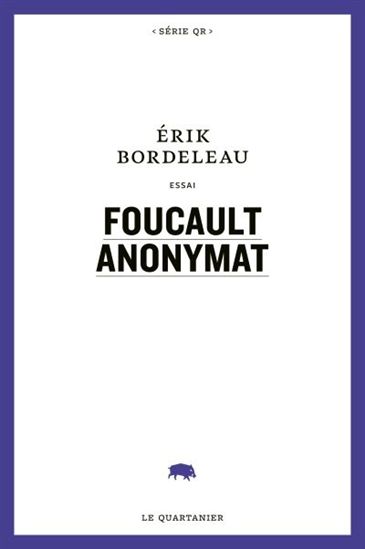
Érik Bordeleau, Foucault anonymat, Le Quartanier 2012

Présentation

Il y a un rapport fondamental dans l’œuvre de Michel Foucault entre résistance politique et expérience de l’anonymat. Ce rapport est demeuré peu exploré, en particulier dans le contexte de sa réception nord-américaine. difficile d’en expliquer le pourquoi. on peut certainement supposer que la célébration de la « différence » et le triomphe de la politique de l’identité ont contribué à l’occultation de cette dimension essentielle de son œuvre.

Plusieurs critiques ont souligné l’ambiguïté du lieu de la résistance chez Foucault. il en était parfaitement conscient. Pour lui, il n’y a pas « d’ailleurs » du pouvoir au sens d’un dehors comme d’une exception. Sa pratique de l’écriture témoigne d’une mise en jeu de tous les instants, là même où le pouvoir nous intime secrètement : la résistance implique une mise en tension éthopoïétique qui déchire l’intériorité privée.

Dans la mesure où notre époque est, selon Foucault, dominée par le « gouvernement par individualisation », ne faut-il pas chercher le point de départ de ses analyses des modes de subjectivation, si celles-ci s’ancrent effectivement dans la résistance, dans une expérience de l’anonymat ? Si tel est le cas, le défi que pose aujourd’hui l’œuvre de Foucault ne sera pas tant de remédier à une insuffisance présumée de sa conception de la résistance que de penser, dans son ambivalence constitutive, l’idée qu’« écrire pour ne plus avoir de visage » fait mieux entendre le grondement d’une bataille dont la ligne de front passe désormais au cœur même des subjectivités. C’est la figure de cet anonymat tonique que veut tracer ce livre.
Via Variazioni foucaultiane

The Foucault Society presents

For the published version, see Beloso, Brooke M., “Queer Theory, Sex Work, and Foucault’s Unreason”, Foucault Studies / (2017): 141-166.
https://doi.org/10.22439/fs.v0i0.5345

Thursday, May 17, 2012
7:30-9:30pm

CUNY Graduate Center
365 Fifth Avenue, Room 5409
New York, NY

Beloso turns to Foucault’s History of Madness (1961) in order to trace a new queer genealogy of sex work which challenges and responds to long-standing debates within feminist theory, as well as silences in queer theory.  Her paper moves beyond the rigid oppositions that continue to divide theorists of sexuality and gender while taking seriously both the historical construction of prostitution and the lived experience of contemporary sex workers.

We are delighted to invite you to join the discussion.
We will have wine and snacks. All are welcome. 

Open to the public.

Suggested donation: $8.
RSVPs are appreciated.  

Email: foucaultsocietyorg@gmail.com

For abstract and speaker bio, see below or go to our website

ABOUT THE TALK:

Abstract:

During the late nineties, leading voices of the sex worker rights movement began to publicly question queer theory’s virtual silence on the subject of prostitution and sex work.   However, this attempt by sex workers to “come out of the closet” into the larger queer theoretical community has thus far failed to bring much attention to sex work as an explicitly queer issue.  Refusing the obvious conclusion—that queer theory’s silence on sex work somehow proves its insignificance to this field of inquiry—I trace in Foucault’s oeuvre signs of an alternate (albeit differently) queer genealogy of prostitution and sex work. Both challenging and responding to long-standing debates about prostitution within feminist theory, I offer a new queer genealogy of sex work that aims to move beyond the rigid oppositions that continue to divide theorists of sexuality and gender.  Focusing specifically on History of Madness (1961), Discipline and Punish (1975),  and History of Sexuality Volume I (1976),  I make the case for an alternate genealogy of sex work that takes seriously both the historical construction of prostitution and the lived experience of contemporary sex workers.


Speaker Bio:  

Brooke M. Beloso (Ph.D., Comparative Literature, Emory University) is Assistant Professor of Gender, Women’s and Sexuality Studies at Butler University in Indianapolis.   Her recent essay, “Sex, Work, and the Feminist Erasure of Class,” is forthcoming in Signs: Journal of Women in Culture and Society.

About the Foucault Society:

The Foucault Society is an independent, nonprofit educational organization offering a variety of programs dedicated to the critical study of the ideas of Michel Foucault (1926-1984).  All of our events are open to the public. We welcome new participants who have an interest in Foucault’s work and its impact on diverse areas of inquiry, including critical social theory, philosophy, politics, history, culture, gender/sexuality studies, and the arts.
The Foucault Society is a 501 (c) (3) recognized public charity.  Donations are tax deductible under section 170 of the Internal Revenue Code.

Website
Facebook
Twitter:  @foucaultsociety

E-mail: foucaultsocietyorg@gmail.com

Using and Reading Foucault in Europe, Asia, and America
Academic Workshop

Foucault in and on the Post-Political Global Present :

Using and Reading Foucault in Europe, Asia, and America

Academic Workshop sponsored by

Deutscher akademischer Austauschdienst (DAAD)
Centre canadien d’études allemandes et européennes (CCEAE) and
Centre d’études et de recherches internationales de l’Université de Montréal (CERIUM)
European School of Management and Technology (ESMT)

May 25-26, 2012

Schlossplatz 1, Berlin
Garden View Room

PROGRAM
Friday, May 25

10:00-10:10
Words of Welcome :

C.B. Bhattacharya, Dean of International Relations, ESMT
Barbara Thériault, Director, CCEAE
Laurence McFalls and Mariella Pandolfi, conveners

10:10-10:30
Introductory Remarks :
“Foucault’s Anticipation of the Post-Political Present:from liberalism to neo-liberalism to post-liberalism”
Mariella Pandolfi and Laurence McFalls (Université de Montréal)

10:30-18:00
Part 1 : Following Foucault into the Global Present
10:30 : “Security, a Field Left Fallow : towards a governmentality of (un)freedom,” Didier Bigo (Sciences-Pô, Paris ; King’s College London)

Summary : I will discuss the legacy of Foucault for critical security studies, by analysing the shift in his work from the notion of security to governmentality in Security, Territory and Population.

11:30 :
“Foucault’s Law ? The case of targeted killing,” Susanne Krasmann (Universität Hamburg)

Summary : Targeted killing, while receiving increasing approval in the US’s fight against terrorism, changes the politico-legal landscape. On the example of this state practice of resorting to lethal force, I will try to show that Foucault indeed provides us with a considerable set of analytical tools for theorizing law. However, rather than about ‘the law’, talk then is about legal practices and their knowledge

12:30-14:00
Lunch (ESMT Restaurant)

14:00 :
“Foucault in the age of globalisation : the governmentality of war”, Alessandro dal Lago (Università Genoa)

Summary : Foucault’s analyses of governmentality and war as presented in his lecture courses of the late 1970s are devoted to the management of power outside the classic realm of the State. Even if Foucault did not work on globalisation or internationalisation of politics (in fact, his intellectual frame of reference was mainly formed by European countries), his concern for “governmentality” can be considered an excellent tool when studying the “modus operandi” of western powers in the so-called new wars. Military operations can be conceived today as a normal feature of western powers : a sort of global police or global enforcement to which the traditional definition of war cannot be applied. In other words, global powers tend to act as managers of the world (cf. the role of NATO in Afghanistan) in a continuum where war and peace are mere options of a global governmentality.

14:55 :
“How Did we Become Unprepared ? From modernist to post-modernist conceptions of disaster”, Mark Duffield (Bristol University)

Summary : The talk examines the shift from the modernist experience of disasters as ‘accidents’ originating outside society, to being events that are intrinsically connected with how society works ; the move from ‘outside’ to ‘inside’ involves important changes in the nature of disaster management. Rather than saving lives or protecting populations, the post-modernist emphasis is on livelihoods and critical infrastructure. At the same time, instead of attempting to separate people from disasters, there is a new willingness, in the interests of encouraging resilience, to embrace uncertainty as a development opportunity. The talk concludes by examining some of the implications of this essentially political transition.

15:50 :
Coffee Break

16:05 :
“Using Foucault to Problematize the Uncertainties of the Insured World,” Luis Lobo-Guerrero (Keele University)

Summary : My work is a problematisation of the political economy of insurance, a technology whose effects have underpinned the security of not only individuals and corporations, but also of states in the modern period. Using Foucault’s understanding of problematization and strategy, I conduct a historical epistemology of past and current insurance strategies.

17:00 :
“Scenario Planning and the Rhetoric of Risk”, James Faubion (Rice University)

Summary : Biopolitics is still very much with us, but from the Second World War forward, it has not been the only technology of the legitimation and orientation of strategic intervention. Scenario planning is its counterpart, and an increasingly salient counterpart as we have found ourselves ever more deeply entrenched in an ecology of ignorance. It does not rest on the authority of statistics, but instead on the narration of what, however incalculably, could be the case in the future. It has no single master trope, but among its most powerful tropes is hyperbole, especially when it is deployed to thematize risk. Foucault did not explicitly address scenario planning, but his careful analysis of biopolitics serves as a foil against which its distinctive features and distinctive effects can be brought to clearer light.

19:00
Dinner for panelists (restaurant TBA)

Saturday, May 26

9:30-12:30
Part 2 : Reading Foucault in and out of Context
9:30 : “Foucault’s Dissertation Between the Measured and the Mad,” Cheryce von Xylander (Universität Darmstadt)

Summary : Histoire de la Folie à l’age classique, Foucault’s monumental doctoral thesis has had a lasting and transformative effect on the concept of reason and its role in history. Given the status both of the author and the text in question, it seems curious that a complementary thesis Foucault wrote and defended together with said dissertation has, until recently, been deemed unsuitable for publication. Foucault’s Anthropologie-essay is tame by comparison with the history of madness. While the former is conservative in subject matter, expository style and methodological precision, the latter is by standards of academic scholarship eclectic, idiosyncratic and conjectural. Scientific publishing tends towards the cautious and the conventional. All the same, the latter was published, the former was not. This unequal treatment of the two theses is puzzling and calls for explanation. Unless the claim is that, erratically, one study fell far short of the other in forethought and mindfulness, we must look for interpretative contingencies governing the human sciences in post-war Europe to supply a discursively grounded account of the lopsided reception of Foucault’s doctoral findings.

10:25 :
“Governmentality and the Politics of Self-cultivation : Foucault in the Context of Contemporary Chinese Philosophy,” Fabian Heubel (Academia Sinica, Taipei)

Summary : My presentation will not only deal with the “reception” of Foucault in China, it rather combines reflections about this reception with the use of Foucault’s “conceptual tool box” to address contemporary problems of political thought in the Chinese speaking world. Throughout the 20th century, Chinese scholars have been discussing possibilities of establishing democratic politics in China. From the perspective of the relation between governmentality and self-cultivation in the late Foucault, I will try to interpret the attempt within contemporary Neo-Confucianism to reconcile modern democracy and the rule of law with the Confucian idea of government based on self-cultivation.

11 : 20 :
Coffee Break

11:30 :
“On the Use and Abuse of Foucault in America”, James Faubion (Rice University)

12 : 00 :
“Foucault in Germany,” Martin Saar (Universität Hamburg)

12:30-14:30
Lunch (restaurant to be announced)

14:30-16:30
Part 3 : Roundtable on Foucault’s Cross-National, Cross-Disciplinary Reception with opening statements by :

Frieder Vogelmann (Universität Frankfurt)
Sven Opitz (Universität Hamburg, co-editor of Foucault Studies)
Elfriede Fürsich (Freie Universität Berlin)
Mariella Pandolfi and other panelists

Sources: Variazioni foucaultiane, The Canadian Centre for German and European Studies