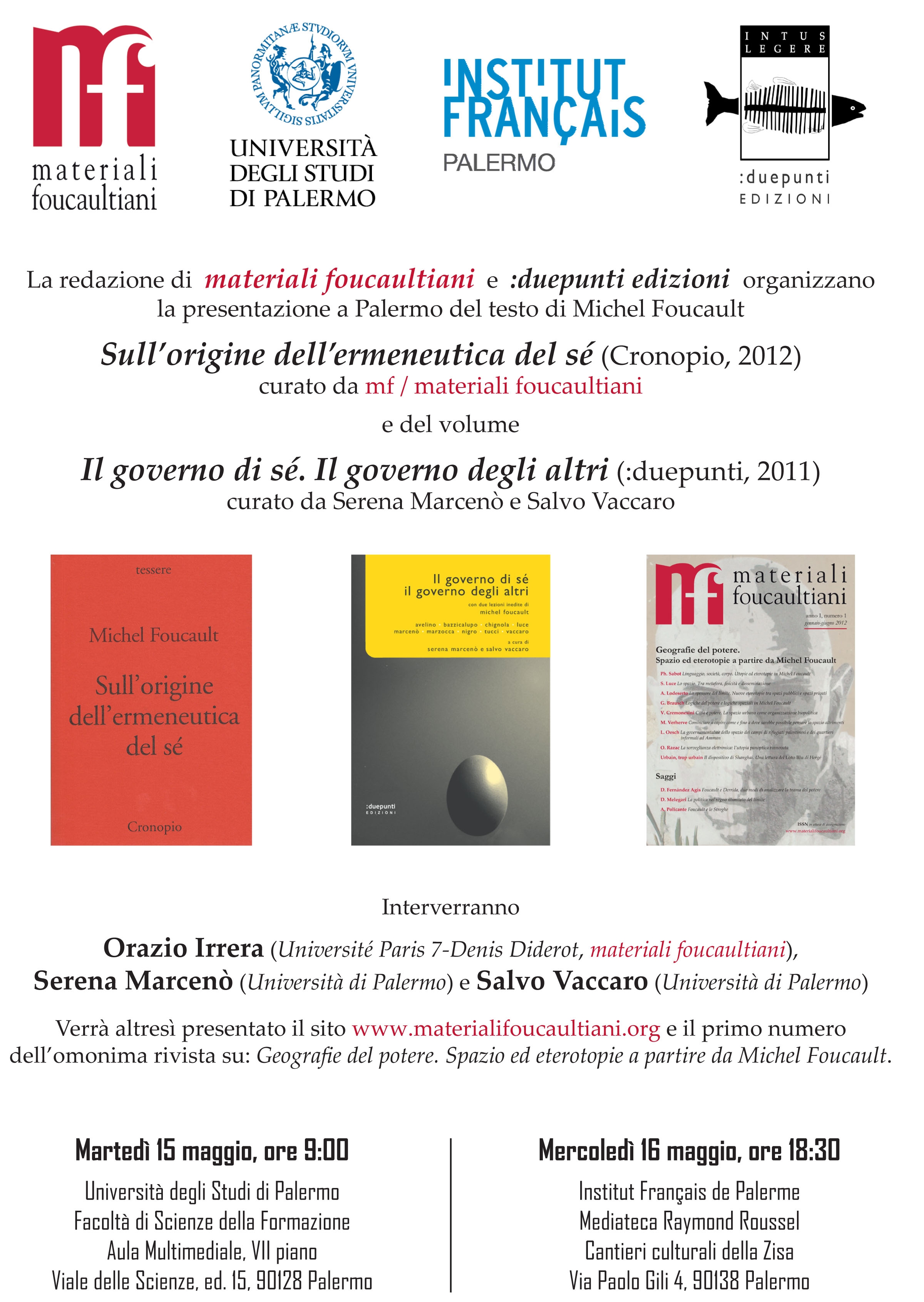
For full details and the conference poster please visit the Conference website
Colloque international
MICHEL FOUCAULT
DU GOUVERNEMENT DES VIVANTS AU COURAGE DE LA VÉRITÉ
Université Paris-Est Créteil/Université Paris 1 Panthéon-Sorbonne
21-22 juin 2012
——
ED « Cultures et sociétés »/EA 4395 « Lettres, Idées, Savoirs » (UPEC)
EA 3562 « Philosophies contemporaines »/<EXeCO (Université Paris 1 Panthéon-Sorbonne)
Revue en ligne « materiali foucaultiani »
——
Parler du « dernier Foucault » est devenu depuis quelques temps à la mode. Mais à quoi correspond ce « dernier » Foucault ? La publication des cours au Collège de France des années 80 arrive à son terme. Le cours de 1981-82, L’herméneutique du sujet, avait été publié en 2001 ; mais c’est à partir de 2008 que l’on a assisté à une véritable « accumulation » de textes auparavant inédits, écrits et prononcés par Foucault pendant les cinq dernières années de sa vie. Le cours de 1982-83, Le gouvernement de soi et des autres, et celui de 1984, Le courage de la vérité, ont manifesté l’intérêt de Foucault pour la parrêsia, Socrate et les Cyniques anciens, intérêt que l’on connaissait déjà grâce aux séminaires de Berkeley de l’automne 1983 (parus en anglais en 2001, sous le titre de Fearless Speech). Dans quelques mois, le cours de 1979-80, Du gouvernement des vivants, paraîtra à son tour – cours fondamental pour comprendre la trajectoire qui a mené Foucault de l’étude de la gouvernementalité néolibérale à l’étude des « régimes de vérité » caractéristiques du Christianisme des premiers siècles, puis de l’Antiquité classique et romaine. Le cours de 1980-81, Subjectivité et Vérité, sera également bientôt publié. D’ici 2013, par conséquent, l’ensemble de l’enseignement foucaldien des années 80 au Collège de France sera disponible, prêt à être exploré, interprété et utilisé par les chercheurs du monde entier.
Ce colloque se propose de relever le défi posé par cette accumulation de connaissances encore en cours. Mais loin de prétendre donner des « réponses » définitives, qui encadreraient le parcours foucaldien des années 80 dans des schémas préconstitués, il voudrait contribuer à l’ouverture d’un vaste champ de problématisations et de questionnements portant sur les particularités, les enjeux, les continuités et les discontinuités que l’on peut repérer dans la pensée du « dernier » Foucault. Il s’agira donc, en premier lieu, de réfléchir sur le « statut » de cette recherche foucaldienne qui s’est faite de manière orale, en se concrétisant assez peu dans les publications « officielles » du philosophe. Dans le sillage de cette réflexion, l’une des questions qu’il importe de prendre en compte est celle du rapport entre l’enseignement des cours et les textes publiés par Foucault lui-même pendant les années 80 – avant tout, bien sûr, les deux derniers volumes de l’Histoire de la sexualité, mais aussi certains articles particulièrement significatifs comme, par exemple, le célèbre essai sur les Lumières, où il est notamment question de l’ « ontologie critique de nous-mêmes »[1]. L’image du « dernier » Foucault comme d’un historien de la « sexualité » ancienne a déjà été mise en discussion ; mais quelle est exactement la relation qui lie ces deux séries de discours (enseignement oral/textes écrits) ? Dans quelle mesure les recherches que Foucault était en train de développer et d’exposer au Collège de France se retrouvent-elles dans les textes qu’il a publiés, et inversement ?
En second lieu, il s’agira d’interroger en tant que tel le développement de la pensée foucaldienne qui s’exprime dans les cours des années 80, et cela tant par rapport aux deux cours qui précèdent celui de 1979-80, que par rapport à un certain mouvement « circulaire » que l’on peut observer entre ce dernier et celui de 1984 – où Foucault parle à nouveau d’alèthurgie (un mot qu’il avait introduit au cours de la leçon du 9 janvier 1980), et où, à la fin de la dernière leçon, il déclare son intention de poursuivre, l’année à venir, « cette histoire des arts de vivre, de la philosophie comme forme de vie, de l’ascétisme dans son rapport à la vérité, justement, après la philosophie antique, dans le christianisme »[2]. Quelle image faut-il se faire, donc, de ces cours de Foucault des années 80 ? Quels sont les enjeux qui meuvent le philosophe tout au long de ces recherches ? Quelle genre de continuité est-il possible d’y mettre en lumière, et quels déplacements, quelles ruptures, quelles discontinuités ? Et, enfin, y avait-il un lien, et lequel, entre ces recherches apparemment « érudites » et l’actualité qui était celle de Foucault ? Et y en a-t-il un avec la nôtre ? Ce lien a-t-il à voir avec la volonté foucaldienne, témoignée clairement au Collège de France, d’explorer plusieurs modalités (anciennes) de l’insertion de l’éthique dans le politique ?
En troisième lieu, la question de l’actualité oblige à prendre en compte aussi les usages qui ont été et sont faits de la pensée du « dernier » Foucault, et en particulier de la pensée exprimée dans ses cours des années 80, au-delà du champ strictement « philosophique » et dans plusieurs champs disciplinaires différents (sociologie, ethnographie, histoire, etc.). En considérant l’importance toujours croissante de l’usage d’une série d’ « outils » foucaldiens dans les Cultural Studies, les Gender Studies et les Postcolonial Studies, ce colloque vise donc à s’interroger sur les usages (actuels et possibles), dans des champs divers, de la pensée foucaldienne des cours des années 80.
[1] M. Foucault, Qu’est-ce que les Lumières ?, dans Dits et écris II, 1976-1988, Paris, Gallimard, 2001, p. 1396.
[2] M. Foucault, Le courage de la vérité. Le gouvernement de soi et des autres ii. Cours au Collège de France. 1984, Paris, Seuil/Gallimard, 2009, p. 290.
——
PROGRAMME
——
Jeudi 21 juin, Université Paris-Est Créteil
61 av. du Général de Gaulle, Créteil, bâtiment i, salle 222
——
Matinée – Président de séance : Charlotte Murgier (Université Paris-Est Créteil)
10h00 – Daniele Lorenzini (UPEC/Università La Sapienza, Roma), Ariane Revel (UPEC), Arianna Sforzini (UPEC/Università di Padova) : Introduction
10h40 – Carlo Natali (Università Ca’Foscari Venezia) : Économique ancienne et souci de soi. De Xénophon à Foucault
11h20 – Marie-Odile Goulet-Cazé (CNRS) : Réflexions sur la vision du cynisme dans Le courage de la vérité
——
Après-midi – Président de séance : Judith Revel (Université Paris 1)
14h00 – Laura Cremonesi (Università di Pisa) : Parresìa, ethos, askesis. Pour une généalogie de l’attitude critique
14h40 – Arianna Sforzini (UPEC/Università di Padova) : Dramatiques de la vérité. La parrêsia à travers la tragédie attique
15h20 – Pause
15h40 – Piergiorgio Donatelli (Università La Sapienza, Roma) : Foucault: freedom and the space of ethics
16h20 – Orazio Irrera (Université Paris 7-Denis Diderot) : Satyagraha. Une alèthurgie décoloniale face au gouvernement colonial des vivants
——
Vendredi 22 juin, Université Paris 1
17 rue de la Sorbonne, Paris, salle Cavaillès
——
Matinée – Président de séance : Jean-François Braunstein (Université Paris 1)
9h30 – Jean-François Braunstein (Université Paris 1), Sandra Laugier (Université Paris 1) : Remarques introductives
10h00 – Michel Senellart (ENS Lyon) : Le cours Du gouvernement des vivants dans la perspective de l’Histoire de la sexualité
10h40 – Philippe Chevallier (BnF) : Vers l’éthique. La notion de « régime de vérité » dans le cours de Michel Foucault de 1980
11h20 – Pause
11h40 – Frédéric Gros (Université Paris-Est Créteil) : Quelques thèses inédites du cours de 1981 au Collège de France
——
Après-midi – Président de séance : Frédéric Gros (Université Paris-Est Créteil)
14h30 – Luca Paltrinieri (CCIP/ENS Ulm) : « A leader creates him or herself, step by step, over time… ». Anarchéologie du management
15h10 – Judith Revel (Université Paris 1) : Petits excursus, promenades et régimes d’historicité
15h50 – Pause
16h00 – Table ronde «Éthique et politique de nous-mêmes: entre pratiques de soi et perfectionnisme moral»
avec
Arnold I. Davidson (University of Chicago/Università Ca’Foscari Venezia)
Sandra Laugier (Université Paris 1 Panthéon-Sorbonne)
Daniele Lorenzini (UPEC/Università La Sapienza, Roma)
——
Toute personne intéressée est cordialement invitée, dans la limite des places disponibles.
——
Contacts :
Daniele Lorenzini – d.lorenzini@sns.it
Ariane Revel – ariane.revel@gmail.com
Arianna Sforzini – arianna.sforzini@univ-paris-est.fr