Foucault News

News and resources on French thinker Michel Foucault (1926-1984)

Philo, C. (2012), A ‘new Foucault’ with lively implications – or ‘the crawfish advances sideways’. Transactions of the Institute of British Geographers
https://doi.org/10.1111/j.1475-5661.2011.00484.x

Abstract
This paper argues that we may now speak of a ‘new Foucault’ with more to say to contemporary human geography than might at first be suspected. A number of recent publications – notably the collected and translated Collège de France lecture series – paint a picture of Foucault that arguably departs from presumptions of him as the chronicler-theorist of discursively constituted, totalising power. The paper has two objectives: first, to offer a synoptic introduction to the lecture series, spotlighting the geographical resonances; and secondly, to thread an interpretative line through these materials demonstrating Foucault’s concern for the vital problematics of lively bodies and unpredictable populations, always threatening to over-spill different forms of power (sovereign, disciplinary, biopolitical, governmental, pastoral, psychiatric). An attempt is made to address Nigel Thrift’s non-representationalist critique of Foucault, and to propose that the gulf between Thrift and Foucault is not as great as the former may imply – a finding of value when identifying future possibilities for critical-geographical inquiry.

Keywords:
Michel Foucault; Collège de France lectures; power; bodies; populations; non-representational theory

Via Stuart Elden’s blog Progressive Geographies

Michel Foucault, Entretien inédit entre Michel Foucault et quatre militants de la LCR, membres de la rubrique culturelle du journal quotidien Rouge (juillet 1977)

Pdf of interview

Présentation
Cet entretien a eu lieu dans les premiers jours du mois de juillet 1977. Animateurs de la rubrique culturelle du journal quotidien Rouge, nous avions le désir de rendre compte d’un livre de Michel Foucault paru en 1976, La Volonté de savoir, premier volume de son Histoire de la sexualité, et plus encore de pouvoir questionner son auteur sur son rapport au marxisme et au gauchisme. Michel Foucault avait paru un temps très lié à la fraction maoïste de l’extrême gauche et n’avait en tout cas jamais eu de contacts directs avec les trotskystes de la Ligue communiste révolutionnaire, lesquels avaient plutôt tendance à le renvoyer hors du champ légitime de la pensée révolutionnaire. Or il était pour nous, surtout depuis Surveiller et punir, un « éveilleur » qui avait toute sa place dans un quotidien comme Rouge, conviction qui n’était pas partagée par les responsables du journal. La Volonté de savoir représentait en outre une mise en question particulièrement de la doxa freudo-marxiste qui avait cours dans la Ligue, tout en posant de redoutables défis à la psychanalyse lacanienne qui nous passionnait alors. Nous étant présentés à Michel Foucault comme des militants de la Ligue et journalistes à Rouge, rien d’étonnant à ce qu’il nous ait considéré comme des représentants de la « ligne » dominante, en accord avec les positions défendues par Jean-Marie Brohm dans la revue qu’il animait à cette époque, Quel corps?, alors que nous étions, pour des raisons d’ailleurs différentes, des « marginaux » à l’intérieur de cette organisation. Notre activité dans la rubrique culturelle était d’ailleurs pour nous un moyen (qui s’est avéré bien illusoire) de transformer le rapport de la Ligue avec la recherche intellectuelle et esthétique du moment. C’est à l’occasion de la réunion mémorable au théâtre Récamier, le 21 juin 1977 que j’ai rencontré Michel Foucault. Comme on sait, cette réunion, organisée à l’occasion de la visite de Brejnev en France, fut l’occasion d’entendre Léonid Plioutch et d’autres dissidents. On en a fait l’une des grandes manifestations de la « nouvelle philosophie », alors même que s’y étaient retrouvés des intellectuels et des militants de presque toute la gauche anti-stalinienne.

C’est d’ailleurs en tant que militant de la Ligue que je m’y trouvais. Profitant d’un intermède, j’ai dit à Michel Foucault notre souhait d’un entretien pour le journal, ce qu’il accepta sur le champ, m’invitant à lui téléphoner rapidement afin que nous puissions mettre sur pied cette rencontre. Ce que je fis quelques jours plus tard. C’est ainsi que nous eûmes la chance de passer un long après-midi d’été à échanger de la façon la plus libre sur tous les sujets qui nous intéressaient. Il se trouve que cet entretien ne reçut pas de la part de la rédaction du quotidien un accueil enthousiaste, on en comprendra les raisons en le lisant, et qu’il est resté en grande partie inédit jusqu’à ce jour. J’ai transmis une copie de l’enregistrement à François Ewald à la fin des années 1980, si je me souviens bien. Certains chercheurs ont pu l’écouter et l’étudier dans les archives Foucault déposées à l’IMEC à Caen et régies par le Centre Michel Foucault, ou en entendre des extraits sur France culture. Plus curieusement, le collectif théâtral Foucault 71 en distribue depuis des années une version fidèle, mais très abrégée, aux spectateurs de ses représentations. La transcription de l’entretien qui suit est presque complète, il en manque toutefois la conclusion.

Christian Laval, juin 2011

Via Variazioni foucaultiane

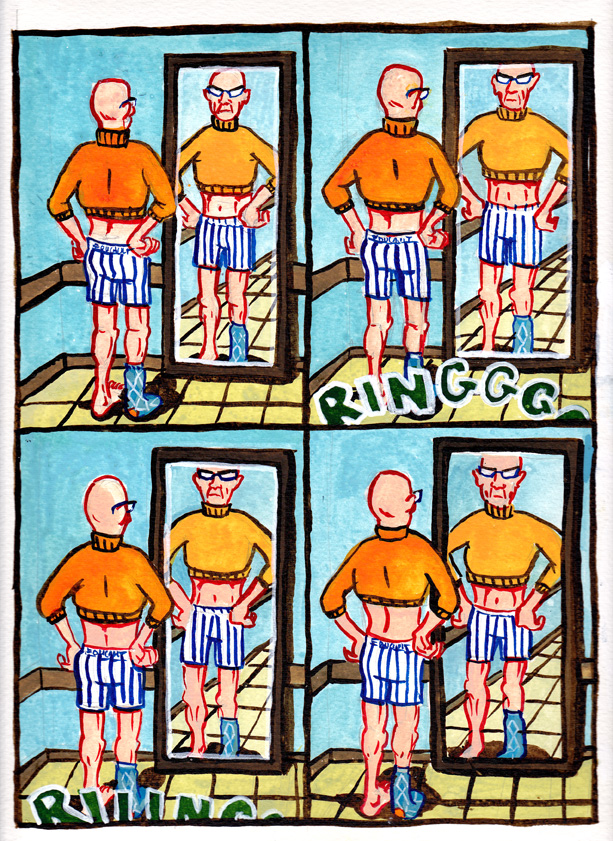
This is the seventh page from a forthcoming short graphic novel written by Lauren Kinney and drawn by by Matt MacFarland.

I will be posting additional panels on Foucault News as they are produced.

Link to page 1
Link to page 2
Link to page 3
Link to page 4
link to page 5
link to page 6
link to page 7
link to page 8

Force, Pierre (2011). “The teeth of time: Pierre Hadot on meaning and misunderstanding in the history of ideas”. History and theory, 50 (1), pp. 20-40.
https://doi.org/10.1111/j.1468-2303.2011.00566.x

Abstract
The French philosopher and intellectual historian Pierre Hadot (1922-2010) is known primarily for his conception of philosophy as spiritual exercise, which was an essential reference for the later Foucault. An aspect of his work that has received less attention is a set of methodological reflections on intellectual history and on the relationship between philosophy and history. Hadot was trained initially as a philosopher and was interested in existentialism as well as in the convergence between philosophy and poetry. Yet he chose to become a historian of philosophy and produced extensive philological work on neo-Platonism and ancient philosophy in general. He found a philosophical rationale for this shift in his encounter with Wittgenstein’s philosophy in the mid-1950s (Hadot was one of Wittgenstein’s earliest French readers and interpreters). For Hadot, ancient philosophy must be understood as a series of language games, and each language game must be situated within the concrete conditions in which it happened. The reference to Wittgenstein therefore supports a strongly contextualist and historicist stance. It also supports its exact opposite: presentist appropriations of ancient texts are entirely legitimate, and they are the only way ancient philosophy can be existentially meaningful to us. Hadot addresses the contradiction by embracing it fully and claiming that his own practice aims at a coincidence of opposites (a concept borrowed from the Heraclitean tradition). For Hadot the fullest and truest way of doing philosophy is to be a philosopher and a historian at the same time.

Food, actor-networks and “the transatlantic destiny of Michel Foucault”
Presenters: Eric Sarmiento and Nate Gabriel
Presented at the annual meeting of the Association of American Geographers, 2011

Extracts
theorists employing actor-network theory (ANT) have frequently come under attack by critical scholars for failing to adequately address or critique asymmetrical power relations, and thus acquiescing or even supporting the status quo. Critics of Michel Calloni, for example, contend that his investigations of economic assemblages, ‘[turn] out…to be an overture to a prospective alliance to be struck with neoclassical economists.’ Responding to similar criticisms, Bruno Latour asserts that many critical analyses of unequal power relations justify themselves and explain the relations they scrutinize by saying in effect, ‘Power relations are unequal because powerful actors exert their power over weaker actors.’ […]

By contrast, Michel Foucault’s work is celebrated for its ability to stir and mobilize the ethical and emotional energies of those who engage with it, enabling researchers (among others) to critique social arrangements, and thus to attempt to modify them. We find this particularly interesting in light of Latour’s desire to rescue Foucault from what he calls his transatlantic destiny. Latour reminds us that: ‘No one was more precise in their analytical decomposition of the tiny ingredients from which power is made and no one was more critical of social explanations [than Foucault].’ Latour goes on to say, however, that ‘as soon as Foucault was translated, he was immediately turned into the one who had ”revealed” power relations behind every innocuous activity and that ‘even the genius of Foucault could not prevent such a total inversion.’

Jonathan Lyons, Islam Through Western Eyes: From the Crusades to the War on Terrorism, Columbia University Press, 2012
ISBN: 978-0-231-15894-7

Description
Despite the West’s growing involvement in Muslim societies, conflicts, and cultures, its inability to understand or analyze the Islamic world threatens any prospect for East–West rapprochement. Impelled by one thousand years of anti-Muslim ideas and images, the West has failed to engage in any meaningful or productive way with the world of Islam. Formulated in the medieval halls of the Roman Curia and courts of the European Crusaders and perfected in the newsrooms of Fox News and CNN, this anti-Islamic discourse determines what can and cannot be said about Muslims and their religion, trapping the West in a dangerous, dead-end politics that it cannot afford.

In Islam Through Western Eyes, Jonathan Lyons unpacks Western habits of thinking and writing about Islam, conducting a careful analysis of the West’s grand totalizing narrative across one thousand years of history. He observes the discourse’s corrosive effects on the social sciences, including sociology, politics, philosophy, theology, international relations, security studies, and human rights scholarship. He follows its influence on research, speeches, political strategy, and government policy, preventing the West from responding effectively to its most significant twenty-first-century challenges: the rise of Islamic power, the emergence of religious violence, and the growing tension between established social values and multicultural rights among Muslim immigrant populations.

Through the intellectual “archaeology” of Michel Foucault, Lyons reveals the workings of this discourse and its underlying impact on our social, intellectual, and political lives. He then addresses issues of deep concern to Western readers—Islam and modernity, Islam and violence, and Islam and women—and proposes new ways of thinking about the Western relationship to the Islamic world.

About the Author
Jonathan Lyons spent twenty years as a foreign correspondent and editor for Reuters, much of it in the Islamic world. His research focuses on the shifting boundaries between East and West, and his publications include The House of Wisdom: How the Arabs Transformed Western Civilization and (with Geneive Abdo) Answering Only to God: Faith and Freedom in Twenty-first-Century Iran. He has a doctorate in sociology and lives in Washington, D.C.

McCallum, David (2011). “Liberal Forms of Governing Australian Indigenous Peoples”. Journal of law and society 38 (4), pp. 604-30.
https://doi.org/10.1111/j.1467-6478.2011.00560.x

Abstract
This article considers three different historical events from the point of view of their connections to aspects of the history of liberal political reason: the actions of the British in New South Wales in the early nineteenth century in their claim to sovereignty over Indigenous lands; the establishment of Aboriginal missions and subsequent removal of Aboriginal children in the early twentieth century; and the Northern Territory Emergency Response and suspension of the Australian Commonwealth Racial Discrimination Act (1975) early in the twenty-first century. The aim is to point to gaps between present claims about liberalism and ‘actual existing liberalism’, review the basis for examining accounts of governance deploying ‘authoritarian liberalism’ and ‘racewar’ as central concepts, and call into question the Northern Territory campaign as an ‘exceptional’ event.

Holloway, Lewis (2011). “Choosing and rejecting cattle and sheep: changing discourses and practices of (de)selection in pedigree livestock breeding”. Agriculture and human values, 28 (4), pp. 533-47.
https://doi.org/10.1007/s10460-010-9298-2

Abstract
This paper examines the discourses and practices of pedigree livestock breeding, focusing on beef cattle and sheep in the UK, concentrating on an under-examined aspect of this-the deselection and rejection of some animals from future breeding populations. In the context of exploring how animals are valued and represented in different ways in relation to particular agricultural knowledge-practices, it focuses on deselecting particular animals from breeding populations, drawing attention to shifts in such knowledge-practices related to the emergence of “genetic” techniques in livestock breeding which are arguably displacing “traditional” visual and experiential knowledge’s of livestock animals. The paper situates this discussion in the analytical framework provided by Foucault’s conception of “biopower,” exploring how interventions in livestock populations aimed at the fostering of domestic animal life are necessarily also associated with the imperative that certain animals must die and not contribute to the future reproduction of their breed. The “geneticization” of livestock breeding produces new articulations of this process associated with different understandings of animal life and the possibilities of different modes of intervention in livestock populations. Genetic techniques increasingly quantify and rationalize processes of selection and deselection, and affect how animals are perceived and valued both as groups and as individuals. The paper concludes by emphasizing that the valuation of livestock animals is contested, and that the entanglement of “traditional” and “genetic” modes of valuation means that there are multiple layers of valuation and (de)selection involved in breeding knowledge-practices.

Bonsu Samuel K. and Polsa Pia (2011). “Governmentality at the Base-of-the-Pyramid”. Journal of macromarketing, 31 (3), pp. 236-44.
https://doi.org/10.1177/0276146711407506

Abstract
The Base-of-the-pyramid (BoP) corporate strategy perceives market-based solutions to the problem of global poverty. The strategy is premised on the view that people in BoP markets live in fundamental lack, which can be overcome with business intervention. The merits of this idea seem obvious, but its ideological premise within contemporary capitalism is often lost on many. The purpose of the authors in this paper is to explore the ideological premise of the BoP strategy. The authors employ Foucault’s notion of “governmentality” to suggest that corporate adoption of the BoP strategy mimics a neocolonial incursion into heretofore inaccessible markets, by constituting the poor as free, self-governing individuals-modern citizens in the Western liberal sense-toward facilitating market control and exploitation for corporate ends.

Steve Urbanski, The Identity Game: Michel Foucault’s Discourse-Mediated Identity as an Effective Tool for Achieving a Narrative-Based Ethic, The Open Ethics Journal, 2011, 5, 3-9

Open access pdf

Abstract:
This article examines in hermeneutic fashion the philosophy of Michel Foucault and isolates an identity matrix that can assist humans in navigating the often numerous and conflicting narratives facing us in the 21st century and empower us to move toward a more narrative-based ethic that is beneficial to multiple stakeholders. Of particular interest is Foucault’s assertion that our identities are not fixed in a traditional sense but mediated by the many rich, dialogical discourses we encounter each day. This identity scheme is suggested in much of Foucault’s philosophy, particularly in Discipline and Punish and The History of Sexuality, and its application to ethics has never been more important. As highly developed countries, particularly the United States, become more egocentric, ethical decision-making too often is defined via an emotivistic framework. Foucault’s thoughts on identity can enlighten us to the power each person has in determining and taking ethical action that can positively inform what this article terms a narrative-based ethic. This portion of the article is informed by philosopher Walter R. Fisher, who sees humans as “storytellers” who view the world based on an awareness of what Fisher terms narrative probability – or what constitutes a coherent story – and their constant habit of testing that story’s narrative fidelity, whether the experience rings true with other stories they know to be true in their lives.

Keywords: Culture, ethics, genealogy, identity, narrative.