Foucault News

News and resources on French thinker Michel Foucault (1926-1984)

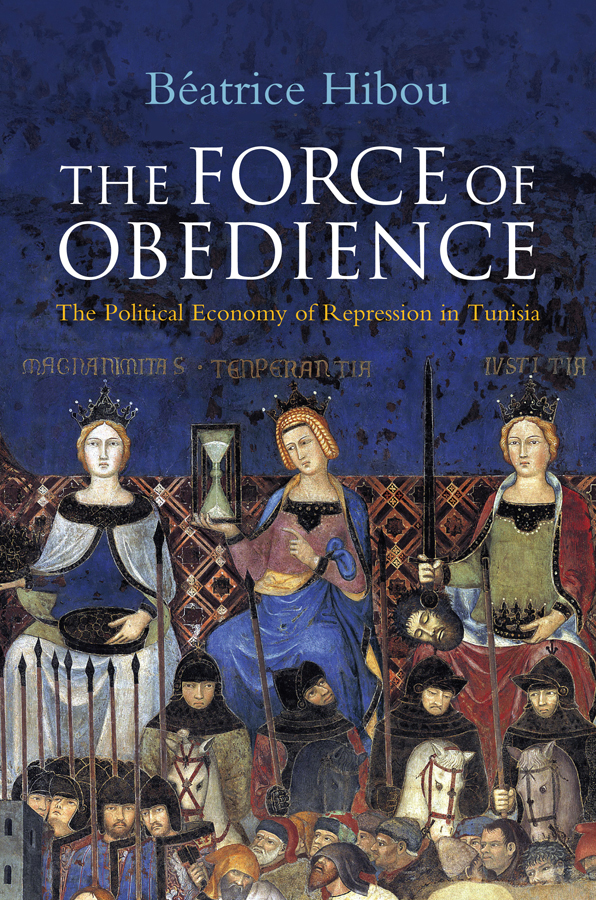
Beatrice Hibou, The Force of Obedience: The Political Economy of Repression in Tunisia, Cambridge: Polity Press, 2011

Publisher’s page

Description
This highly original book is a detailed analysis of the everyday mechanisms of domination and repression that enable political regimes to function and to secure the submission of their populations. It takes modern-day Tunisia as its object of analysis but this book is not just a case study of a particular country: it is a brilliant analysis of the politics and economic life under which we all live today.

Hibou combines two intellectual traditions, drawing on Weber and Foucault, in order to scrutinize the modes of government and the apparatuses that regulate the concrete exercise of power. Starting from an analysis of the Tunisian economy, she lays bare the mechanisms of subjection. She explains how the debt economy, the tax system, the management of privatizations, and the organization of social solidarity and welfare all create processes of mutual dependence between the governing and the governed. As a result, repression and police control appear to play a less central role than the accommodations, calculated stratagems, day-by-day compromises, and reciprocal interdependencies which, together, secure the daily legitimizing of the regime.

Above and beyond the case of Tunisia, this brilliant work unveils the processes through which authoritarian regimes are perpetuated. It sheds light on the mechanisms of domination at work in apparently democratic states too.
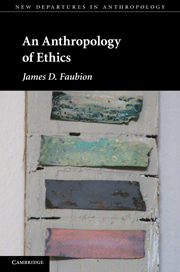
James D. Faubion, An Anthropology of Ethics, Cambridge University Press, 2011

Description
Through an ambitious and critical revision of Michel Foucault’s investigation of ethics, James D. Faubion develops an original program of empirical inquiry into the ethical domain. From an anthropological perspective, Faubion argues that Foucault’s specification of the analytical parameters of this domain is the most productive point of departure in conceptualizing its distinctive features. He further argues that Foucault’s framework is in need of substantial revision to be of genuinely anthropological scope. In making this revision, Faubion illustrates his program with two extended case studies: one of a Portuguese marquis and the other of a dual subject made up of the author and a millenarian prophetess. The result is a conceptual apparatus that is able to accommodate ethical pluralism and yield an account of the limits of ethical variation, providing a novel resolution of the problem of relativism that has haunted anthropological inquiry into ethics since its inception.

Author
James D. Faubion is Professor of Anthropology and Director of Graduate Studies at Rice University. In addition to ethics, his interests include epistemic authority, kinship, social and cultural theory, aesthetics, heterodoxy and radicalism. He has published widely on research interests, including The Shadows and Lights of Waco: Millennialism Today (2001), and two edited volumes of Essential Works of Michel Foucault (1998 and 2000).

Via Variazioni foucaultiani

Simon Thorpe, In Defence of Foucault: The Incessancy of Resistance, Critical Legal Thinking Blog, 7 Feb 2012

Extract
In a recent article, ‘Foucault and the Revolutionary Self-Castration of the Left’, Jérôme E. Roos argued that:

“Because it connects power with knowledge through discourse, and because it posits that knowledge and power are continually reproduced through both formal and informal institutions, there is ultimately no way for wilful agents to escape the choking grasp of their culture without reproducing the same forms of oppression they are trying to overcome. As a result, Foucault’s philosophy precludes the possibility for revolutionary action.”

I admire the noble activist intent of Roos’ article, and I thank him for sparking this vital debate on Left intellectual strategy and its varied implications for praxis. However, I fundamentally disagree with his interpretation of what is possible within the theory of Michel Foucault, and I will argue, in the most comradely spirit, that Foucault in fact provides priceless insights for resistance. […]

This is the last page from a forthcoming short graphic novel written by Lauren Kinney and drawn by by Matt MacFarland.

Link to page 1
Link to page 2
Link to page 3
Link to page 4
link to page 5
link to page 6
link to page 7
link to page 8

The Foucault Society, NYC

Bernard Gendron, “Foucault’s 1968”

Wednesday, March 7, 2012
7:30-9:30pm
CUNY Graduate Center
365 Fifth Avenue, Room 5409
New York, NY, USA

Abstract:
Foucault’s relation to May 1968 is crucial for understanding the transformation in his theory and practice in the years 1969-1974, leading to the publication of Discipline and Punish. This transformation is frequently interpreted as a transition from “archaeology” to “genealogy” resulting from Foucault’s discovery of basic flaws in his archaeological method. A closer analysis shows, however, that his turn to political militancy within a post-1968 horizon was the chief catalyst for halting and then redirecting his theoretical work. These reflections appear not in Foucault’s books and well-known articles, but in the many interviews he conducted in the early 1970s. In these texts, Foucault repeatedly shifts positions while trying both to make theoretical sense of his militant practices and to wrest from Marxism the proper interpretation of May 1968, until finally he arrives at the formulations that lead to Discipline and Punish. The formula, “from archaeology to genealogy,” taken as wholly methodological, explains little and indeed gives an oversimplified picture of that transformation.

Speaker Bio:
Bernard Gendron is Professor Emeritus of Philosophy at the University of Wisconsin-Milwaukee where he taught courses on Nietzsche, Foucault, Miles Davis, and the aesthetics of popular music, among others. He is the author of Technology and the Human Condition (St. Martins, 1976) and Between Montmartre and the Mudd Club: Popular Music and the Avant-Garde (University of Chicago, 2002). He now lives in New York and is working on a book, Downtown Sounds: The Experimental Music Scene in New York (1970-1990). The essay, “Foucault’s 1968,” is forthcoming in The Long 1968: Revisions and New Perspectives, eds., Jasmine Alinder, A. Aneesh, Daniel J. Sherman, and Ruud van Dijk (Indiana University Press, Spring 2013).

We are delighted to invite you to join the discussion.
We will have wine and snacks. All are welcome.

Open to the public.
Suggested donation: $8.

RSVPs are appreciated. Copies of the paper are available upon request.

2012 Colloquium Series
The Foucault Society Colloquium series is a forum for new research and works-in-progress, this series will provide an opportunity for both junior and senior scholars to share new work with a friendly and supportive audience of colleagues.
Join The Foucault Society Facebook page

About the Foucault Society
The Foucault Society is an independent, non-profit educational organization offering a variety of forums dedicated to critical study of the ideas of Michel Foucault (1926-1984) within a contemporary context. The Foucault Society is a 501 (c) (3) recognized public charity. As such donations are tax deductible under section 170 of the Internal Revenue Code.

E-mail: foucaultsocietyorg@gmail.com
Website
Facebook
Twitter:  @foucaultsociety

Julien Pallotta, L’Ecole mutuelle au-delà de Foucault, Editions EuroPhilosophie 2012, Bibliothèque de Philosophie sociale et Politique. ISSN 2110-5251

Résumé
Ce travail, tout en partant des analyses de l’appareil scolaire dans Surveiller et punir, interroge la description que Foucault livre de l’école mutuelle comme ultime rationalisation disciplinaire de la « machine à apprendre ». Pour cela, il s’appuie sur les travaux d’Anne Querrien qui nous invitent à voir dans l’école mutuelle une pédagogie alternative, avant de finir par se demander, en faisant appel au Maître ignorant de Jacques Rancière, si une institution comme l’école peut être émancipatrice.

Terry Flew, ‘Michel Foucault’s The Birth of Biopolitics and contemporary neo-liberalism debates’, Thesis Eleven, February 2012 vol. 108 no. 1 44-65
https://doi.org/10.1177/07255136114214

Abstract
Neo-liberalism has become one of the boom concepts of our time. From its original reference point as a descriptor of the economics of the ‘Chicago School’ or authors such as Friedrich von Hayek, neo-liberalism has become an all-purpose concept, explanatory device and basis for social critique. This presentation evaluates Michel Foucault’s 1978–79 lectures, published as The Birth of Biopolitics, to consider how he used the term neo-liberalism, and how this equates with its current uses in critical social and cultural theory. It will be argued that Foucault did not understand neo-liberalism as a dominant ideology in these lectures, but rather as marking a point of inflection in the historical evolution of liberal political philosophies of government. It will also be argued that his interpretation of neo-liberalism was more nuanced and more comparative than more recent contributions. The article points towards an attempt to theorize comparative historical models of liberal capitalism.

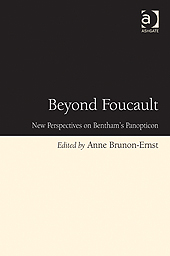
Anne Brunon-Ernst, ed. Beyond Foucault: New Perspectives on Bentham’s Panopticon, London: Routledge, March 2012

Pdf flyer

Description
In his hugely influential book Discipline and Punish, Foucault used the example of Jeremy Bentham’s Panopticon prison as a means of representing the transition from the early modern monarchy to the late modern capitalist state. In the former, power is visibly exerted, for instance by the destruction of the body of the criminal, while in the latter power becomes invisible and focuses on the mind of the subject, in order to identify, marginalize, and ‘treat’ those who are regarded as incapable of participating in, or unwilling to submit to, the disciplines of production. The Panopticon links the worlds of Bentham and Foucault scholars yet they are often at cross-purposes; with Bentham scholars lamenting the ways in which Foucault is perceived to have misunderstood panopticon, and Foucauldians apparently unaware of the complexities of Bentham’s thought. This book combines an appreciation of Bentham’s broader project with an engagement of Foucault’s insights on economic government to go beyond the received reading of panopticism as a dark disciplinary technology of power.

Scholars here offer new ways of understanding the Panopticon projects through a wide variety of topics including Bentham’s plural Panopticons and their elaboration of schemes of ‘panoptic Utopia’, the ‘inverted Panopticon’, ‘panoptic governance’, ‘political panopticism’ and ‘legal panopticism’. French studies on the Panopticon are groundbreaking and this book brings this research to an English-speaking audience for the first time. It is essential reading, not only for those studying Bentham and Foucault, but also those with an interest in intellectual history of the eighteenth and nineteenth centuries, and those studying contemporary surveillance and society.

Contents:
Foreword, Clare O’Farrell;
Introduction, Anne Brunon-Ernst;
Part I Historiography Reconsidered: from Discipline to Governmentality: Deconstructing Panopticism into the plural Panopticons, Anne Brunon-Ernst;
From Discipline and Punish to The Birth of Biopolitics, Christian Laval.
Part II Status of the Panopticon in Prison, Penal and Constitutional Reform: From ‘utopia’ to ‘programme’: building a Panopticon in Geneva, Emmanuelle de Champs;
Penal theory without the Panopticon, Jean-Pierre Cléro;
From the penitentiary to the political Panoptic paradigm, Guillaume Tusseau.
Part III Is There a Panoptic Society? Social Control in Bentham and Foucault: Transparency and politics: the reversed Panopticon as a response to abuse of power, Marie-Laure Leroy;
Social control and the legal Panoptic paradigm, Malik Bozzo-Rey;
Epilogue: the Panopticon as a contemporary icon?, Anne Brunon-Ernst and Guillaume Tusseau;
Bibliography; Index.

About the Editor:
Anne Brunon-Ernst is Senior Lecturer in Legal English at the University of Paris 2 (Panthéon-Assas) and a member of the Centre Bentham, Paris.

Arnaud Fossier, « La contagion des péchés (xie-xiiie siècle). Aux origines canoniques du biopouvoir », Tracés. Revue de Sciences humaines [En ligne], 21 | 2011, URL : http://traces.revues.org/5128

Aperçu du texte
Le modèle contagionniste d’explication de certaines maladies physiologiques, mais aussi des mouvements collectifs et de la criminalité, a vu ses fondements théoriques consolidés au xixe siècle avec l’identification médicale de germes pathogènes d’une part, la répression du monde ouvrier, l’émergence de la science criminologique, et la psychologie des foules, d’autre part. Ce modèle a porté ses fruits bien au-delà de la seconde moitié du xixe siècle, mais les multiples usages du terme « contagion » extérieurs au champ lexical de la médecine – que l’on pense au paradigme épidémiologique de la philosophie cognitive ou à la virologie qui innerve les sciences de l’information et de la communication – sont aujourd’hui considérés comme métaphoriques (Cheyronnaud et al. éd., 1998). L’idée même de transmission du mal par contact n’est pourtant pas issue de la science médicale. Si le modèle contagionniste a sans doute pris force au xixe siècle et a trouvé dans les dispositifs biopolitiques du…

Jonathan Tran, Foucault and Theology, Bloomsbury, 2011

Description
Near the end of his life, Michel Foucault turned his attention to the early church Fathers. He did so not for anything like a return to God but rather because he found in those sources alternatives for re-imaging the self. And though Foucault never seriously entertained Christianity beyond theorizing its aesthetic style one might argue that Christian practices like confession or Eucharist share family resemblances to Foucaultian sensibilities. This book will explain how to do theology in light of Foucault, or more precisely, to read Foucault as if God mattered. Therefore, it will seek to articulate practices like confession, prayer, and so on as techniques for the self, situate “the church as politics” within present constellations of power, disclose theological knowledges as modes of critical intervention, or what Foucault called archaeology, and conceptualize Christian existence in time through mnemonic practices of genealogy.

Table of Contents
Acknowledgements / Introduction / Part I: Power and Totality / 1. Power / 2. Capitalism, Totality, and Resistance / Part II: Self-Writing / 3. Biography and Biopolitics / 4. Writing the Self / 5. Self-Care: The Case of Animals / Postscript
Author(s)

Jonathan Tran,
Jonathan Tran is Assistant Professor of Theological Ethics at Baylor University, Waco, Texas. His book Theology and the Vietnam War: History, Memory, and Redemption is forthcoming in the Blackwell series “Challenges in Contemporary Theology”