Foucault News

News and resources on French thinker Michel Foucault (1926-1984)

Minka Woermann (2012), Interpreting Foucault: an evaluation of a Foucauldian critique of education. South African Journal of Education Vol 32:111-120
https://dx.doi.org/10.15700/saje.v32n1a560

Abstract
The potential strengths and weaknesses of a Foucauldian critique of education are discussed and evaluated. The article focuses specifically on the value of Foucault’s work for critiquing social and political ideologies prevalent in education, which is understood as a societal institution, and hence, as a modern regime of institutional power. In terms of strengths, the ability to raise issues of knowledge, power and contestation that are traditionally ignored in educational theory is addressed. In terms of weaknesses, Foucault’s problematic use and understanding of power and his apparent rejection of objective truth are investigated. The critique develops at the hand of influential, but competing, interpretations of Foucault’s contribution to the field of education in particular, and philosophy in general. It is argued that these influential readings of Foucault gain traction within specific discourses (such as education), and should thus be subjected to critical scrutiny.

Keywords: critique; education; Foucault; institution; power; truth

Séminaire “La décolonisation des savoirs. Pour une géographie postcoloniale de la connaissance” (sous la direction de Orazio Irrera, Daniele Lorenzini, Matthieu Renault)

Mercredi 11 avril 2012, 14h-17h
Université Paris-Est Créteil, Maison des Langues, salle 117

Sonia Dayan-Herzbrun (Université Paris 7-Denis Diderot)
« Depuis la première publication en France de l’Orientalisme d’Edward Saïd, une place a-t-elle été faite à une décolonisation des savoirs? »

Orazio Irrera (Université Paris 7-Denis Diderot)
« Perspectives généalogiques et enjeux politiques chez Edward Saïd et Michel Foucault »

Further Info

Deutscher, P. (2012). “Foucault’s History of Sexuality, Volume I: Re-reading its Reproduction”. Theory, culture & society, 29 (1), p. 119-137.
https://doi.org/10.1177/0263276411423772

Abstract
This paper interrogates the status of the Malthusian couple and the policing and government of reproduction in the first volume of Foucault’s History of Sexuality, Volume I (HS1), and the associated College de France lectures. Presented by Foucault as one of the four ‘strategic ensembles’ of the 18th century through which knowledge and power became centered on sex, what Foucault calls the socialization of procreative sexuality (HS1: 104) also constitutes a largely invisible hinge between the trajectories in HS1: biopolitics (vector of governmentality, management, administration and intensification of life) and sex (vector through which the repressive hypothesis is rejected). Particularly because it is one of the least discussed figures in Foucauldian commentary, my argument is that a reading of HS1 through the prism of its Malthusian couple produces unexpected results. A text that can be interpreted from the perspective of (a) its debate with psychoanalysis, or (b) its potential debate with those for whom sexual rights belong to a sexual subject, or (c) its status as a watershed text for biopolitical theory, enters into a fourth dialogue with the history of reproduction as politicized and biopoliticized, a problematic to date taken up most directly by Ann Stoler in Race and the Education of Desire. This allows for a revisiting of the complex relationship between the vectors of ‘sex’ and ‘life’ in HS1. Although reproductive sex, and reproductive life, are not the themes of the strongest importance in HS1, they serve as the invisible hinge at the interface of biopolitics and sex in HS1. Considering the status of reproductive life from this perspective becomes a departure point for reconsidering the reproductive woman, in her historical role as part of the problematized Malthusian couple and at the intersection of biopolitics and thanatopolitics.

Ben Golder, Foucault, Rights and Freedom, International Journal for the Semiotics of Law (11 February 2012), pp. 1-17.
https://doi.org/10.1007/s11196-012-9259-8

Abstract
As dominant liberal conceptions of the relationship between rights and freedom maintain, freedom is a property of the individual human subject and rights are a mechanism for protecting that freedom—whether it be the freedom to speak, to associate, to practise a certain religion or cultural way of life, and so forth. Rights according to these kinds of accounts are protective of a certain zone of permitted or valorised conduct and they function either as, for example, a ‘side-constraint’ on the actions of others or as a ‘trump’ over governmental or community goals. In such accounts, of course, the emphasis is placed upon the forms of power against which rights protect the individual, whether that be the trespasses of others or the overweening attentions of the state. Such accounts famously do not themselves take much account of the multiple ways in which rights also function as forms of power, often delimiting the courses of action that a putative rights-holder can take and affecting the manner of its exercise, indeed often in the very name of freedom itself. Of course, there is a sizeable critical literature which does address itself to these kinds of question, most notably from the radical traditions of Marxism and critical legal theory, which see rights in terms of the relations of production, consumption and exploitation that they establish between legal subjects.

For various reasons, Foucault has not figured as prominently in critical discussions of rights. Here I do not propose to enter into debates surrounding Foucault’s engagement with, or failure to engage with, law as an object of study, nor with the emergent literature on Foucault’s deployments of rights, indeed even of human rights. Rather, what I want to do in this paper is to articulate and defend the view that through a reading of Foucault’s work, both on rights and on power relations more broadly, we can discern an understanding of the political ambivalence of rights. For Foucault (and for some of the post-Foucaultian scholars whose work I shall address, below), rights are both political tools for the contestation and alteration of mechanisms of power and simultaneously mechanisms of inscription, both disciplinary and governmental, which work to conduct those who rely upon them. Far from being an unproblematic tool for the protection of the subject’s freedom, rights emerge in this account as conflicted and ambivalent mechanisms. In the first part of this paper I develop a Foucaultian account of rights along these lines and then hope to illustrate it by reference to several examples, from the constitution of gender and cultural identity via rights to the figure of the refugee, whilst in the final part of the paper I make a return to the idea of freedom in Foucault’s work and link the view of rights developed herein to a certain conception of freedom in his work.

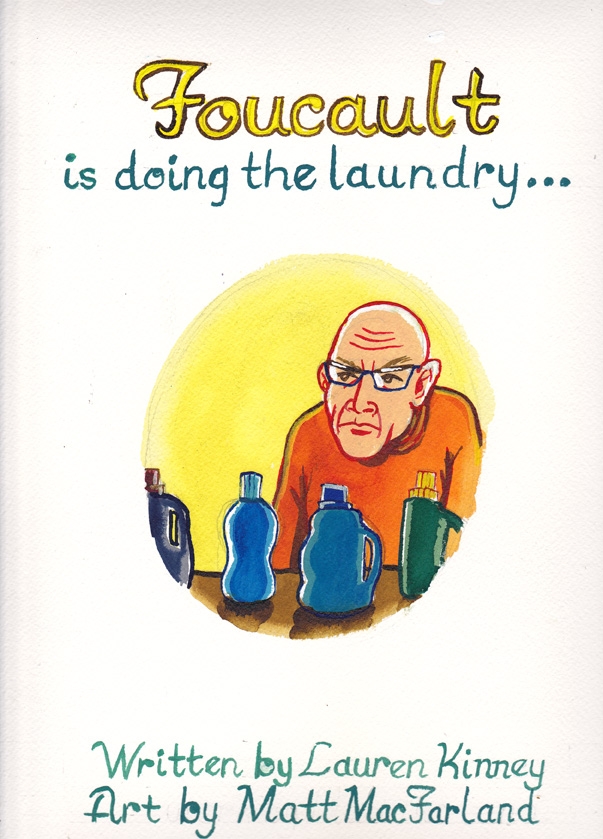
This is the cover of a forthcoming short graphic novel written by Lauren Kinney and drawn by by Matt MacFarland.

Link to page 1
Link to page 2
Link to page 3
Link to page 4
link to page 5
link to page 6
link to page 7
link to page 8

Luca Paltrinieri, « L’archéologie à l’épreuve de l’analyse du langage : Foucault avec Wittgenstein »

Quatrième séance du séminaire « Philosophie française & Philosophie analytique au 20e siècle »
Mardi 3 avril 2012, 17h-19h, Université Paris Ouest Nanterre, France

Il est désormais connu que Foucault connaissait et lisait l’œuvre du philosophe autrichien pendant l’écriture de l’Archéologie du savoir. Mais il s’agira moins de s’interroger sur les emprunts de Foucault à Wittgenstein ou sur l’influence de Wittgenstein sur Foucault, que de repérer les analogies et les “ressemblances de famille” entre deux styles de pensée qui aboutissent à deux conceptions de la vérité fondées sur la même critique du modèle représentationnel de la connaissance. C’est dans cette perspective que seront abordées des questions comme celles du rapport entre explication et compréhension, de la fiction et du jeu linguistique, ou encore de la différence entre les notions de “discours” et de “langage”. Nous chercherons alors à obtenir un éclairage réciproque des deux méditations sur la connaissance : la réflexion wittgensteinienne sur la certitude permet d’expliquer la notion de savoir chez Foucault, tandis que la méthode archéologique foucaldienne révèle une dimension historique qui était restée implicite dans les écrits de Wittgenstein.

Michel Foucault, Sull’origine dell’ermeneutica del sé, Cronopio, 114 pages,
These lectures
are not as yet published in French.

The edition, translation, notes and foreword are by mf / materiali foucaultiani (Laura Cremonesi, Orazio Irrera, Daniele Lorenzini, Martina Tazzioli). The afterword is by Arnold I. Davidson.

Marquez, Xavier (2012). “Spaces of Appearance and Spaces of Surveillance”. Polity, 44 (1), p. 6-31.
https://www.jstor.org/stable/41426920

Abstract
Hannah Arendt and Michel Foucault developed different but complementary theories about visibility and power In an Arendtian “space of appearance,” the common visibility of actors generates power, which is understood as the potential for collective action. In a Foucauldian “space of surveillance,” visibility facilitates control and normalization. Power generated in spaces of appearance depends on and reproduces horizontal relationships of equality, whereas power in spaces of surveillance depends on and reproduces vertical relationships of inequality The contrast between a space of appearance and a space of surveillance enhances both Arendt’s and Foucault’s critiques of modern society by both clarifying Arendt’s concerns with the rise of the “social” in terms of spaces of surveillance, and enriching Foucault’s notion of “resistance.”

Bourcier, M.-H. (2012). “Cultural translation, politics of disempowerment and the reinvention of queer power and politics”. Sexualities, 15 (1), p. 93-109.
https://doi.org/10.1177/1363460711432107

Abstract
This article addresses the task of describing the flows and trends of cultural translation of queer between the USA and Europe, particularly France. Firstly, it demonstrates how queer groups located in France re-translated ‘queer made in the USA’, inspired by continental philosophy, back into a French idiom in the mid-1990s. It then seeks to explain their contemporary responses to new trends and agendas in queer studies and politics that sound more and more compliant with ‘logics of disempowerment’. The re-sexualization and re-politicization of French post-structuralist philosophers and psychoanalysts such as Foucault, Deleuze, Derrida and Lacan, made possible by American queer theory and cultural studies, have been succeeded by a phase in which American theorists seem to crave the traditionally European privilege of being lauded as public intellectuals. At the beginning of the new century, a violent recodification by straight scholars and institutions took place and is still taking place in France: queer and post-colonial studies are dismissed or banned as subjective, unscientific agit prop. Today’s benevolent researchers reaffirm their power through powerlessness and ‘identify’ with the victims they defend. In this context, recent American queer theory and politics can give the impression of being driven by a logic of disempowerment. To illustrate this, Judith Butler’s Gender Trouble is compared with her Undoing Gender. Thus where Gender Trouble promoted strategies of resignification and resistance for both gender expression and hate speech, Undoing Gender displaces the strategy of resignification from hate speech to what could be called ‘master words’ such as ‘the universal’ and ‘the human’, and this ‘neo-universalism’ is linked to a politics of vulnerability. Moreover, whereas in Gender Trouble, textual or discursive performativity is impersonal and reversible, in Undoing Gender, the continental European figure of the philosopher is back. To counter this development, to pursue a strategy of dis-identification with the nation state and the United States, to quit the politics of vulnerability or desperation and to reverse the disempowering effects of the neo-assimilationist agenda, the article proposes a specifically French alternative. This consists of seeking to insert a queer version of what Felix Guattari calls ‘micropolitics’ into the macrocultural agenda of the LGBT right.

Taylor, Chloe (2012). “Foucault and Familial Power”. Hypatia, 27 (1), p. 201-18.
https://dx.doi.org/10.1111/j.1527-2001.2011.01171.x

Abstract
This paper provides an overview of Michel Foucault’s continually changing observations on familial power, as well as the feminist-Foucauldian literature on the family. It suggests that these accounts offer fragments of a genealogy of the family that undermine any all-encompassing or transhistorical account of the institution. Approaching the family genealogically, rather than seeking a single model of power that can explain it, shows that far from this institution being a quasi-natural formation or a bedrock of unassailable values, it is in fact a continually contested fiction that masks its own histories of becoming.